Rules
Do Historic Motels Need Fire Suppression Upgrades in California?
Historic motel fire suppression in California depends on scope of work, not age. Three compliance paths exist, and who signs off on each varies by local rules.
What to take away
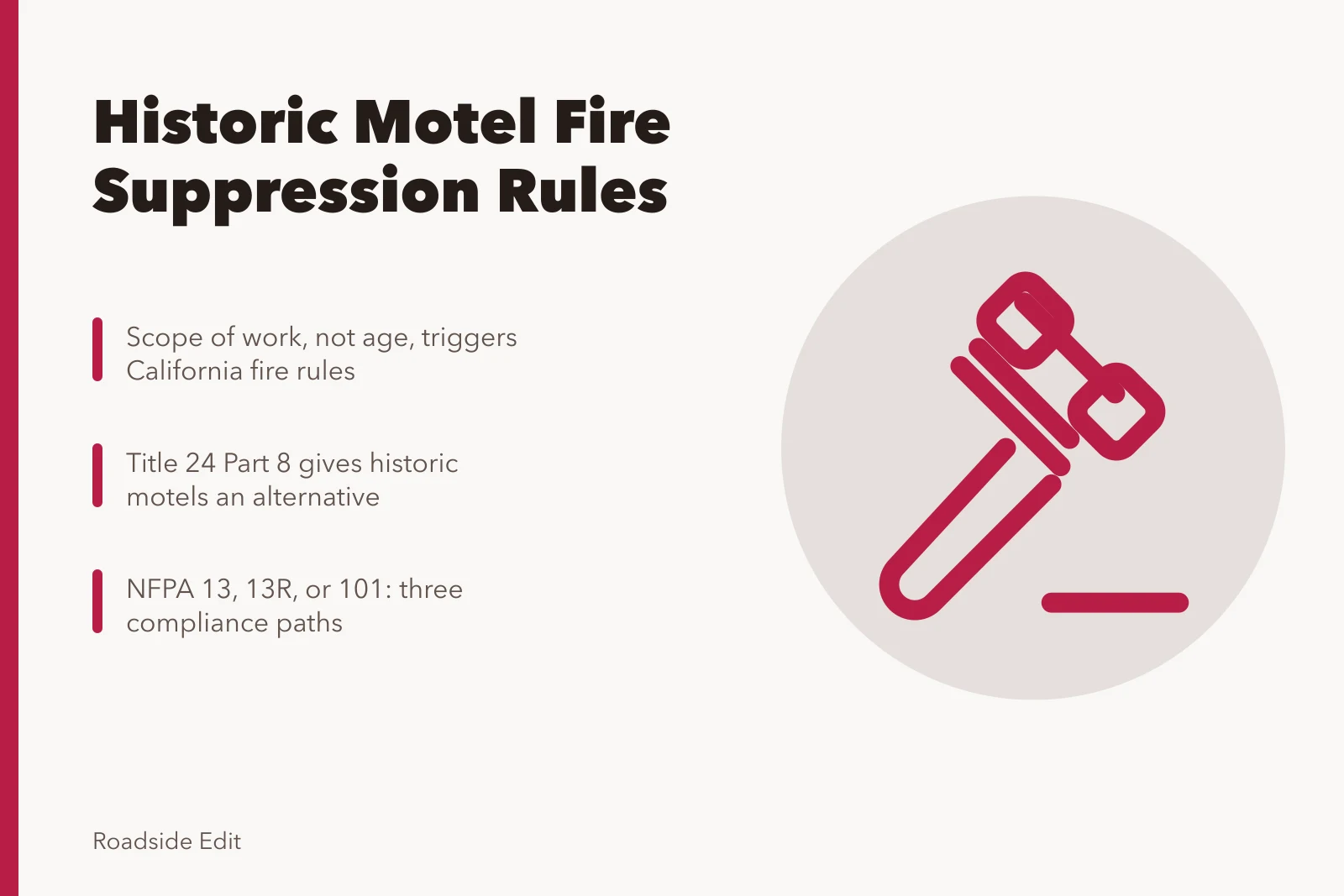
- Age is not the trigger. Scope of work, occupancy and local ordinances are.
- The California Historical Building Code (Title 24, Part 8) gives designated historic motels a documented alternative.
- Local ordinances, not state law, set seismic retrofit deadlines in many California cities.
- A written interpretation from the local fire authority settles most disputes before money is spent.
- Federal travel listing requires hard-wired smoke alarms and sprinklers in buildings of four or more stories.
Where the requirement actually comes from
A 1958 courtyard motel in Modesto faces the same rules as a 2019 limited-service property once its owner pulls a permit for work beyond paint and carpet.
The scope of work and the local fire authority's reading change the answer. Before you price any suppression work, historic motel restoration questions help owners separate visible changes from evidence gaps.
California enforces its fire code locally, and NFPA 1 covers suppression requirements that can reach an older motel.
Three triggers raise the question most often. A change of occupancy is the first: guest rooms converted into a restaurant. The second is a substantial alteration, such as a new roof structure or a gutted wing. The third is a local ordinance that names the building type, usually an unreinforced masonry or soft-story retrofit program.
Where the building is formally historic, the state offers a second route. The California Historical Building Code applies to properties on a state or local register, or found eligible by the State Historic Preservation Officer.
It lets a designer show the code's intent is met without erasing what makes the motel worth keeping. Owners who need that argument built from the ground up can start with Historic Motel Restoration Help.
The three compliance paths
Each route asks something different of the building.
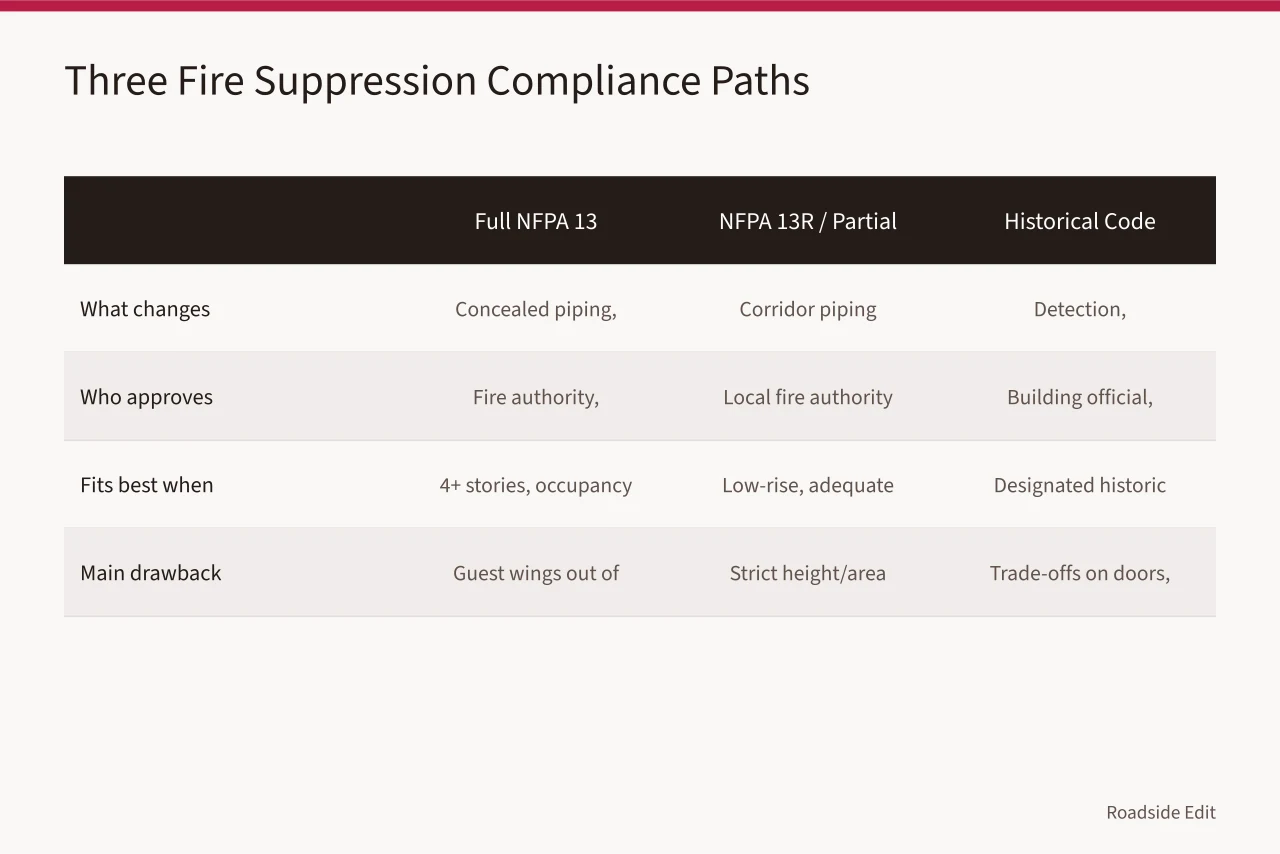
A full NFPA 13 system brings concealed piping, a dedicated water supply, a riser room and a monitored alarm. The second route is a residential-style system such as NFPA 13R, which some low-rise layouts can support.
NFPA 101, the Life Safety Code, sets fire safety requirements for existing buildings and is often cited by a fire official. The third route uses the historical code, trading pipe for detection, compartmentation and egress work.
| Path | What changes on the building | Who approves it | Fits best when | Main drawback |
|---|---|---|---|---|
| Full NFPA 13 system | Concealed piping, dedicated water supply, riser room, monitored alarm | Local fire authority and building department | The motel is four or more stories, or a change of occupancy drives full code compliance | Guest wings come out of service while the work runs |
| NFPA 13R or partial system | Piping in corridors and common areas, sometimes in guest rooms | Local fire authority | The building is low-rise with an adequate water main | Height and area limits are strict, and some fire authorities decline it |
| Historical code alternative | Detection, compartmentation, alarms, egress and door hardware | Local building official, with appeal to the State Historical Building Safety Board | The motel is designated or eligible and character is the asset | Heavy documentation, and acceptance rests with one official |
Where each path is the right answer
The full system is right when the motel is four or more stories. It is also the answer when a change of occupancy pulls the whole structure into current code.
A limited 13R system fits a low-rise courtyard motel if the water main can carry the demand. The fire authority must accept a residential standard. It is the wrong choice when guest rooms sit above a commercial kitchen or the supply is shared and undersized.
If the water supply is shared and undersized, a modern roadside design maintenance plan should document that limit before you choose a system.
The historical route is right when the building is designated and its character is the asset being protected. Exterior-corridor layouts usually need the least work, and most of the trade-off lands on doors, stairs and windows, which is where Help for a Motel Exterior becomes the relevant reading.
The limit no path removes
Every route depends on two things no owner can argue away: an adequate water supply and the local fire official's judgment.
Nothing under the historical code overrides a city seismic ordinance deadline. Those deadlines run whether or not the fire work is finished. A field list for roadside renovation photography covers what a reviewer expects to see before a submittal goes in.
Who signs off, and in what order
Approvals follow a sequence, and skipping a step usually means a resubmittal.
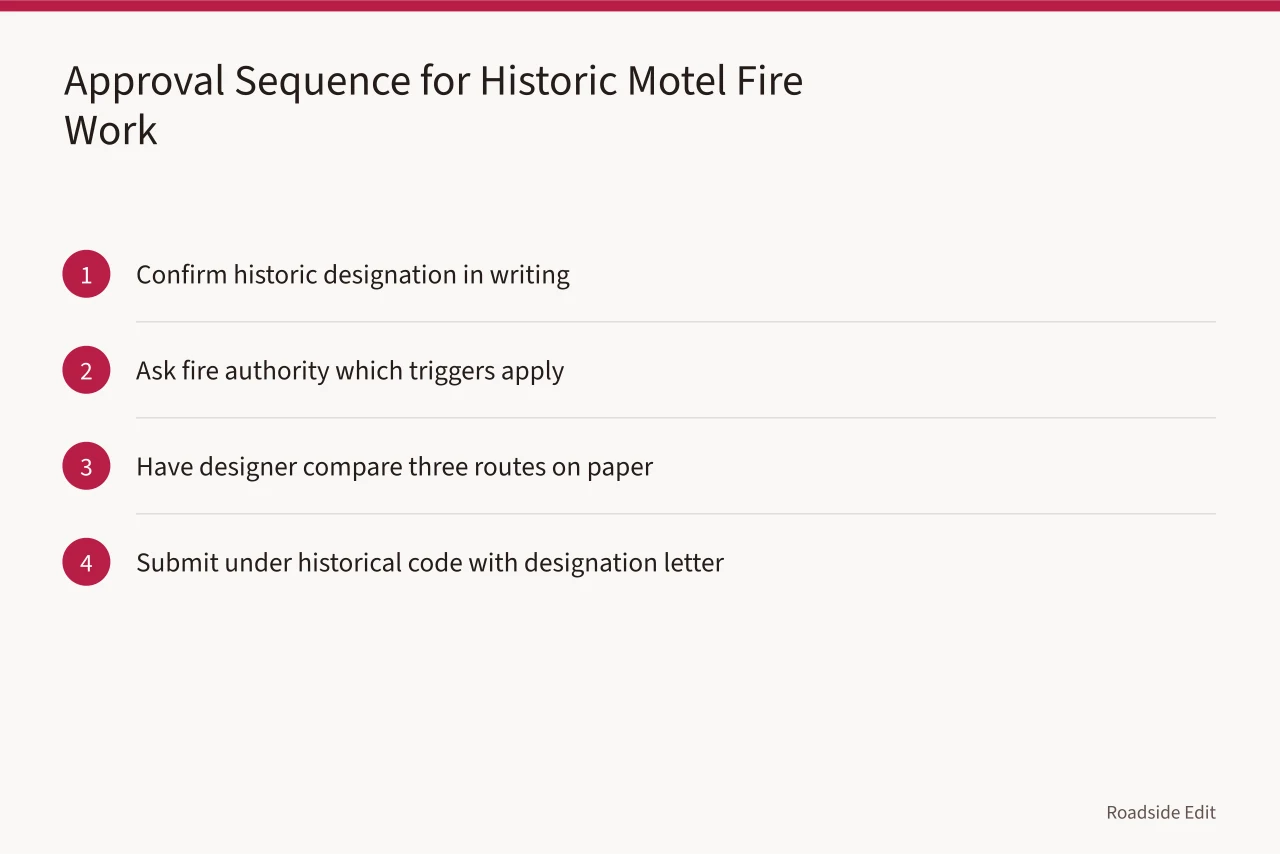
The California Historical Building Code does not waive fire safety. It changes how an owner demonstrates it, and it puts the burden of the argument on the applicant.
Example: the submittal that gets approved
Complete packages usually hold three items: a site plan with hydrant locations and water main size, floor plans with exit travel distances, and the designation letter.
Portable extinguishers are checked monthly and serviced annually; OSHA sets that expectation for workplaces.
For the wider building, Help for Roadside Architecture explains how to brief a designer before the first site visit.
Common questions
Does historic designation exempt a motel from sprinklers? No. It changes the route to compliance. A building official can accept alternatives that meet the code's intent, but fire safety is still required.
Who decides whether the historical building code applies? The local building official, working from the designation or an eligibility finding issued by the State Historic Preservation Officer.
How disruptive is a sprinkler retrofit in an occupied motel? Piping and a riser room mean wings come out of service, and the work is usually staged one section at a time.
Do the extinguishers already on the property need anything? Monthly visual checks and annual maintenance by a qualified person, documented and kept on site.