Rules
Roadside Architecture Photo Permits: What US Preservationists Must Know
Roadside architecture photo permits in the US turn on rights-of-way, trespass law and site rules. What preservationists must clear before a shoot.
What to take away
- Photographing a private motel or filling station from a public sidewalk or highway right-of-way needs no permission in the United States.
- Permission begins at the property line, and trespass is defined by state law rather than by a federal standard.
- Independent owners usually want one to three weeks of notice; chain offices need three to six.
- Ask for a written property release, since a verbal yes carries little weight after publication.
- Federal sites add their own rules, including limits on drones and on some structures.
Do I need permission to photograph that motel? It depends on where your feet stand, not where the lens points.
What you have to book ahead
From a public right-of-way there is usually nothing to book. A state highway shoulder and a downtown sidewalk are public space, and an owner has no say over a photograph taken from either. Stay out of travel lanes and off private gravel.
The United States is unusually permissive here. Copyright law allows photographs of buildings, and a plain summary of freedom of panorama laws shows how few countries grant the same latitude.
Booking starts when you want to cross the line: the office, the courtyard, a guest room, or the pumps. Call an independent and describe the project in two sentences. Offer a one-page note on how the images will be used.
Chains move more slowly. A regional media office handles dozens of properties, may request a certificate of insurance, and often sends the request through legal review.
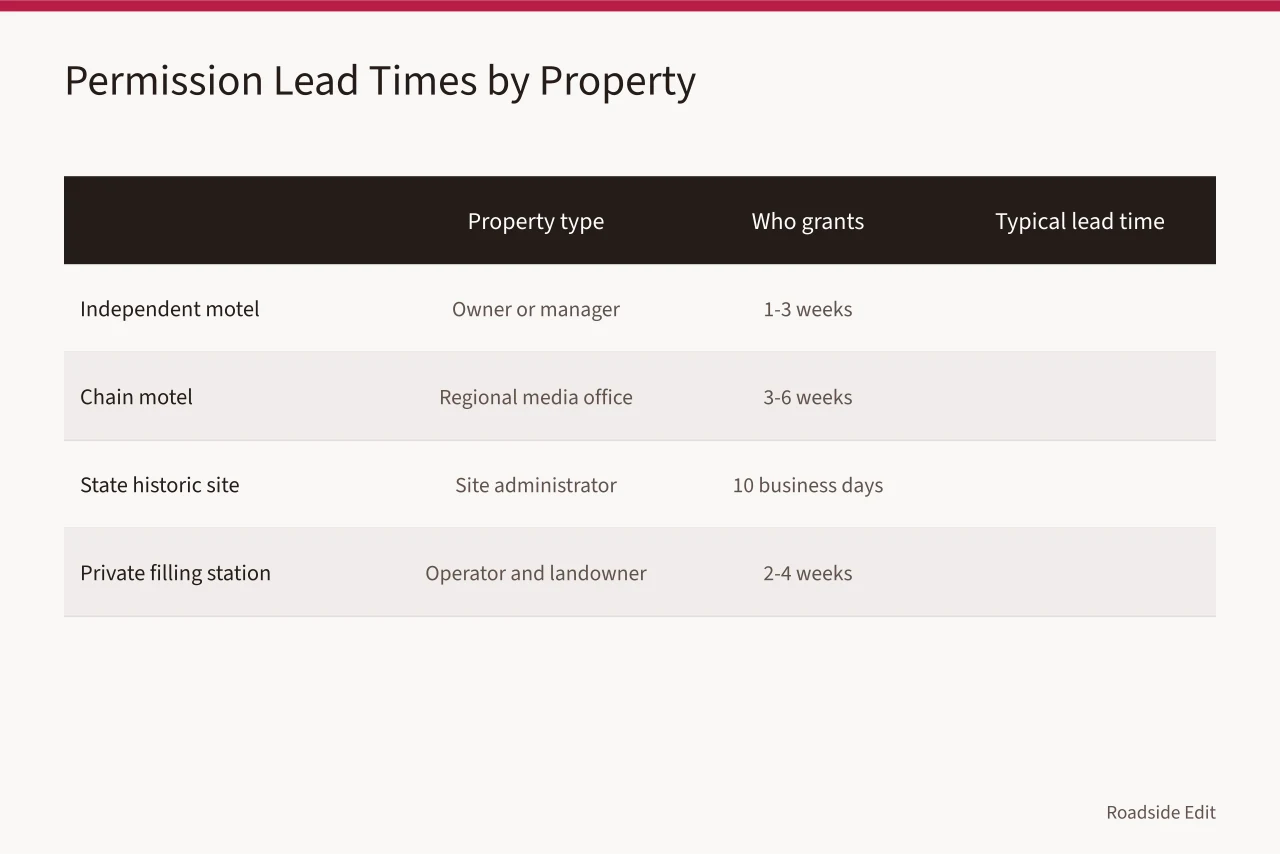
The figures below are planning numbers, not published service standards.
| Property type | Who grants permission | Typical lead time |
|---|---|---|
| Independent motel | Owner or manager | 1-3 weeks |
| Chain motel | Regional media office | 3-6 weeks |
| State historic site | Site administrator | 10 business days |
| Private filling station | Operator and landowner | 2-4 weeks |
Canopies, pumps and underground tanks raise separate questions about who may stand where, and Gas Station Preservation Basics sets out what a documentation visit should record before a contractor arrives.
Opening times that catch people out
Inside the National Park Service system, the agency publishes current hours on each unit's own page, and those hours decide when a tripod may stand inside the boundary. Roads and overlooks close at short notice.
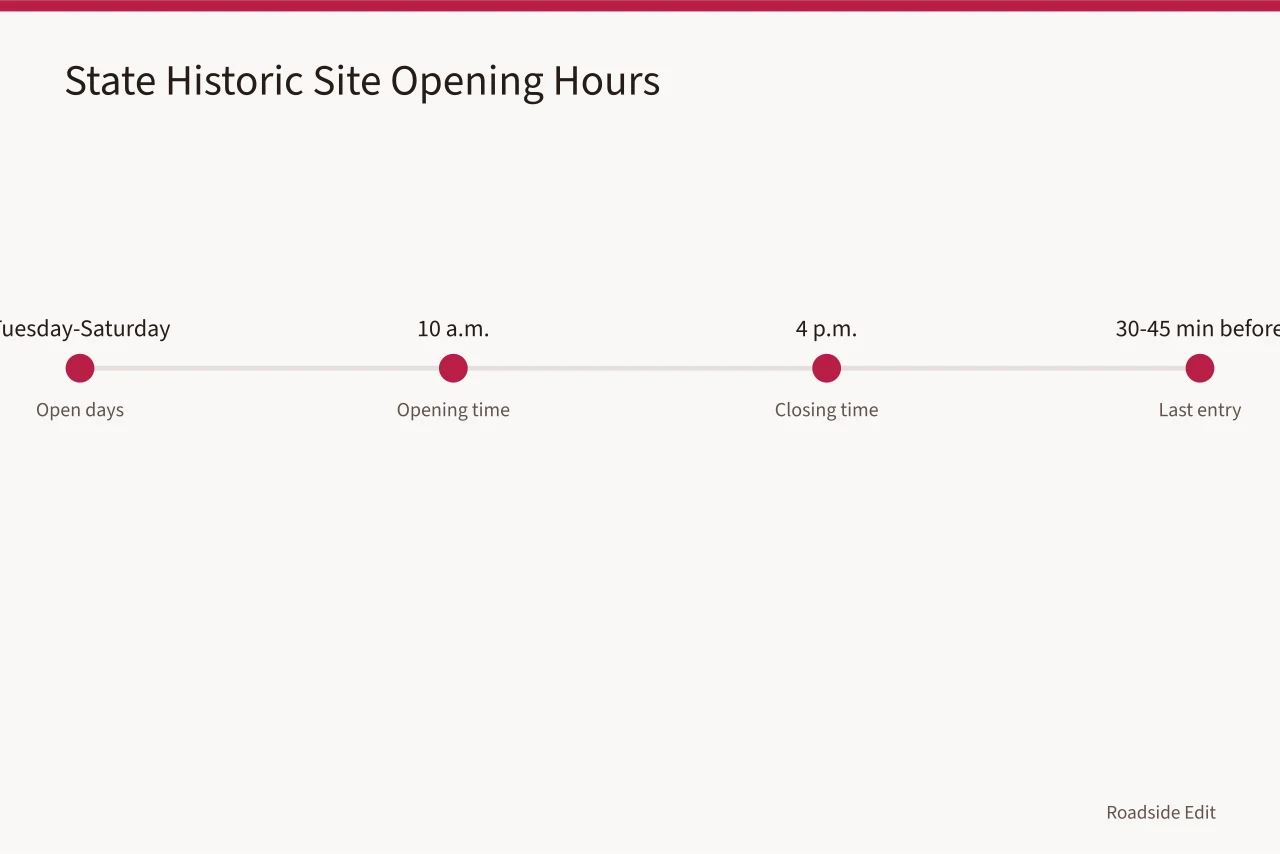
State historic sites commonly open Tuesday through Saturday, roughly 10 a.m. to 4 p.m., with last entry 30 to 45 minutes before closing. Arriving at opening is the difference between clean frames and a tour group in every doorway.
Seasonal closure matters more than daily hours in the north. A sign that reads well in July can sit behind a snowbank in January, with the office shut.
The right-of-way is public. The parking lot is not. Most disputes start with a photographer who treated the second as the first.
Access on arrival
Arrival varies with the owner. An independent may wave you through, ask to see the images later, or walk the property with you. A chain will usually have a manager check your name against an approved request.
The condition that stops a shoot at the door is usually insurance. Some owners require a certificate naming the property as an additional insured, and that can take a day or two to issue. Ask before you travel.
Owners already planning work are the easiest to reach. Choosing Historic Motel Restoration Help early often means a contractor who can vouch for you.
What is not accessible, stated plainly
- Occupied guest rooms
- Fuel islands during a tanker delivery
- Rooftops without fall protection
- Sign fabrication floors
- Federal sites with photography bans
Occupied rooms are closed in every state. A fuel delivery shuts the forecourt for 20 to 40 minutes, and a cashier cannot waive the driver's loading zone.
After 2001, many federal facilities added photography restrictions, set site by site. Read the posted notice rather than assuming a national standard.
Ethics sit beside the law. How institutions weigh documentation against owner consent is described in the Wikipedia article on historic preservation.
When demolition or a remodel is coming, shoot the building first. A field list for roadside renovation keeps the record consistent from one visit to the next.
Who to contact when the site says nothing
- Pull the parcel record from the county assessor or tax office for the owner's legal name.
- Check the state historic preservation office list to see whether the property is surveyed.
- Call the local Main Street or downtown development office, which usually knows who answers the phone.
- Send a short written request and keep the reply.
If the sign itself is the subject, a neon contractor who already services it often knows the owner. Choosing Neon Sign Restoration Help early saves a cold call.
Where a formal documentation file is required, National Park Service guidance on historic preservation research and documentation sets out what it should contain.
Common questions
Do I need a permit to photograph a motel from the street?
No, in most cases. Public sidewalks and highway shoulders are open to photographers, and no state requires a permit for that view.
What does a property release actually do?
It records the owner's consent to images of their property, which matters for commercial publication. Copyright stays with the photographer.
Can I fly a drone over a roadside building?
Airspace is governed by the Federal Aviation Administration, and property consent is a separate question. Many states restrict takeoff and landing.
Are national parks open to commercial photography?
Yes, but some units require a permit, and approval can take weeks. Check the park page before planning around it.