Guides
Part of Historic motel restoration fundamentals: how to plan before any work starts
Historic motel restoration questions to ask before you assume a full site scope
Historic motel restoration questions for 2027 separate phased project records, individual features, and current facts without assuming a whole-site scope.
Ask feature-level questions before describing a motel project. A roof, door, window, sign, room, parking court, or lobby can have different records and dates. A project focused on one feature should not become evidence that every part of a motel was reviewed or completed.
What to take away
- State the feature and project date before discussing work.
- A phased project is not the same as a whole-site conclusion.
- Use a document's own terms for proposed, underway, or completed work.
- Keep source boundaries visible when a project record is partial.
Ask what the source actually covers
An NPS Route 66 grant description for the Western Host Motel lists distinct elements, including doors, a roof, windows, rooms, a sign, and a parking lot, with work described in phases. Read the NPS Route 66 2016 grant example. It is a dated example of a program project. It does not establish the scope or status of another motel.
| Question | Why it matters |
|---|
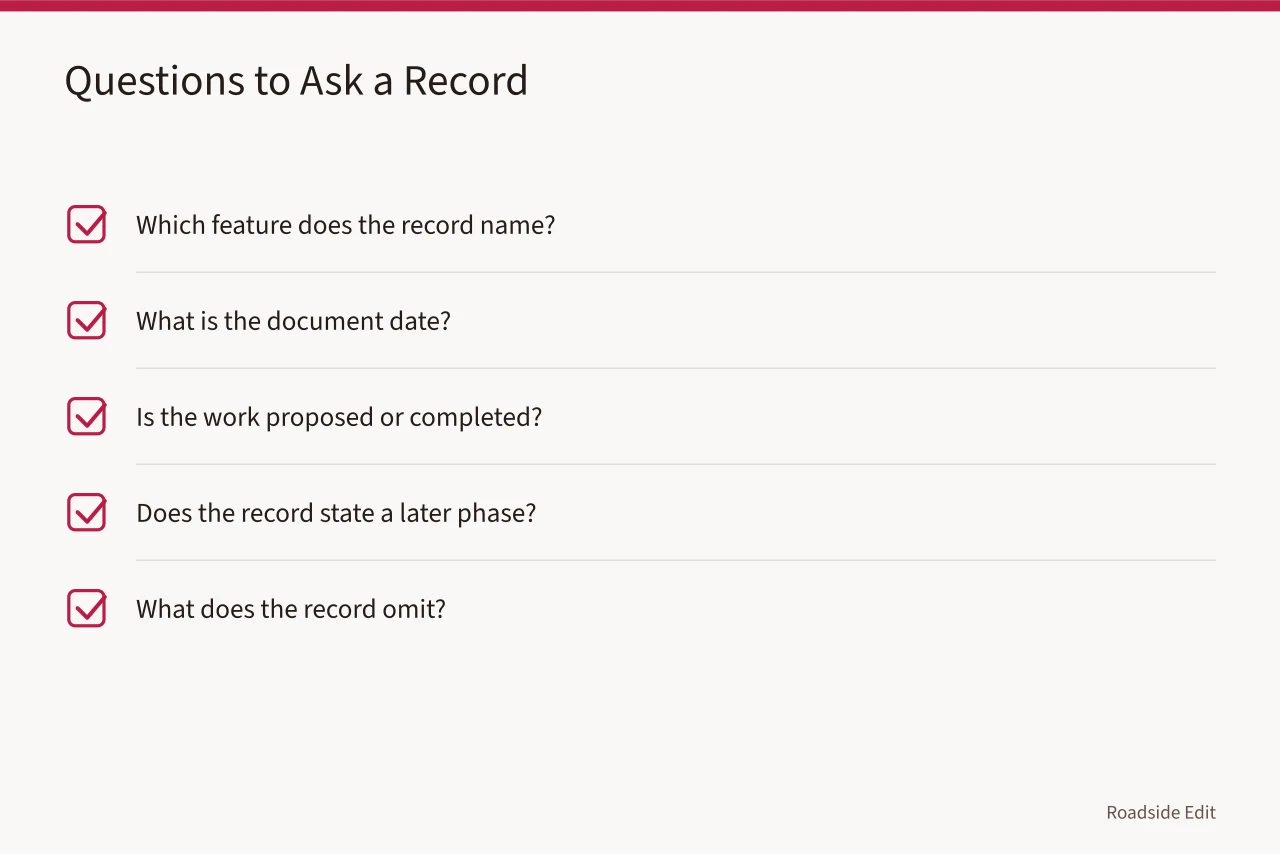
Use a phased-work question set
- What is the exact project title or record label?
- Which named motel feature does it address?
- Does the source describe funding, planning, construction, or completion?
- Is a later record available for a status update?
- Does the article need to state that later work is unknown?
| Do not write | Write when supported |
|---|---|
| "The motel was restored." | "The cited record describes work on the named feature." |
| "Everything was updated." | "The record lists these specific elements and no broader scope." |
| "The project is complete." | "The source reports completion only if it states that fact." |
Check project status in sequence
Project documents often use different verbs for planning, funding, grant award, procurement, construction, and completion. Keep those terms intact. A grant announcement may explain the intended purpose of a project but not prove that work began. A later completion report may cover only a phase. Do not convert several dated records into one broad claim about the whole motel.
The NPS preservation planning standards describe planning as a process that gathers information, identifies issues, and develops strategies. Read NPS preservation planning standards. That source supports treating a planning document as planning evidence rather than proof that construction was completed.
| Record language | Article language |
|---|---|
| Grant award | "The award record describes the stated purpose." |
| Scope or proposal | "The document proposes the listed work." |
| Contract record | "The record identifies an agreement or scope." |
| Completion report | "The report states completion of the named work." |
NPS treatment standards explain that treatment choices depend on property condition and available documentation. See the NPS treatment standards overview. This is why a writer should not treat a project title as evidence that every room, sign, or exterior feature received the same work.
Leave unknown phases unknown
Ask whether a later source identifies the status of the phase you describe. If no later source appears, say the record does not establish later work. Do not fill the gap with before-and-after language, online listings, or a current photo. A current photo can show present appearance. It cannot identify the project's history without a suitable record.
NPS documentation standards call for records based on reliable sources with limitations stated. Review NPS documentation standards. The limitation is part of the answer, not an apology for incomplete research.
For each phase, save exact title, date, source, named feature, and status verb. A careful article may say a dated record proposed work, funded work, or reported completion of a named item, but it should not combine those verbs.
If a later record is missing, say the available material does not establish later status. This makes a project history more useful than a broad claim that a motel was restored.
Common questions
Can a grant award prove that work was completed?
No. An award record can describe the funded purpose. Seek a later record before writing that the work occurred or finished.
Why separate project phases in an article?
Each phase can have its own scope, date, and record. Combining them can create a claim the sources do not support.
Can a project article discuss a motel's full history?
Only when separate sources support that history. A project document usually has a narrower role.