Guides
Part of Historic motel restoration fundamentals: how to plan before any work starts
Historic motel restoration warning signs: what to record before you diagnose
Historic motel restoration warning signs for 2027 separate visible observations from structural claims, scope labels, and unsupported repair conclusions.
Warning signs in an article are usually language warning signs. A writer sees an old roof, stained wall, sagging sign, or closed room and turns a visible detail into a structural or safety conclusion. This guide helps keep the observation useful without pretending it is an assessment.
What to take away
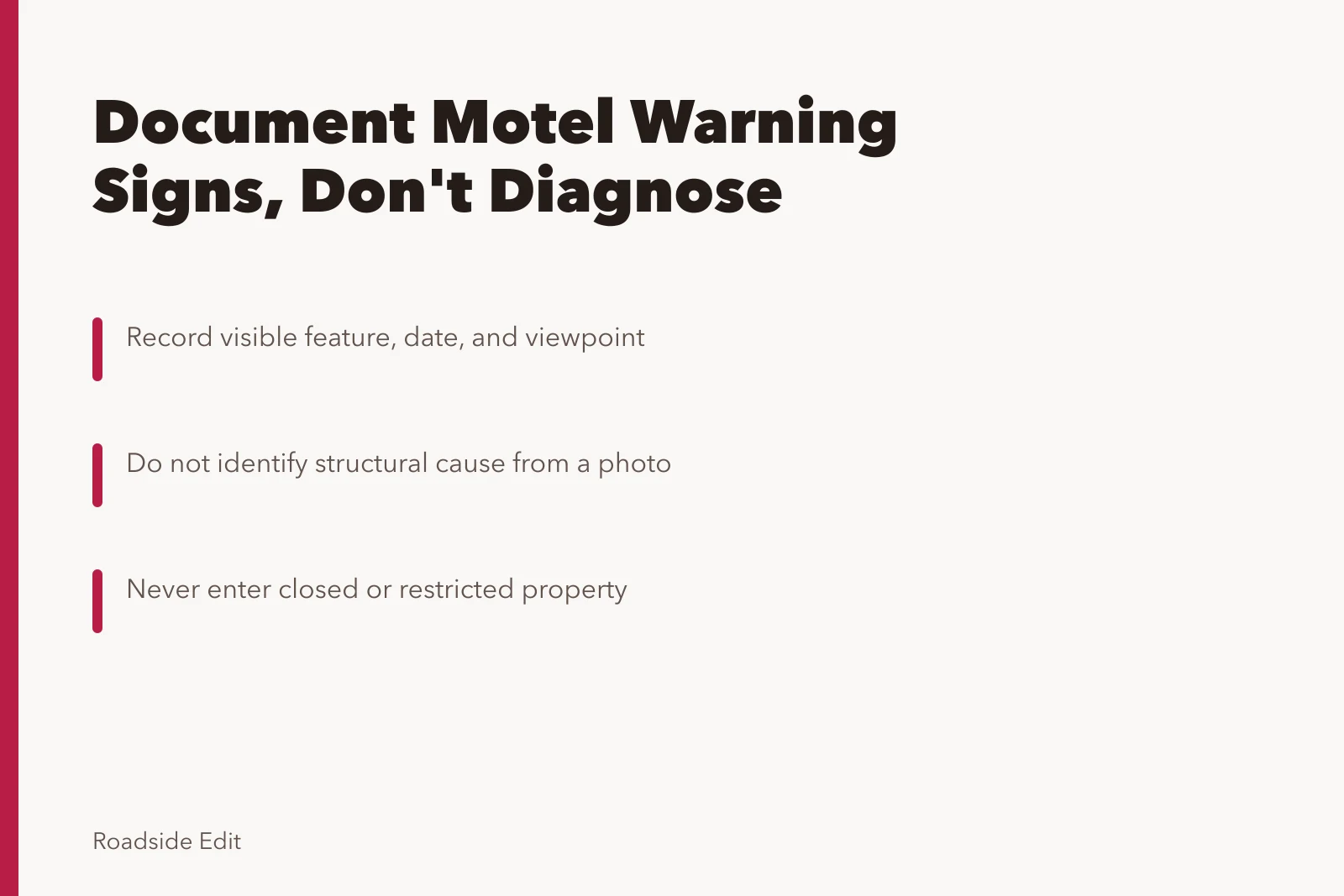
- Record the visible feature, date, and viewpoint.
- Do not identify a structural cause from a public image.
- Do not enter a closed or restricted property for a better picture.
- Escalate a real concern through an appropriate, lawful reporting path rather than an article recommendation.
Distinguish appearance from a condition finding
NPS documentation guidance for structurally deteriorated historic buildings calls for identifying the structural system and documenting deterioration and its extent before a structural condition is established. Read NPS guidance on structural-condition documentation. The document does not assess a motel shown online and should not be used to label one as safe or unsafe.
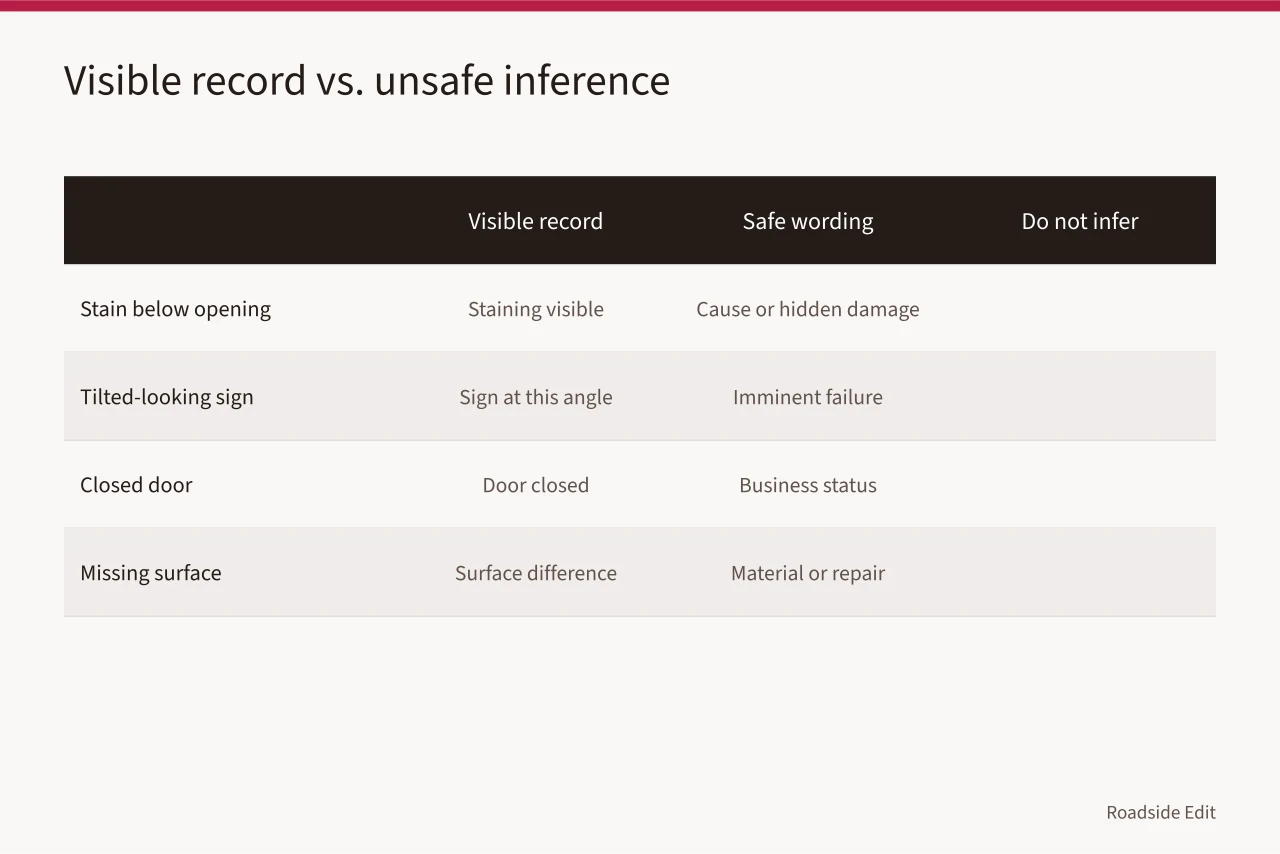
| Visible record | Safe article wording | Do not infer |
|---|---|---|
| Stain below an opening | "Staining is visible in the dated image." | Cause, extent, or hidden damage |
| Tilted-looking sign | "The image shows a sign at this angle." | Structural security or imminent failure |
| Closed door | "The door is closed in the image." | Business status or public access rules |
| Missing surface | "A surface difference is visible." | Material type or repair method |
Run the warning-sign review
- Does the draft say exactly what is visible?
- Is the image date and lawful viewpoint clear?
- Has the draft added a cause, safety conclusion, or repair method without a proper record?
- Does it name any property-specific professional finding accurately?
- Does it avoid directing readers toward a private or unsafe location?
| Remove this phrase | Replace it with |
|---|---|
| "The roof is failing." | "The photo shows a visible roof-surface condition." |
| "The motel is unsafe." | "The article does not evaluate safety." |
| "It needs immediate repair." | "The source does not identify a work recommendation." |
Record a warning without making a diagnosis
A visible condition can require careful wording. A stain, missing part, open window, displaced sign panel, or blocked route is an observation from a stated viewpoint. It is not proof of cause, structural condition, code status, or needed work. Do not enter a closed motel, move closer to a loose feature, or publish access details to obtain a stronger image.
The source does not allow a public observer to make a structural finding. It supports documenting what is known before a project claim is made.
| Visible evidence | Safe article wording |
|---|---|
| Staining below an opening | "Staining is visible in the dated image." |
| New gap in a sign face | "An opening appears in this view." |
| Closed entrance | "The entrance is shown closed in the photograph." |
| Detached-looking part | "The image shows a displaced-looking feature." |
NPS Preservation Brief 18 explains that interior character can involve plan, spaces, features, finishes, and materials. Read NPS guidance on historic interiors. A limited view does not identify every one of those elements or their condition.
NPS documentation standards call for reliable sources and stated limitations. Review NPS documentation standards. The limit belongs beside the warning, not hidden after publication.
NPS treatment guidance explains that preservation work focuses on existing features and documented decisions. Read NPS preservation treatment guidance. It does not turn an image into a project scope.
Use a consistent report note: feature, date, lawful viewpoint, visible fact, and limit. Leave out motive, cause, condition grade, and work recommendations.
A responsible owner, public agency, or qualified professional may need a fuller record. That does not mean a visitor should investigate a closed motel. Keep public readers away from access details and private areas.
Give the observation a clear end point. If an image shows a stain, say only that it appears in that image at the stated date. Do not imply that it remained, spread, or caused damage after the photograph was taken. This distinction keeps a compelling visual detail from becoming an unsupported diagnosis.
Common questions
Can a writer report a visible concern?
Yes. Describe the feature, date, and viewpoint. Do not diagnose its cause or significance without an appropriate record.
Should readers inspect a motel to verify a photo?
No. Do not encourage entry, close access, or other activity that may be unsafe or unauthorized.
What is the safest general statement about an unknown condition?
State that the available image does not establish the cause, extent, or technical significance of the visible feature.