Guides
Part of Historic motel restoration fundamentals: how to plan before any work starts
Historic motel restoration basics checklist for 2027: what to gather before work starts
Historic motel restoration checklist for 2027 separates interior records, visible features, planning questions, and source limits before work is discussed.
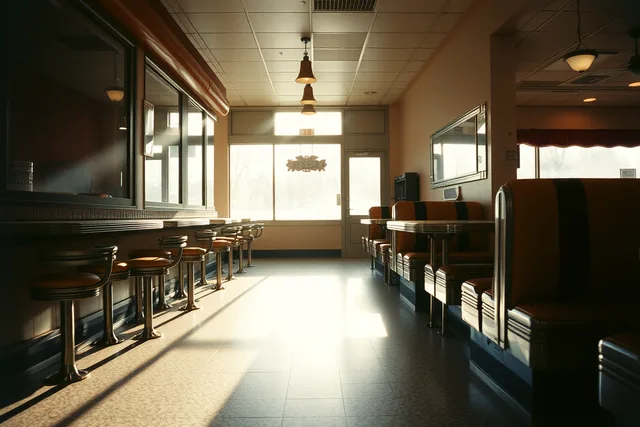
Use this checklist when an article mentions an historic motel interior, such as an office, lobby, guest room, corridor, restaurant, or manager's residence. The checklist controls claims. It does not identify a feature's condition or tell an owner what to retain, repair, or replace.
What to take away
- Name the interior space and source date before describing it.
- A floor plan, room sequence, finish, and fixture can be different research subjects.
- Keep a visible feature separate from a conclusion about its history or condition.
- Record what is outside the article's view.
Identify the interior record
NPS Preservation Brief 18 explains that interior character can include plan, spaces, architectural features, finishes, and materials. It recommends identifying relevant elements before planning a rehabilitation project. Read NPS Preservation Brief 18 on historic interiors. The brief offers general guidance and does not determine what is significant at a particular motel.
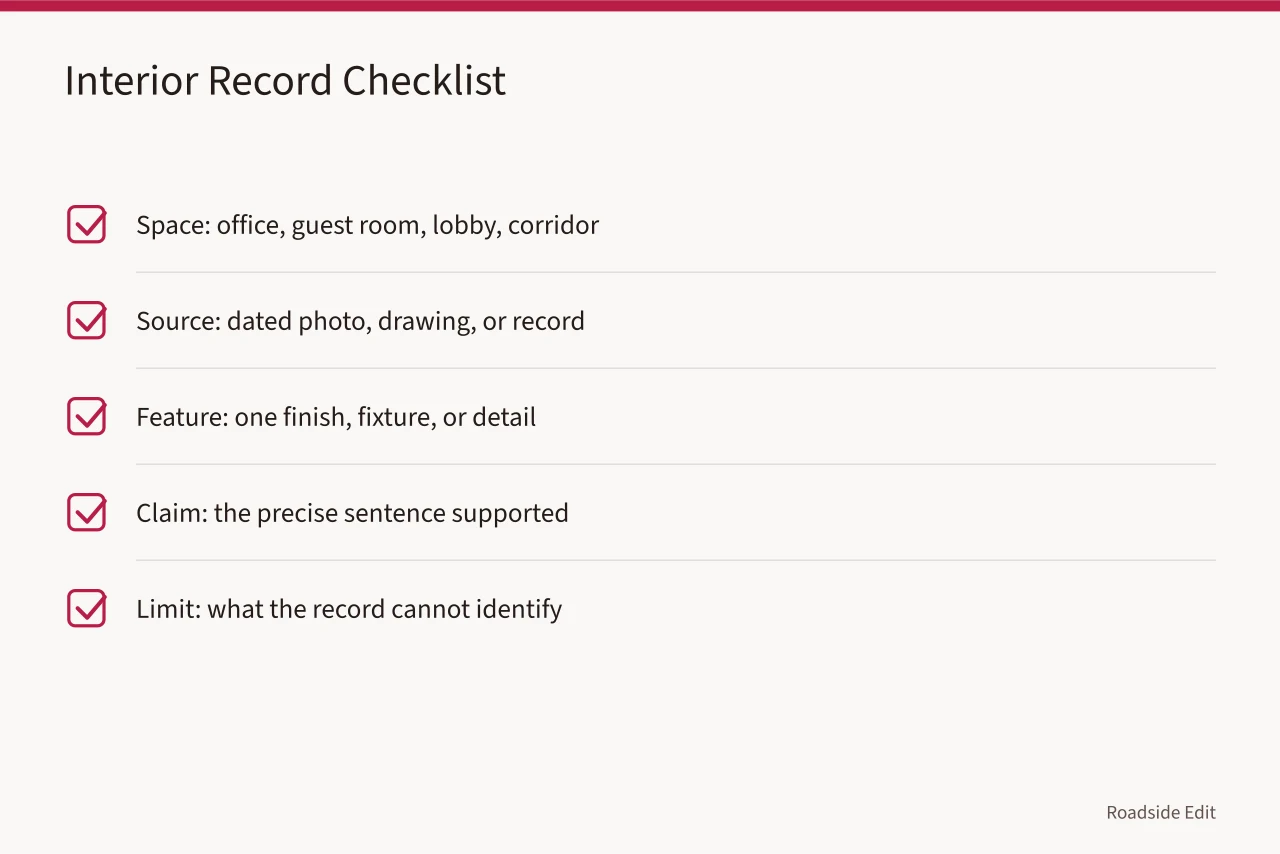
| Checklist item | What to record |
|---|---|
| Space | Office, guest room, lobby, corridor, restaurant, or other defined area |
| Source | Dated photo, drawing, description, or public record |
| Feature | One finish, fixture, room relationship, or visible detail |
| Claim | The precise sentence supported by the record |
| Limit | What the record cannot identify or evaluate |
Check the draft
- Does the article distinguish an interior image from an exterior record?
- Does it identify the date of the image or document?
- Does it avoid calling a finish original without a source that says so?
- Does it avoid calling a room safe, compliant, or restored from a photo alone?
- Does it state when interior access or current records are unavailable?
| Risky phrase | Safer wording |
|---|---|
| "The original lobby" | "The cited image shows the lobby on the stated date." |
| "The rooms need restoration" | "The article does not assess room condition or work needs." |
| "The tile was preserved" | "The available record does not identify the tile's history or project status." |
Build a feature file before writing a treatment claim
An interior record can list a room plan, circulation path, ceiling, wall finish, and flooring. Add a built-in item, light fixture, door, or furniture, and list each separately.
Then record whether the evidence is a current photograph, historic photograph, owner-supplied document, drawing, or archive description. This stops one attractive image from being proof of a whole room's age or condition.
The NPS treatment standards describe preservation as work that retains existing form, features, and materials, with documentation planned before work. Read NPS preservation treatment guidance. That source does not decide what matters at a particular motel. It supports documenting the existing record before repeating a claim about retention or replacement.
| Evidence type | It can support | It cannot support alone |
|---|---|---|
| Dated interior image | What appears in the pictured view | Current condition or hidden construction |
| Floor plan | A stated room relationship | Current finishes or use |
| Project record | Its listed scope and date | Unstated work elsewhere |
| Archive description | The precise historical detail quoted | A present-day condition |
NPS documentation standards call for reliable sources and stated limitations so records can be independently checked. Review NPS documentation standards. Keep the date and limitation beside the claim in a motel article, not in a separate research note.
Keep access and privacy in view
Motel interiors may be occupied, privately owned, or unavailable to the public. Do not enter a room, photograph guests, or publish room numbers, access details, or security information for the sake of a fuller story. If an interior record is unavailable, say so plainly. An exterior history can still be useful without inventing an unseen interior.
NPS guidance for Route 66 property owners encourages planning and seeking appropriate help before preservation work. Read NPS Route 66 building guidance. Use that source as general context, not as a repair instruction for a named motel feature.
Before publication, reread each interior sentence beside its source, confirming the date belongs to the source, not an assumed date of construction or alteration. Check that the caption identifies only the view shown.
A room may have changed after an image is made, and an image may not show the entire room; keep those limits in the article. If later records contradict a caption, correct the caption and retain a dated editorial note in the research file.
Common questions
Can a postcard document a motel interior?
It can document what the item depicts and what its source identifies. It should not be treated as proof of present condition or unchanged features.
Does an interior checklist recommend a treatment?
No. It is an editorial evidence check, not a project plan.
What if no interior record is available?
State the limit, keep the article focused on documented exterior or historical material, or wait for a suitable source.