Reviews
Part of How to build a neon sign restoration case study: a 2027 method guide
Neon sign restoration case study: questions to test before you publish
Neon sign case study questions for 2027 help editors test photos, timelines, local records, company statements, and unanswered points before publishing.
Good questions make a roadside-sign case study more useful than a polished guess. They force the writer to distinguish what a photograph shows from what an owner says, what an older record proves from what needs current confirmation, and what deserves to remain unanswered.
What to take away
- Ask about the record before drawing a conclusion from it.
- Give each question an evidence type and a person or office able to answer it.
- Treat conflicting accounts as a reporting assignment, not a vote.
- State gaps plainly when no source can settle them.
- Keep promotional claims separate from a documented project history.
Begin with observation questions
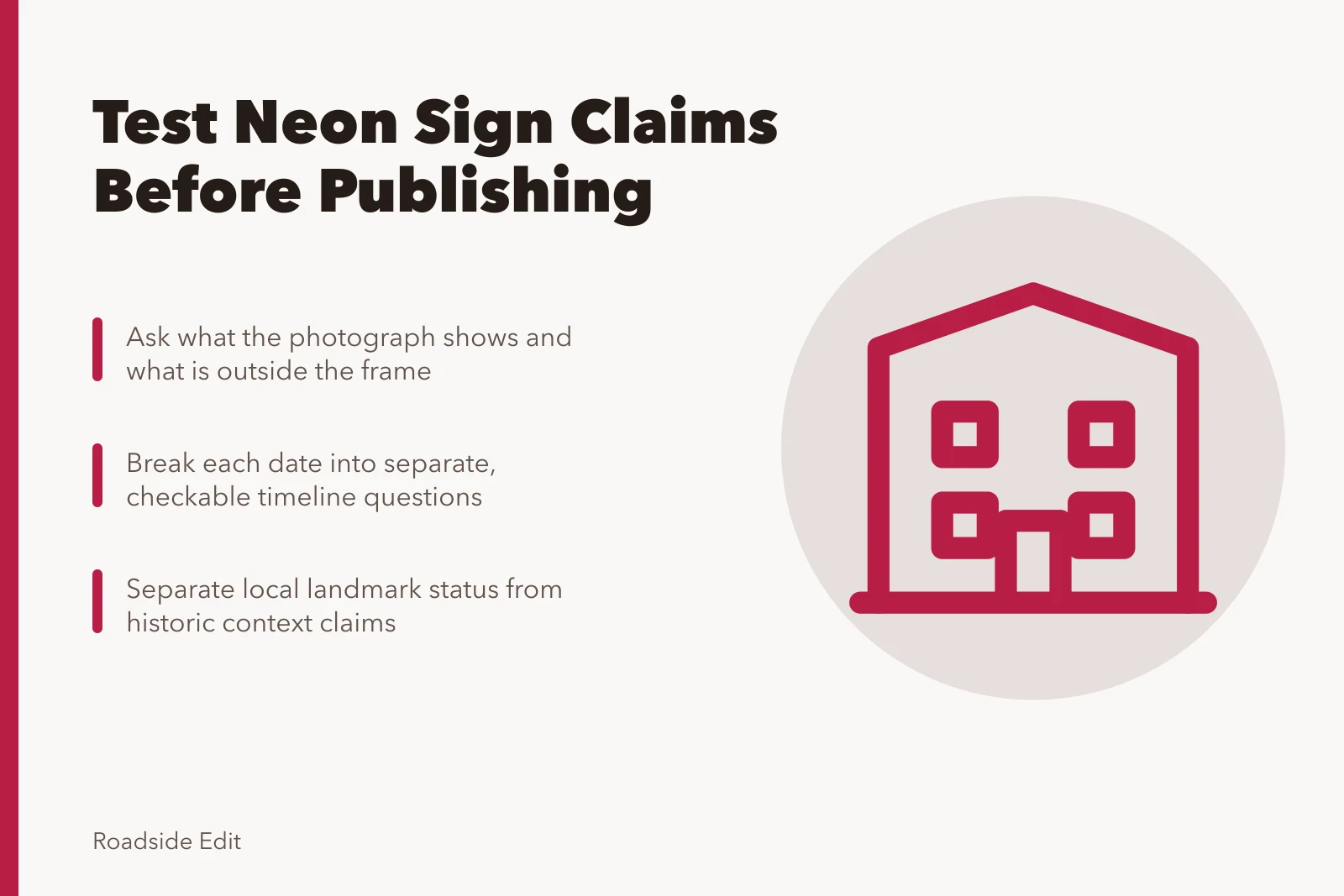
The first questions should have modest answers. What does the photograph show? Is the image dated? Does the caption identify a location, a business, or a photographer? What part of the sign is outside the frame? These prompts reduce the chance that a writer will attach a broad story to a narrow visual detail.
The Library of Congress guide to forming questions explains how observation and reflection can lead to further investigation. Start with "What can I see or read?" and then move to "What do I need to verify?"
A glowing sign in a night image may be a useful observation. It does not show that every letter worked, that a restoration was recent, or that the business is open today.
| If you need to know | Ask this question | Best starting evidence |
|---|---|---|
| What the image documents | When and where was this image made? | Original image page and caption |
| What happened in the past | Which dated record describes the event? | Permit, news item, archive, or owner record |
| What is true now | Who can confirm this present detail? | Current owner, agency, or direct observation |
| Why accounts differ | What detail is each source actually describing? | Side-by-side dated notes |
| Whether a claim is promotional | Who supplied it and what relationship exists? | Disclosure and source log |
Ask timeline questions that can be checked
Timelines create authority quickly, even when the dates are weak. Break each date into a separate question: What happened? Who recorded it? When was that record created? Was the date reported later by somebody else? A business recollection may be useful background, while a permit may establish a filing date. They are not interchangeable.
The National Archives primary-source explanation notes that whether a source is primary depends on the question. That is why a document should not be called definitive simply because it is old. A 1960 newspaper advertisement can document what was advertised in 1960. It cannot establish the current condition of a sign in 2027.
When a source conflicts with another source, do not flatten the difference into a smooth narrative. Write down both accounts, identify the date of each, and ask whether they refer to different stages of the same work. If the conflict remains unresolved, say so. Readers can handle an open question better than a false certainty.
Separate local-status questions from history
Historic context and formal status need different questions. Ask: Is the property listed, locally designated, or merely described as historic by a contributor? Which public office holds the designation record? Is the sign itself included, or only the building? These distinctions matter before an article repeats language from a press release or tour page.
The National Park Service explains the role of State Historic Preservation Offices in the federal preservation program. That page is a starting point for finding the appropriate state office, not proof that a specific site has a designation. For a published claim, cite the relevant record or describe the status as an unverified statement.
Use questions like these during local research:
- Which office or archive holds a record for this address?
- Does the record name the sign, the building, or a wider district?
- What date does the record cover?
- Is the source describing a legal status, a planning opinion, or local history?
- What information remains unavailable to the public?
Test business and provider statements fairly
An owner or restoration shop can explain its own work, timeline, and goals. Attribute those accounts directly: "The contractor said..." or "The owner provided..." Do not convert a supplied result into an independent finding unless reporting has independently established it.
When an article includes a recommendation, free service, sponsorship, or other material connection, ask a reader-centered question: Would this relationship affect how a reasonable reader weighs the statement?
The Federal Trade Commission's endorsement guidance says material connections that could affect how people evaluate an endorsement should be disclosed clearly and conspicuously. A disclosure does not decide a claim's truth. It gives readers information they may need to judge it.
Keep an unanswered-question box
Every case study should end reporting with a short list of what is unknown. This is not a failure. It tells the editor what to revisit and tells readers where the evidence stops. Common entries include an undated image, an unconfirmed opening date, a missing permit file, or a repair detail supplied only by one party.
Before publishing, read each unanswered question aloud. If the headline or introduction silently answers it, revise the copy. The final article should be clear about what it found, who supplied each account, and what readers would need to know before reaching a different conclusion.
Common questions
Can a question remain unanswered in a published article?
Yes. State the gap, name the kind of evidence that could address it, and do not fill the gap with speculation.
Should every project use the same questions?
Use a stable core for image, timeline, source, and disclosure checks. Add specific questions only when the available evidence makes them relevant.
Is a quote an answer to every question?
No. A quote documents a speaker's account. It may answer what that person said, but it does not establish facts outside the speaker's knowledge.