Costs
Part of How to build a neon sign restoration case study: a 2027 method guide
How to write neon sign restoration case study budget notes without guesswork
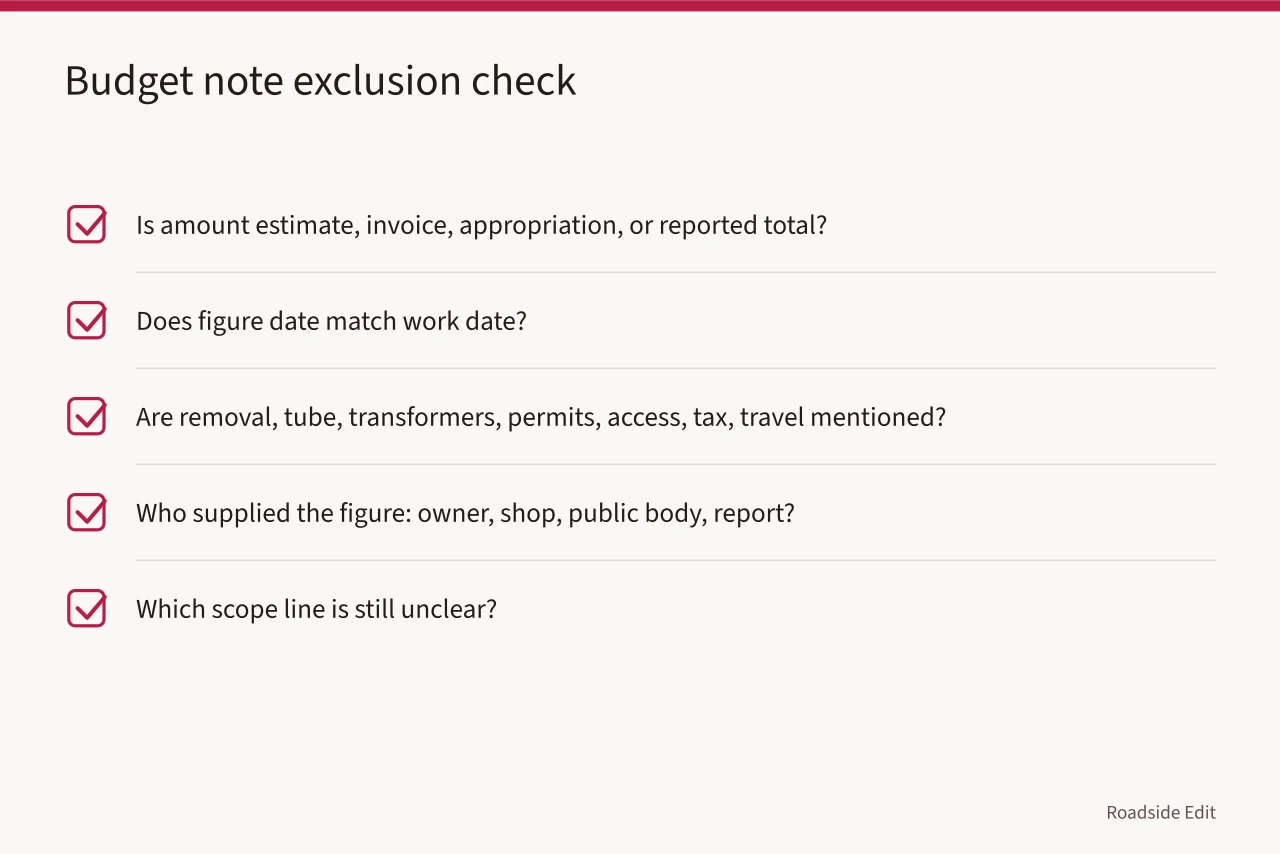
Neon sign restoration case study budget notes work when each figure carries its date, source, scope and exclusions, so readers compare like with like.
A figure from a past neon job can anchor a case study or wreck it. What decides which is whether the note carries its date, its source, and the scope the money actually bought.
What to take away
- Write every amount as a dated record, never as a current price.
- Name the scope in trade terms: tube diameter, transformer count, pylon steel, access equipment.
- Say who supplied the figure and whether the article also promotes them.
- State what the record does not cover, in the record's own words.
- Add the final budget note after every amount, then check the date, source and scope sit beside it.
Separate the tube from the transformer
Neon scope splits into parts that price very differently, and a note that lumps them together tells a reader nothing.
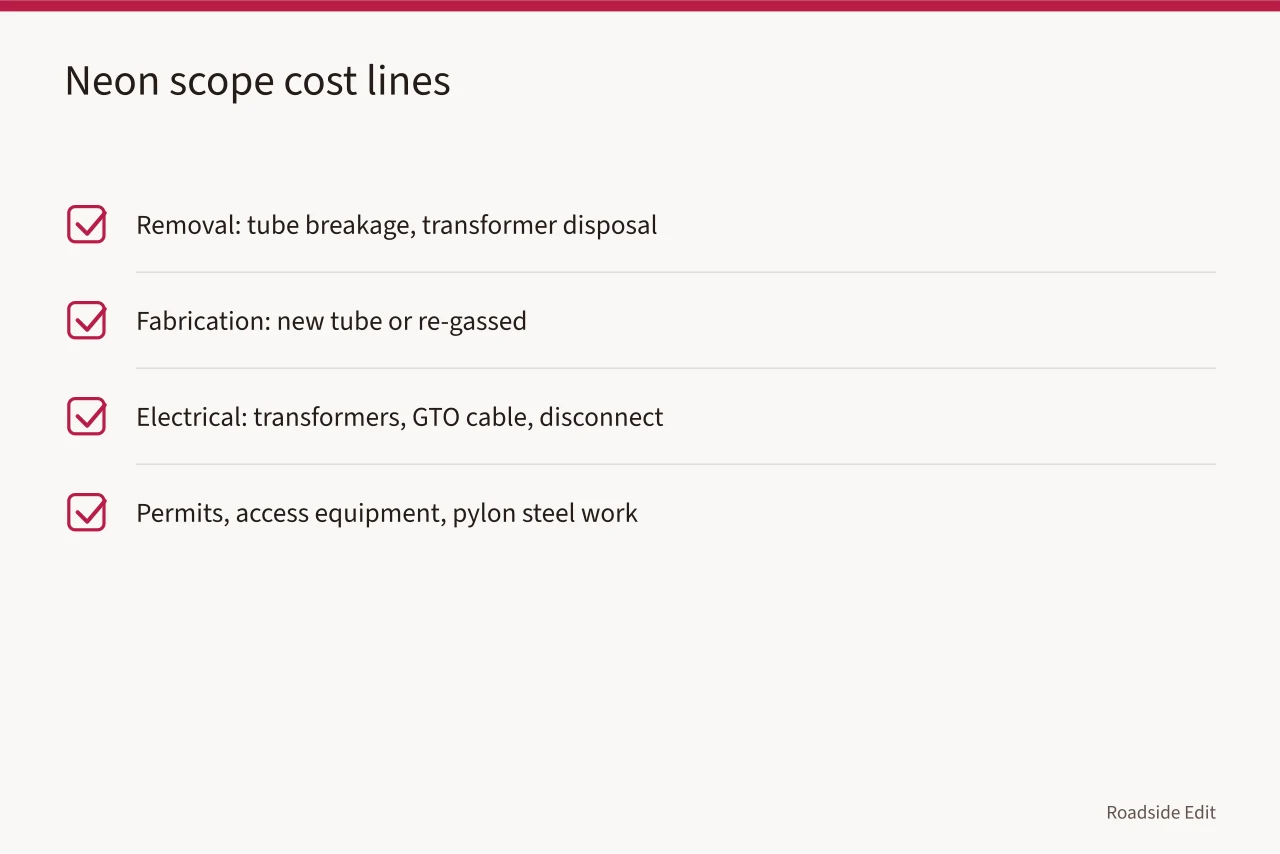
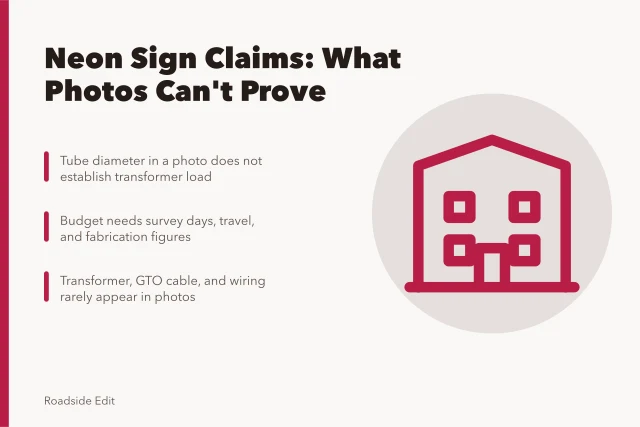
Removal is one line: tube breakage, transformer disposal, and whether the can or pylon stays. Fabrication is another: new tube bent to the original pattern, or the original tube cleaned and re-gassed. Electrical is a third: transformers, GTO cable, and the sign's disconnect. Permits, access equipment and any pylon steel work are separate again.
A note that says "sign restoration, $X" hides all of it. A note that says which of those lines the money covered is usable.
Match the note to the sign you are describing
A 1950s porcelain-enamel station sign and a 1960s plastic-faced box sign fail in different places and get documented differently. Enamel chips and rust creep at the mounting holes; plastic faces yellow, craze and crack at the fasteners.
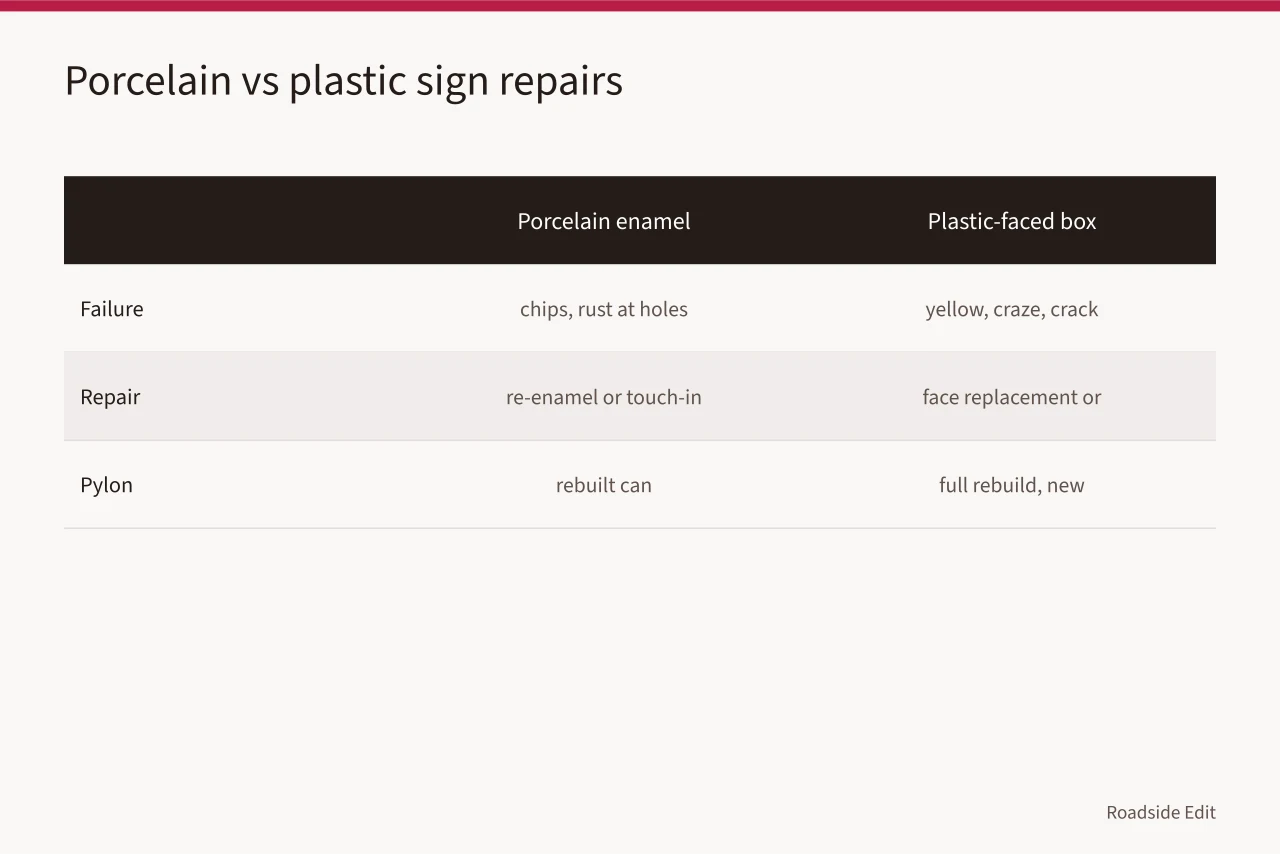
Say which you are writing about. A re-enamel or touch-in figure belongs to the porcelain sign. A face replacement or a re-lamp figure belongs to the box sign. Readers comparing the two are comparing repairs that share almost nothing.
The same split runs through pylon work. A single-pole pylon with a rebuilt can is not the same job as a full pylon rebuild with new steel and a fresh foundation. Say which one the amount describes.
Put the exclusions in the record's own words
The most common failure is not the number. It is dropping the sentence that said what the number left out.
If the invoice says "estimated," write estimated. If it says "contract amount," do not assume it absorbed later changes. If the record is silent on permit fees, write that the material reviewed does not identify them.
An amount for cleaning and re-glassing one letter set is not a benchmark for a pylon rebuild. Saying so costs one sentence and prevents the misread.
Read the document, then stop reading into it
The Library of Congress reflection guidance draws the line between what a source shows and what you conclude from it. Apply that line to budgets.
Reading "$X on a 2024 invoice" is an observation about the invoice. Writing "a comparable job should cost $X" is an inference the invoice cannot support. Keep the first, and label the second as your own estimate or drop it.
The Government Accountability Office's cost estimating guide treats assumptions, data and documentation as parts of a credible estimate. A case study is not an estimate, but it can borrow the habit: no amount without its conditions.
| Record type | What it can support | What it cannot |
|---|---|---|
| Paid invoice | A dated amount billed for the scope on that invoice | A fair price for a different sign |
| Public budget line | An amount allocated or reported by a public body | The final cost, unless the record says so |
| Sign shop estimate | The shop's proposed scope and price | Independent confirmation of the result |
| Owner recollection | The owner's account of a past amount | Complete scope or present market value |
| News report | What the report said when it ran | Terms the report omitted |
Handle public records and supplied figures differently
For a public document, link the specific record and use its own label. The National Archives' records-management overview is about identifying the actual record in front of you, not citing "the archives" as a source.
For a figure from a sign shop or an owner, name the supplier. Then ask whether the article also promotes them. The Federal Trade Commission's endorsement guidance says a connection that could change how a reader weighs the claim has to be disclosed clearly. Disclosure adds context; it does not verify the amount.
Where a current figure matters and you do not have one, give the arithmetic instead. Let T be transformer count, L be linear feet of tube, and R be the shop's rate per foot; the note shows the reader how to build their own total rather than borrowing someone else's.
Use a final budget note
Close every amount with the same sentence: "This historical figure is reported for context only. It is not a quote or a prediction of current costs."
Then check the paragraph above it. Date, source, scope, omissions, all four present. If one is missing, cut the number. A case study with no budget line reads better than one that turns an incomplete document into a price signal.
Neon work also runs into the Secretary of the Interior's Standards and, on publicly funded jobs, Section 106 review, and both can reshape scope after the invoice date. Say so rather than pretending the record is the whole job. For how those reviews played out on finished projects, the renovation case records show the paper trail.
Common questions
Can a past project amount be useful?
Yes, when the note names its source, its date and the scope it covered. It describes one record. It is not a price promise for the next sign.
Should a case study print a total when the exclusions are unknown?
Only if the missing scope is obvious in the same paragraph. If the gap would make the total misleading, leave the total out and describe the work instead.
Can a paid profile include a budget figure?
It can report a dated figure the business supplied, with the connection disclosed. That is attribution, not independent verification, and the note should say which one it is.
What if the only record is an owner's memory of the cost?
Report it as the owner's recollection, with the year they gave. Do not convert it into a per-foot rate or a range. The interior case studies show how recollected figures are handled when no invoice survives.