Guides
Part of Roadside architecture mistakes: a claim card method before you publish
Roadside architecture mistakes checklist before your preservation article goes live
Roadside architecture mistakes checklist for 2027 helps writers verify materials, sources, photo limits, and claims before a preservation article goes live.
Use this checklist before publishing a story that mentions a roadside building material, replacement, or visible feature. It is designed to stop a common editorial mistake: describing a product, surface, or component as if its identity and relationship to the building were already known.
What to take away
- Identify the feature and source before naming a material.
- Do not call an item a replacement unless a record says it is one.
- Separate a visible finish from the material beneath it.
- Keep material description away from repair advice.
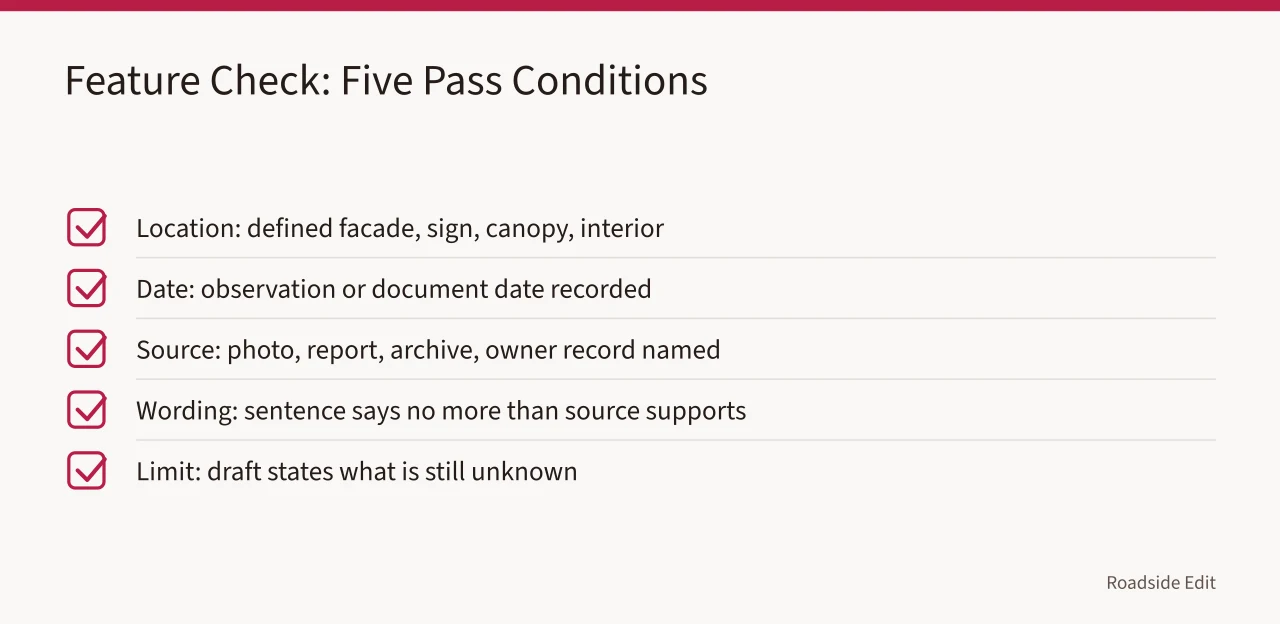
Run the feature check
| Check | Pass condition |
|---|---|
| Location | The feature is located on a defined facade, sign, canopy, or interior area |
| Date | The observation or document date is recorded |
| Source | A photo, report, archive item, or owner-provided record is named |
| Wording | The sentence says no more than the source supports |
| Limit | The draft states what is still unknown |
The National Park Service notes that choosing substitute materials requires understanding their properties and their relationship to surrounding materials and systems. Review NPS guidance on substitute materials. That is a reason to avoid casual material claims in an article. It is not an instruction to select a material for a specific roadside property.
Check the source before naming the material
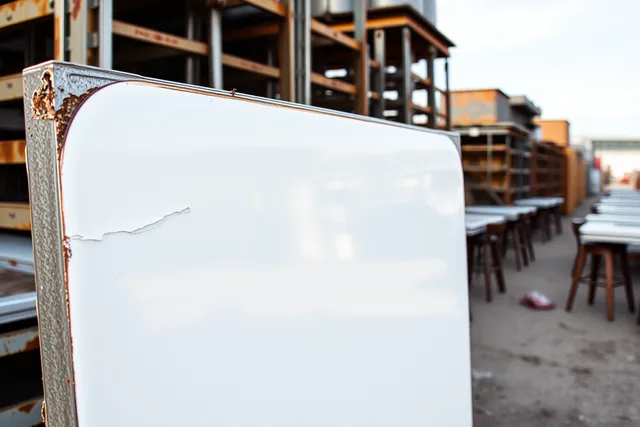
An image can show color, texture, shape, or visible damage. It cannot establish composition, age, installation method, or whether a surface hides another material. NPS documentation standards require reliable sources and clear limitations that allow later verification. Read the NPS documentation quality standard.
In a roadside article, a caption should identify the visible feature and date, then leave unverified details out.
The Library of Congress primary-source guide recommends examining a source before drawing conclusions from it. Use the Library of Congress primary-source analysis guide. Put that idea into a simple editorial test: what does this image show directly, and what would require another record?
Use the no-assumption checklist
- Do not identify a material from color alone.
- Do not assume paint, cladding, sealant, or a coating reveals the substrate.
- Do not infer that a newer-looking component is a replacement.
- Do not call a feature original without a source that supports its history.
- Do not treat a product name in an old advertisement as proof of what remains today.
- Do not write a compatibility claim without a source that actually addresses the relationship.
| Draft phrase | Safer replacement |
|---|---|
| "The brick was replaced." | "The available source does not establish whether this wall surface was replaced." |
| "The neon is original." | "The cited image dates to 1962; it does not identify the sign's current components." |
| "The siding is failing." | "The photo shows a visible gap at the siding edge." |
Do not turn a treatment word into proof
Words such as "rehabilitated," "restored," and "reconstructed" describe different treatment approaches. The NPS defines rehabilitation as making compatible use possible through repair, alterations, and additions while retaining identified values. See the NPS rehabilitation treatment standard. A newer-looking panel or fresh paint does not prove that a project used that treatment.
Use the project record if one is available. If it calls for a replacement, quote that limited scope. If it identifies a material, attribute the statement to the document. If it does neither, describe only the observable result. This makes later corrections easy and prevents a visual impression from becoming a claim about construction history.
Review the caption and claim together
Before publishing, compare the image caption with every sentence that relies on it. The two should agree about date, viewpoint, and feature. Remove a claim if it reaches past the frame. Do the same with old advertisements, postcards, and promotional images: they can document a past appearance, but they do not prove what survives now.
Name the date and source type in the article file so a later reviewer can retrace the claim without guessing.
Common questions
Can a writer identify a building material from a photo?
Only when the source itself identifies it or the visual evidence is clear enough for a narrow description. Do not turn a likely appearance into a confirmed material claim.
Does this checklist approve a replacement material?
No. It is an editorial accuracy check, not a technical assessment or a work specification.
Why include a limit in a material note?
The limit tells readers exactly what the record cannot prove and keeps an image from carrying more meaning than it has.