Guides
Part of Roadside architecture mistakes: a claim card method before you publish
Roadside architecture mistake budget notes: put unknowns before numbers
Roadside architecture mistake budget notes for 2027 help editors avoid false cost certainty when the scope, materials, records, and conditions remain unknown.
Cost language can make a roadside feature article feel practical, but a tidy dollar figure is often the least reliable part of an early story. When scope, existing material, access, records, and project responsibility are unknown, a price range can look like a promise instead of an editorial estimate.
What to take away
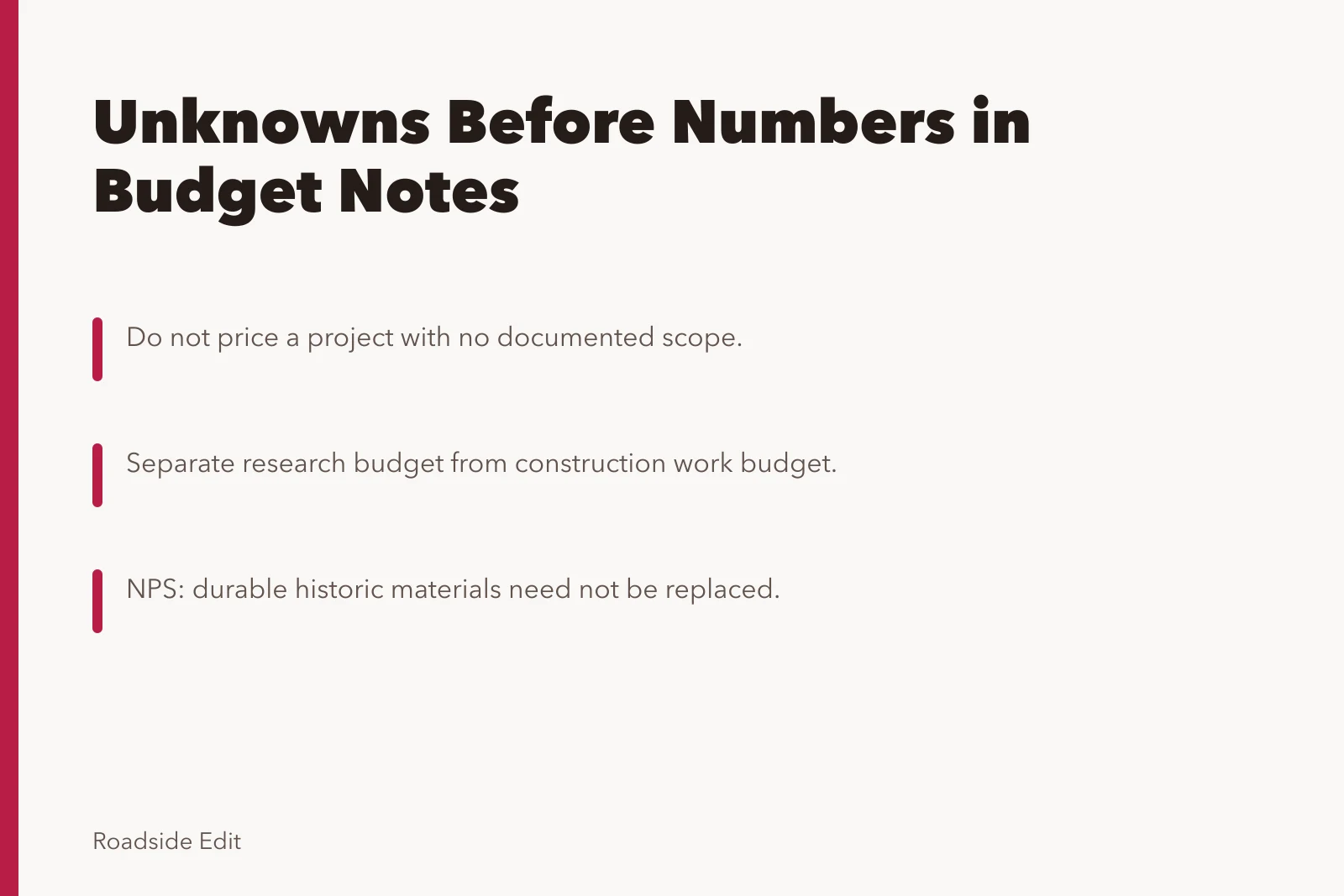
- Do not price a project that has no documented scope.
- Separate a research budget from a work budget.
- Explain the missing inputs rather than filling them with a generic range.
- A durable historic material is not automatically a candidate for replacement.
Put unknowns ahead of numbers
Use a budget note to describe what would need to be known before cost discussion is meaningful. The National Park Service cautions that replacing durable historic materials solely because another product appears sustainable can be problematic. Consult the NPS sustainability guidelines. This supports a careful scope question, not a cost estimate for a named building.
The General Services Administration explains that cost estimates evolve as a project moves forward and its scope becomes clearer. See GSA's cost-estimate guidance. Its framework is for government projects, but it makes the editorial point well: label an estimate by stage and do not publish it as a fixed future result.
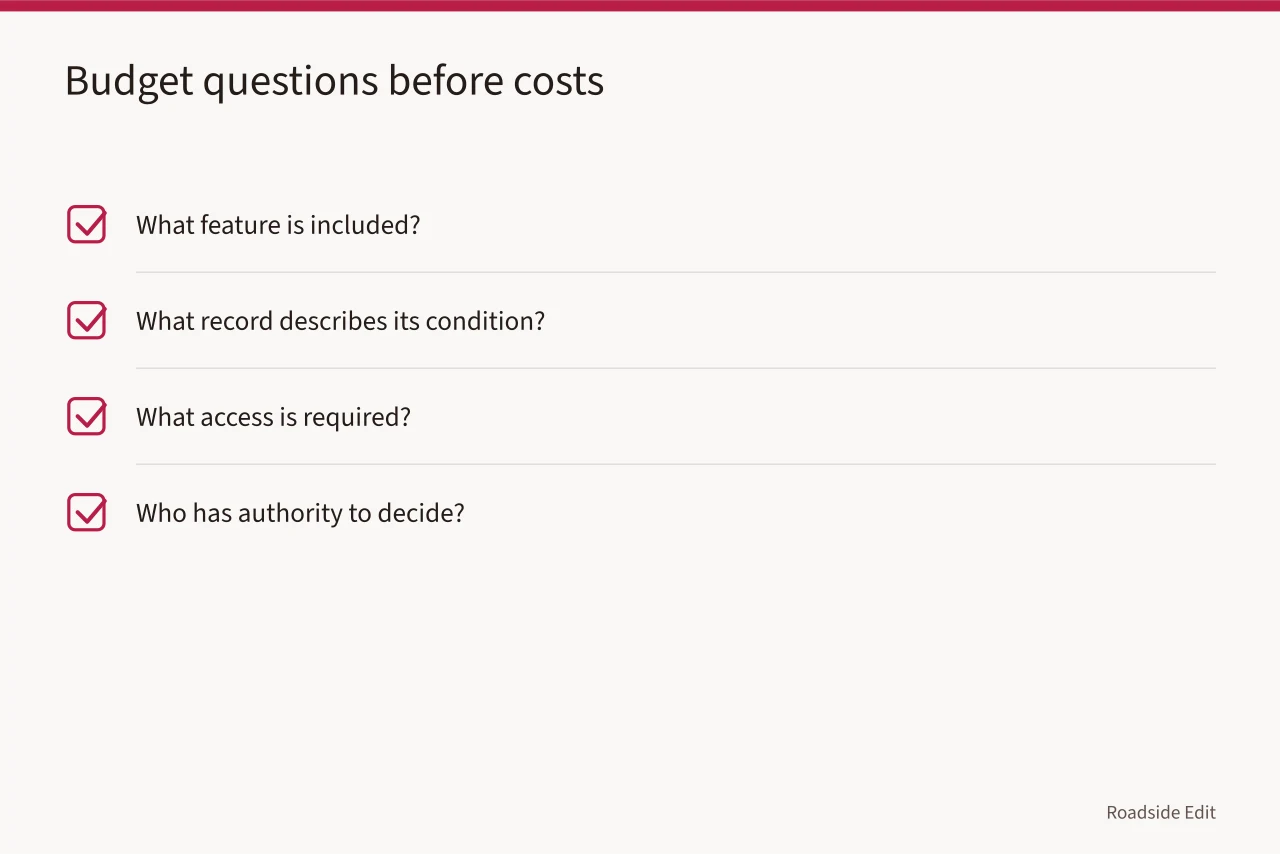
| Budget question | Why it changes the discussion |
|---|---|
| What feature is included? | A single sign face and a whole storefront are different scopes |
| What record describes its condition? | An image may not show the full extent of a feature |
| What access is required? | Access affects timing and planning but must be documented |
| Who has authority to decide? | A writer cannot assign project responsibility |
| What does the source leave unknown? | The limit prevents invented precision |
Use a research-first budget note
Instead of publishing a price, build a small research note:
- Identify the feature and its documented location.
- List the records already available.
- State whether those records identify a scope of work.
- Name the questions a qualified project team would need to answer.
- Avoid presenting research costs and construction costs as the same thing.
| Weak framing | Better framing |
|---|---|
| "It will cost $20,000 to restore." | "The available records do not provide a project scope or cost basis." |
| "Replacement is cheaper." | "The article does not compare materials, project scope, or life-cycle costs." |
| "A quick fix saves money." | "The current source does not identify an approved work method." |
Separate the property record from the budget claim
The National Park Service's Historic Property Project Documentation tool connects property information with planned project scope and design decisions. Read the NPS project-documentation overview. An early article may have a photograph or historic note, but it may not have the documentation that a project team needs for scope. State that gap rather than turning an image into a price basis.
Use this review before mentioning money:
| If the source contains | An article can say | It still cannot say |
|---|---|---|
| A dated planning estimate | The document includes an estimate for its stated scope. | The final work will cost that amount. |
| A completed invoice | The invoice records prior work. | Another property will cost the same. |
| A historic report | The report identifies research or treatment questions. | The report author priced later work. |
| A photograph only | The image records a visible appearance. | The image establishes a work budget. |
NPS guidance for historic structure reports notes that their costs can be shaped by factors unique to each property and by the information already available. Review NPS Preservation Brief 43. That is why an article should avoid copying a figure across properties that only look similar.
Write a better early-stage article
Early coverage can still be useful without a number. Identify the feature, date the source, explain what the record shows, and list the unanswered scope questions. This gives readers a way to understand why a cost has not been published. It also reduces the chance that a business, owner, or reader treats the article as a quote.
If a responsible organization later publishes a dated project budget, add it with the document's stated scope and any visible exclusions. Do not retroactively make an earlier, incomplete estimate sound settled.
Common questions
Can an article publish a generic restoration cost range?
It can, but it is often less useful than an honest statement of missing scope. A generic range can be mistaken for a quote or a finding about a specific property.
Is sustainability a reason to assume replacement is best?
No. A comparison needs evidence about the existing material, the proposed option, and their relationship to the building.
What budget content is safe for an early article?
Describe the decision inputs, records, and unanswered questions. Do not present a number as property-specific without a documented basis.