Guides
Part of Roadside architecture mistakes: a claim card method before you publish
How to keep roadside architecture mistake records that last
A historic structure report keeps survey, sources and limits in one file. Editors can borrow that shape to log claims, dates and corrections.
A historic structure report is the model worth stealing. It keeps survey notes, sources, photographs and stated limits in one file, so the next person can see what was measured and what was guessed.
What to take away
- Log every factual sentence in a roadside article against the page that supports it, with the date you checked.
- Write the limit in the same row as the claim. A source that dates a sign does not date the building.
- Give each photograph its own row: source page, creator, date, caption boundary, crop.
- Correct the smallest affected claim and date the change. Never overwrite the old wording.
- Confirm survey scope with your State Historic Preservation Office before you publish a date.
Start from the historic structure report
The National Park Service describes a historic structure report as research, survey, investigation, evaluation and recommendations held together in one usable record. Read NPS Preservation Brief 43 on historic structure reports. The lesson for an editor is the separation of inputs, not the document's length.
NPS documentation standards ask for reliable sources, stated limitations and information a stranger can check independently. See the NPS documentation quality standard. Apply that as a test: could another writer see why this sentence ran, and where its evidence stops?
The six-field row
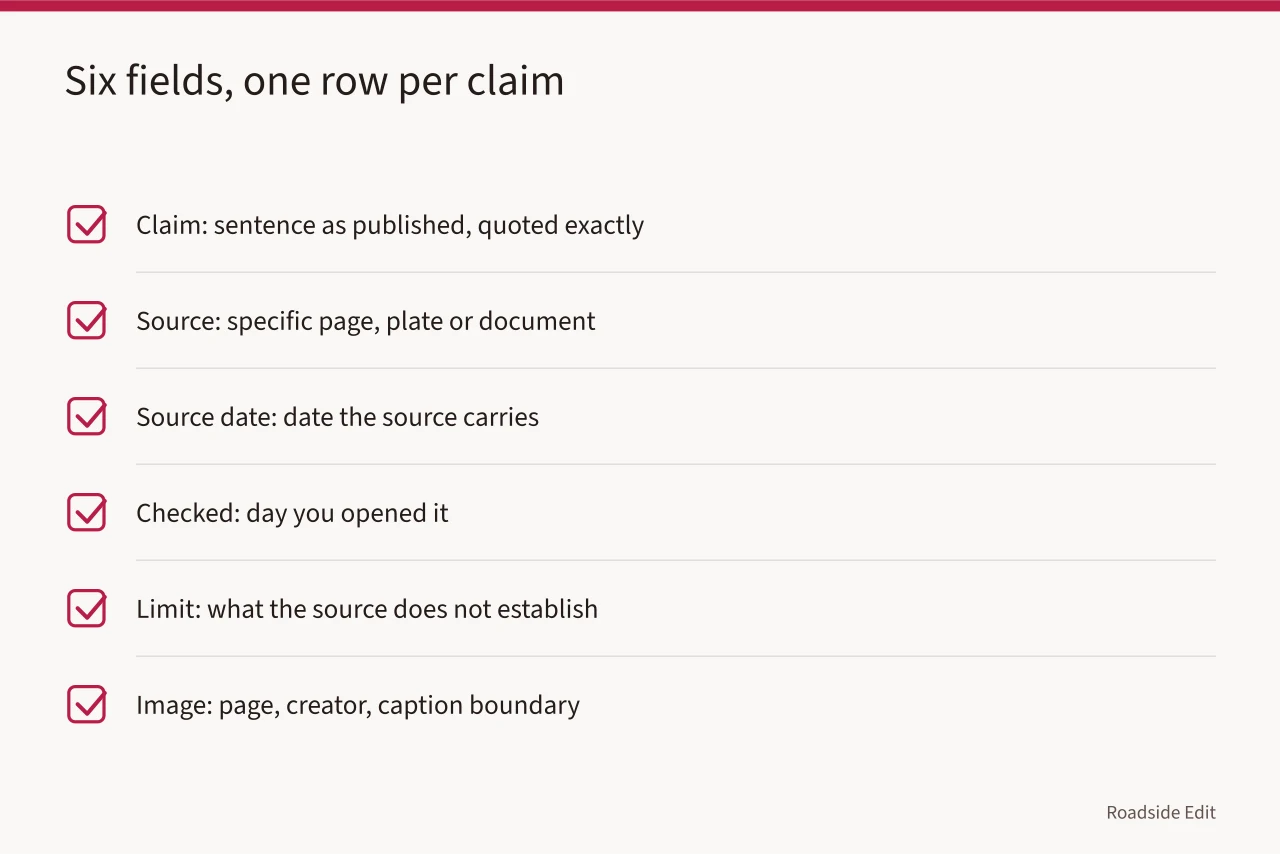
One row per claim. Six fields, no more, or the table stops being read.
A worked example: the Aztec Motel sign
Say you publish: "The Aztec Motel sign on this stretch of Route 66 dates to the 1950s." The row reads:
- Claim: the sentence above, verbatim.
- Source: the National Archives image page, plus any state survey form you actually opened.
- Source date: the date on the photograph, if the catalog record gives one.
- Checked: today's date.
- Limit: a photograph dates the photograph. It does not date the sign, the pole, or the building.
- Image: the NARA page, the photographer or collection label, and where the caption stops.
That limit field is the whole point. Without it, the next writer reads your sentence as a construction date and repeats it in a corridor survey.
The correction order
When better evidence arrives, work in this order and stop when the claim is true again.
- Quote the original sentence into the record before you touch the article.
- Save the page that supported it, with the date you first checked it.
- Add the new source and write one line naming what it changes.
- Edit only the claims that depend on the changed fact. A sign date and a property identification are separate claims and rarely move together.
- Re-read the caption and the metadata line for the same error, since both usually inherit it.
Photographs are records, not illustrations
An image credit line is not evidence. Keep the source page, the creator or collection label, the date, the caption boundary and the crop you published.
National Archives guidance for digital photographic records asks for unique identifiers, descriptive information and captions that let a user retrieve the photograph. Read National Archives guidance for digital photo records. The same fields keep your caption tied to something checkable.
Never treat a file name as evidence. File names travel without context and get renamed in a CMS. Use the page the image came from, write the caption from what that page establishes, and note the date you checked it.
Add, do not overwrite
New evidence earns a dated entry in the record. It does not erase the path to the old wording. NPS project-completion guidance calls for documenting work, discoveries and scope changes. Review NPS project-completion record guidance.
This pays off on small fixes. A corrected photograph date changes a caption and leaves the article alone. A new survey form may change one sentence about a canopy soffit and nothing else. Because each claim sits in its own row, you edit the row and the sentence it names.
Common questions
Do I need to save every source I open?
Save the pages that support a published claim or an image credit. A row with no source is a sentence you cannot defend, and it is the first thing a landmarks commission will ask about.
What if the source page changes or disappears?
Record the date you checked it and keep the earlier note. Revise the article only when a current source supports different wording, and say so in the record.
Is this only for serious errors?
No. Caption, date and attribution slips are the ones that spread into later corridor surveys, where nobody can trace them back.