Guides
Part of Roadside architecture mistakes: a claim card method before you publish
Before you publish: how to catch roadside architecture mistake warning signs
Roadside architecture mistake warning signs for 2027 help editors spot loose treatment language, unsupported history, and misleading source labels before publishing.
The fastest way to improve a roadside article is to flag language that looks certain but has no matching record. Watch for treatment words, condition labels, historical claims, and captions that say more than their sources do.
What to take away
- Watch for verbs that quietly prescribe work.
- A formal treatment term has a defined scope and should not be used as decoration.
- Remove status labels that rely only on appearance.
- Make every caption narrower than the story it illustrates.
Flag treatment words first
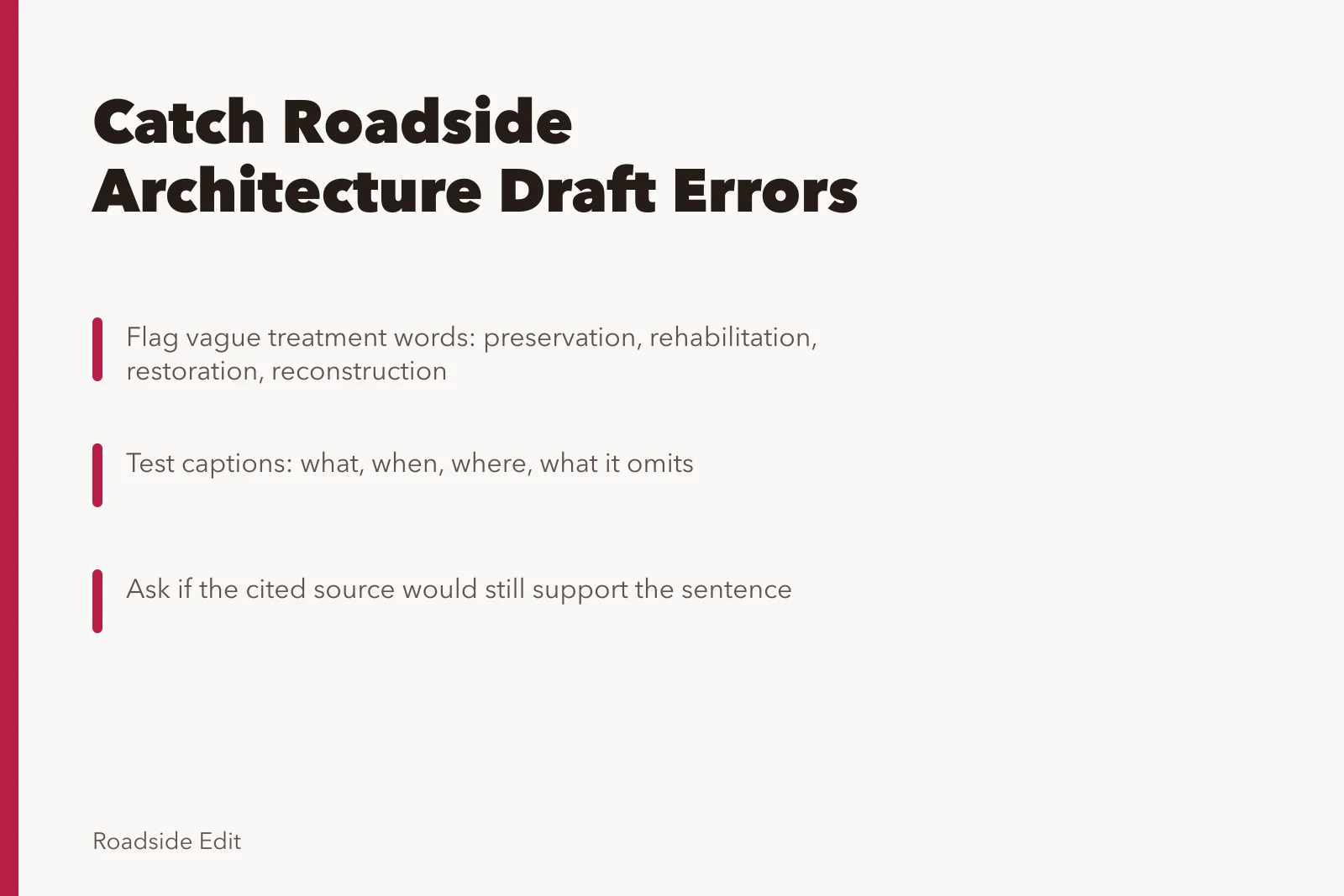
The National Park Service's treatment standards have a documented history and defined vocabulary. See the NPS history of treatment standards. That makes vague uses of words such as preservation, rehabilitation, restoration, and reconstruction risky in general-interest copy. A writer should use a term only when the source and context support it.
The treatment words also have different meanings. NPS describes rehabilitation as making compatible use possible through repair, alterations, and additions while retaining identified values. Read the NPS rehabilitation treatment standard. If a project record does not use that term, do not let a fresh paint job or a new tenant supply it.
| Warning sign | Why it is risky | Editorial response |
|---|
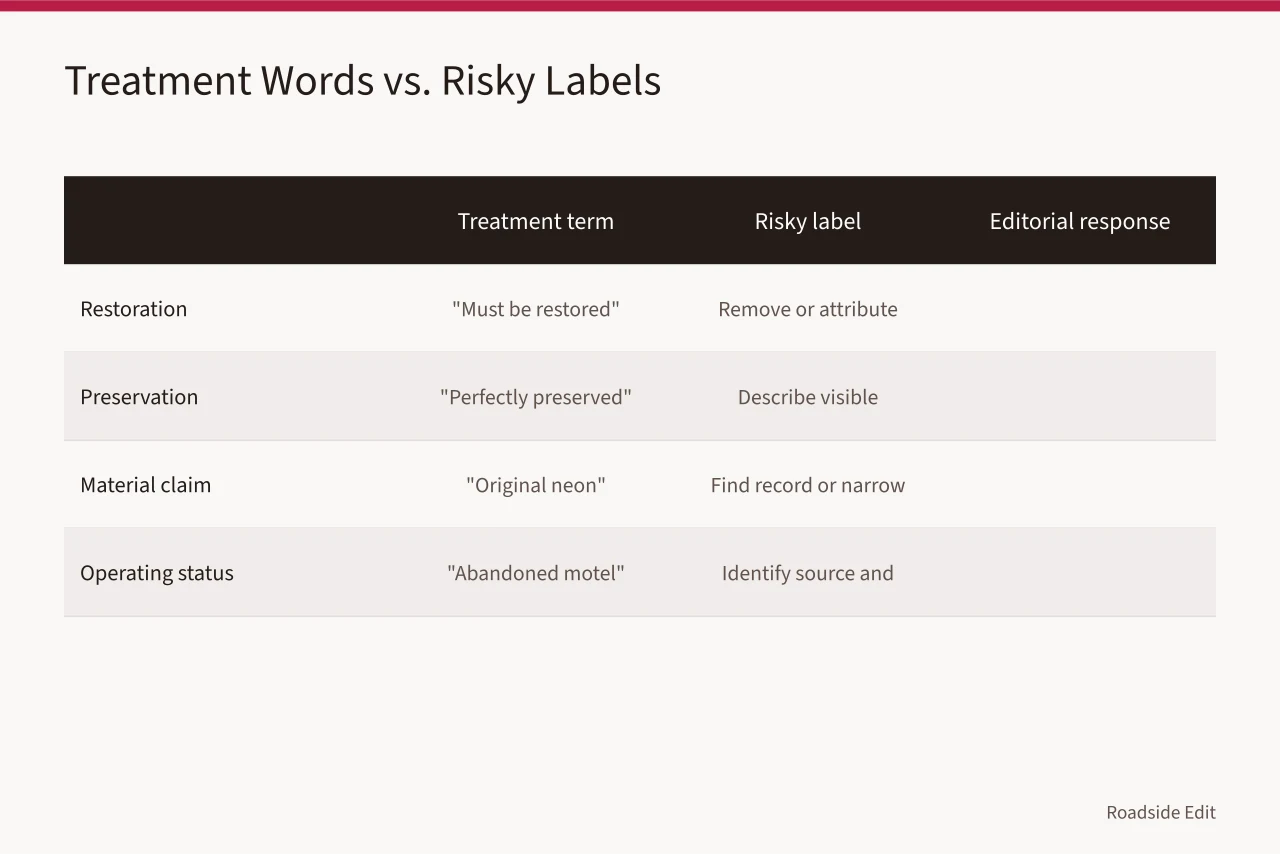
Read for hidden conclusions
Search a draft for words such as must, needs, failed, unsafe, original, abandoned, neglected, historic, restored, and saved. They are not forbidden, but each can hide a conclusion. Put a source beside the sentence or replace it with a direct observation.
- Does the sentence identify who made the finding?
- Does the source cover this property rather than a nearby place?
- Does the date fit the tense of the sentence?
- Is a photograph being asked to prove a fact outside its frame?
- Does the article say what the record cannot establish?
Test captions against the source
Every caption should answer four questions: what is shown, when it was recorded, where the viewpoint was, and what it does not show. NPS documentation standards call for reliable sources and stated limitations that permit independent verification. See the NPS documentation quality standard. A caption cannot carry more certainty than its source.
This matters when a historic image has a strong label. A caption from a past date may establish how an organization described a place then. It does not establish present ownership, current business status, safety, or the condition of features outside the frame. State the image date and attribute the label when it is relevant.
Use a final source question
The Library of Congress primary-source guide asks readers to examine a source before drawing conclusions. Use the Library of Congress primary-source analysis guide. Before publishing, ask one more question: if a reader opened this source, would the sentence beside it still be fair? If the answer is no, revise the sentence or remove it.
| Draft issue | Final edit |
|---|---|
| The source is undated | Avoid a current-tense claim. |
| The image shows only one side | Identify the viewpoint and leave other sides unclaimed. |
| A press release uses a broad term | Attribute the wording and report the stated scope. |
| The caption names a past status | Keep the claim tied to that date. |
Run this review after headlines, captions, metadata, and social copy are drafted. An article can become inaccurate when a short promotional line drops the date, source, or limitation that made the body copy fair. Keep the same narrow language wherever the article appears.
That consistency prevents a headline from creating a false claim.
Common questions
Is it wrong to use the word restoration in an article title?
Not necessarily. The article should make clear whether it is reporting a documented project, describing a source's language, or using the word only as a general topic.
Can an editor call a place abandoned from a historic photo caption?
Only if the caption supports that label for the stated date. Do not turn it into a claim about current operations.
What should replace a broad condition label?
Use a dated, visible observation and state its limits. That gives readers information without an unsupported judgment.