Guides
Roadside architecture mistakes: a claim card method before you publish
Roadside architecture mistakes to avoid in 2027, with a practical evidence method for documenting places, claims, images, and unknowns before publishing.
An interesting roadside-architecture article can still mislead a reader. The common problem is not a spelling error or an imperfect photo. It is a sentence that turns a visible detail into a history, a history into a condition assessment, or a condition assessment into a recommendation. Those are separate kinds of information and need different records.
This guide is for writers, editors, local-history volunteers, and small publishers. It covers motels, diners, service stations, signs, motor courts, roadside cabins, and commercial strips in the United States.
It is an editorial method, not preservation advice for one property. Readers should leave knowing what the evidence says, what it does not say, and what record is needed next.
What to take away
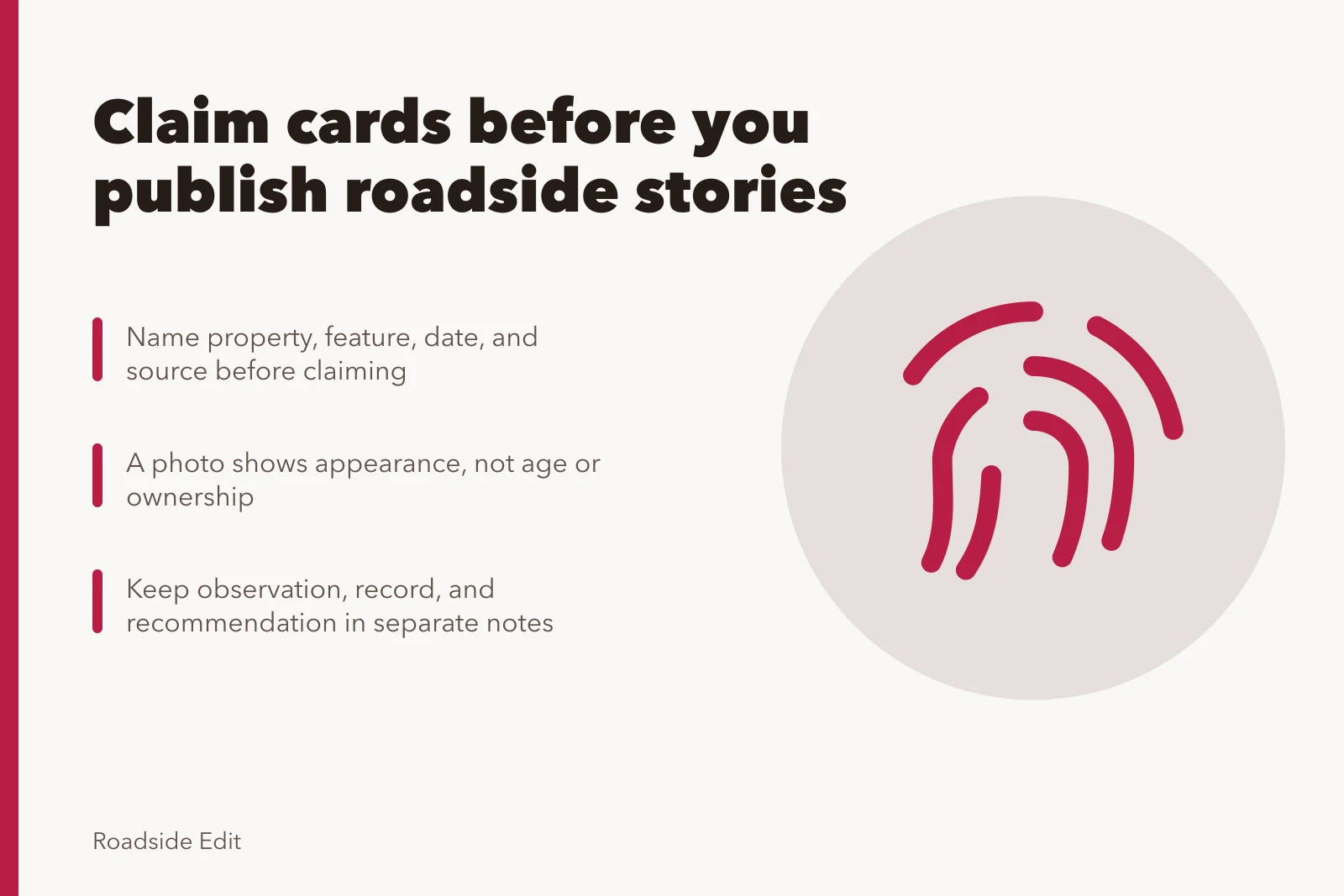
- Name the property, feature, date, and source before making a factual claim.
- A photograph records an appearance. It does not prove age, ownership, cause, safety, or legal status.
- Keep an observation, a historical record, and a work recommendation in different notes.
- State uncertainty directly instead of filling a gap with a familiar roadside story.
- Preserve the evidence trail so a later editor can correct the article without starting over.
The mistake behind most weak roadside stories
Roadside places are easy to romanticize. A faded sign, an empty motor court, or an older canopy can suggest a complete narrative in a single frame. That suggestion is useful as a reporting lead. It is not enough to support a conclusion.
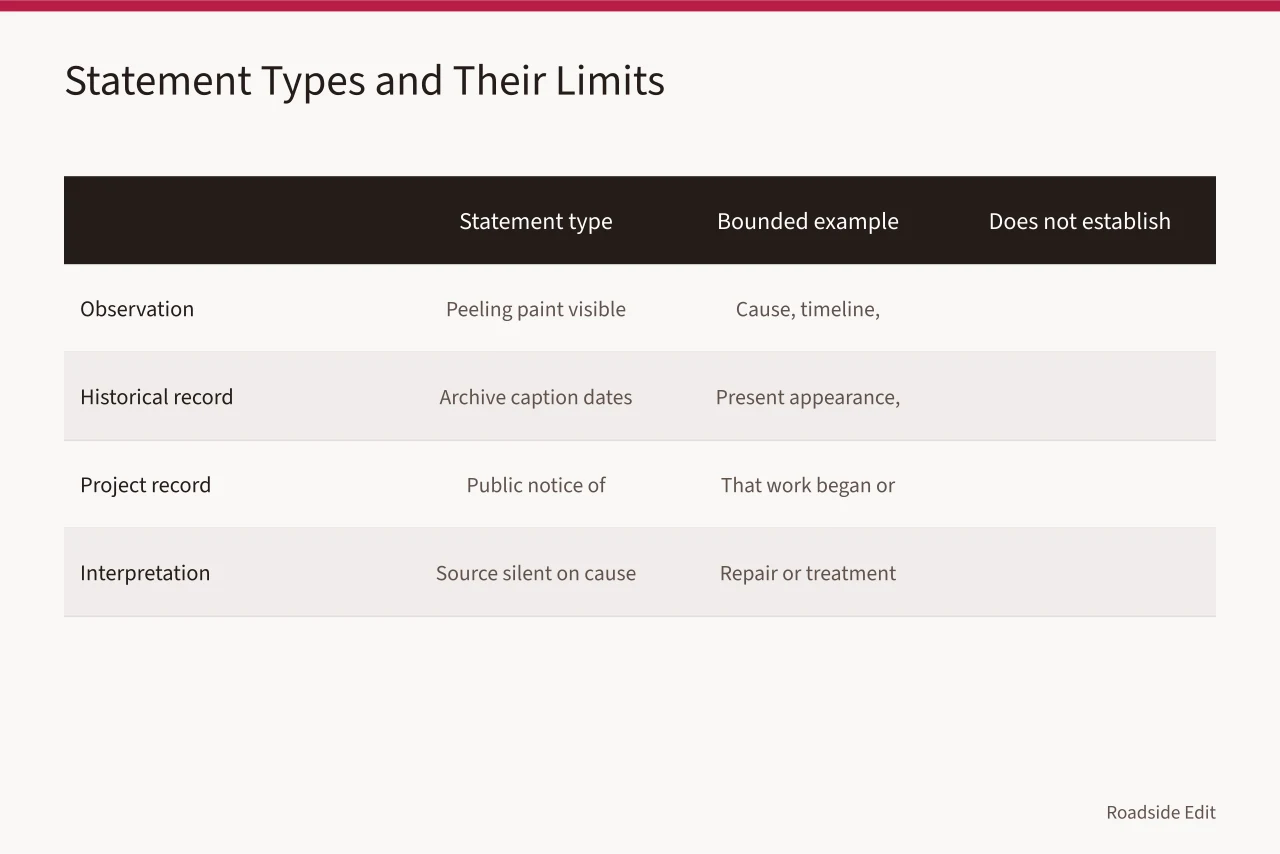
Consider the difference among these statements:
| Statement type | Bounded example | What it does not establish |
|---|---|---|
| Observation | "Peeling paint is visible on the sign face in a photo dated April 2029." | Cause, timeline, material, or safety |
| Historical record | "A cited archive caption dates the image to 1958." | Present-day appearance or ownership |
| Project record | "A public notice describes a planned exterior project." | That the project began, finished, or applies elsewhere |
| Interpretation | "The source does not identify why the finish changed." | A repair or treatment decision |
The discipline is simple: match the sentence to the record. A visible photograph can support a visual description. An archive record may support its own date or caption. A project document may support the stated scope. None of those sources automatically supports a diagnosis or a promise about future work.
NPS documentation standards require reliable sources, stated limitations, and enough information for independent verification. See the NPS documentation quality standard. Use that requirement as an editorial filter: if a reader cannot tell what a source establishes, the sentence is too broad.
Start with a claim card, not a draft
Before writing, make a short claim card for every fact that could be challenged. It takes a few minutes and prevents an article from collecting unsupported sentences during later edits.
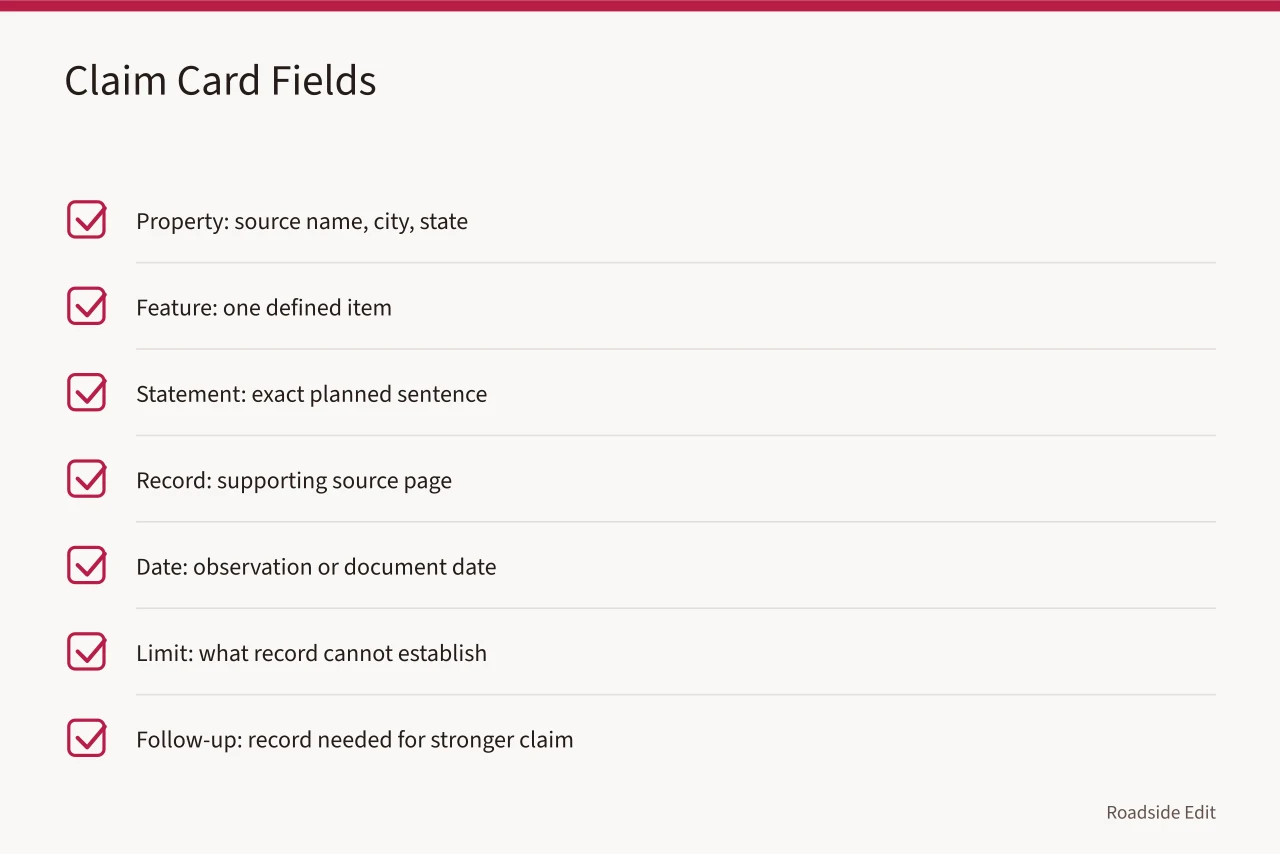
| Claim-card field | What to write |
|---|---|
| Property | The name used by the cited source, plus city and state |
| Feature | One defined item, such as a blade sign, entry canopy, wall, or parking court |
| Statement | The exact sentence planned for publication |
| Record | The source page, document, or dated image that supports it |
| Date | The date of the observation or document |
| Limit | What the record cannot establish |
| Follow-up | The record needed before making a stronger claim |
For example, "The photo shows a freestanding sign beside the east driveway" is a small, testable claim.
"The iconic sign has deteriorated because of decades of neglect" contains at least four claims: the sign is iconic, it has deteriorated, the change happened over decades, and neglect caused it.
The second sentence is much harder to support. Break it apart or remove it.
Do not mistake removal for a blank page
When historic fabric must be removed, documentation becomes especially important. The National Park Service advises recording evidence before, during, and after removal so later work can understand what was present and what changed. Read NPS Preservation Brief 35 on architectural investigation. That guidance supports a documentation principle. It does not determine what work any particular roadside property needs.
In editorial terms, an article should not act as if a removed detail never existed. Note the source date, viewpoint, feature location, and whether the image is a current observation or a historical record.
If a source says an element was replaced, do not assume the replacement is visible today. If a photo shows a removed element, do not assume the photo explains why it was removed.
Keep four evidence lanes apart
A productive research folder has four lanes. The lanes can be spreadsheet columns, notes, or labels in a content system. What matters is that they do not collapse into one narrative too early.
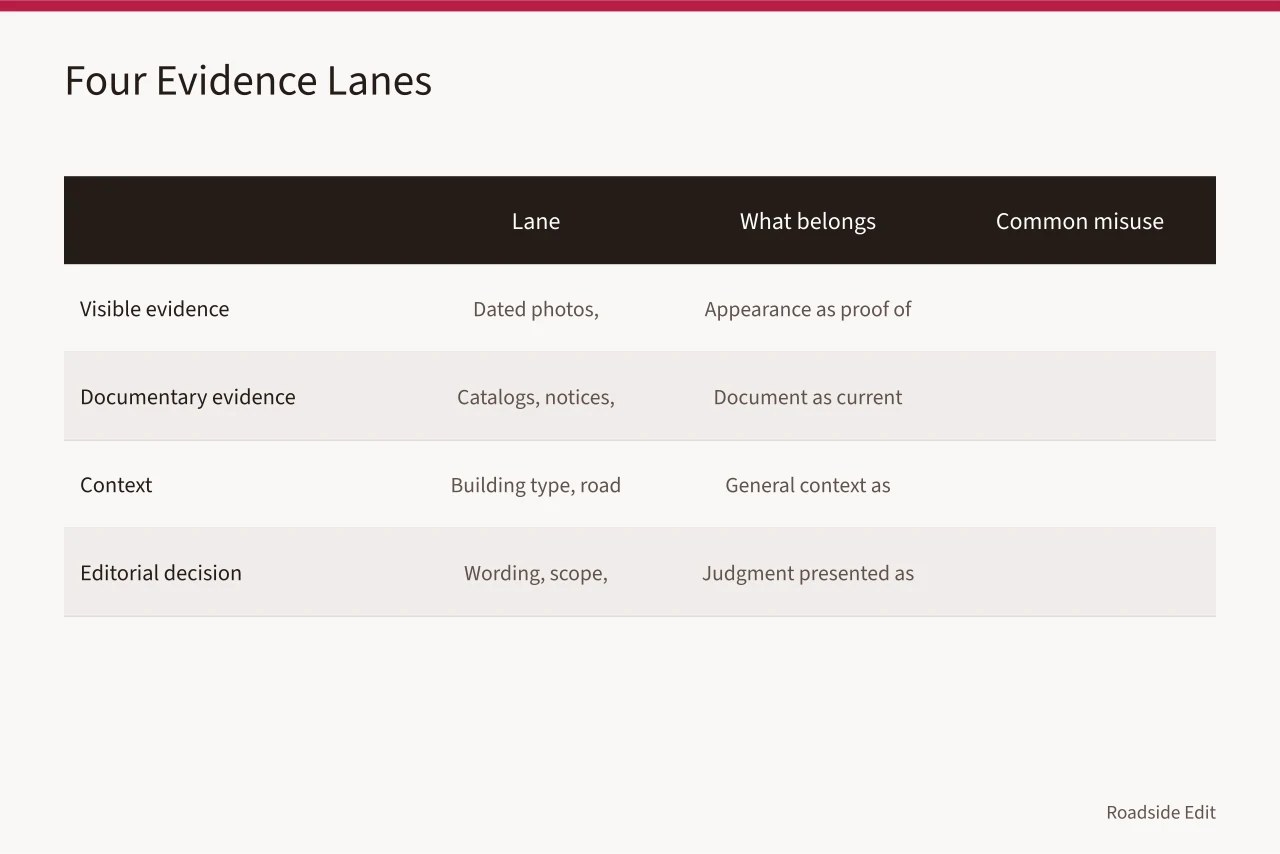
| Lane | What belongs there | Common misuse |
|---|---|---|
| Visible evidence | Dated photographs and first-hand notes | Treating appearance as proof of cause |
| Documentary evidence | Archive catalogs, public notices, permits, and reports | Treating a document as a current inspection |
| Context | A source on a building type, road history, or broad practice | Applying general context as a property finding |
| Editorial decision | The article's wording, scope, and declared limits | Presenting an editorial judgment as a source fact |
The lanes let a writer say something useful without pretending to know more than the file shows. They also make a correction easier. If an archive date changes, the editor can update the documentary lane without rewriting an observation as though it happened on a different day.
Avoid the five seductive shortcuts
1. Calling a place abandoned from one image
An image may show a closed door, a vacant lot, or an empty parking area. It does not confirm business status, ownership, access rights, or future plans. Use the narrow description that the image can support. If a reliable public record identifies an operating status, cite that record and date it.
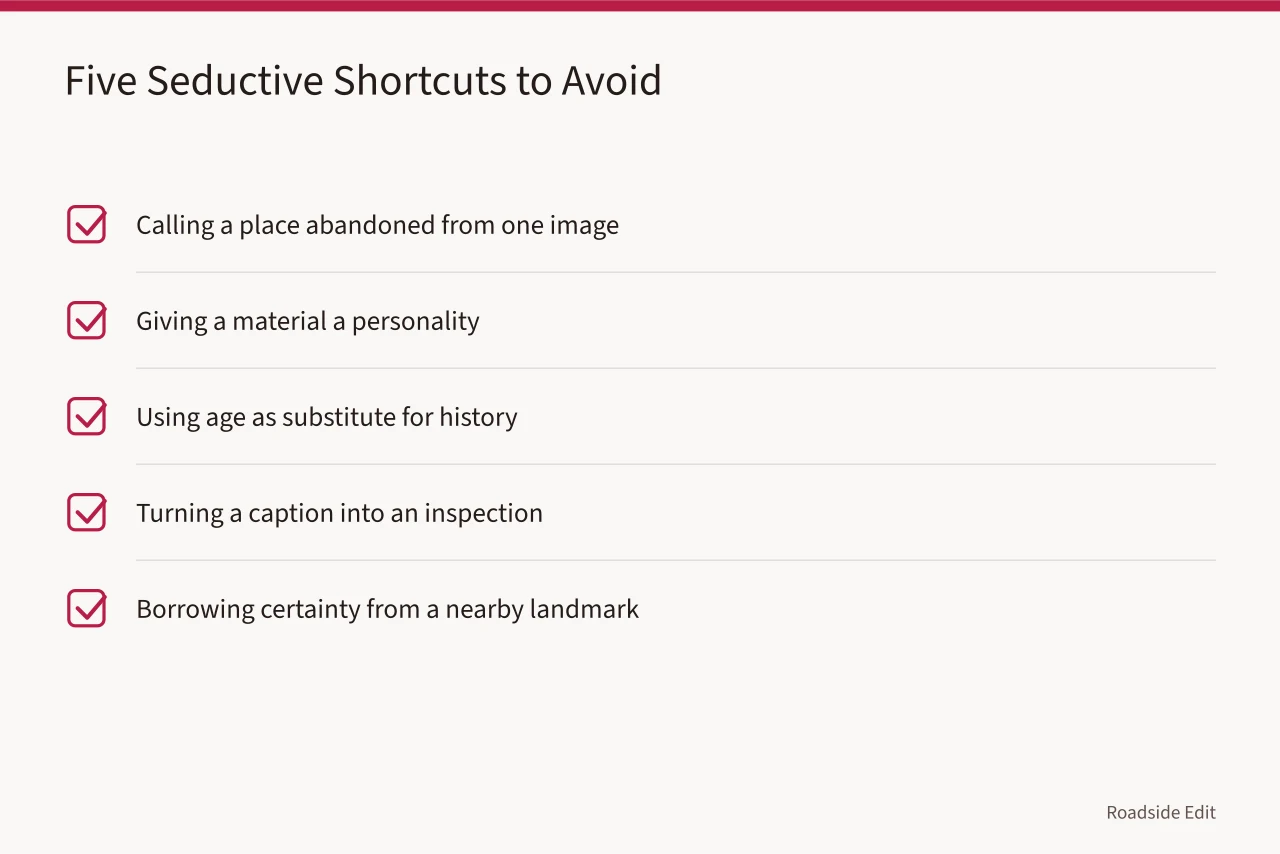
2. Giving a material a personality
Phrases such as "the stubborn concrete" or "the fragile neon" can make a draft feel lively, but they blur observation and judgment. Describe the feature, the condition visible in the record, and the unknown. Save evaluation for a source that actually makes it.
3. Using age as a substitute for history
Old-looking construction is not a verified construction date. A building may have later additions, new cladding, relocated signs, or a reused business name. Use a date only when the cited record supplies it, and make clear whether it refers to construction, a photograph, a directory entry, or a later project.
4. Turning a caption into an inspection
Captions are valuable, especially when they identify a place and date. They are not condition reports. A caption that says "motel on Route 66" does not establish structural soundness, historical designation, or commercial status.
5. Borrowing certainty from a nearby landmark
One documented landmark does not authenticate every nearby business. Avoid writing that a property is part of a district, eligible for a listing, or covered by a program unless the appropriate record says so. Place names and road names are not legal designations.
Use an editorial stop rule
A stop rule tells the writer when a claim is not ready. It is more useful than a vague warning to "research more." Apply the rule whenever a draft crosses from description into inference.
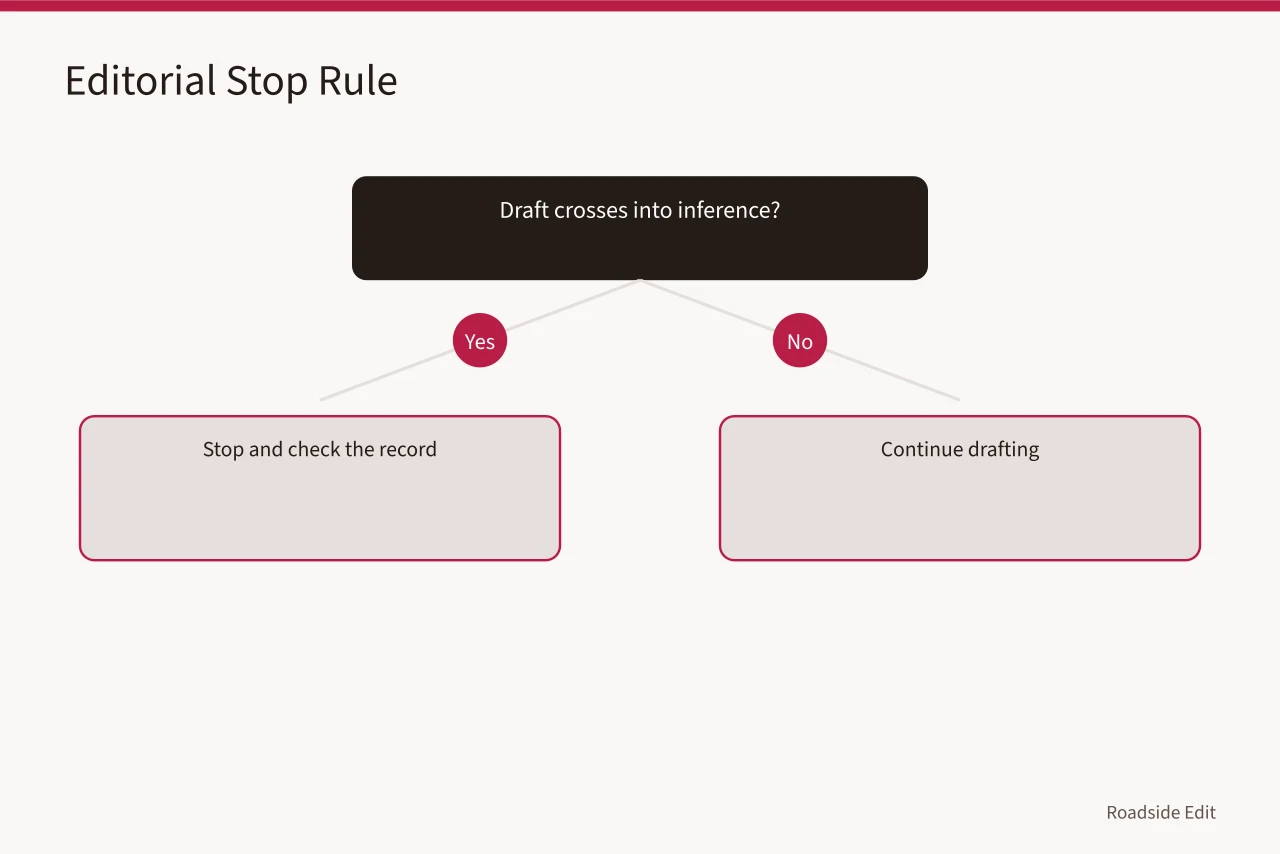
| If the draft says... | Stop and ask... | Safe next step |
|---|---|---|
| "This damage was caused by..." | Does a qualified record identify a cause? | Describe only what is visible |
| "The building dates to..." | Which source names that date and what does it date? | Attribute the record precisely |
| "The owner plans to..." | Is there a current, public, property-specific record? | State that plans are unknown if needed |
| "This should be restored..." | Does the article have a property assessment and authority to advise? | Remove the recommendation |
| "It is historic..." | Is there a stated designation or documented significance? | Describe the source's language instead |
The stop rule should also apply to catchy labels. A phrase such as "lost Americana" may be a tone choice, but it can hide a claim that a place is no longer active or valued. Prefer language a record can carry.
Treatment labels require the same care. The NPS describes rehabilitation as a defined approach that permits compatible use through repair, alterations, and additions while retaining identified values. Read the NPS rehabilitation treatment standard. A writer should not apply that term to a local project merely because a building has a new facade or a new tenant.
Treat images as evidence with boundaries
An image can anchor an article when it is used honestly. Record where it came from, what it shows, when it was made if that information is available, and whether it is illustrative or property-specific. A photo may need a caption that says "illustrative roadside motel" rather than naming it as proof of a story about another site.
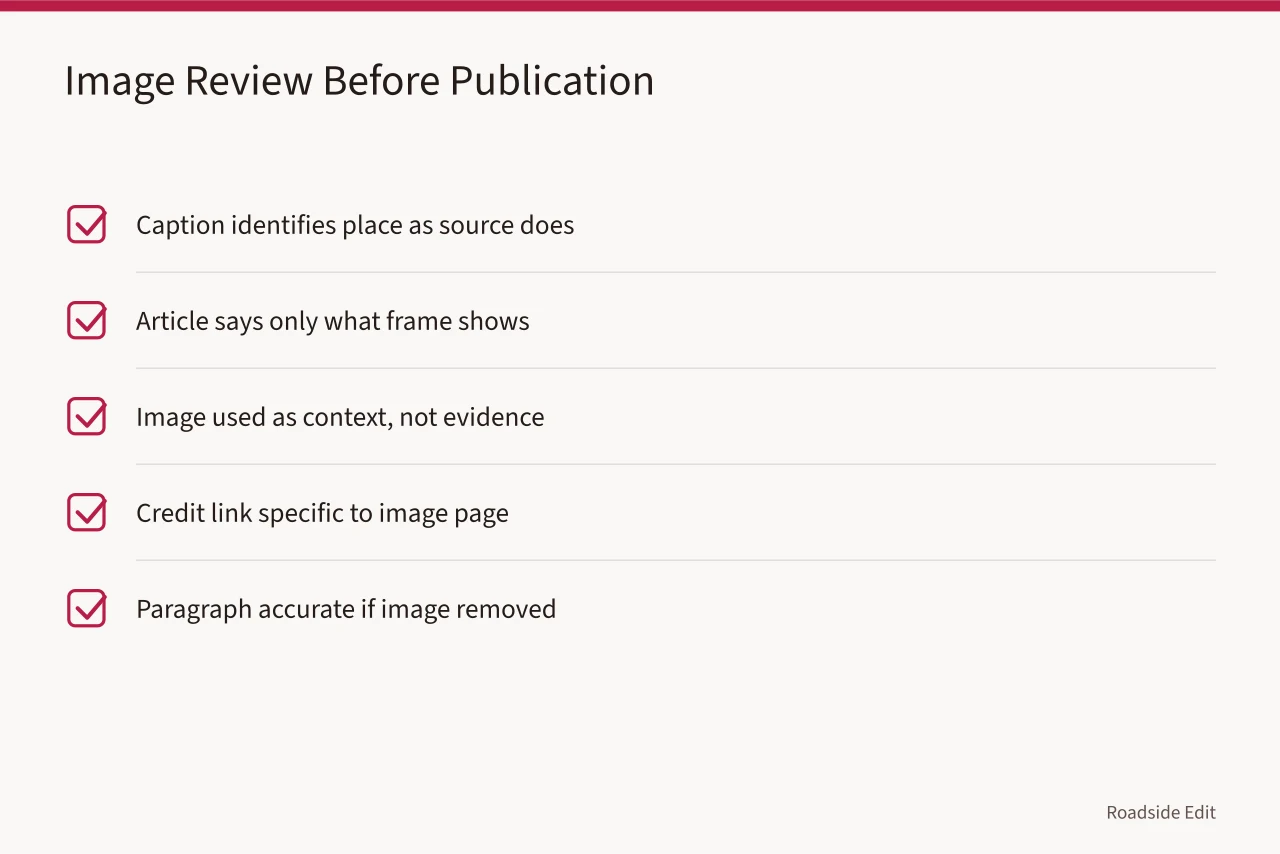
Use this image review before publication:
- Does the caption identify the place exactly as the image source does?
- Does the article say only what the image's frame shows?
- Is the image being used as context rather than evidence of a different property?
- Is the credit link specific to the image page?
- Would the paragraph still be accurate if the image were removed?
The last question catches an important error. A paragraph that depends on a dramatic photo to imply a claim should be rewritten. Readers deserve the written evidence, not a visual nudge toward an unsupported conclusion.
The National Archives recommends unique identifiers, captions, and descriptive metadata for digital photographic records. Review National Archives digital photo records guidance. A newsroom file does not need to become a federal archive, but it should preserve the source page and the context that makes an image usable.
Write useful uncertainty
Uncertainty is not empty language. It can tell readers exactly what the research has and has not established. A strong article might say, "The available image shows paint loss on the sign face, but the source does not identify its cause or date." That sentence is more useful than a decorative guess.
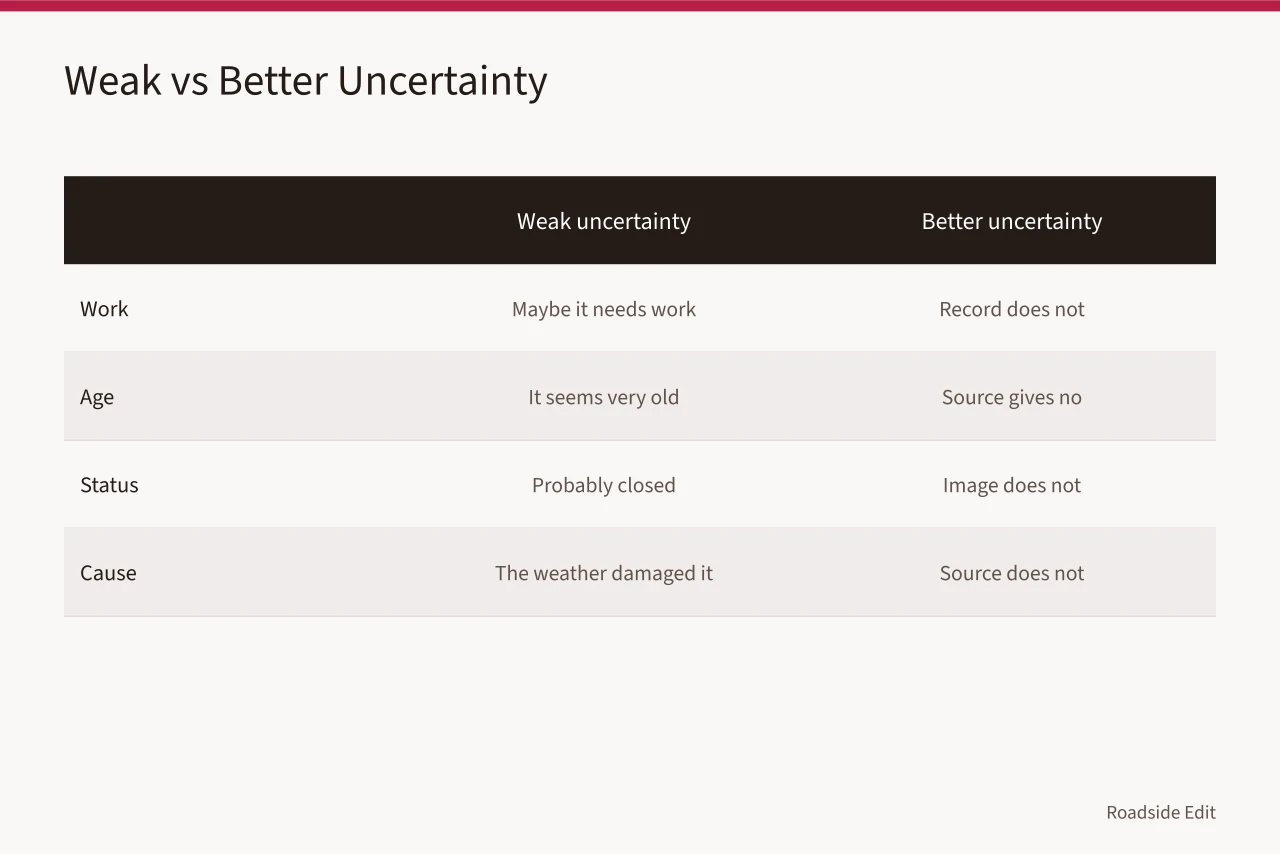
| Weak uncertainty | Better uncertainty |
|---|---|
| "Maybe it needs work." | "The available record does not describe a current work scope." |
| "It seems very old." | "The consulted source does not provide a construction date." |
| "Probably closed." | "The image does not establish current operating status." |
| "The weather damaged it." | "The source does not identify a cause for the visible condition." |
Specific limits also earn trust with prospective local partners and advertisers. A business does not want to see its property described as closed, unsafe, or neglected because a writer guessed from an old photo. A careful article can still be vivid. It simply keeps its factual footing.
Build a correction trail
Every article should leave behind enough information for a later editor to revisit it. Keep a research note with the publication date, source titles, exact URLs, source dates, image page, and statements the sources support. When a new record arrives, correct the narrow sentence affected instead of silently revising unrelated history.
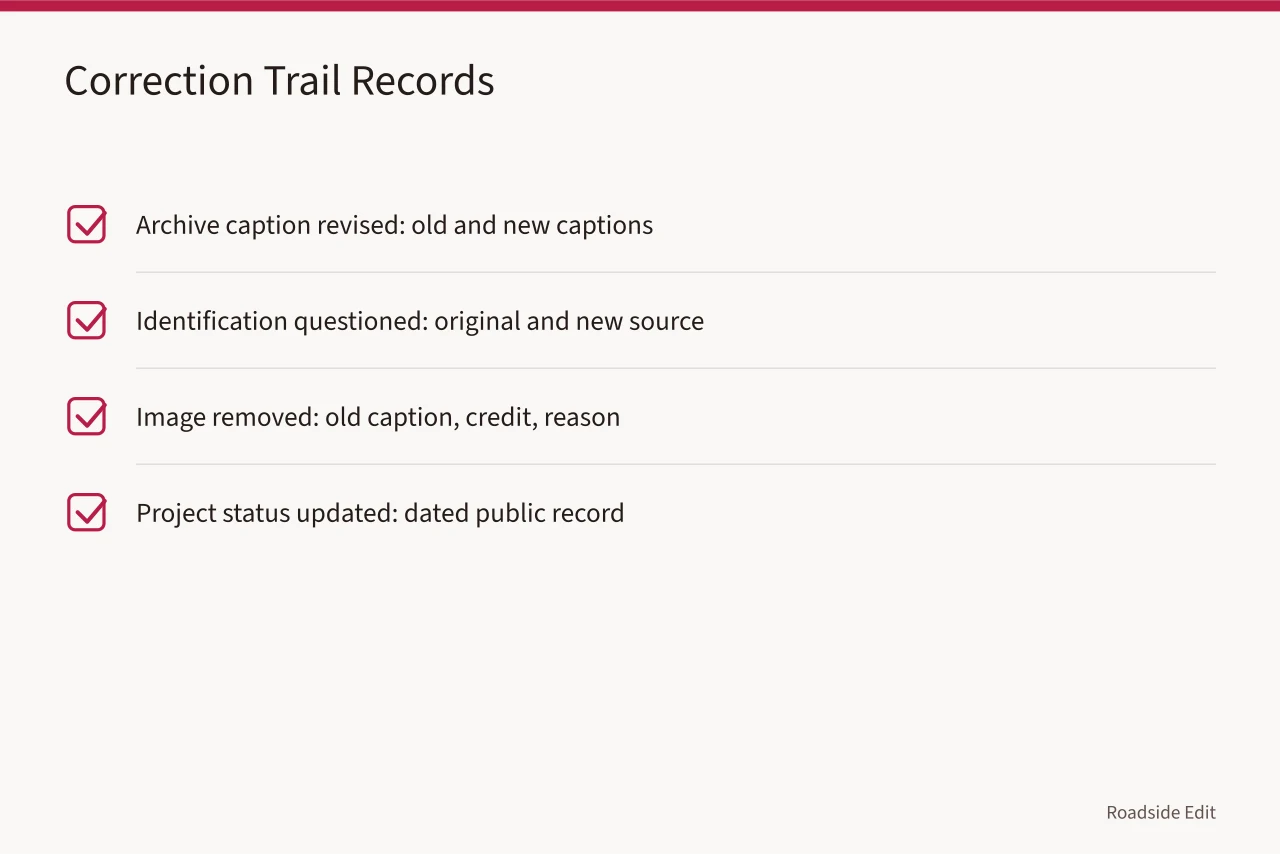
| Correction event | What to retain |
|---|---|
| Archive caption revised | Previous and current captions, page date, and changed article wording |
| Property identification questioned | The original source, the new source, and the unresolved point |
| Image removed | The old caption, credit, replacement decision, and reason |
| Project status updated | The dated public record and the exact scope it describes |
This trail protects both readers and editors. It avoids a cycle in which a vivid but weak assertion is copied into future articles because no one can see where it began.
A practical pre-publication review
Read the finished article one sentence at a time, and mark each sentence as observation, record, context, interpretation, or editorial note. If a sentence has no category, it may be filler. If two, split it.
Then check that the source attached to a factual claim is specific and that the article does not give it a broader job than it can do.
The goal is not a sterile article. It is a dependable one. A roadside story becomes more interesting when readers can see the difference between a documented detail, a useful question, and an honest unknown.
Common questions
Can one photo prove that a roadside building is abandoned?
No. It can support a description of what appears within the frame on the stated date. Operating status requires a separate, current record.
Should an article recommend a repair method?
Not without property-specific evidence and appropriate professional judgment. This guide is for reporting and editorial controls, not treatment selection.
What should be corrected first when new information arrives?
Correct the exact sentence affected, retain the source trail, and update any caption or date that depends on the changed record.
In this guide
- Roadside architecture mistakes checklist before your preservation article goes liveRoadside architecture mistakes checklist for 2027 helps writers verify materials, sources, photo limits, and claims before a preservation article goes live.
- Roadside architecture mistake questions to ask before you call it preservationRoadside architecture mistake questions for 2027 show what to ask before calling a survey, scan, photo set, or archive record a preservation decision.
- Roadside architecture mistake budget notes: put unknowns before numbersRoadside architecture mistake budget notes for 2027 help editors avoid false cost certainty when the scope, materials, records, and conditions remain unknown.
- Before you publish: how to catch roadside architecture mistake warning signsRoadside architecture mistake warning signs for 2027 help editors spot loose treatment language, unsupported history, and misleading source labels before publishing.
- How to keep roadside architecture mistake records that lastA historic structure report keeps survey, sources and limits in one file. Editors can borrow that shape to log claims, dates and corrections.