Guides
Part of Roadside architecture mistakes: a claim card method before you publish
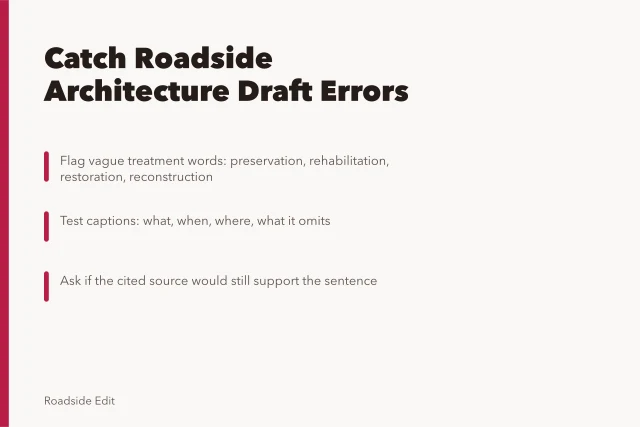
Roadside architecture mistake questions to ask before you call it preservation
Roadside architecture mistake questions for 2027 show what to ask before calling a survey, scan, photo set, or archive record a preservation decision.
New scans, drone images, photo sets, and archive uploads can make a roadside article look well researched. They are valuable records, but a record is not automatically a decision about preservation work. Ask these questions before treating collected information as proof that a project is needed, approved, or complete.
What to take away
- A survey or scan collects information; it does not choose a treatment.
- Ask what the record covers, when it was made, and what it leaves outside the frame.
- Keep an observation separate from a recommendation.
- Use questions to expose missing evidence before publication.
Ask what was actually collected
The National Park Service explains that laser scanning can collect detailed information about a historic resource, while the collection process itself is not preservation treatment. Read the NPS overview of laser scanning. Use that distinction when writing about any technical record: documentation can be useful without proving what should happen next.
NPS documentation standards require reliable sources and a clear account of their limitations. See the NPS documentation quality standard. A technical image becomes more useful when its file, date, feature, method, and limits travel with it. Without that context, the article should make a narrower claim.
| Question | Why it matters |
|---|
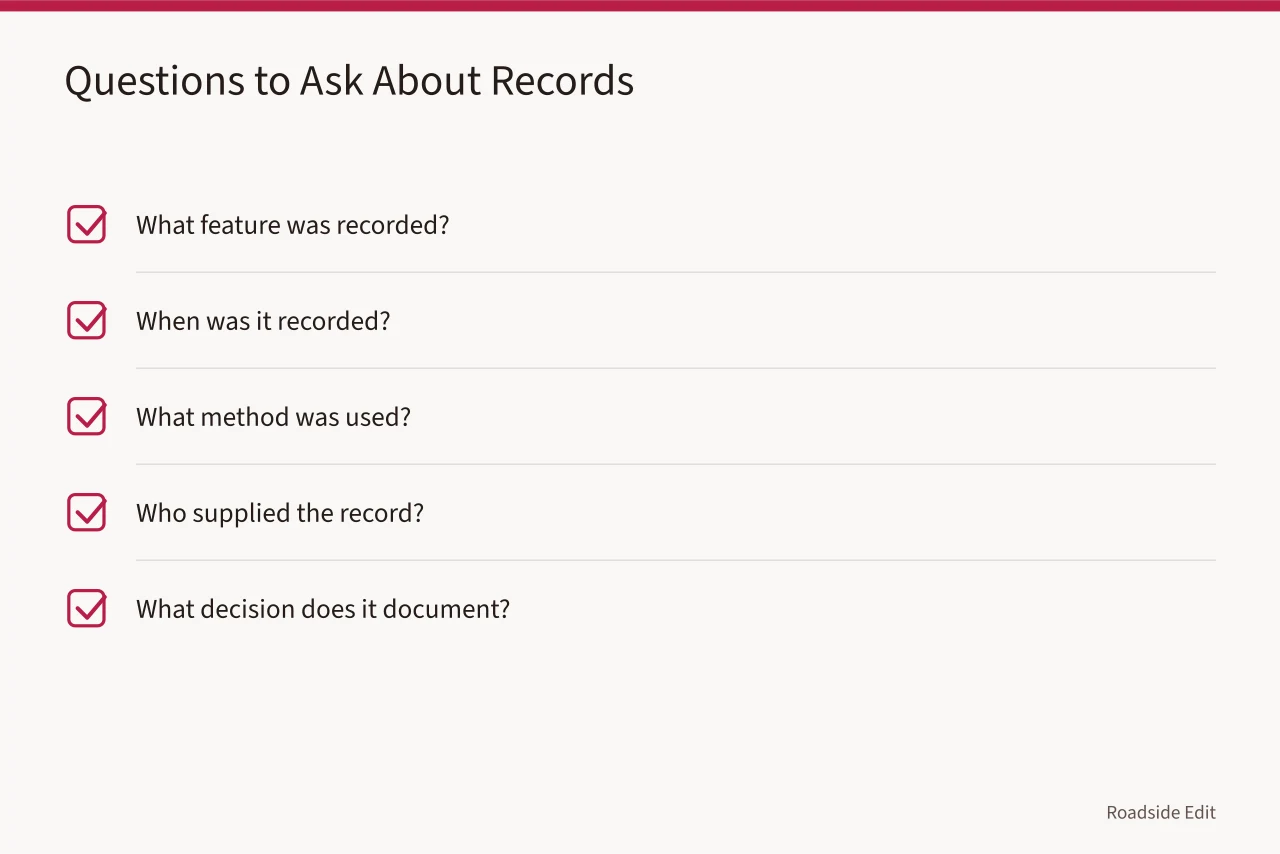
Questions before using a technical image
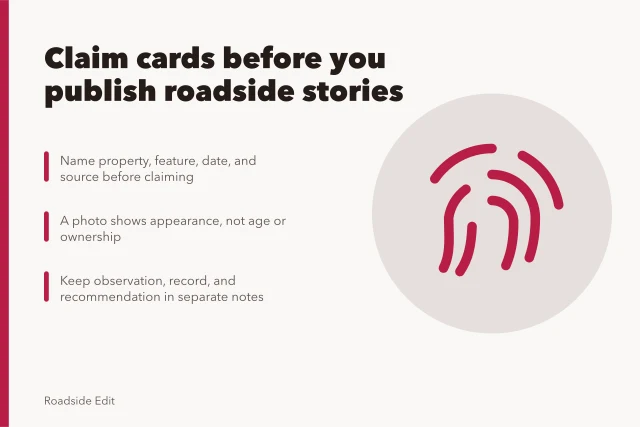
- Does the image identify the property, feature, and capture date?
- Is it a complete view, a crop, a model, or a detail image?
- Does the caption describe observation, measurement, interpretation, or a proposed scope?
- Is the article using the image to imply a cause it does not identify?
- Has anyone confused a survey result with a work recommendation?
| Do not write | Ask instead |
|---|---|
| "The scan proves it needs restoration." | "What does the scan document, and what assessment is still missing?" |
| "The drone image confirms damage." | "What condition is visible, and does the image identify a cause?" |
| "The survey solved the problem." | "What question did the survey answer?" |
Ask whether a decision document exists
A scan, survey, or image set may be part of a project file, but it does not prove a project's approval or completion. Read the NPS project-documentation overview.
The NPS Historic Property Project Documentation tool is meant to help teams connect property information to scope and design decisions. That relationship is the point: information can inform a decision without being the decision itself.
Before writing a treatment statement, look for a dated scope, agency record, owner statement, or project report that actually describes the action. If no document is available, say that the article reviewed a record of the feature rather than a decision about work. Do not let the technical appearance of a scan supply authority it does not have.
Make questions part of the record
The Library of Congress advises users of primary sources to observe, reflect, and question before reaching a conclusion. Use the Library of Congress primary-source analysis guide. In a publication file, the questions should sit beside the source: What does it show? What is outside its frame? What later change could make it outdated?
These prompts are not filler. They are a check against the most common mistake in an image-led article: writing a fuller story than the record permits. Keep unresolved questions in the research log. Put only supported answers in the published copy.
Before publication, add the source date to the article file and compare it with the planned article date. A record can be accurate yet too old to describe current conditions.
Common questions
Is a laser scan a preservation treatment?
No. It is a form of information collection. It may inform later work, but it does not decide or perform that work.
Can a technical image prove the cause of a condition?
Not by itself. The article should describe what the record shows and avoid assigning cause without an appropriate supporting source.
What should a writer do when a record has no date?
State that the date is not available, avoid time-based claims, and seek a dated source if the timing matters.