Reviews
Part of Roadside renovation fundamentals: how to plan with evidence, scope and reuse in mind
Roadside renovation questions to ask before you compare plans
Ask these 2027 roadside renovation questions before describing scope, accessibility, existing conditions, reuse plans, budgets, approvals, or opening claims.
Before a roadside renovation becomes a story, it is a set of unanswered questions. The useful questions are specific: What part of the property is affected? What record supports the statement? Who can confirm the present condition? A good answer can lead to a next step. A vague answer should remain a question, not become a public claim.
What to take away
- Ask about the exact area and work before describing a project as a renovation.
- Keep historical material, current observations, and proposed work in separate notes.
- Treat accessibility, approvals, environmental matters, and operating plans as project-specific questions.
- Identify the source, date, and responsible speaker behind every public update.
Start with the work, not the appearance
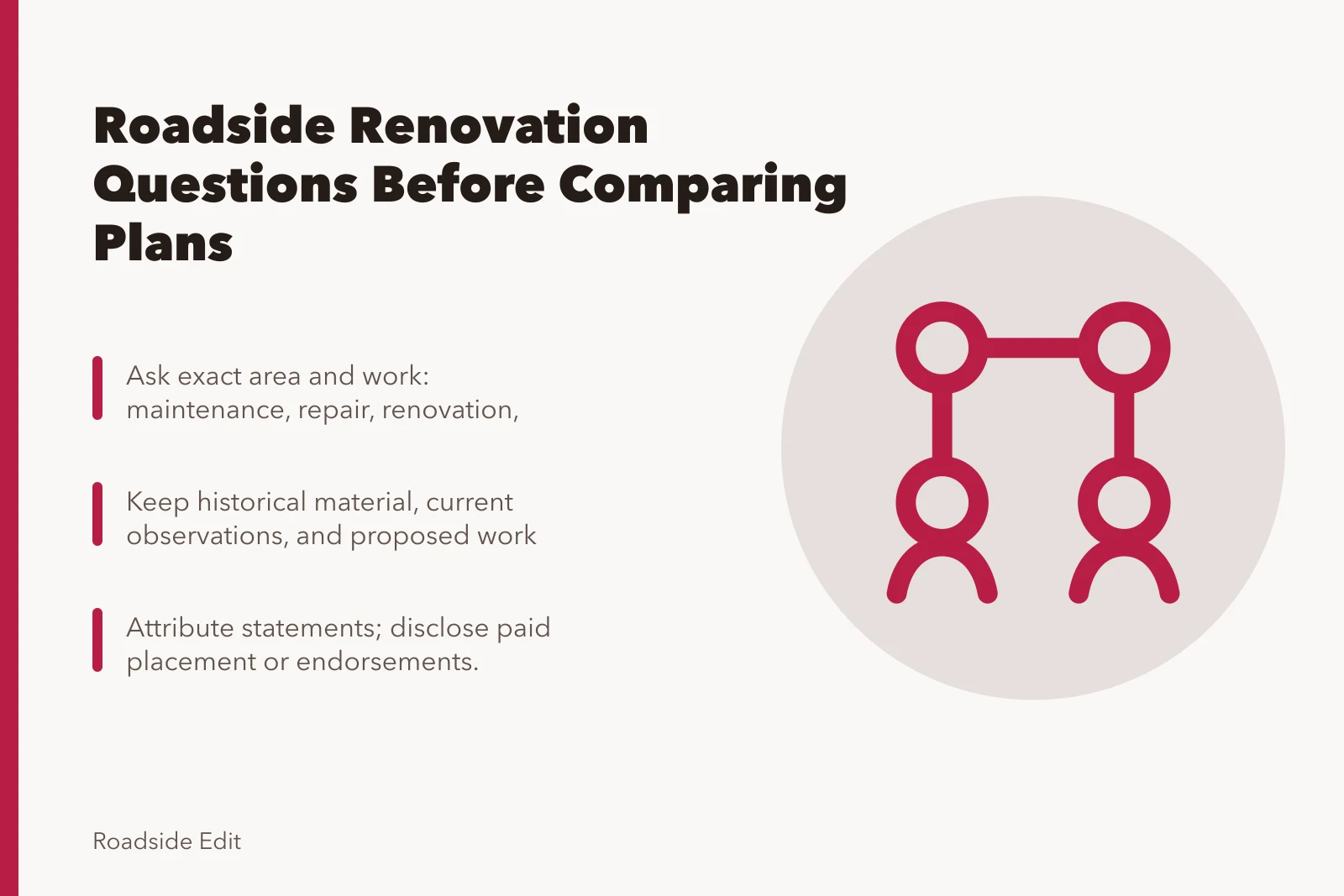
A painted sign, new windows, or a cleaned forecourt can be part of a project. None tells a reader the legal or physical scope. Ask what the team intends to change. Is the work maintenance, repair, renovation, an addition, or only a preliminary concept?
Ask which rooms, exterior features, routes, or utilities fall inside that statement. The answer should name the affected area. It should not suggest the rest of the property has been inspected.
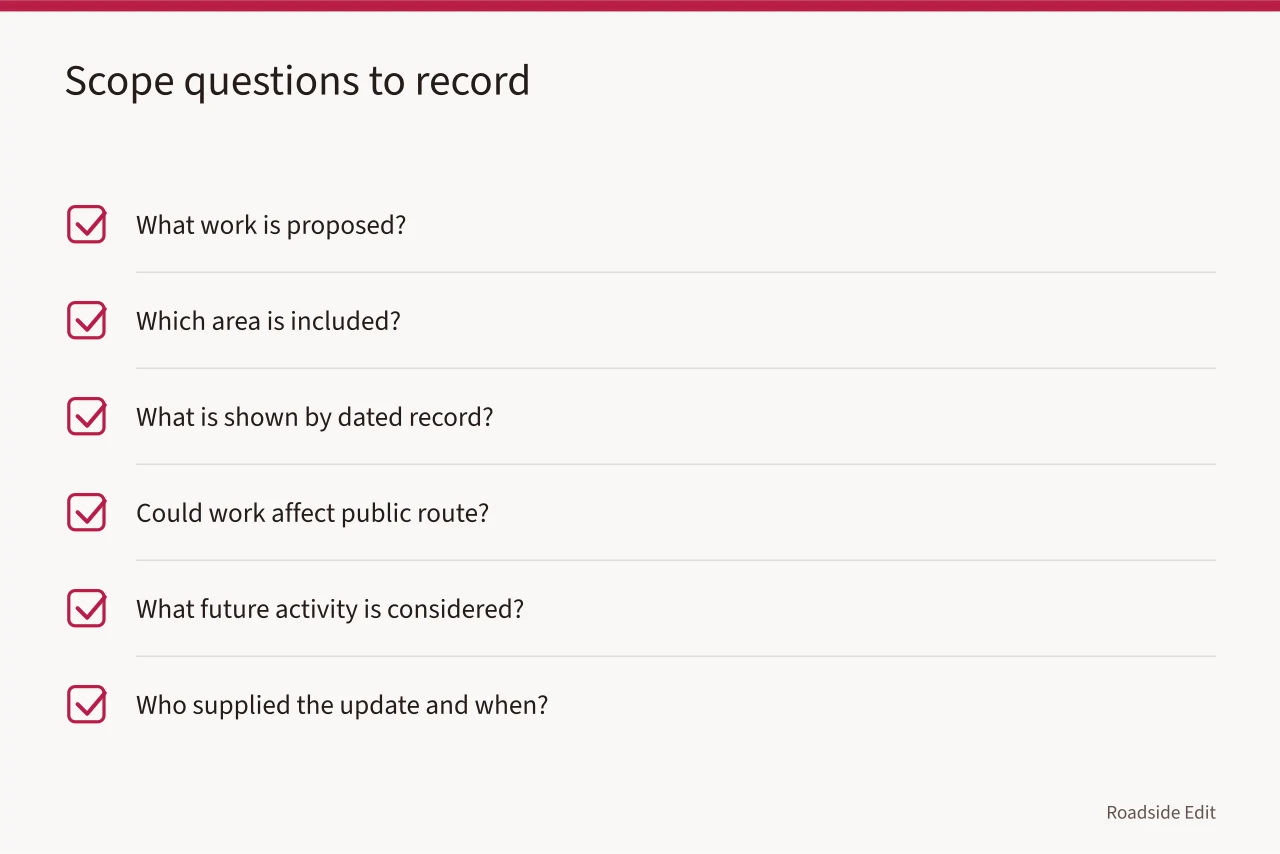
| Topic | Questions worth recording | Do not assume |
|---|---|---|
| Scope | What work is proposed? Which area is included? | That a sitewide renovation is planned |
| Conditions | What is shown by a dated record or authorized visit? | That an old photograph describes the present |
| Access | Could the work affect the public route or an entrance? | That visible improvements settle accessibility |
| Reuse | What future activity is being considered? | That a concept has approvals or an operator |
| Publication | Who supplied the update and when? | That a supplied statement is independent evidence |
The federal accessibility standards explain that an alteration is a change that affects or could affect a facility's usability. They also describe circumstances in which work affecting a primary-function area can bring a path of travel into the discussion. See the Access Board's ADA standards introduction.
That source does not decide any individual project. It does explain why a writer should ask about routes, entrances, restrooms, and the affected use rather than writing that a building is accessible from a photo or a rendering.
Ask what the record can actually prove
The next question is whether each document answers the question at hand, not simply whether records exist. A historic image may show an earlier facade, while a lease may identify a party at one time. A current public notice may identify a hearing or application.
Keep the source date beside the note and state its limit in plain language. "This photograph shows the site in 1978" is a different claim from "the exterior remains unchanged."
Use a small source log for every important statement:
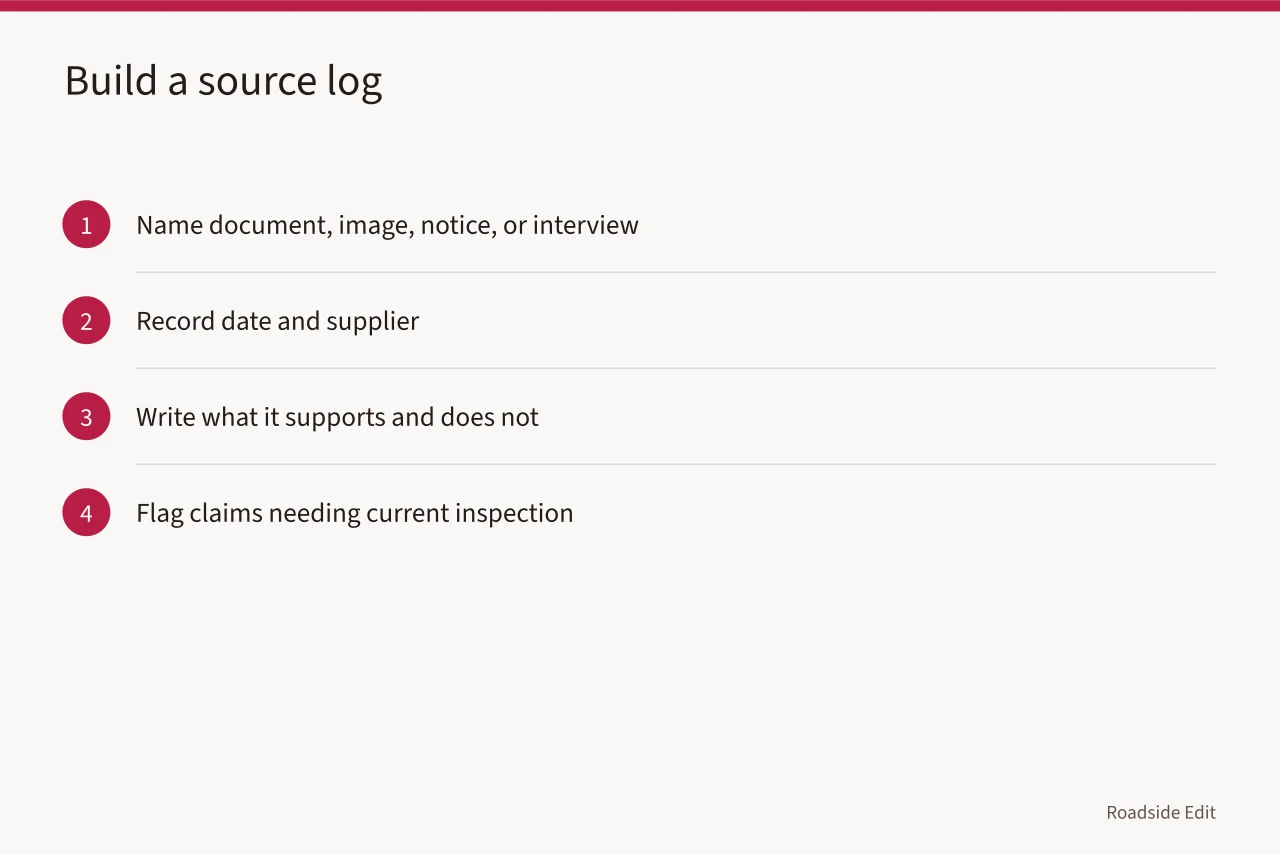
The National Archives separates records-management concepts such as inventories, file plans, and records schedules. Review National Archives records-management basics.
A private property file is not a federal records program, but the distinction remains useful. A collection is easier to use when an editor can tell if it is an inventory, a working file, or the source for a particular published claim.
Test a reuse idea against its constraints
An old service station or roadside shop can spark a strong reuse idea. That idea may be sensible, but it is not a completed plan.
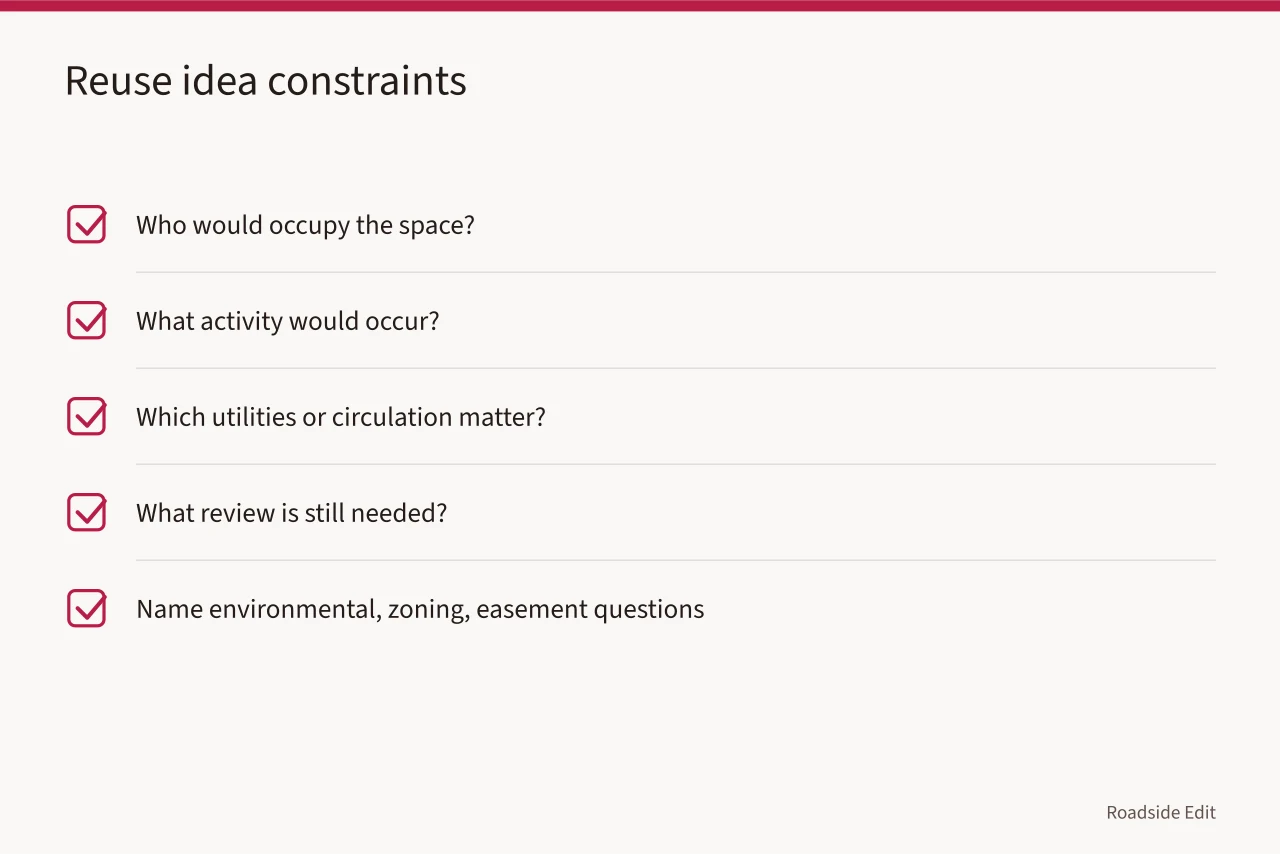
Ask who would occupy the space, what activity would occur, which utilities or circulation patterns matter, and what review is still needed. If environmental history, zoning, easements, or restricted areas might affect the proposal, name them as questions. Do not treat them as conclusions without a property-specific source.
EPA's reuse-planning guide covers property controls, existing buildings, accessibility, and potential uses when forming a conceptual reuse plan. Read EPA's reuse-plan guidance. The guide addresses brownfield planning, so it is not a checklist for every roadside property.
Its method is still relevant: a concept should clearly state the conditions and limits that may affect whether the idea can move forward.
Separate information from promotion
Roadside projects often have a business interest behind the update. That is normal. Editors must tell readers what is attributed, what is documented elsewhere, and what remains proposed.
If a company, owner, tenant, or agency supplies a statement, attribute it; if a page has paid placement, a sponsored recommendation, or another endorsement, disclose that relationship where readers can see it.
The Federal Trade Commission says endorsements must be honest and not misleading. Material connections that affect how readers evaluate an endorsement should be disclosed clearly and conspicuously. Consult the FTC endorsement guidance.
That guidance covers endorsements and advertising. It does not turn an ordinary project update into an ad, but it sets a clear rule for paid or compensated recommendations that appear alongside the reporting.
Compare different answers without forcing agreement
People close to a project may answer the same question differently. An owner explains a business goal, a preservation consultant identifies a feature that needs study, and a municipal record describes an application or public decision.
Each source has a different role, so do not average those answers into a confident sentence just because they point in the same direction.
When sources differ, use this short review:
- Is each statement dated?
- Does each source have authority over the point being made?
- Is one statement a proposal and the other a completed action?
- Does the disagreement matter to a reader's decision or understanding?
If it matters, report the difference or wait for a better source. A correction is better than a polished sentence built on an uncertain premise.
Common questions
Does a proposed alteration require the same solution at every building?
No. Requirements and feasible approaches depend on the property, work scope, jurisdiction, and project facts. Describe the question and direct readers to the responsible parties for a project-specific answer.
Can a writer call an existing condition a safety issue?
No. State what a dated record or authorized observation shows. Leave a safety conclusion to the appropriate qualified person or authority.
Is a rendering proof that a use will open?
No. A rendering communicates a concept. Name the project stage and do not imply approvals, construction, or operations that have not been documented.