Costs
Part of Roadside renovation fundamentals: how to plan with evidence, scope and reuse in mind
Roadside renovation budget notes: how to read the numbers and costs before you commit
Roadside renovation budgets need a scope, a date and a source before the number means anything, and public cost guides never replace a local bid.
What to take away
- A roadside renovation budget figure needs four labels before it means anything: scope, date, source, and whether it is an allowance, an estimate, or a bid.
- Keep research, design, permits, and construction in separate columns. Utilities and opening costs answer different questions and move at different speeds.
- RSMeans Data and Craftsman National Estimator give planning ranges by ZIP code. Neither one is a contractor's bid.
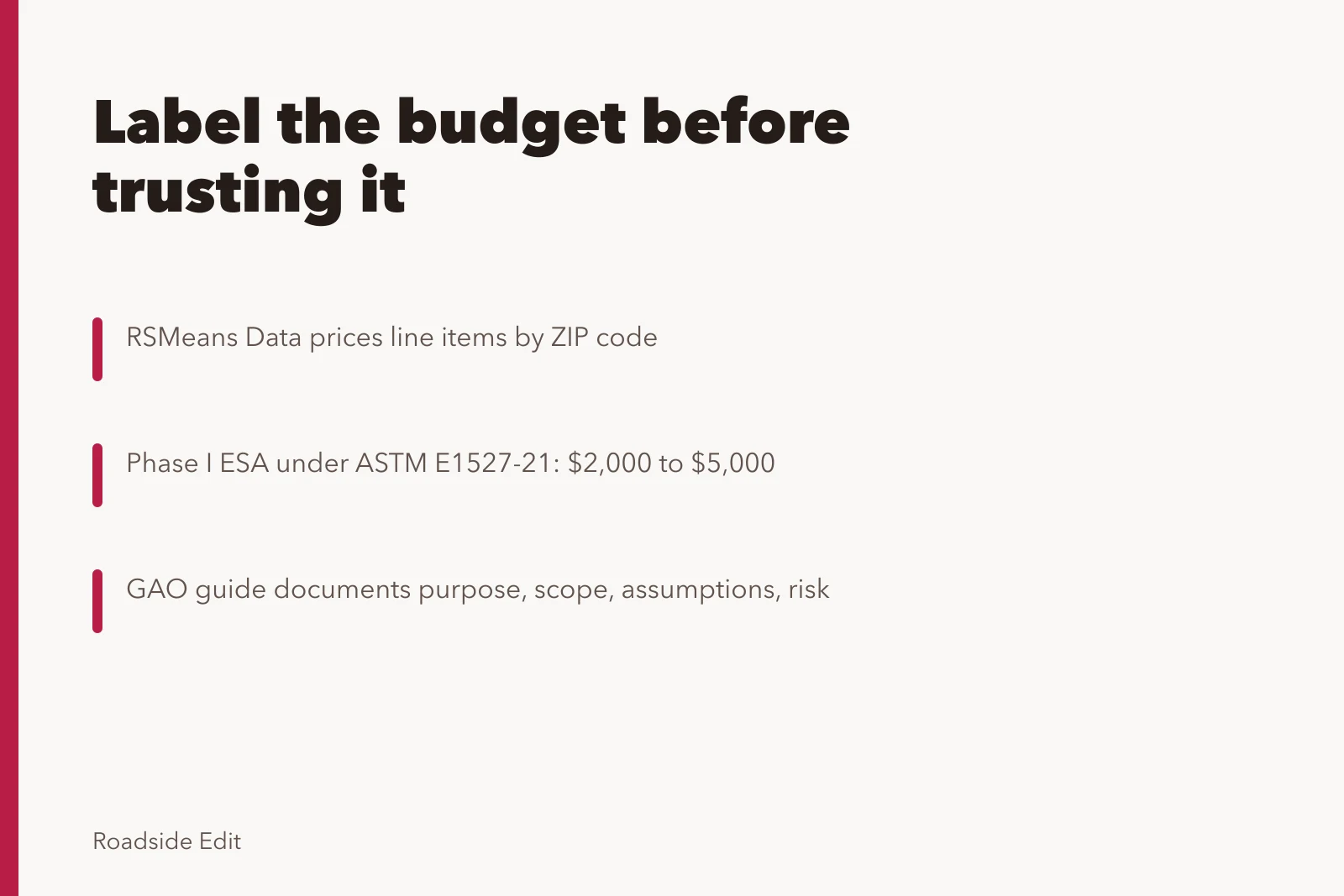
- A Phase I Environmental Site Assessment under ASTM E1527-21 commonly runs $2,000 to $5,000 on a simple site. Prior industrial use pushes it higher.
- A published cost from one motor court or filling station shows how that project defined its scope. It does not set a rate for the building down the road.
Read the label before the number
A roadside renovation budget goes wrong when one headline number hides five decisions. Ownership records, environmental review, drawings, permits, and construction each answer a separate question. Utility work and opening costs answer still others.
A usable note says what the number covers, what it leaves out, and what would change it. Without those three, the figure is decoration. A scope line that reads "restore the motel court" covers nothing until someone names the roof, the sign, and the room count.
An allowance sets money aside for a question still open. An estimate predicts cost from a defined scope and a stated date. A bid commits a contractor to a price for a named scope. Mixing the three is where budgets break.
Public cost guides fill part of the gap. RSMeans Data from Gordian is a subscription database of line items priced by ZIP code. Craftsman National Estimator is a downloadable database sold as a one-time purchase. Both support planning allowances. Neither is a bid.
HomeAdvisor and Angi publish free consumer cost guides and connect owners with contractors, who often pay lead fees. Treat those ranges as regional context, not a project price. BuildZoom publishes free contractor license and permit records, which helps you check whether a local firm is real. It is not a cost source.
On the sign side, the Neon Museum in Las Vegas and the American Sign Museum in Cincinnati hold public collections of restored commercial signage. The Society for Commercial Archeology, a nonprofit for roadside commercial architecture, publishes a journal on the subject. Those collections show what original work looked like. None of them prices your project.
For environmental work, Terracon and AEI Consultants perform Phase I Environmental Site Assessments under ASTM E1527-21. Public estimates commonly land between $2,000 and $5,000 on a simple site. Larger parcels and prior industrial use run higher, and a shuttered filling station with tanks in the ground belongs in that group.
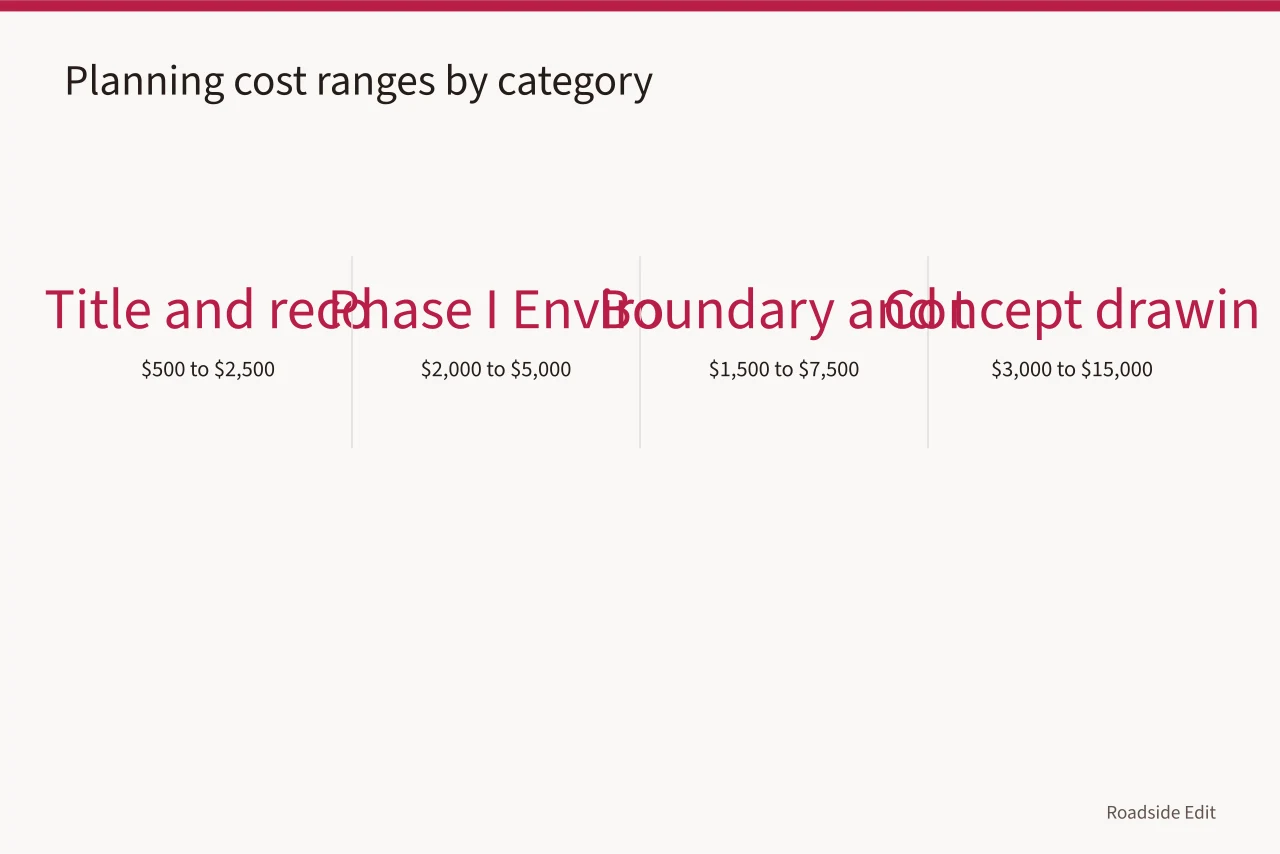
Planning figures for records, surveys, signs, and site work
Treat this as a 2027 planning table. Adjust for local labor, site size, and market. Most public guides still publish 2025 or 2026 data, so add escalation, and say which index you used.
| Category | Planning range | What it covers |
|---|---|---|
| Title and records review | $500 to $2,500 | Ownership, easements, liens, site history |
| Phase I Environmental Site Assessment | $2,000 to $5,000 | ASTM E1527-21 review, site visit, report |
| Asbestos and lead survey | $500 to $3,000 | Sampling, lab work, limited report |
| Boundary and topographic survey | $1,500 to $7,500 | Property lines, elevations, utilities |
| Concept drawings | $3,000 to $15,000 | Reuse options, rough layout, order-of-magnitude cost |
| Permit fees | $500 to $15,000 | Local plan review, inspections, certificates |
| Asphalt resurfacing | $2 to $5 per square foot | Mill and overlay, limited patching |
| Concrete sidewalk | $6 to $12 per square foot | Removal, base, pour, finish |
| ADA curb ramp | $1,500 to $5,000 each | Design, demo, concrete, detectable warnings |
| Utility relocation | $10,000 to $100,000 | Water, sewer, electric, gas moves |
| Demolition | $5 to $15 per square foot | Structure removal, hauling, disposal |
| Environmental remediation | $20,000 to $250,000 | Soil or groundwater cleanup |
| Historic structure report | $5,000 to $40,000 | Research, photographs, conditions survey, agency correspondence |
| Neon sign restoration | $15,000 to $100,000 | New tubes, transformers, glass, paint, electrical |
| Roof replacement on a motel wing | $5 to $12 per square foot | Tear-off, deck repair, membrane or shingle |
A small job skips rows. A canopy soffit repair and a dry-stand pipe inspection may be the whole scope, with no remediation line at all. A neon repaint at a roadside motel can work the same way.
A local official, a licensed professional, or the owner decides what applies. The table stops a planning allowance from hardening into a construction price.
Start with the decision, not a renovation total
An early budget should fund the work needed to make the next responsible choice. That could be confirming ownership records at a motor court, documenting visible conditions inside a filling station, testing a reuse idea for a drive-in, or buying a specialist's opinion. It does not mean inventing a construction total before the scope exists.
EPA's site-reuse guidance describes an opportunities-and-constraints analysis that names information gaps and helps a community pick the next step. EPA's site-reuse planning guide is not a price list.
It supports one editorial rule: research and planning costs sit in a different category from construction costs. They buy certainty before a project can be priced.
Write the immediate decision in one sentence. Does the building merit further study? Does the reuse idea fit the footprint? Do conditions require a defined investigation? Then list only the work needed to answer it. The reader sees where the estimate stops.
Build an estimate another reader can inspect
The Government Accountability Office defines a reliable cost estimate as a process with a documented purpose, scope, and assumptions. It also records ground rules, data, calculations, risk, and uncertainty.
GAO's Cost Estimating and Assessment Guide was written for federal work. Its documentation logic still fits a public renovation note, because a reader should see what the estimate assumes and what would change it.
Keep a short record beside every published number:
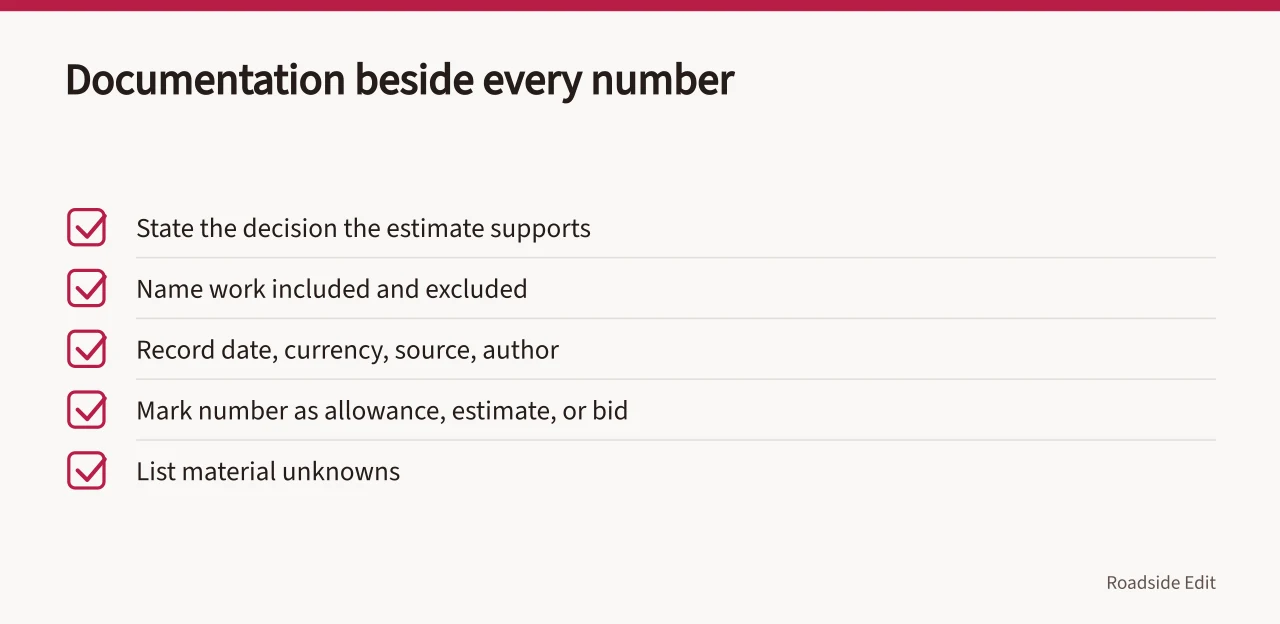
Do not use a soft contingency to hide an undefined scope. If these are open, say so:
- the roof
- the utilities
- site access
- code questions
- environmental conditions
"Subject to confirmation" beats false precision, and it gives a later editor a clear reason to revise the page.
Keep compliance work visible in the scope
Access questions belong in the scope before anyone discusses price. The U.S. Access Board explains that the ADA Standards apply to newly constructed and altered facilities covered by ADA titles II and III.
The Access Board's introduction to ADA standards does not decide whether a particular roadside property is covered or what alterations cost. It explains why access review is not a footnote.
A restroom remodel at a motor court and a curb ramp at a roadside diner both raise the altered-facility question. The answer depends on the property, the work, and the rule that applies.
For a preservation project, the same logic runs through Section 106 review and the Secretary of the Interior's Standards. Section 106 covers properties listed on or eligible for the National Register of Historic Places, such as the Wigwam Motel in Holbrook, Arizona, a Route 66 motor court built of concrete teepees.
Your State Historic Preservation Office or local landmarks commission sets what applies, and the adopted ordinance is the document that decides.
Keep a review allowance and a compliance claim in separate sentences. An allowance covers an identified question. A claim needs dated facts about the property, the work, and the rules.
Do not confuse awards with available cash
Funding language needs the same care as cost language. A grant award, a proposed match, a reimbursement request, and money already spent are four different facts.
The National Park Service's Route 66 Corridor Preservation Program awards cost-share grants for work on Route 66 properties. Cost-share means the recipient brings matching money. An award letter is not a bank balance.
Where federal money is involved, state only the category the source establishes. Federal cost principles require costs to be necessary, reasonable, allocable, and consistently treated for a federal award.
The federal cost-principles rule does not describe every grant or local program. It is a reminder that an award amount is not a blank check across every renovation expense.
The federal historic preservation tax incentives work differently. The National Park Service and the IRS allow a 20 percent credit for the certified rehabilitation of income-producing certified historic structures.
A second credit covers 10 percent of rehabilitation work on non-historic, non-residential buildings built before 1936. A credit lowers the tax an owner owes. It is not a check you hand a contractor in month one.
Do not write "fully funded" unless the source says it and identifies the scope. If a release describes an award for planning, construction is not funded. If it names a construction award, operating costs and later changes are still outside it.
Publish numbers without creating a false benchmark
Put the label next to the number. A reader should not scroll three paragraphs to learn whether a figure is a preliminary estimate or an executed contract. Give the date, because materials, labor, scope, and local conditions move. Name broad exclusions where they matter: land acquisition, environmental work, utility relocation, furniture, operating reserves.
For cross-border material, the same discipline applies. Salvage from Canada, neon parts, and diner booths carry customs paperwork. A customs broker or the applicable agency states the duty and classification. Do not print a rate you cannot source.
One site's cost can still carry an article. The Blue Swallow Motel in Tucumcari, New Mexico, is a 1939 Route 66 motor court that still operates with its restored neon sign. A note about that sign work can show how one project defined a scope, documented a funding source, or split planning from construction.
It cannot prove what a different roadside building will cost. Say what the number meant for that project, then stop.
Roadside renovation work fails most often at the scope line, not the price line: over-painting original porcelain enamel, swapping neon for LED, and losing provenance records all cost more to undo than to avoid.
Common questions
Is a grant award the same as money ready for every renovation cost?
No. An award may cover one phase, carry conditions, require a match, or reimburse expenses after approval. Describe it at the stage and scope the source states, and let the funding agency's own terms govern.
Can an article call an estimate a final project cost?
No. Label it an estimate and give its date, scope, assumptions, and exclusions. A final cost comes from a source reporting completed or paid work, such as a closing statement or a paid invoice.
Should a budget article compare contractor prices?
Only where services, dates, scope, and authority to publish are genuinely comparable. Private proposals should not become a market claim, and a single bid is not a benchmark.
Does a historic tax credit pay for a preservation project up front?
No. The 20 percent credit applies to a certified rehabilitation of an income-producing certified historic structure, and the owner claims it after the building is placed in service. Some owners bridge the gap with a construction loan or a state credit program. Check those terms before you treat the credit as construction money.