Guides
Part of Roadside renovation fundamentals: how to plan with evidence, scope and reuse in mind
Roadside renovation fundamentals: a scope checklist before you decide
Roadside renovation basics for 2027: a practical checklist for records, scope, site limits, public updates, and the next responsible decision.
A roadside building can look simple from the shoulder. It may have a former sign band, a closed canopy, an old service bay, or long local memory.
Those details do not show whether work is approved, safe, funded, or ready to begin. This checklist helps property owners, writers, community groups, and prospective sponsors describe early renovation talks without overstating the record.
Use it before publishing a project note, a reuse idea, or a sponsored profile. It is not a permit, accessibility, building-code, environmental, engineering, or construction checklist for any particular property.
What to take away
- Start with a dated record, then name the limited decision it will support.
- Separate what someone observed from the conclusion a qualified professional may reach.
- Put the work area, access limits, deliverable, and stop points in writing.
- Treat a business-supplied update as attributed information, not independent reporting.
Build the first property record
The first version does not need to answer every question. It needs enough order to keep later writing honest. Give the record a property name or address, the date it was assembled, and the person who can authorize a public update. Keep historic material, current observations, and supplied project information in separate folders or sections.
The Library of Congress calls primary sources the raw materials of history. Its primary-source analysis guides are a useful reminder that a photograph, map, notice, or old plan needs a date and origin before it carries much weight in a project description.
A 1950s photograph can support a claim about a past appearance. It cannot establish present condition, ownership, or repair need.
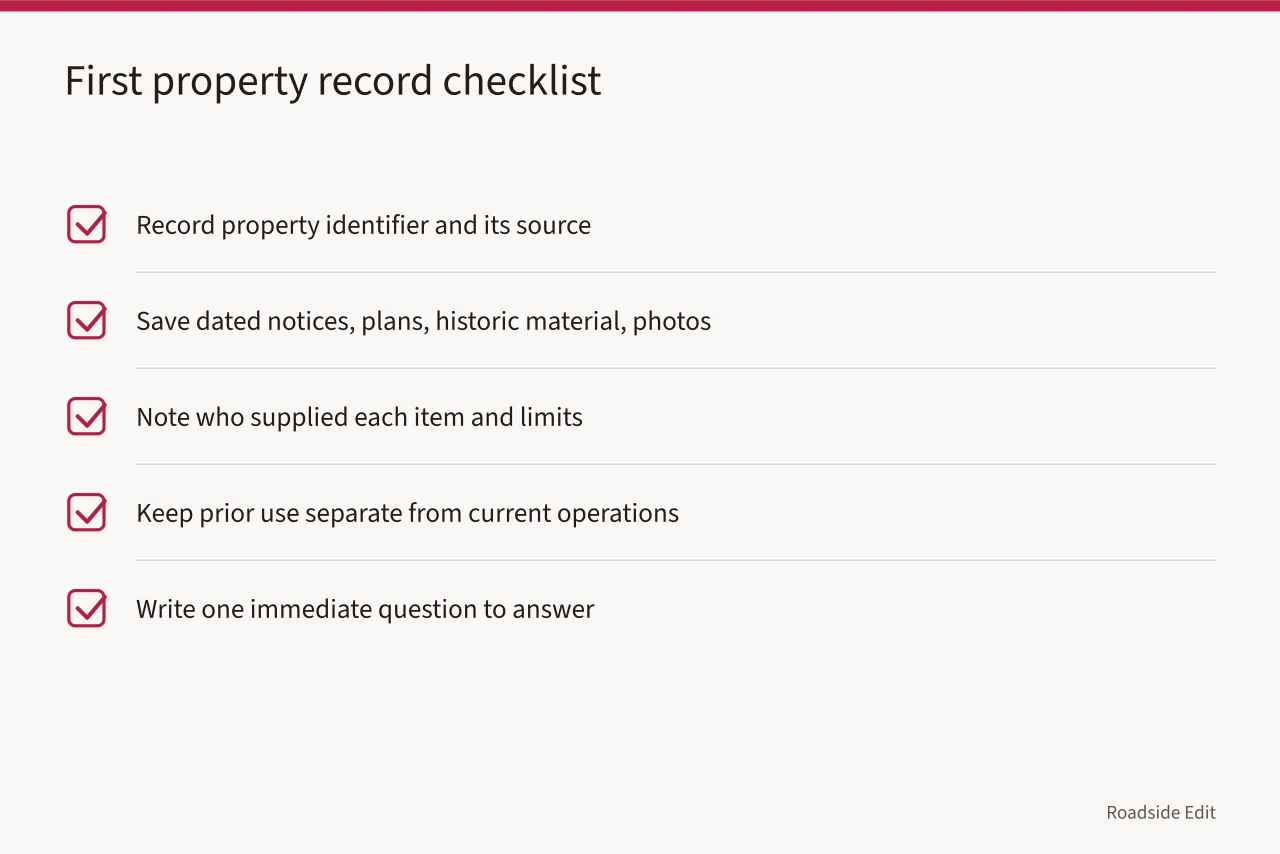
- Record the property identifier and the source of that identifier.
- Save dated public notices, available plans, historic material, and authorized current photos.
- Note who supplied each item and what the item does not show.
- Keep prior use separate from current operations, ownership, and site conditions.
- Write one immediate question, such as "Should the exterior be documented before a reuse concept is published?"
Do not make the record sound more complete than it is. If the interior was not entered, say that. If a photograph was taken from a public right of way, say that too. Those small limits help a later reader understand what the checklist can and cannot support.
Define the proposed work with limits
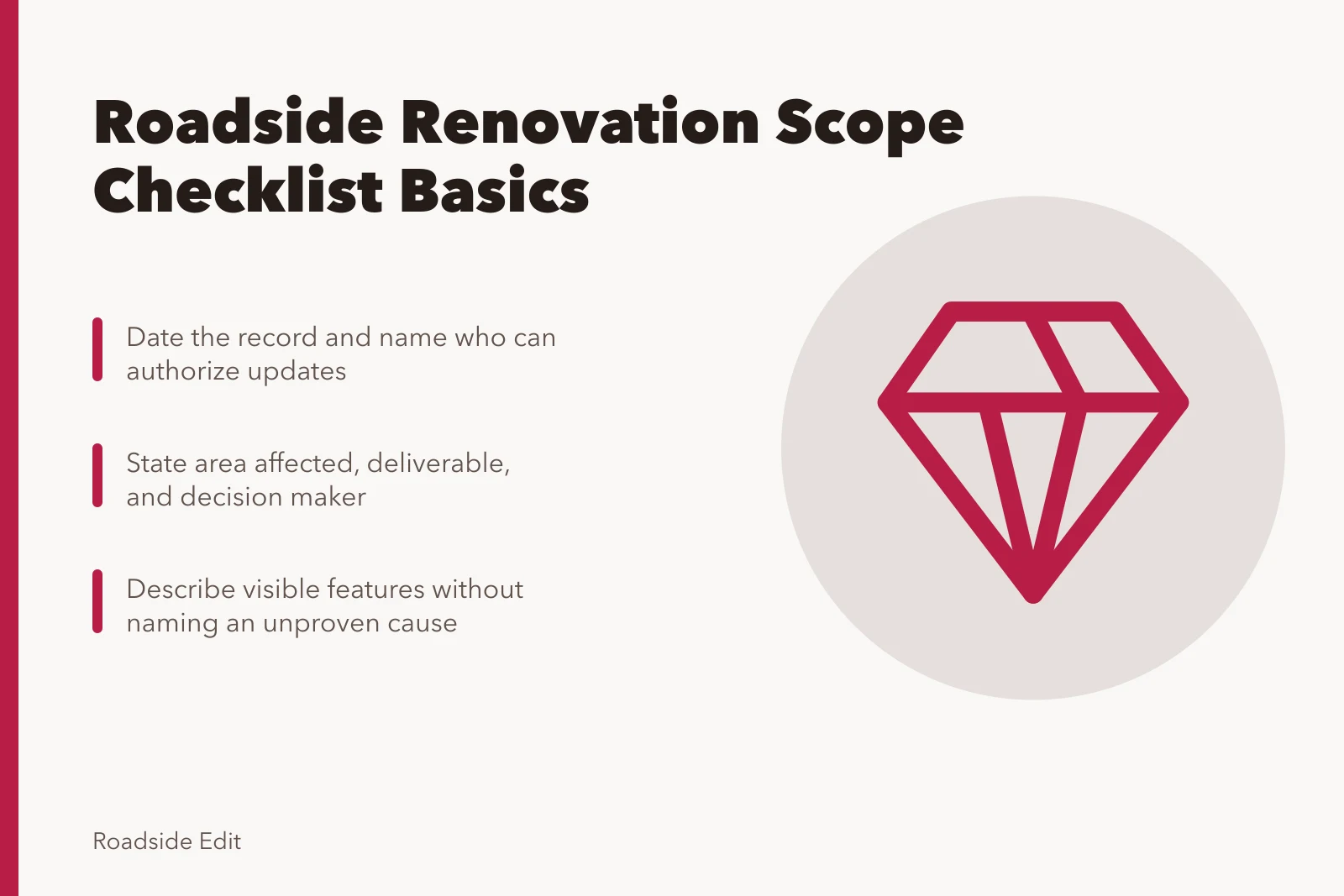
"Renovation" can mean anything from repairing a sign cabinet to redesigning an entire parcel. A useful checklist turns that broad word into a bounded scope. State the area affected, the information available, the proposed deliverable, and the decision maker who will decide whether to proceed.
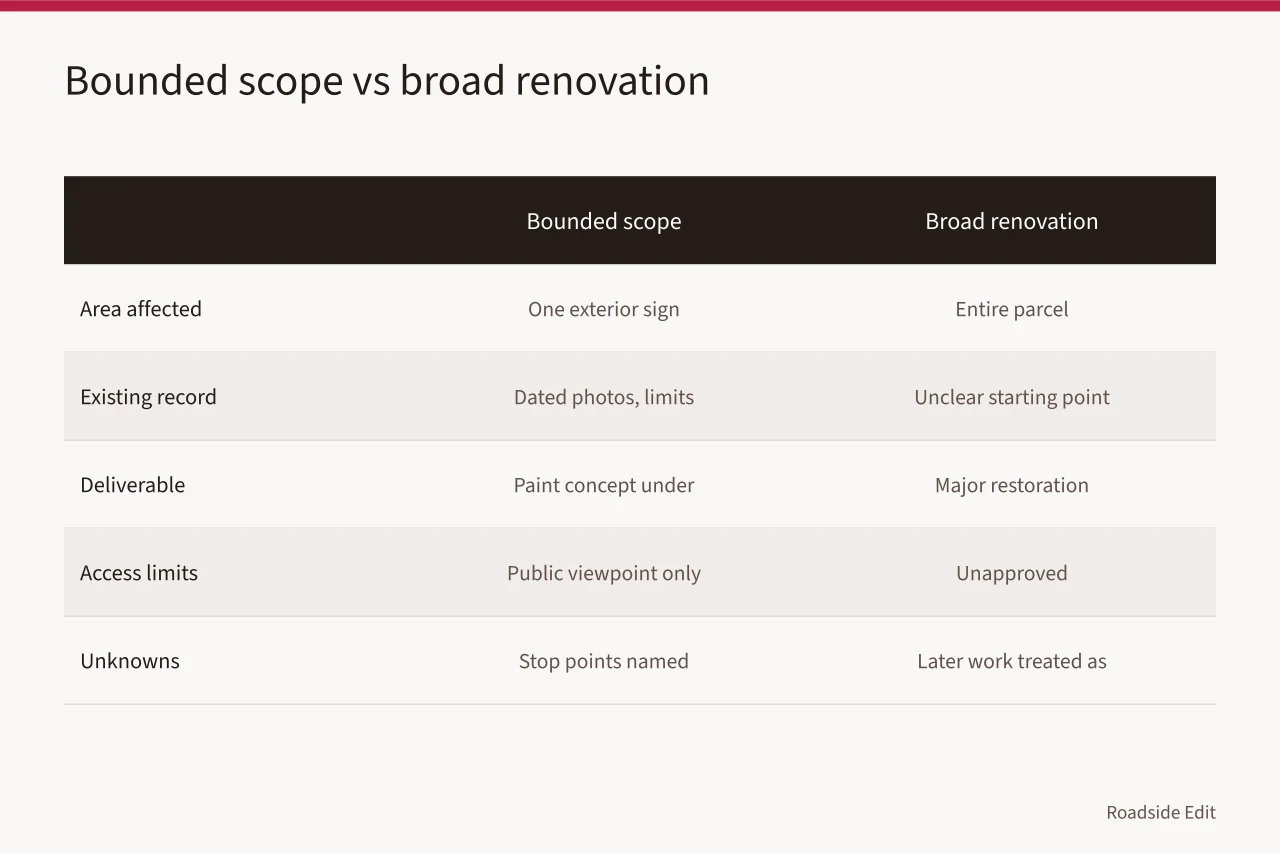
| Item to state | Why it belongs in the record |
|---|---|
| Area affected | Prevents an all-building claim based on one exterior view |
| Existing-condition record | Shows the starting point and the limits of observation |
| Deliverable | Explains what the work is meant to inform |
| Access limits | Prevents a photo visit from becoming an unapproved investigation |
| Unknowns and stop points | Creates a clear handoff when new facts appear |
The National Park Service's rehabilitation-phasing video discusses the need to describe known work, the sequence of phases, and existing conditions in an historic-preservation review setting. That setting will not govern every roadside project. The basic writing discipline still travels well: state the work that is known now, and leave later, undefined work as proposed rather than settled.
Use direct labels. "Exterior paint concept under review" says more than "major restoration planned." A supplier estimate, an owner interview, or a local-news report may be useful, but each belongs to a different kind of evidence. List it by name instead of merging every item into a single confident story.
Set boundaries around site conditions
Visible wear is not a diagnosis. Peeling paint, a locked door, standing water, or an empty forecourt may deserve documentation, but none of those details proves why the condition exists or what treatment is appropriate. The checklist should tell readers where ordinary observation ends.
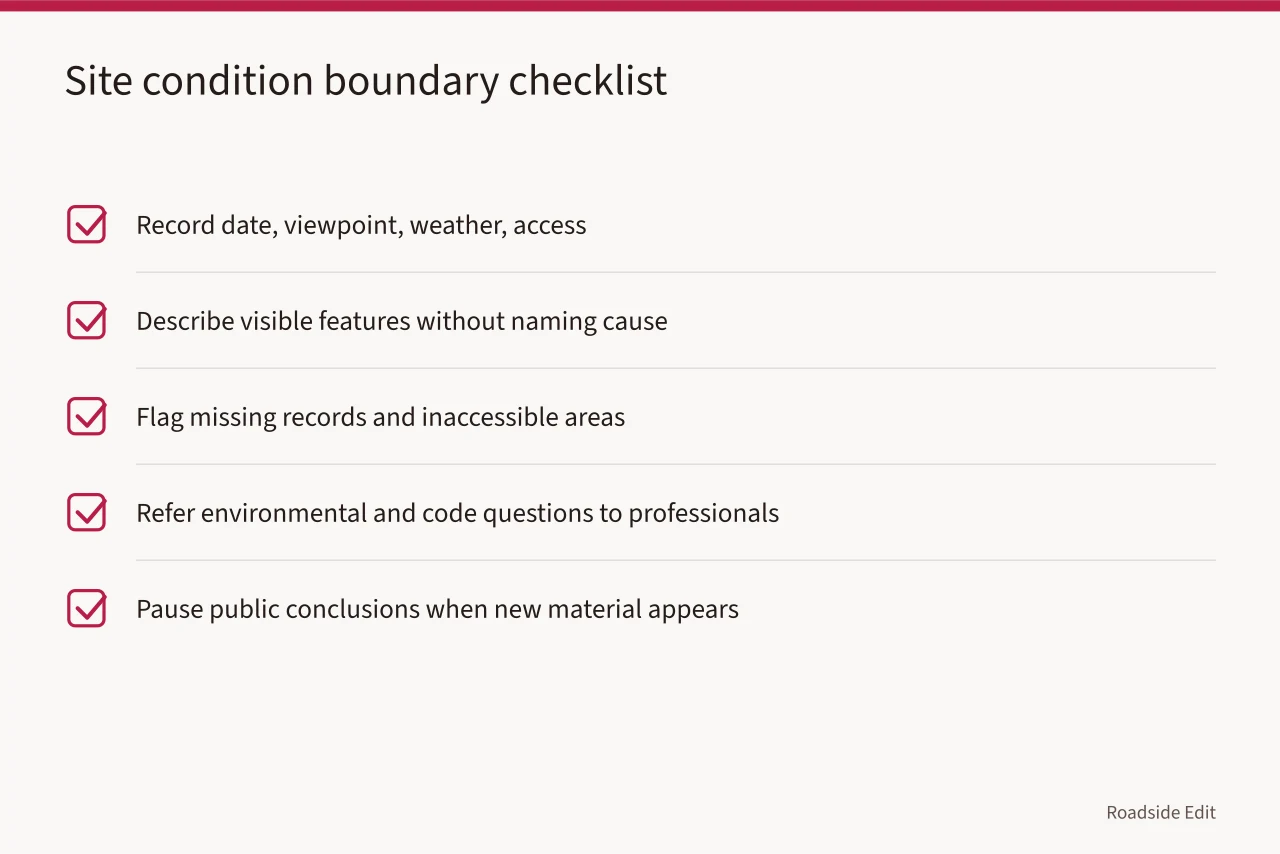
- Record the date, viewpoint, weather, and access conditions for each site visit.
- Describe visible features without naming a cause that has not been established.
- Flag missing records and inaccessible areas as unknowns.
- Refer environmental, structural, code, and accessibility questions to the appropriate professionals or agencies.
- Pause public conclusions when new material changes the scope.
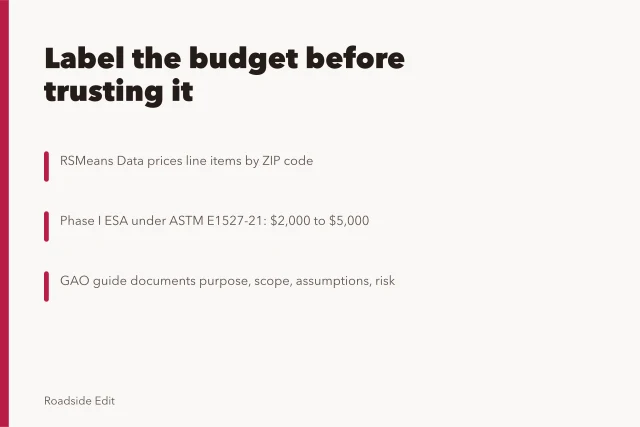
For properties where past uses or potential contamination affect a decision, the EPA says All Appropriate Inquiries evaluates environmental conditions and potential contamination liability. EPA lists records review, visual inspection, significant data gaps, and written reporting as parts of that formal process.
This editorial checklist is not an AAI assessment. It should never suggest a few photos or a basic property timeline cleared an environmental question.
This distinction protects both the audience and the project. A careful article can say that a question exists, who should answer it, and what document may be needed next. It should not replace that document with a polished sentence.
Publish a useful update without overselling it
Readers can understand a tentative project when the language is candid. Use "proposed," "planned," "under review," "funded," and "completed" only when the stated source supports that stage. Date the update, identify the source, and explain whether the statement comes from a property owner, a public agency, a contractor, or a sponsor.
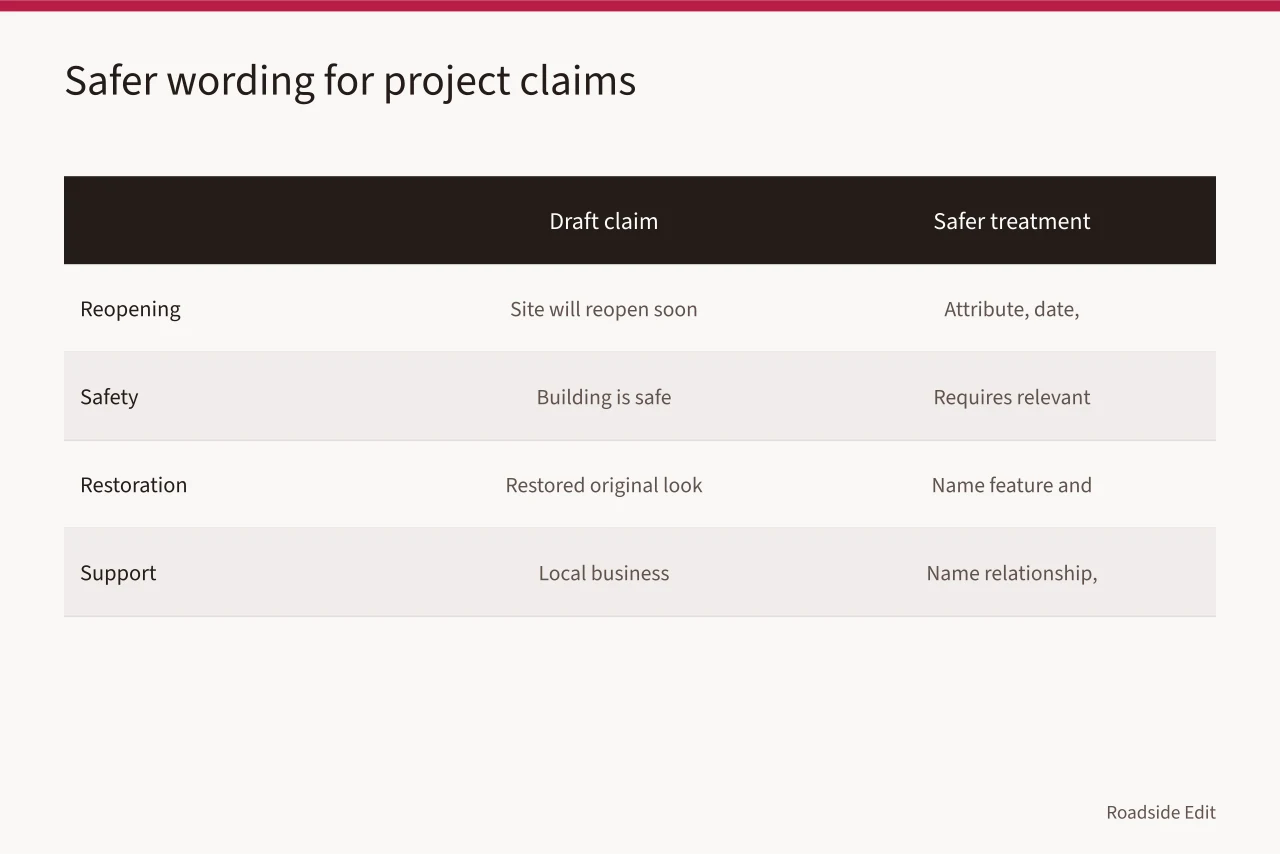
| Claim in a draft | Safer treatment |
|---|---|
| "The site will reopen soon" | Attribute it, give the date, and state that timing may change |
| "The building is safe" | Do not publish it without the relevant authority and context |
| "The project restored the original look" | Identify the feature and the evidence used for the comparison |
| "A local business supports the work" | Name the relationship and distinguish support from approval |
If a paid placement, donated service, affiliate arrangement, or other relationship could affect how a reader weighs a recommendation, disclose it in ordinary language near that statement.
The Federal Trade Commission says its Endorsement Guides cover endorsements that must be honest and not misleading, including material connections readers would not expect. The facts of a particular arrangement control. A disclosure does not make an unsupported claim supported.
Add one contact route for corrections. It can be an editorial email address or a clearly identified contact form. Corrected facts should replace the old claim, not sit below it as an unexplained footnote.
Before you publish
Read the proposed article once as a skeptical neighbor, and ask whether a reader can tell which statements come from the record or the project team, and which remain unanswered. If not, revise the labels before publishing.
The most useful early renovation article is often modest: it gives the public a reliable starting point and tells them what has not yet been decided. That restraint builds editorial trust.
Common questions
Can a renovation checklist establish that a property is ready for work?
No. It organizes questions, records, and next decisions. The responsible owner and the appropriate professionals determine readiness for any specific project.
Should every old roadside feature be retained?
No. Record the feature and its context before making a treatment choice. The record is the beginning of a decision, not the decision itself.
Can a sponsor supply the project update?
Yes. Attribute the update, date it, and keep it separate from independently supported facts and editorial conclusions.