Reviews
Part of Gas station preservation mistakes to avoid before you start work in 2027
Gas station preservation: questions to ask before you publish in 2027
Gas station preservation questions for 2027 separate verified history, present conditions, proposed reuse, records, and sponsored copy before publication.
A former service station can be an architectural subject, an environmental site, a commercial address, or all three. Those labels do different jobs. Before publishing a profile, proposed reuse, or paid listing, ask which record supports each sentence. The most common error is not a missing fact. It is moving a fact from one category into another.
What to take away
- A historic photograph does not establish a building's present condition.
- A proposal is not an operating business, even when the proposal is detailed.
- Site-specific records matter more than nearby examples or broad program guidance.
- Sponsored copy needs an attribution, a review date, and a clear correction path.
Start by naming the question
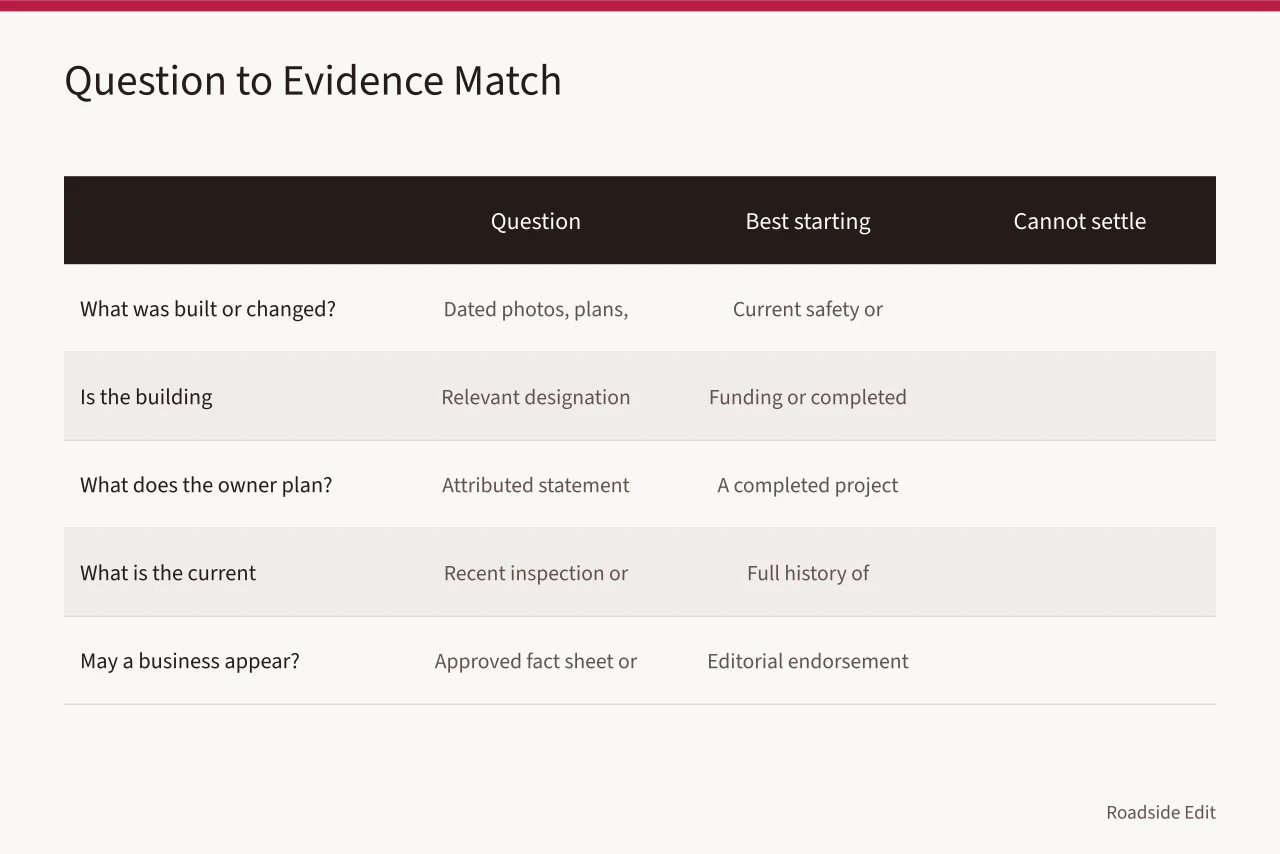
Good editing begins with a narrow question. "What did this station look like in 1940?" calls for different evidence than "Can visitors enter the building this weekend?" A newspaper clipping, a survey form, a permit, an owner interview, and a cleanup record may all be useful. None should be treated as a universal answer.
The EPA land revitalization toolkit describes a planning sequence that can include assessment, cleanup, reuse, and community discussion. That is useful context when an article explains why a project team is gathering information. It does not establish contamination, ownership, funding, or a viable reuse for a named property. Those conclusions need records tied to the site and date in question.
Test historical-status claims
A station can be old without having a formal historic designation. A recognized property may still have unanswered questions about access, maintenance, tenants, or future work. Use the wording that the source supports. Avoid calling a site "landmarked" or "on the Register" unless the responsible record identifies the property and the status.
The National Park Service's National Register FAQ distinguishes listing from outcomes readers often assume follow from it. A listing does not automatically create a grant or stop every change by a private owner.
It is a useful source for an article explaining the limits of a designation claim. It is not proof that a particular filling station qualifies or has been listed.
Ask these questions before publishing historical status:
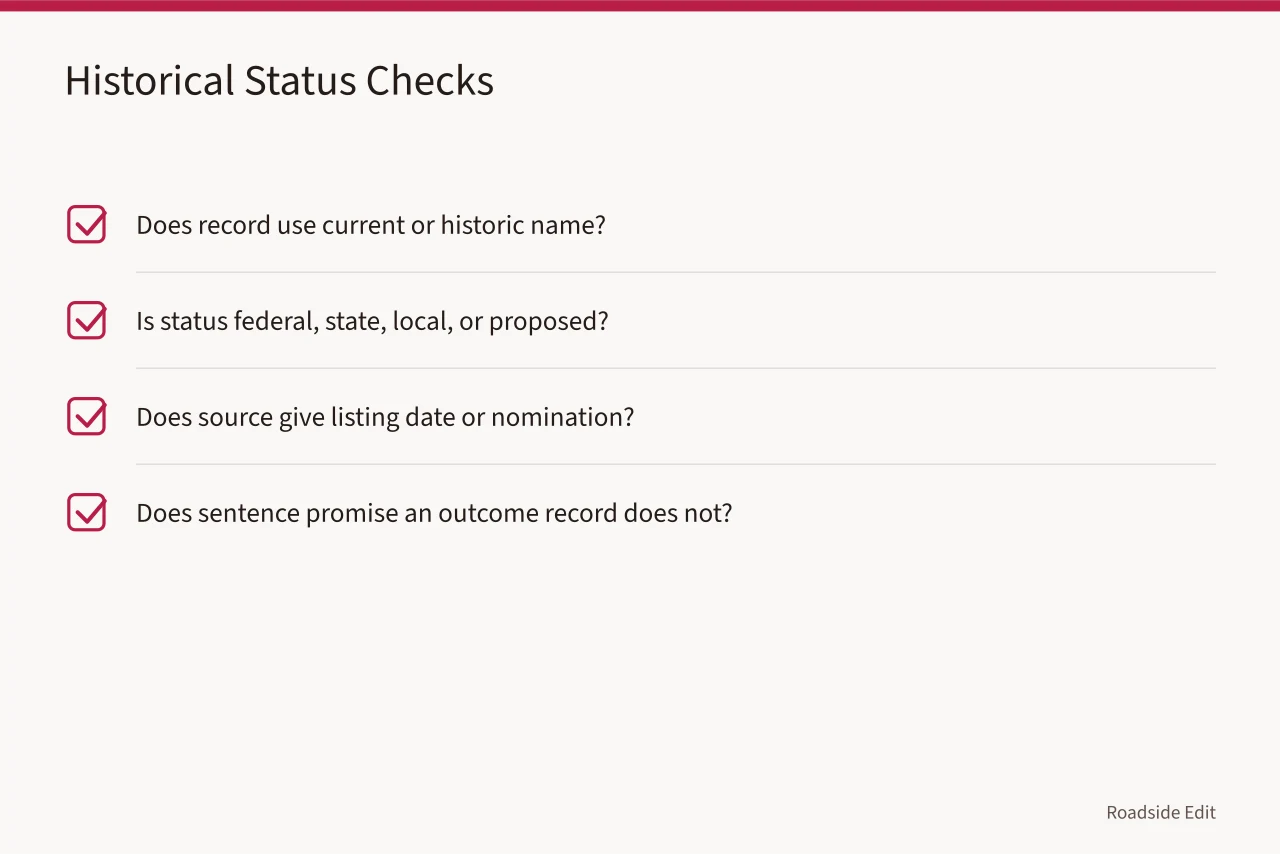
The answer may be "we do not know yet." That is usable editorial information. It tells a reader what has not been confirmed and prevents a profile from hardening a rumor into a permanent search result.
Separate primary evidence from later summaries
A well-written secondary article can help a reader understand a site. It cannot replace the original record for a date, an owner, an architectural change, or an agency decision.
The National Archives explains what makes a primary source, including that the source's relation to the event or subject matters. For preservation reporting, a practical editing rule: identify the document, who made it, and why it was made before treating it as proof.
For example, an old sales brochure may document how a company presented a station. It may not reliably describe every later alteration.
A current leasing listing may report a marketing claim, but it does not replace a public approval or inspection. A precise sentence gives the reader the boundary: "A 1950 brochure describes..." or "The owner said in a 2027 statement..." It does not make either document a claim about the present unless a current source confirms it.
Keep future-tense claims in their lane
The wording around reuse plans needs special care. "The owner proposed a cafe" reports a claim and identifies its source. "The station will open as a cafe" predicts an outcome. The difference matters when permits, financing, cleanup, leases, or construction are still unresolved.
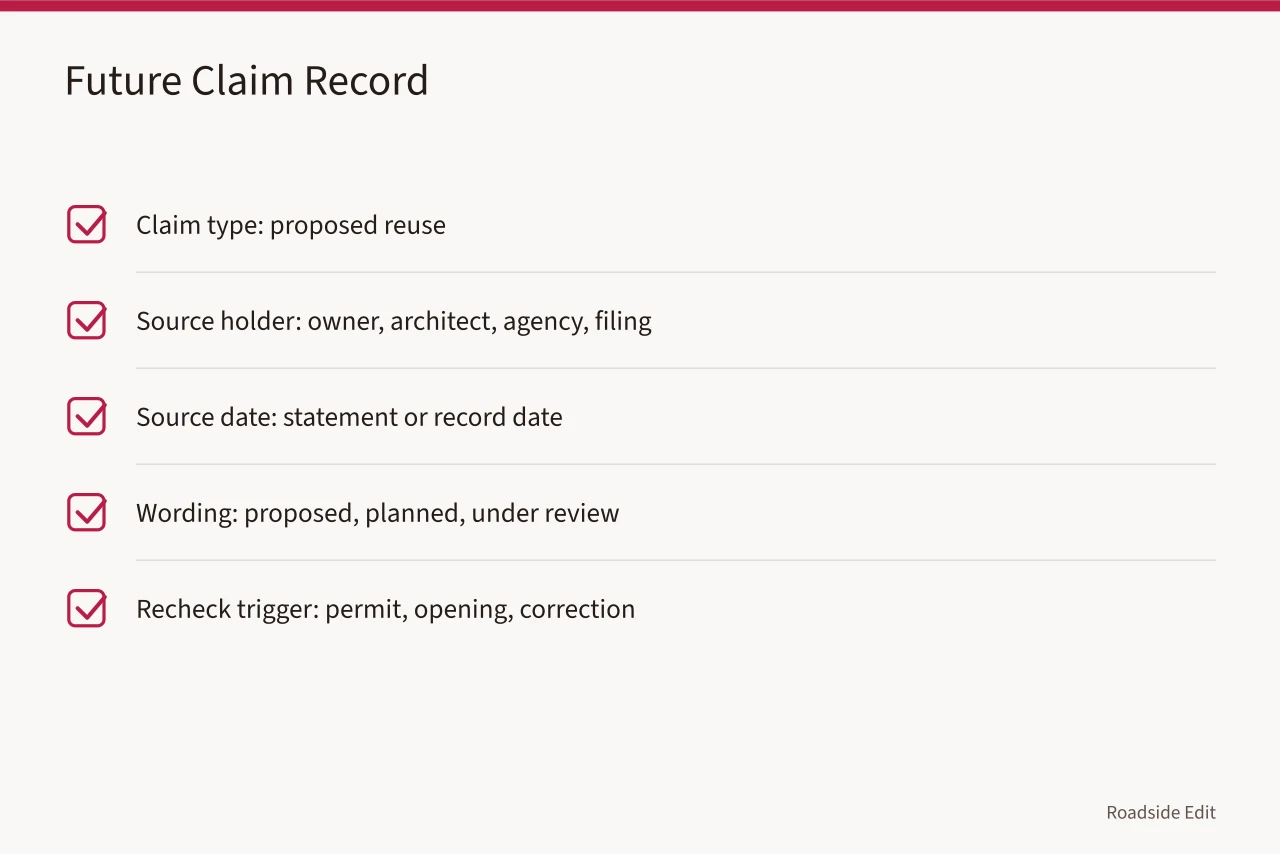
Use a short editorial record for each future-facing claim:
| Field | Example of a publishable entry |
|---|---|
| Claim type | Proposed reuse |
| Source holder | Owner, architect, agency, or public filing |
| Source date | Date of the statement or record |
| Wording | "Proposed," "planned," or "under review" when applicable |
| Recheck trigger | Permit decision, opening announcement, correction request |
This format leaves room for a later update without rewriting the earlier article as if it had always known the outcome. It also gives an editor a clear reason to decline a claim that arrives without a source.
Handle paid profiles without disguising advocacy
An agency, retailer, or property owner may later purchase a directory profile or request a placement. Payment can buy a labeled placement. It cannot change an unsupported claim into a verified fact. Keep supplied copy separate from reporting, preserve the original date, and identify who provided it.
The Federal Trade Commission's endorsement guidance says that material connections can require clear disclosure. For an editorial site, that supports a plain label for paid placement or supplied promotional content. The guidance does not certify a business claim. The article still needs evidence for statements about opening dates, public access, preservation work, or environmental status.
A final pre-publication check
Before a profile goes live, read every sentence that sounds definite and ask whether it describes the past, the present, a proposal, or an opinion. Then compare it with the named source. If the source is older than the claim, change the sentence or seek a newer record.
If the source covers another property, keep it as context only. This method is slower than copying a description, but it protects readers and the site from a correction that was visible from the start.
The photograph is illustrative only. It does not verify the history, condition, access, or reuse path of another station.
Common questions
Can an assessment from a nearby parcel support this article?
No. It can provide local context, but it cannot establish a conclusion about another property's condition or scope. Identify the exact property and record before making a site claim.
Is a planned reuse a confirmed use?
No. Describe the plan as proposed until a responsible source confirms that the relevant step has occurred.
Why leave an open question in a public article?
An open question is more accurate than an invented answer. State what record is missing and revisit the article when a source becomes available.