Guides
How to pick a vintage diner interiors provider for 2027 projects
Hire help for a vintage diner interior in 2027 with a clear scope, relevant evidence, realistic comparisons, conflict checks, and usable project records.
Vintage diner interiors provider selection means matching a clearly stated need to demonstrable experience, not finding one person with the right label.
A writer, designer, researcher, preservation professional, or photographer may help. An architect or contractor may help differently.
This guide helps an owner or editor compare that help without implying a public article can assess a particular diner, approve work, or replace local professional advice.
What to take away
- Define the decision before comparing people or firms.
- Ask for comparable work and a clear division of responsibilities.
- Keep scope, fees, disclosures, and approvals in one dated record.
- Treat a provider's portfolio as evidence of experience, not proof of a result.
Start with the question, not the provider category
"We need someone for the interior" is too broad to price or compare. It may hide several different needs: documenting an existing room, researching its history, creating an editorial feature, planning a design concept, reviewing a proposed change, producing drawings, coordinating permits, or doing physical work. Those needs call for different evidence and different contractual language.
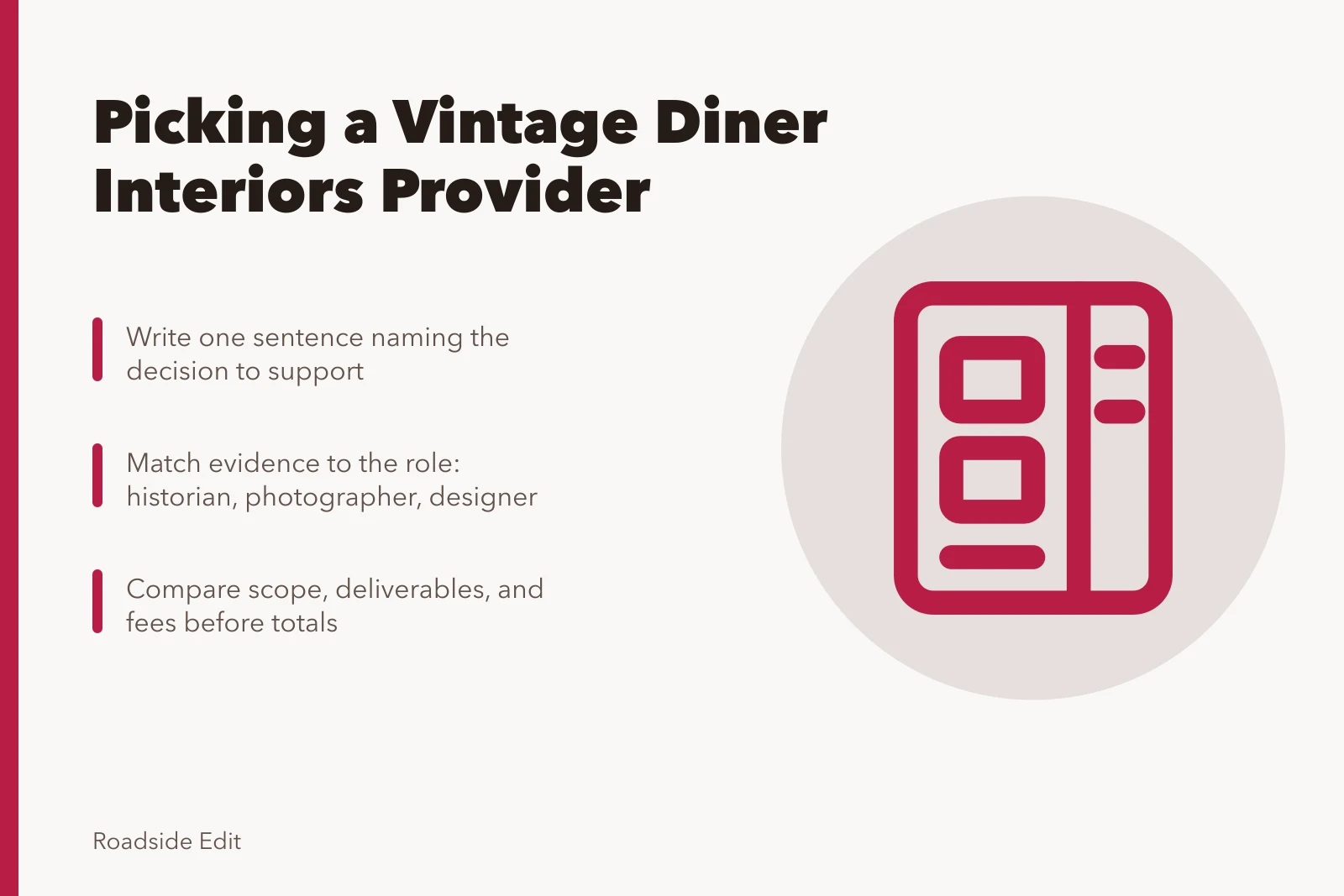
Write one sentence naming the decision the engagement should support. For example: "Create a dated photographic and written record of the counter area for future editorial use" differs from "Develop drawings for a proposed interior project."
The first is documentation. The second may require design and regulatory coordination a writer or photographer should not provide.
This distinction protects both sides. A provider can describe relevant experience, schedule, and deliverables only when the requested outcome is intelligible. An owner can compare proposals against the same question instead of choosing the most polished portfolio.
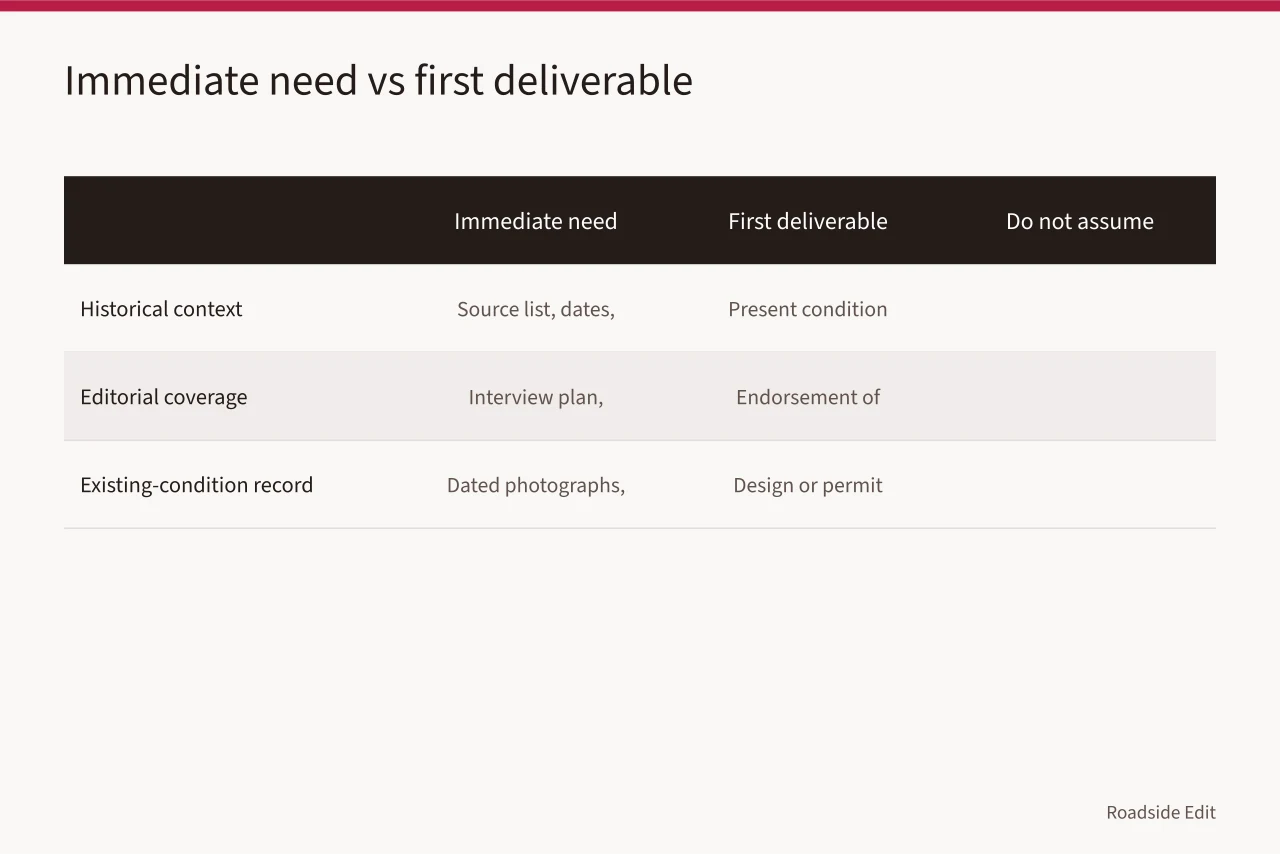
| If the immediate need is | A useful first deliverable | Do not assume it includes |
|---|---|---|
| Historical context | Source list, dates, and research memo | A conclusion about present condition |
| Editorial coverage | Interview plan, disclosures, and copy scope | Endorsement of a business claim |
| Existing-condition record | Dated photographs and observed descriptions | A treatment recommendation |
| Design planning | Drawings, assumptions, and review path | Construction pricing or approvals |
| Physical work | Defined materials, methods, and acceptance checks | Historical research or code interpretation |
Match evidence to the role
Ask every candidate for evidence tied to the proposed task. A historian or researcher should explain sources, date ranges, and limits of a prior study. A photographer should show credited work and describe what is delivered.
A design professional should be clear about the documents they prepare and the assumptions behind them. A contractor should distinguish comparable work from a generic renovation portfolio.
Comparable does not mean identical. A person who worked on a similar restaurant in another city may still be a poor match if the role, materials, documentation needs, or approval path are different. Conversely, relevant experience may be shown through a smaller project that used the same type of record, coordination, or workmanship.
The National Park Service's sample contractor and recipient records include keeping a consultant's professional qualifications on file and reviewing whether grant costs are reasonable, allowable, allocable, and necessary.
That does not set a universal hiring rule for a private diner. It supports a narrower practice: retain the qualifications and cost basis behind a selection, not memory after work starts.
Build a short, comparable request
The best request for help is specific enough to decline. It should say what is known, what is not known, what the provider must deliver, and who makes decisions. Avoid asking a candidate to fill gaps with certainty before they have seen evidence.
Include these seven fields:
- Purpose: the decision or publication need.
- Place: the room, feature, or record covered, without exaggerating what is known.
- Starting material: photographs, archives, prior reports, owner statements, or drawings already available.
- Deliverables: memo, photograph set, research file, drawings, estimate, editorial draft, or other defined output.
- Exclusions: what the provider is not being asked to determine, approve, or perform.
- Timing: milestones, review periods, and any fixed publication or project date.
- Decision contact: the person allowed to accept scope changes and approve payment.
An exclusion is not a sign of distrust. It is a way to prevent a research engagement from being treated as design advice, a design concept from being treated as an approved construction document, or a promotional interview from being mistaken for independent reporting.
Compare the proposal behind the price
A low fee can reflect a smaller scope, a missing review stage, fewer deliverables, or a different assumption about who supplies records. A high fee can include coordination that another proposal leaves to the owner. Read the scope before comparing totals.
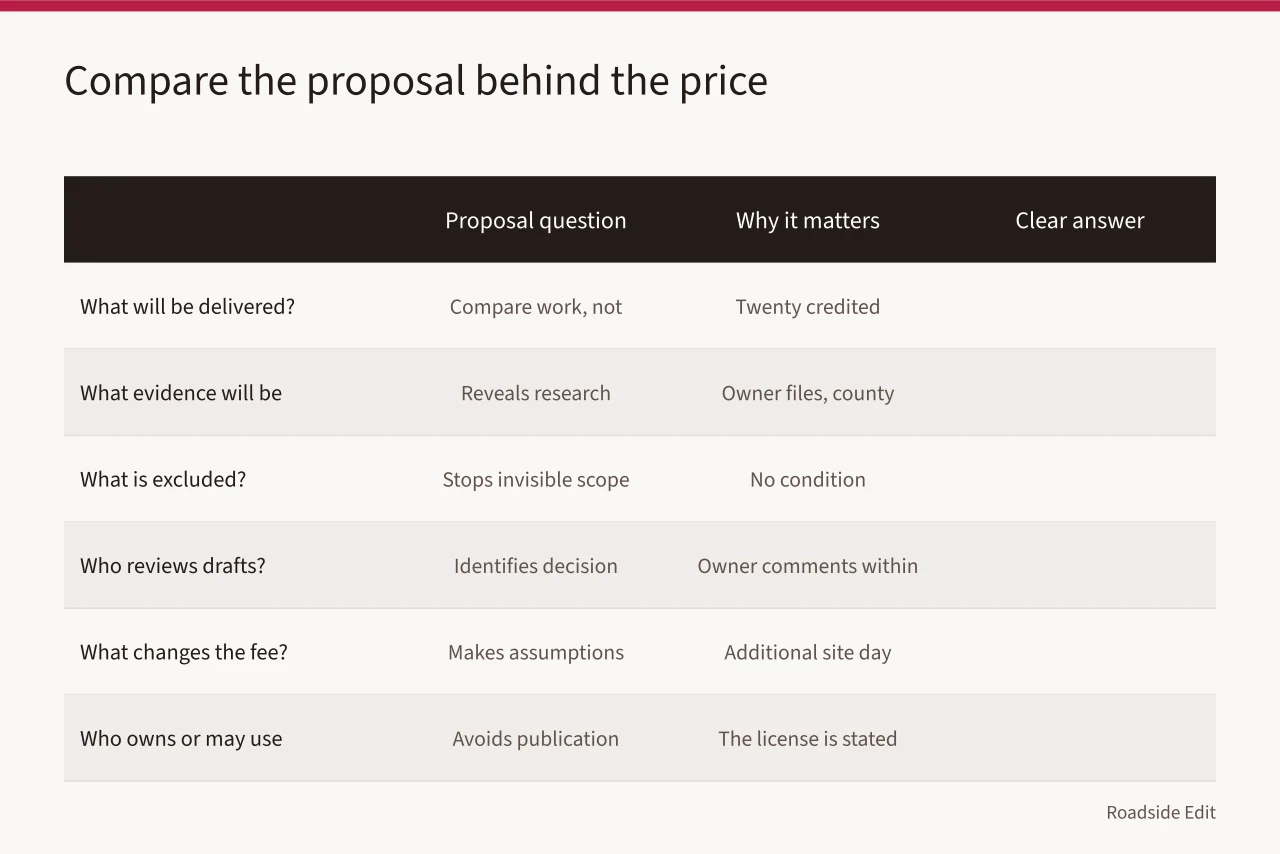
| Proposal question | Why it matters | A clear answer sounds like |
|---|---|---|
| What will be delivered? | Lets you compare work, not adjectives | "Twenty credited images and a dated inventory" |
| What evidence will be used? | Reveals research limits | "Owner files, county records, and interviews" |
| What is excluded? | Stops invisible scope growth | "No condition assessment or permit filing" |
| Who reviews drafts? | Identifies decision delays | "Owner comments within five business days" |
| What changes the fee? | Makes assumptions visible | "Additional site day requires written approval" |
| Who owns or may use the output? | Avoids later publication disputes | "The license is stated in the agreement" |
Do not ask a candidate to guarantee an outcome that depends on third parties, local approvals, unknown materials, or later choices. Ask instead how the candidate identifies uncertainty and how a scope change is documented.
Check independence and possible conflicts
Independence matters differently in different assignments. A business may appropriately hire a photographer, designer, or contractor. But an editorial guide should identify owner-supplied information, a paid listing, or a provider's commercial role. Readers deserve to know when a statement comes from the operator, the person selling the service, or an independent public record.
Before selecting help, ask who is paying, who benefits from a recommendation, and whether a provider has a financial tie to another proposed vendor. This matters most when the person researching a claim also sells the work that claim could justify.
A conflict does not automatically disqualify someone. It may call for a different role, a disclosure, or a second review.
Use a plain conflict note: "The provider disclosed that it also offers [service]. The engagement does not include a recommendation to purchase that service." That is more useful than a vague statement of independence.
Set review points before work begins
Most bad hiring experiences are not caused by a lack of talent. They come from a mismatch that was never recorded: a missing source, a photo with no license, an estimate based on an unstated assumption, or an editor who expected a ranking when the writer agreed only to compile submissions.
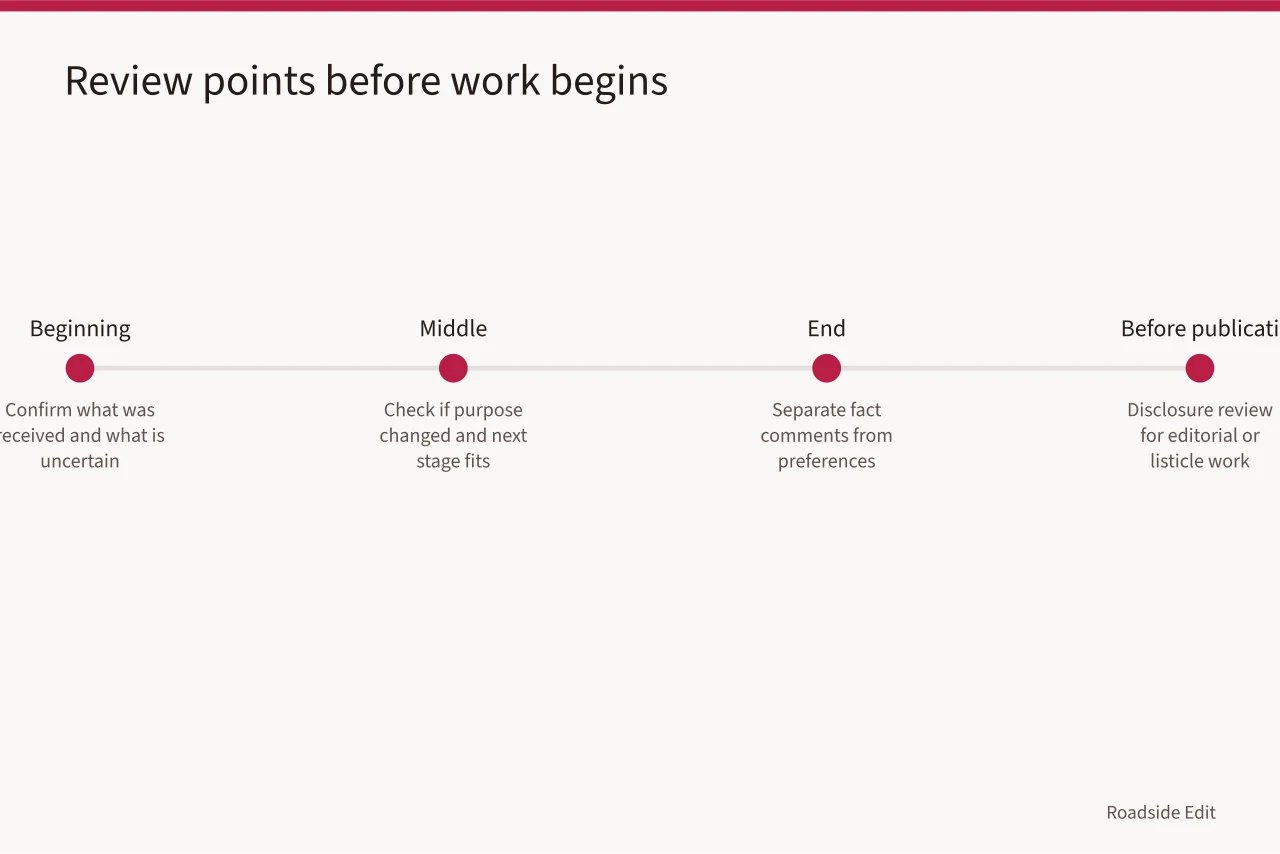
Set short review points at the beginning, middle, and end. At each, confirm what was received, what's uncertain, if purpose changed, and if the next stage still fits the approved scope.
Keep fact comments separate from preferences: a factual correction needs a source or clear attribution, while a preference can be handled as an editorial or design decision.
For editorial or listicle work, include a disclosure review before publication. Decide who checks the facts, who labels paid placements, who approves photos, and who handles a correction request. This is essential if a future page may sell a placement, because commercial participation must not be presented as an independent ranking.
Keep a selection file that another person can understand
The selection file should let a future editor or owner answer simple questions without guessing: Who was considered? What role was requested? What documents were reviewed? What was selected? What was declined? What changed later?
Keep the file small and practical:
- The original request and date.
- Each submitted scope and fee.
- Comparable-work examples supplied by the candidate.
- Qualification or license information where relevant to the role.
- Conflict and relationship disclosures.
- The decision note and any dissenting concerns.
- Signed scope, revisions, approvals, invoices, and delivered files.
The file should not become a folder of private personal details. Retain only information needed to explain the engagement, honor the agreement, and support future editorial accountability. Store sensitive material appropriately and follow the terms of the agreement and applicable law.
A practical decision sequence
Use this sequence when there is no urgent deadline:
- Define the decision and the narrow task.
- Gather the existing records before requesting proposals.
- Send the same essential scope to every candidate.
- Compare deliverables, exclusions, assumptions, and disclosed relationships.
- Ask follow-up questions in writing.
- Select the role and scope, not a promise of a predetermined result.
- Record the reason for selection and set the first review date.
That sequence works for a small editorial assignment as well as a more formal project because it makes uncertainty visible before it becomes an invoice dispute or an unsupported published claim.
What this guide cannot decide
No general guide can identify the right provider for a named diner, evaluate qualifications under a local rule, interpret a contract, determine a building's condition, or approve physical work. Those questions depend on the actual assignment, property, jurisdiction, records, and people involved. Use this guide to make the question clearer, then obtain advice appropriate to the work.
The National Archives records-management overview supports maintaining records that can be identified, reviewed, and managed over time. In a selection file, that means preserving the request, response, evidence considered, and decision date. It does not prescribe retention obligations for a private engagement.
The Library of Congress primary-source analysis guide separates evidence gathering from interpretation. That supports a practical hiring habit: look at what an example or source actually demonstrates for the requested role before treating it as proof of a future outcome.
The Federal Trade Commission's endorsement guidance supports clear disclosure when a financial or other material connection could affect how readers evaluate a recommendation. A provider's commercial role should be visible in a public list without being mistaken for independent editorial approval.
Common questions
Should an owner hire one person for every task?
Not necessarily. One person may coordinate several tasks, but the agreement should identify which work they will actually perform and where another specialty is needed.
Is a strong portfolio enough to select a provider?
No. It is useful evidence of prior work, but compare the role, scope, deliverables, assumptions, and disclosures against the present need.
Can an editorial page include a provider in a list?
Yes, if the inclusion method is clear. A paid or supplied listing should be labeled and never presented as an independent recommendation.
What should happen when the scope changes?
Document the new question, deliverables, fee, timing, and approval before the additional work begins.
In this guide
- Vintage diner interiors provider selection: how to build a 2027 budgetBuild a 2027 budget for vintage diner interior providers by pricing survey days, travel, and fabrication, and comparing named firms on stated criteria.