Guides
Part of How to plan motel exterior regional adaptation for 2027 with local climate evidence
How to document motel exterior regional warning signs before 2027
Motel exterior regional warning signs for 2027 help U.S. readers document visible changes, local weather context, and responsible review questions.
Regional conditions can help an editor decide what context to record. They cannot turn a photograph into a defect diagnosis. A useful warning-sign note identifies the visible change, the date, the local context source, and the responsible question.
What to take away
- Record a visible change before guessing its cause.
- Use a specific local weather or climate source, with date and area.
- Never use regional context to decide a repair, permit, or safety outcome.
- Stop when access, utilities, height, structural performance, or immediate safety is involved.
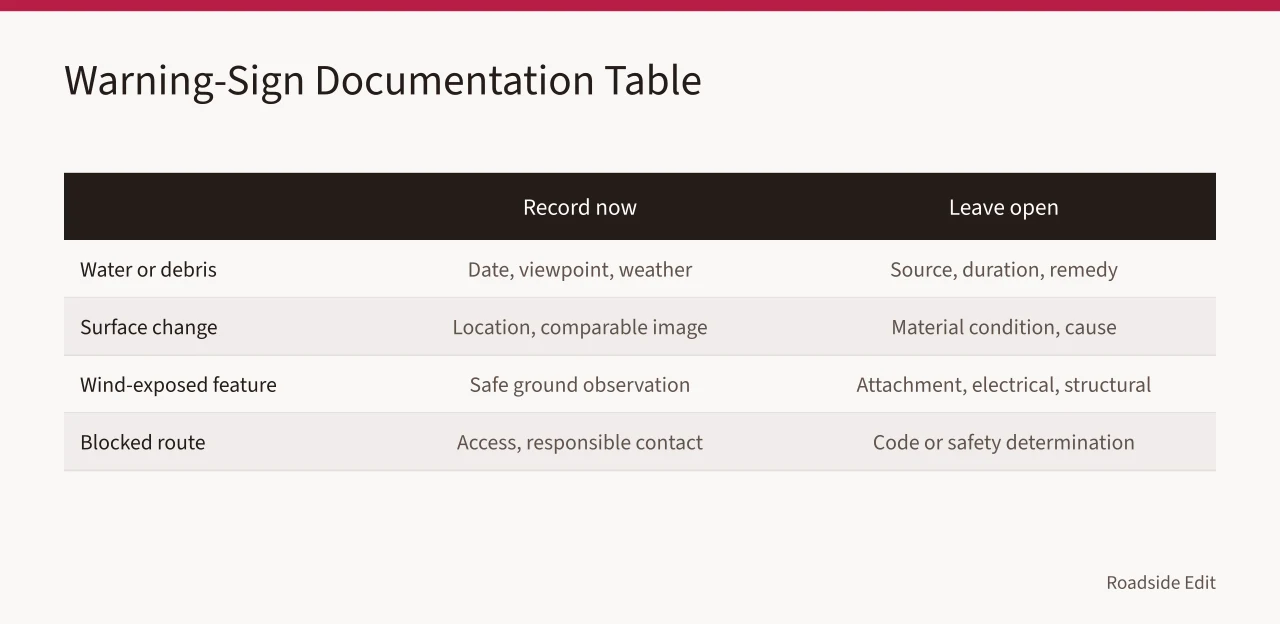
Warning-sign table
| Visible change | Record now | Leave open |
|---|---|---|
| Water or debris | Date, viewpoint, weather context | Source, duration, and remedy |
| Surface change | Location and comparable image | Material condition or cause |
| Wind-exposed feature | Safe ground-level observation | Attachment, electrical, or structural status |
| Blocked route | Access condition and responsible contact | Code or safety determination |
NOAA's regional temperature and precipitation outlooks are produced for different regions of the United States. Read NOAA's regional climate outlook overview. These outlooks provide regional context, not a prediction or assessment for one motel. Use them only to frame a local evidence question and retain the observation's limits.
The Federal Emergency Management Agency cautions local planners against deriving future probability simply by dividing event counts by years of record. Read FEMA's local mitigation planning handbook. That does not calculate risk for a motel. It supports a careful editorial rule: describe an event history as context without promising what will happen at a named property.
Escalate without overclaiming
If a change appears urgent, do not keep gathering content. Contact the responsible owner, relevant service, authority, or qualified professional. Preserve a safe, dated record if appropriate, but do not publish a conclusion about the condition while the question is unresolved.
Write "visible change recorded after a weather event" instead of "weather damage." The first wording preserves a fact; the second asserts a cause. This distinction is especially important in regional content, where a broad climate narrative can make an unsupported conclusion sound plausible.
If the view is not safe or authorized, record that boundary. An unanswered question is better than a closer observation obtained by taking an unnecessary risk.
The National Archives describes records management as control of information created or received during activity. Review National Archives records-management basics. A dated observation, source page, weather reference, and handoff note make it possible to revisit an article without turning the earlier image into proof of a current condition.
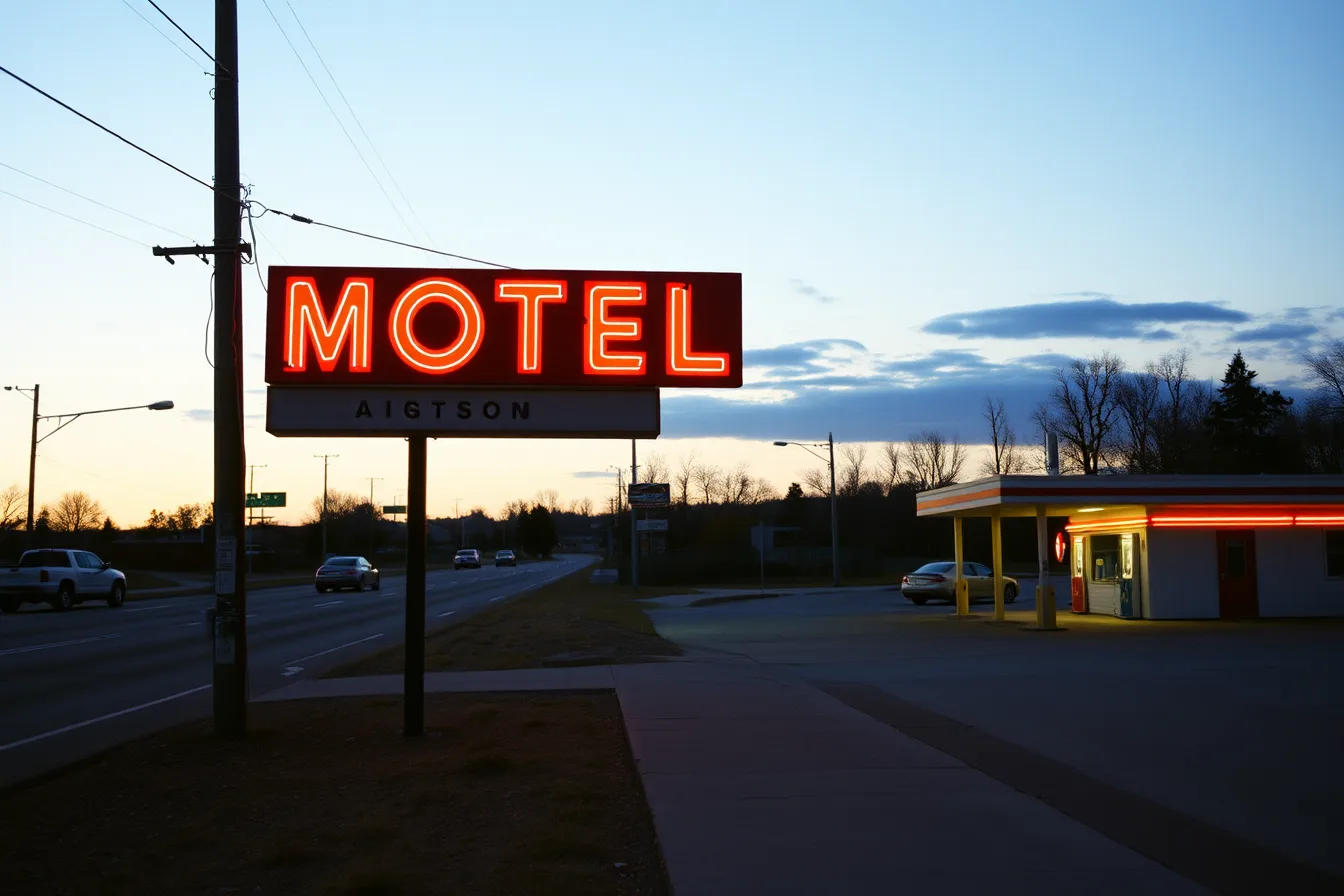
Source image
Separate commercial material from evidence
Regional service providers may supply details about weather preparedness, inspection, or repairs. Attribute that submission and label any paid relationship. It is not independent evidence that a named motel has a particular condition. The Federal Trade Commission says advertising that resembles independent content should be recognizable as advertising. See the FTC native-advertising guide.
Build a local evidence packet
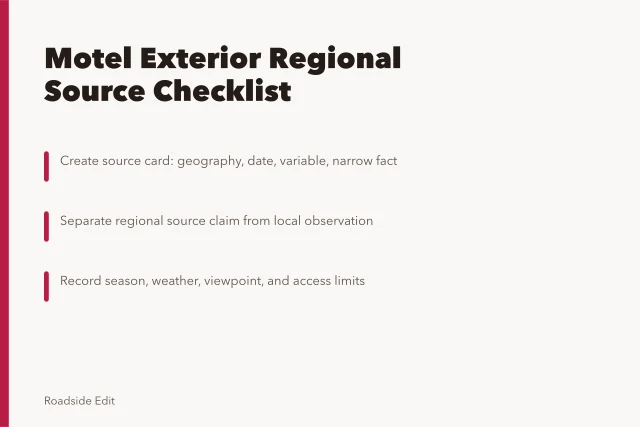
Regional context works best with a simple local packet. Start with the observation date, the address or described area, a narrow image caption, the recent weather source, and what the record cannot show. Add the person or office responsible for the next question.
This packet does not create a technical assessment and stops a broad source from becoming a personal prediction.
Keep seasonal records distinct. A winter observation, a summer heat event, and a monsoon-season report may use the same exterior view but have different circumstances.
Do not replace the earlier note but add the new record with its own date and context. That history shows if a feature was repeatedly observed or if the article has only one isolated image.
Review the wording before release
Before publication, scan every sentence that uses a regional word such as "flood," "heat," "wind," or "climate." Ask whether the source describes a region or this property. If it describes the region, retain that boundary in the sentence. If the article needs a local conclusion, leave it as an open question for the responsible review path at that site.
Common questions
Keep the source boundary visible at all times.
Does a weather event prove why an exterior changed?
No. It provides context but does not establish cause or treatment.
What should be included in an escalation note?
Give the date, visible fact, evidence limit, responsible contact, and unanswered question.
Should a regional article publish urgent property details?
No. Keep property-specific and security-sensitive details out of public content.