Guides
Part of How to plan motel exterior regional adaptation for 2027 with local climate evidence
How to keep motel exterior regional records clean for 2027
Motel exterior regional records guide for 2027 helps U.S. owners retain source scope, dated observations, version changes, evidence limits, and clear handoffs.
Regional research helps only when a future reader can tell its source, the place it covered, and what it did not prove. A regional record should keep that context beside a dated observation from a specific motel exterior, never instead of it.
It should not become a shortcut to diagnosing a wall, choosing a repair, or declaring a local rule.
This guide gives owners and editors a way to preserve regional source notes, observation records, corrections, and handoffs. It is not an engineering report, flood determination, weather forecast, or legal finding for a named property.
What to take away
- Record source geography, data period, and check date before using a regional fact.
- Keep regional background and a property observation as separate entries.
- Save the exact source page or file used for an article sentence.
- Add revisions as dated entries, not quiet replacements.
- Hand off only the current context, open questions, and necessary evidence.
Start with a regional evidence register
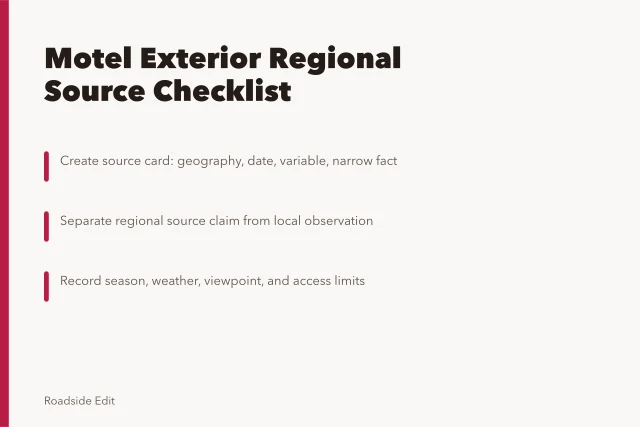
Create one row per source used in a story or property research file. Include organization, page title, precise URL, date accessed, and geographic coverage. Add the time period and the sentence it supports.
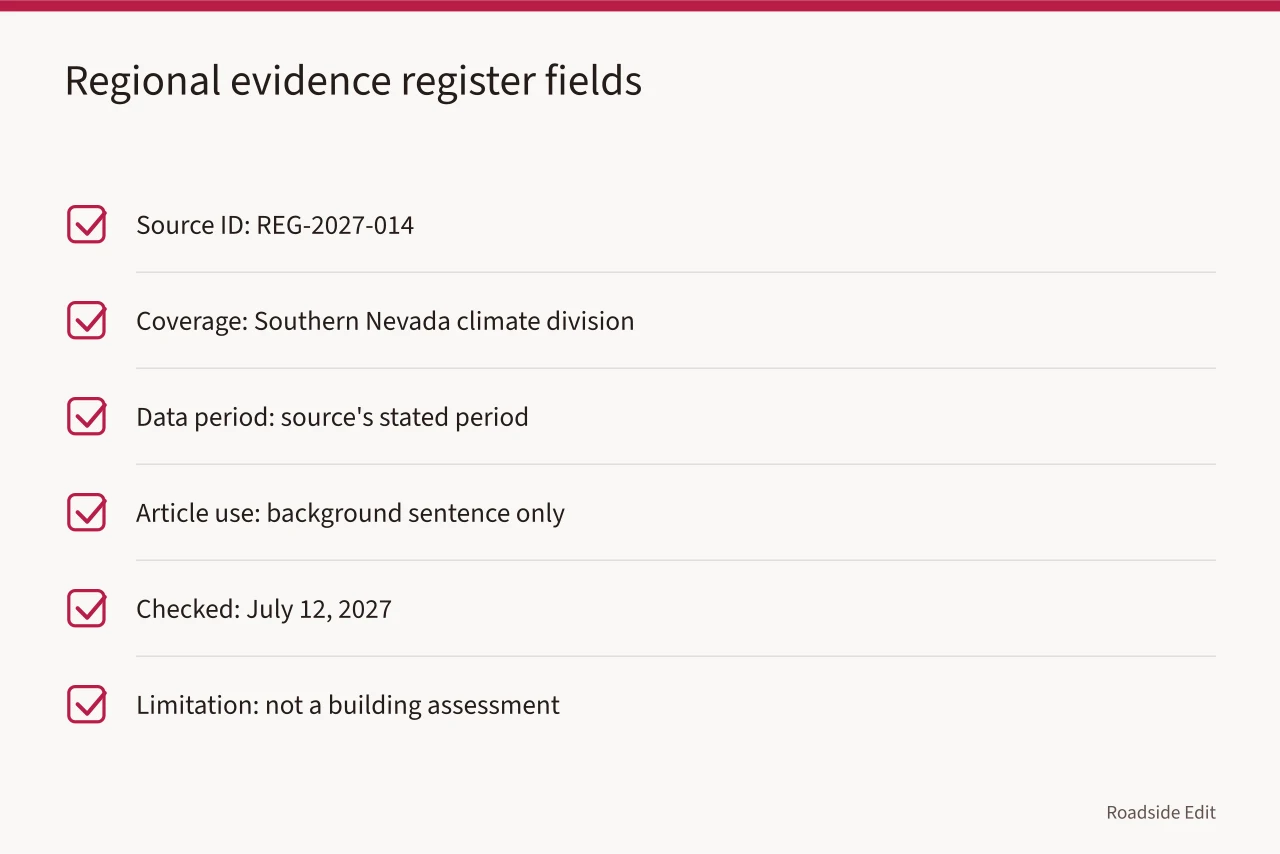
If the scope is statewide, do not label it a county finding, and if a source covers a climate division, do not describe it as a street-level condition.
| Register field | Example | Purpose |
|---|---|---|
| Source ID | REG-2027-014 | Connects notes and article copy |
| Coverage | Southern Nevada climate division | States the actual geography |
| Data period | Source's stated period | Shows the age of the context |
| Article use | Background sentence only | Prevents a leap to a property fact |
| Checked | July 12, 2027 | Marks the version reviewed |
| Limitation | Not a building assessment | Keeps the claim honest |
NOAA's U.S. Climate Division data plots provide access to regional climate-division information. They are not condition reports for individual buildings. The correct record practice is to retain the source coverage and the date it was consulted, then keep a motel observation in a separate record with its own location and viewpoint.
Store source snapshots with the claim they support
Pages change and interactive maps update, so a later editor may not see what an earlier reader saw. Save a durable reference to the source page, its title, and the check date.
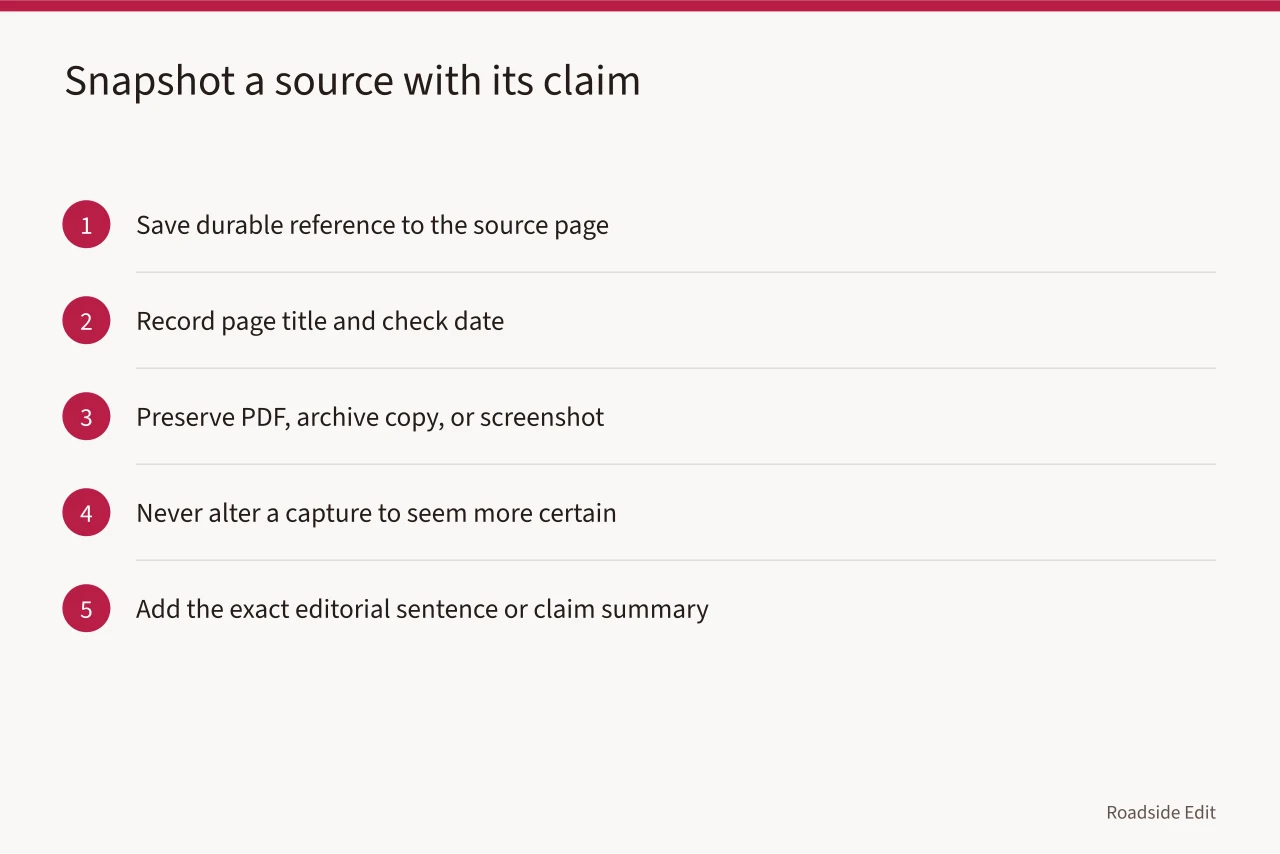
When permitted and practical, preserve a PDF, archival copy, or screenshot in the internal research folder. Do not alter a source capture to make it appear more certain than it was.
Add the exact editorial sentence or a short claim summary to the register. For example: "This source supplies regional precipitation context for a named coverage area." That is much safer than a note such as "proves water damage." It shows the intended use and makes claim review faster.
The National Oceanic and Atmospheric Administration's U.S. Climate Atlas presents mapped temperature and precipitation observations from thousands of stations. It provides broad climatic context, not evidence that a particular roof, drain, or wall condition resulted from climate. A source snapshot should preserve that boundary alongside the map or data reference.
Link the local observation without merging it into the source
Create a second record whenever a team documents an exterior. The observation record should carry the date, exact area, safe viewpoint, visible fact, access limit, image source, and next question. It can point to the regional source ID for context, but it should not repeat a regional statement as though it were visible at the motel.
Use a paired format:
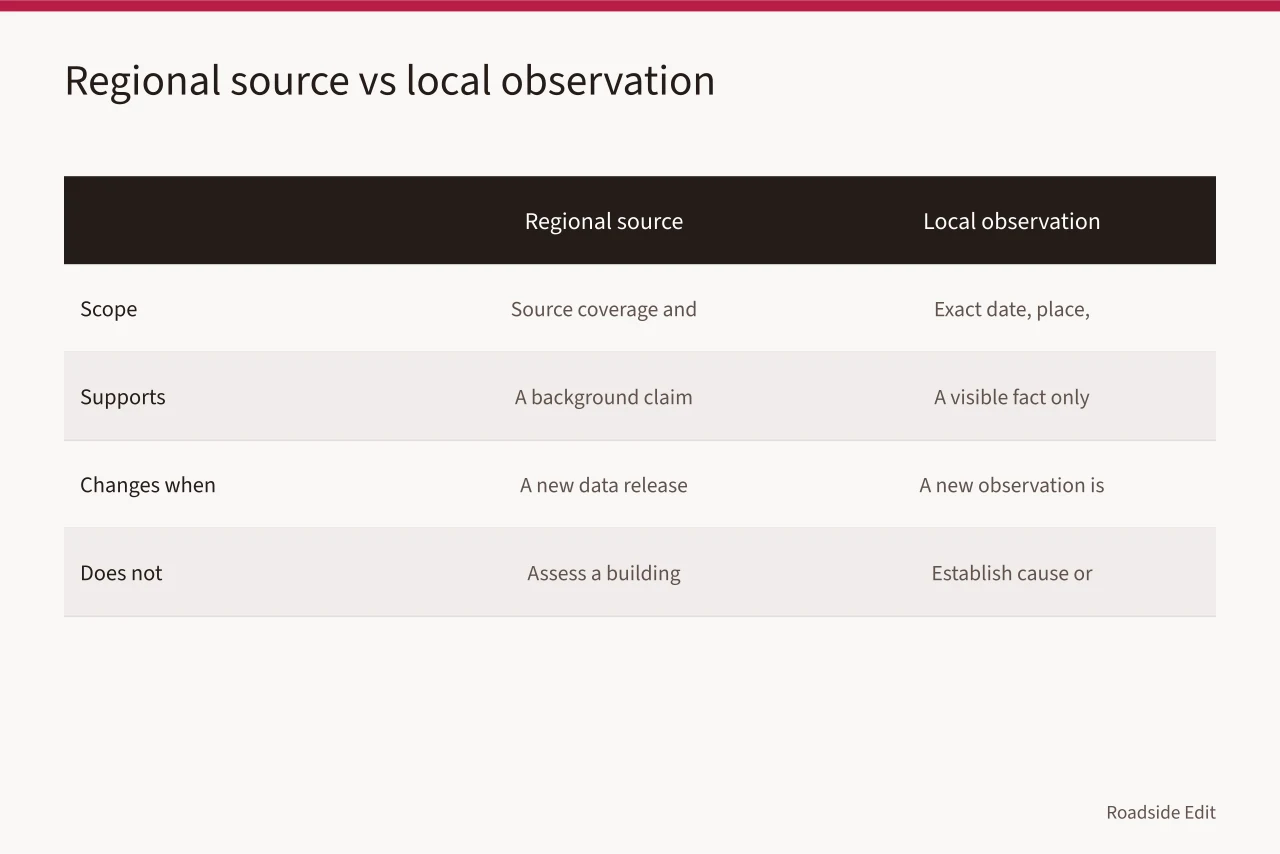
Example: a register may state that a federal source covers a particular climate region. A local record may state that water was visible on a north parking edge during a walk. Neither item proves why water was present, whether it is recurring, or what treatment is needed. Keep the open question clear.
Preserve locations without exposing sensitive details
Use stable, plain area names such as "west guest walkway" or "main sign at street approach." Avoid publishing access codes, private service routes, staff schedules, guest information, or security-sensitive images. A private operational record may need more detail than a public editorial file. Maintain that separation from the start.
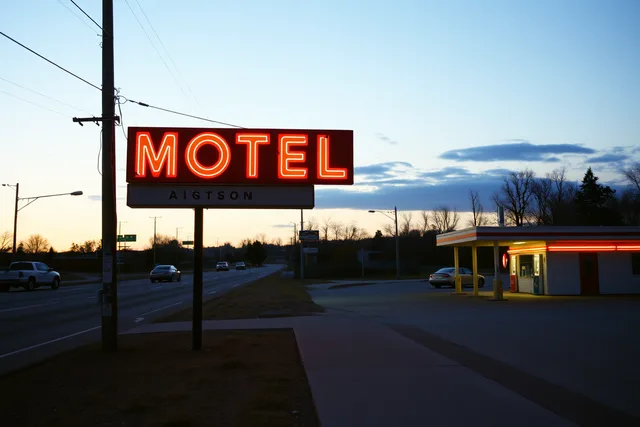
For photos, add a narrow caption: place, date or historical context, source, and what the image is included to show. A historical image of another motel can illustrate regional roadside history. It cannot prove a present condition at the property being discussed.
Use climate zones as context, not as a project instruction
Climate-zone material helps a writer locate an appropriate research lens. It does not settle material selection, local permitting, present maintenance status, or a building's energy performance. Record the source scope and use it to ask a more precise question of the responsible local party.
The Department of Energy's climate-zones overview describes Building America climate regions using factors that include temperature and precipitation. This information supports a broad regional label for energy-planning purposes. It does not set a maintenance requirement for a motel. In the evidence register, write the source's stated purpose rather than inventing a property-specific implication.
Track corrections as an audit trail
A source page can be revised. An observation may be re-located after a better labeled image arrives. A quoted authority may clarify its statement. In each case, retain the original entry and add a correction record with a date, new source, and reason. Do not quietly replace the old context and make a historical claim impossible to review.
Use this correction sequence:
- Identify the original source or observation ID.
- State the limited fact that is being corrected.
- Add the newer page, image, or attributed response.
- Explain why the new evidence is better.
- Mark whether an article sentence was changed or withdrawn.
The National Archives' information-quality guidelines describe correction procedures that identify the affected information and document the response. They apply to agency information, not motel research. The practical lesson is still sound: a correction should show what changed and why, rather than erase the record that led to the earlier statement.
Prepare a regional handoff packet
Before an editor or manager changes roles, make a short handoff packet. Include the evidence register, current source snapshots or links, open local observations, latest corrections, article claims that depend on regional context, and a list of sources that need rechecking. Do not send a massive, unindexed archive and expect the next person to find what matters.
The receiving person should be able to answer four questions quickly:
- What region does this source actually cover?
- Which published sentence depends on it?
- What was personally observed at the motel, and from where?
- What question is still waiting for a responsible local answer?
If the packet cannot answer those questions, the register needs more work before handoff.
Keep commercial submissions outside the evidence register
Regional tourism groups, contractors, and property managers may offer useful leads. Record their author and date, but do not place a sales statement in the same category as independent climate data or a dated observation. If the site accepts a paid placement, disclose it and maintain a separate commercial record.
This separation protects both the reader and the business. It leaves room for a company to describe its services without making that description look like third-party proof of a regional condition, local authorization, or expected outcome.
Common questions
Does a regional record establish the condition of one motel?
No. It records background context. A property observation needs its own date, viewpoint, source, and stated limits, while a condition assessment needs appropriate property-specific review.
What is the minimum useful source snapshot?
Keep the exact URL, organization, page title, check date, geographic scope, and the narrow claim the source supports. Add a saved copy when the source is likely to change and retention is permitted.
When should an old regional claim be corrected?
Correct it when the underlying source no longer supports the sentence, the geography was described incorrectly, or better evidence changes the stated fact. Keep a dated correction note with the original record.