Guides
Part of How to plan motel exterior regional adaptation for 2027 with local climate evidence
Motel exterior regional checklist: how to document climate sources before 2027
A repeatable route, dated wording, and named climate sources let you document a motel exterior without turning regional data into a claim about the building.
A climate zone covers a county. A motel exterior is one building on one parcel, and the difference between those two facts is where most regional writing goes wrong.
This checklist gives you a route you can walk the same way twice, wording you can reuse across seasons, and the named sources that carry regional context without pretending to assess the building.
Use it before a seasonal walkaround, before a local guide, or when you are deciding whether a regional source belongs in a property article at all. It does not predict weather, diagnose a building, or choose a repair.
What to take away
- Walk the same route in the same order each visit, and name each stop the way a later reader can find it.
- Keep the regional statement and the site observation in separate sentences, each with its own source.
- Date every photo and every note; a one-season view is not a history of a feature.
- Send permit, drainage, and sign questions to the authority that sets the rule, and keep the written reply.
- Re-check a climate or hazard page before you reuse the sentence it supported.
Build a source card before you write a claim
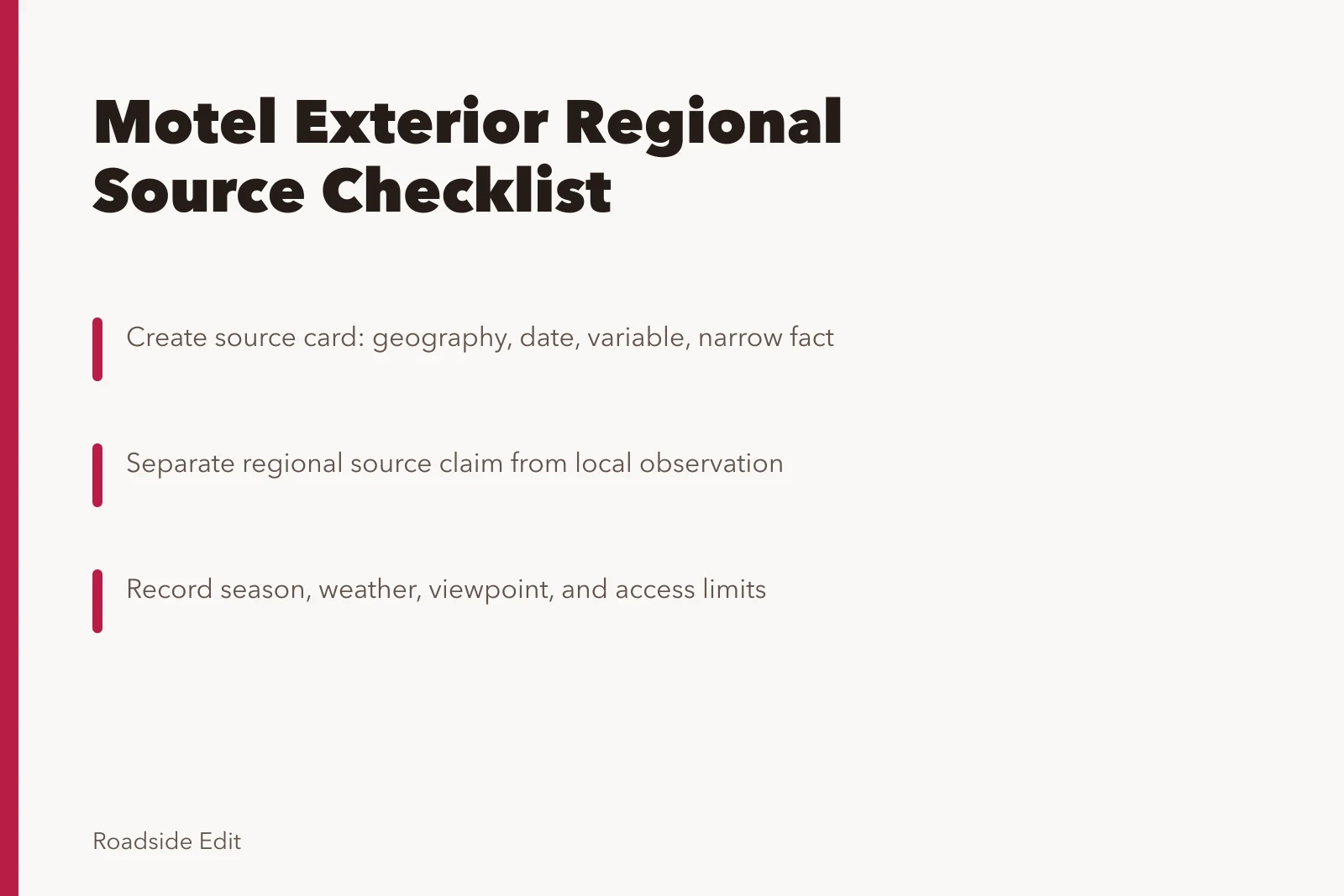
One card per source. It records the publishing organization, the page or PDF address, the geography, and the data period. It also records the variable, the check date, and the single narrow fact.
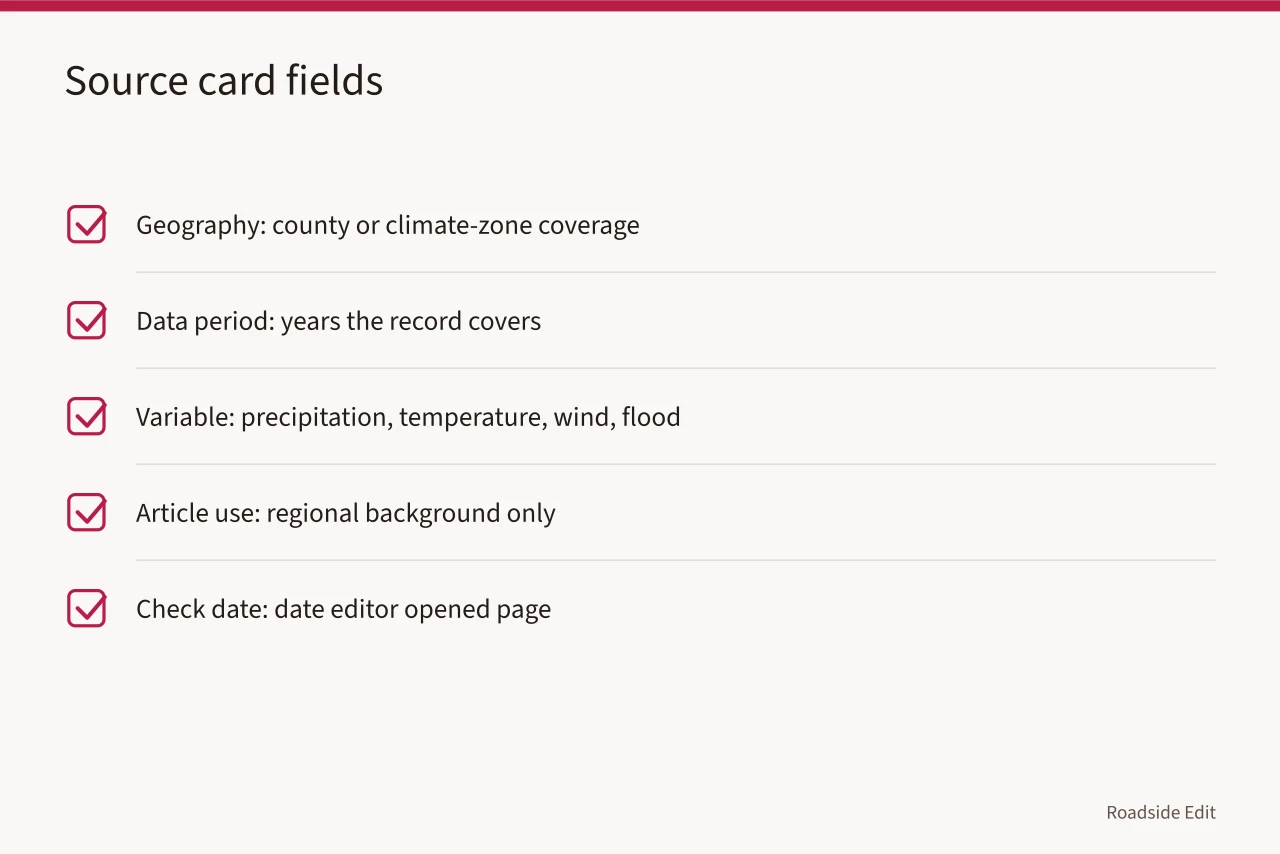
| Field | Example entry | Why it stays on the card |
|---|---|---|
| Geography | County or climate-zone coverage | Stops a broad source being read as site-specific |
| Data period | Years the record covers | Shows the age of the context |
| Variable | Precipitation, temperature, wind, mapped flood | Keeps the claim narrow |
| Article use | Regional background only | Blocks the leap to a building diagnosis |
| Check date | Date the editor opened the page | Tracks a revised source |
The Department of Energy publishes Building America climate zones built from temperature and precipitation measures, with county-level material. Review the DOE climate-zones overview. It is an energy-planning resource. It will place a property in a zone; it will not tell you anything about the condition of a canopy soffit.
Keep the regional fact and the local observation apart
Write two sentences, never one blended claim. The regional sentence cites its source and its geography. The local sentence says what was visible, from where, on what date. The first never proves the second.
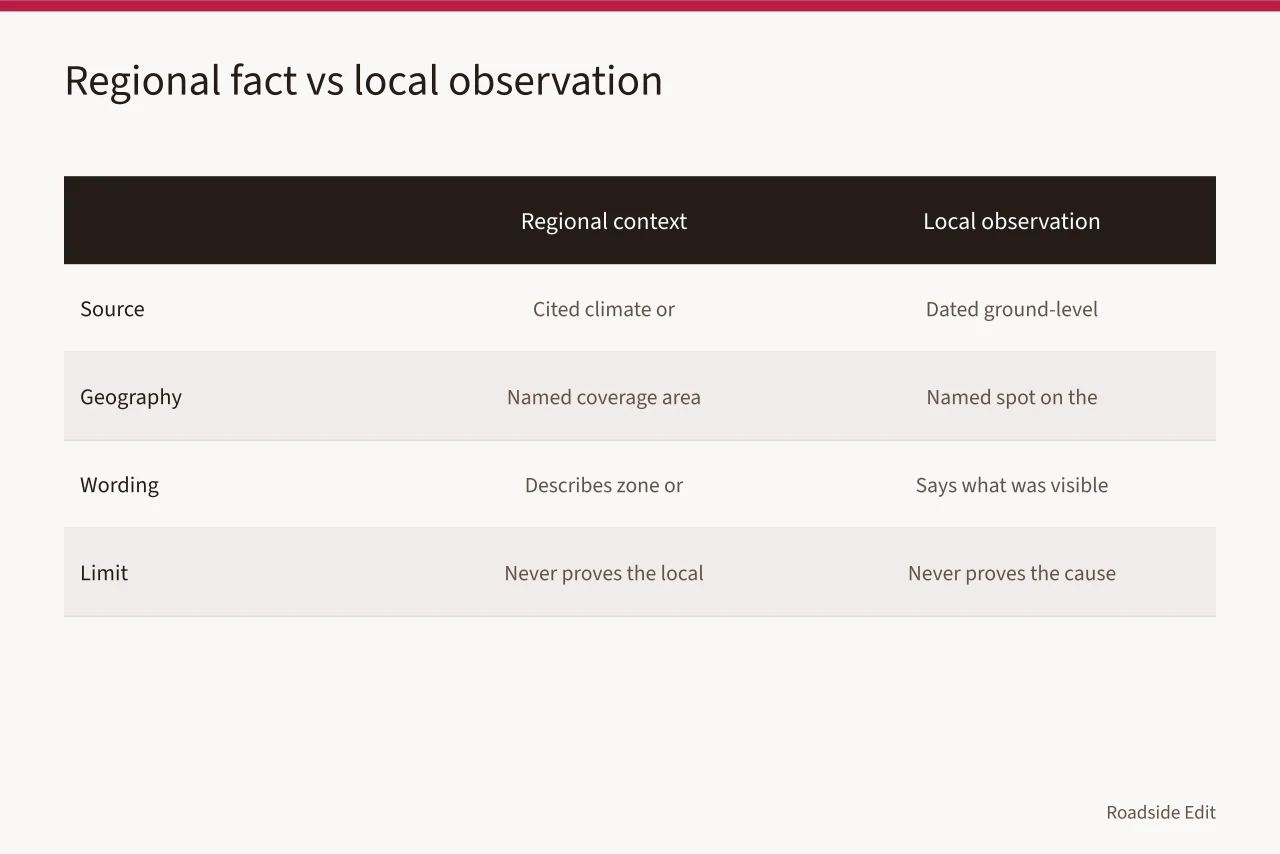
- Regional context: a cited source describes a climate zone or a historical weather pattern for a named coverage area.
- Local observation: on a named date, water stood along the west parking edge, seen from the public sidewalk.
- Open question: whether that is a property-specific issue, and what to do about it, belongs to the owner and a qualified reviewer.
The common failure is turning "the region gets seasonal rain" into "rain caused this stain." The source does not carry that chain, and a ground-level photo does not fill the gap.
NOAA's U.S. Climate Atlas maps daily temperature and precipitation observations from thousands of stations. Use it to name the climate context and record the coverage. Leave every property conclusion off the card.
Walk a route you can repeat
A regional checklist earns its name by giving you a small route, not a survey of the whole parcel. On a roadside motel that is often the entrance, the north wall, the parking edge, the sign zone, and the drainage path visible from authorized ground.
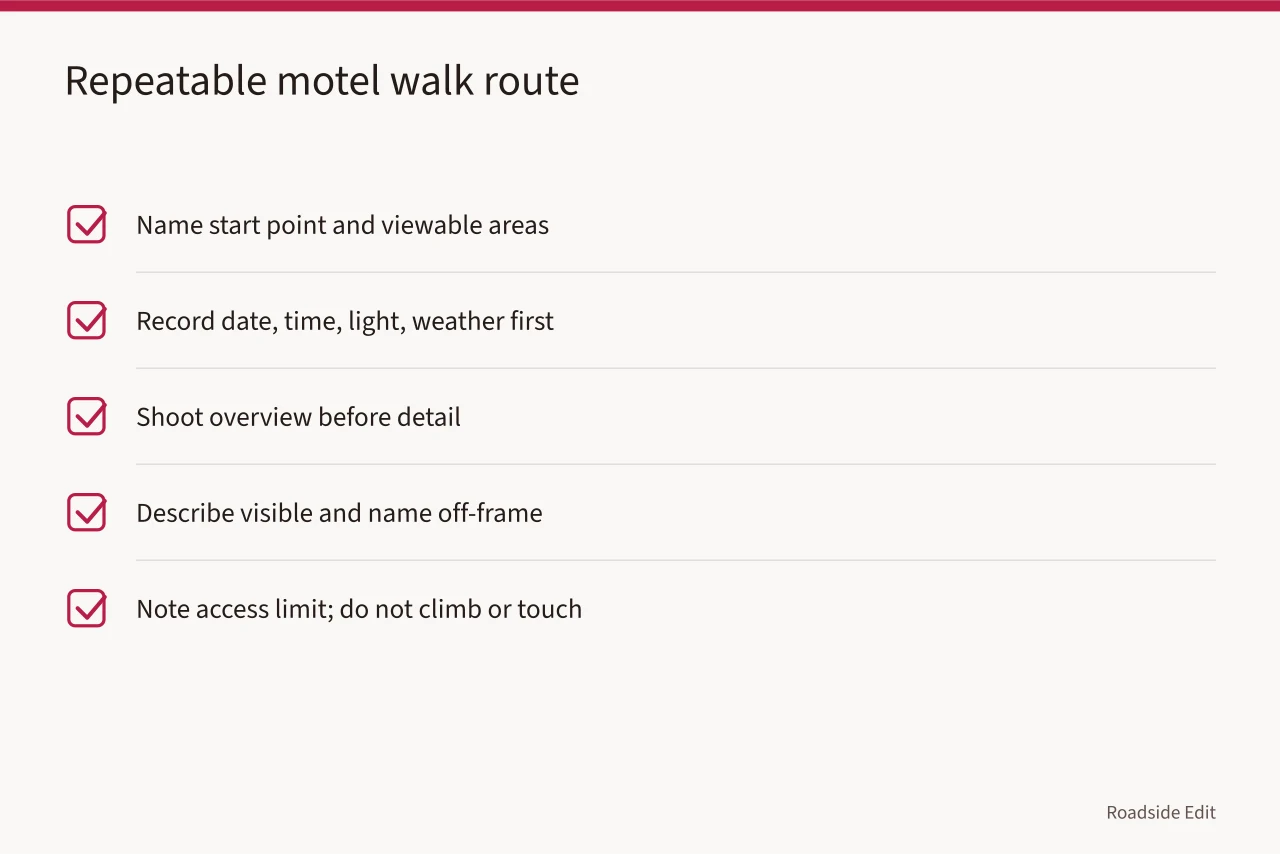
- Name the start point and the areas you can view without crossing a barrier.
- Record date, time, light direction, and weather before the first photo.
- Shoot the overview before the detail, so the detail has a place to sit.
- Describe what is visible in plain words, and name what is outside the frame.
- Note the access limit instead of climbing, opening, or touching equipment.
Keep the place names stable between visits. "West walkway by room 108" compares across years; "side path" does not. When a feature changes, write the change down rather than quietly reusing the old label.
Write the season into the record, not the diagnosis
Season controls what you can see and how long you can stand there. Rain shortens the route. Heat ends a midday walk early. Snow and leaf cover hide surfaces. Record the limit, and stop short of saying the season caused what you saw.
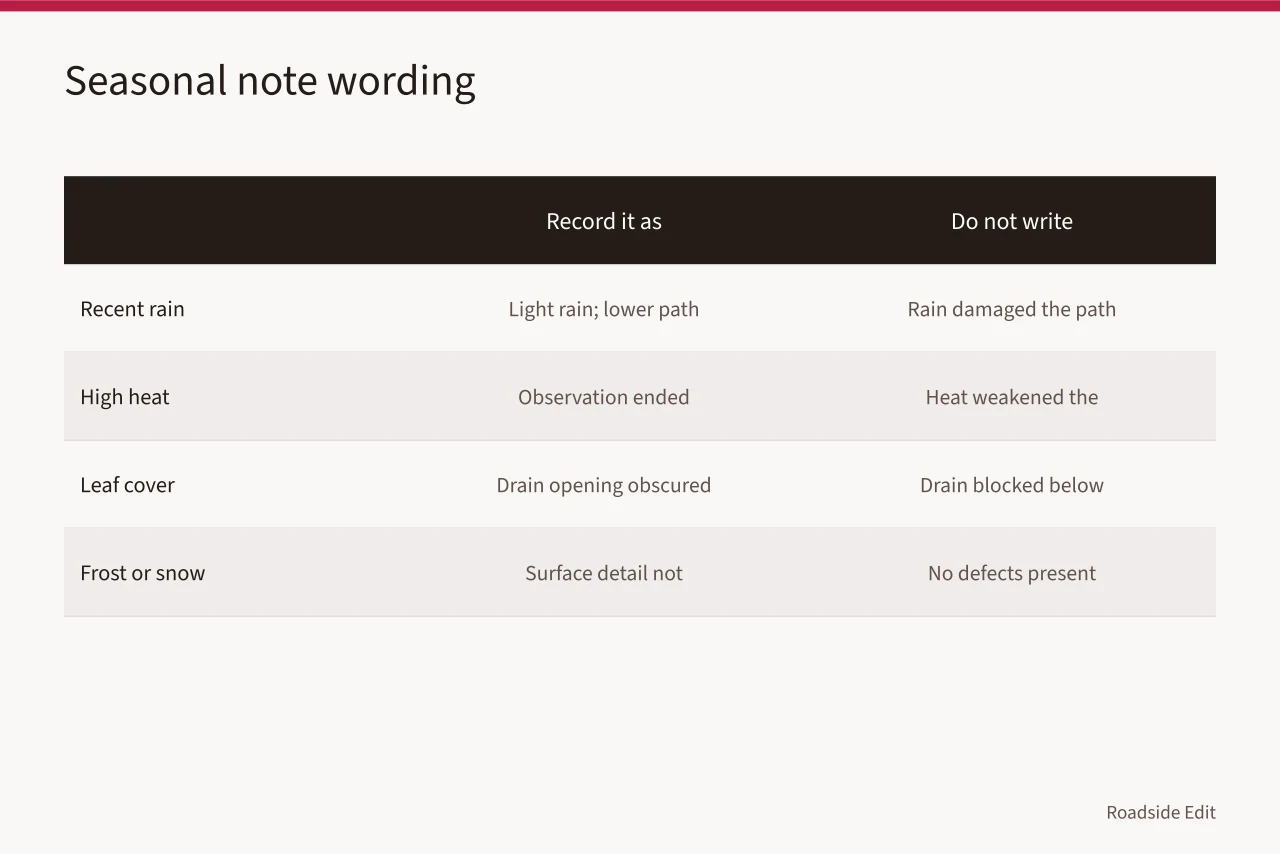
| Seasonal note | Record it as | Do not write |
|---|---|---|
| Recent rain | "Light rain during the walk; lower path wet." | "Rain damaged the path." |
| High heat | "Observation ended early; heat exposure." | "Heat weakened the facade." |
| Leaf cover | "Drain opening partly obscured by leaves." | "The drain is blocked below grade." |
| Frost or snow | "Surface detail not visible under snow." | "No defects present." |
The National Park Service's Preservation Brief 47 on exterior maintenance treats maintenance as planned, recurring attention to exterior features. It is written for historic buildings, not every motel.
What carries over is the habit: observe on a schedule, keep the dates, and never let one season stand in for the history of a wall.
The roadside architecture regional checklist walks through what to verify before any of this reaches a published page.
Read mapped hazards as background
Mapped flood information, station records, and climate-zone descriptions tell you where to ask a better question. They do not establish current site safety, existing damage, insurance status, or project scope.
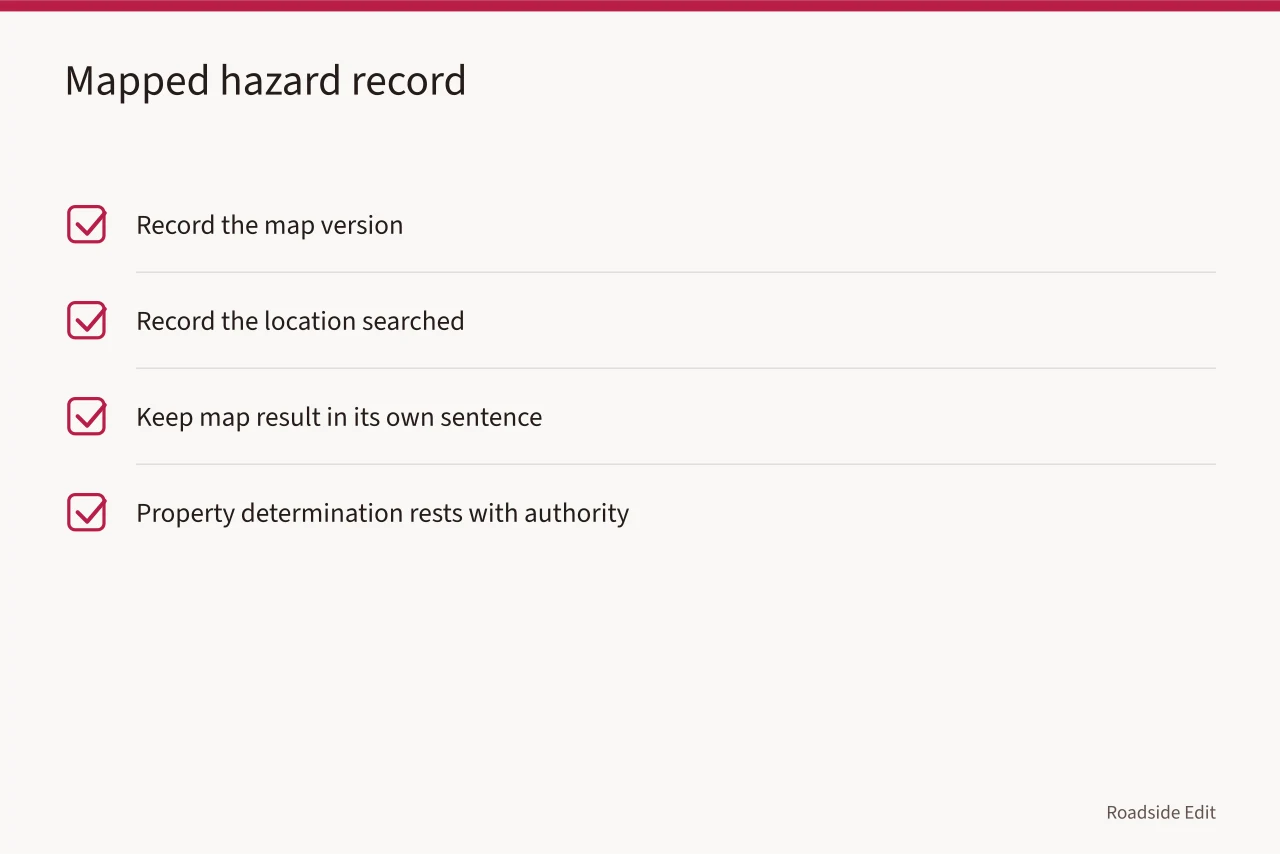
FEMA's National Flood Hazard Layer carries flood hazard information for mapped areas. A map layer does not describe the current condition of a parking lot, a foundation, or a drainage feature. When mapped information matters, record the map version, the location you searched, and the fact that a property-specific determination rests with the responsible authority.
Keep the map result in its own sentence, apart from the observation record. A reader should be able to see which line came from the map and which came from a dated photo.
Ask the authority, keep the reply
Regional research does not settle local rules. Before publishing a claim about permits, find the office that holds the question. The office may be city, county, tribal, state, or federal. Ask in writing and keep the date.
- Which office has jurisdiction over this issue?
- What page, code section, or public document supports the answer?
- What location and project details would that office need to answer for this property?
- Does the source show an effective date, or has it been superseded?
- Which sentences must stay general because the source does not decide the individual property?
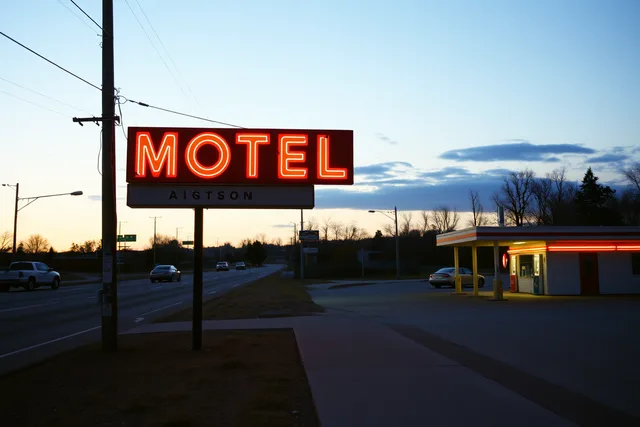
The same discipline applies to the sign on the pole. A regional question list for neon keeps tube diameter, transformer load, and repainting questions with the electrician and the landmarks commission rather than in the article.
Log the update, and separate paid from editorial
Climate and hazard pages change. Log the source card ID, the check date, the editor role, and the changed page or data version. Log the sentence it supported and the action taken. If a source no longer supports a sentence, fix the sentence. Do not leave a claim standing because it was once convenient.
A tourism office, contractor, or property manager may hand you useful local information. Record who said it and when, then sort it into commercial material, a research lead, or something you can confirm independently. A paid placement gets disclosed and never becomes the only support for a climate, safety, or property claim.
For public images, keep the exact source page and a narrow caption. A regional photo shows historical or visual context. It is not evidence of the present condition of another motel. A modern roadside safety checklist is the companion habit on the ground: it keeps each field note dated, named, and usable when the article is finally drafted.
Common questions
Can a climate zone tell me what repair a motel needs?
No. A zone is broad context. The repair depends on the actual building, its materials, its condition, the local requirements, and a qualified reviewer's judgment.
What belongs in a regional photo caption?
The location, the source, and the reason the image is here. Say plainly that it is contextual when it is not a photo of the property under discussion.
How often should a source card be reviewed?
When the article is updated, when the source page changes, and before you make a new claim from it. Keep the earlier check date in the research record so the sequence stays visible.