Guides
Part of How to avoid vintage diner interior reporting mistakes before you file
Vintage diner interiors: how to prevent budget note mistakes before you reuse a figure
Reusing a diner interior figure safely means keeping its source, date and scope attached, and filing superseded amounts instead of overwriting them.
A budget note fails the moment a figure travels without its paperwork. The number is the easy part. The source, the date and the scope are what keep it honest, and they are the first things lost when a cost moves from a long article into a table, a caption or a listicle.
What to take away
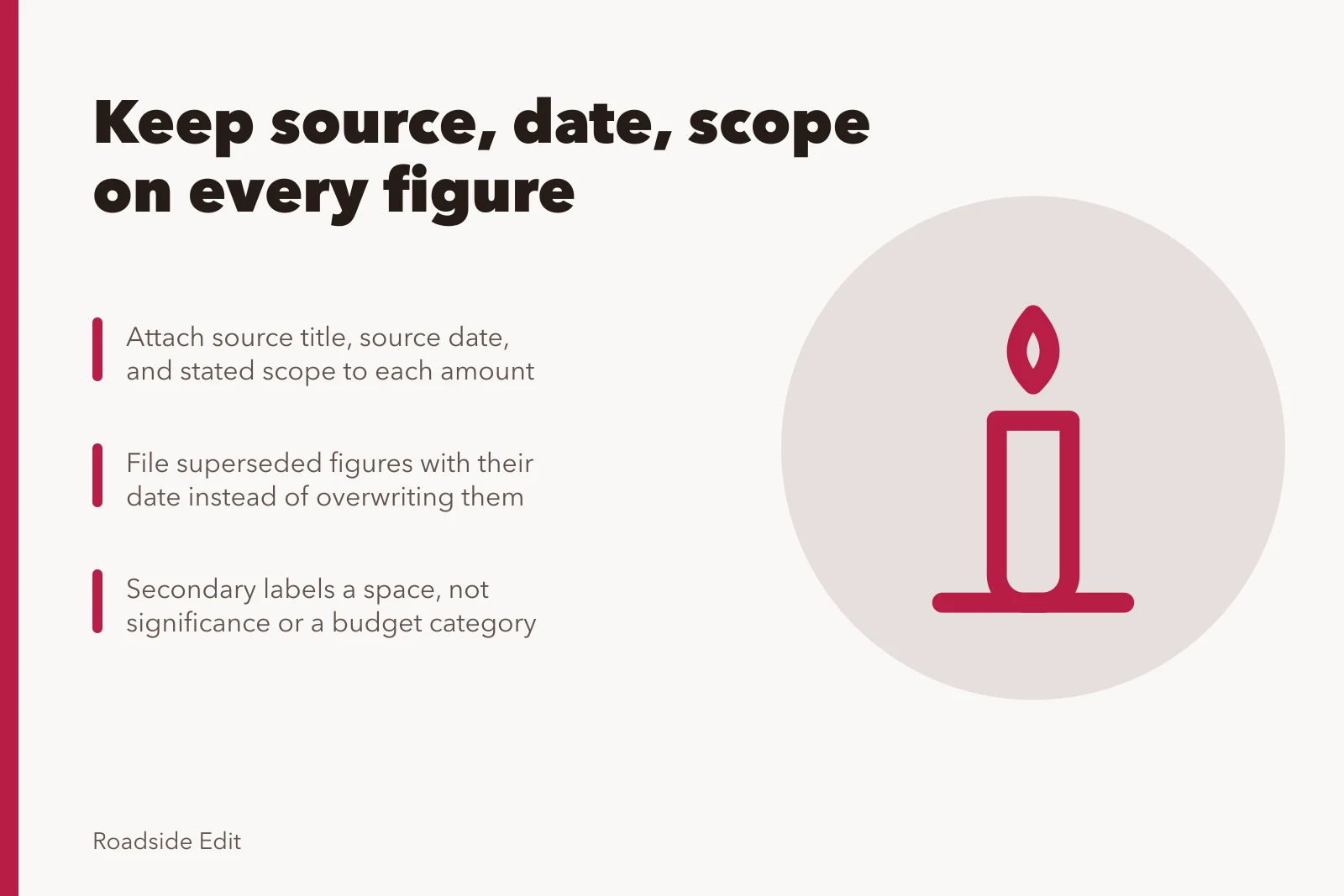
- Every reused amount keeps three things attached: source title, source date, and the scope the source stated.
- Never overwrite a superseded figure. File it with its date and source so the record shows what was once reported.
- Set a review date on every figure in an evergreen article, and state what changed when the source updates.
- A label such as secondary describes a space in a building, not its significance and not its budget.
- Paid placement needs conspicuous disclosure, and disclosure does not verify the price next to it.
Keep the source wording, not a tidier version
If the source calls an amount an award, call it an award. If the source says preliminary, proposed or estimated, keep that word in your sentence. "Final project cost" is a claim about a completed project, and it belongs only to sources that say so.
The same discipline applies to the noun. Renovation, rehabilitation, interior work and restoration cover different scopes in different programs, so a figure labeled one way does not transfer to a sentence using another. When the detail needed to compare two amounts is missing, write that the figures are not comparable.
Vintage diner interior mistakes usually start here, with a number that was accurate in its original sentence and wrong in its new one.
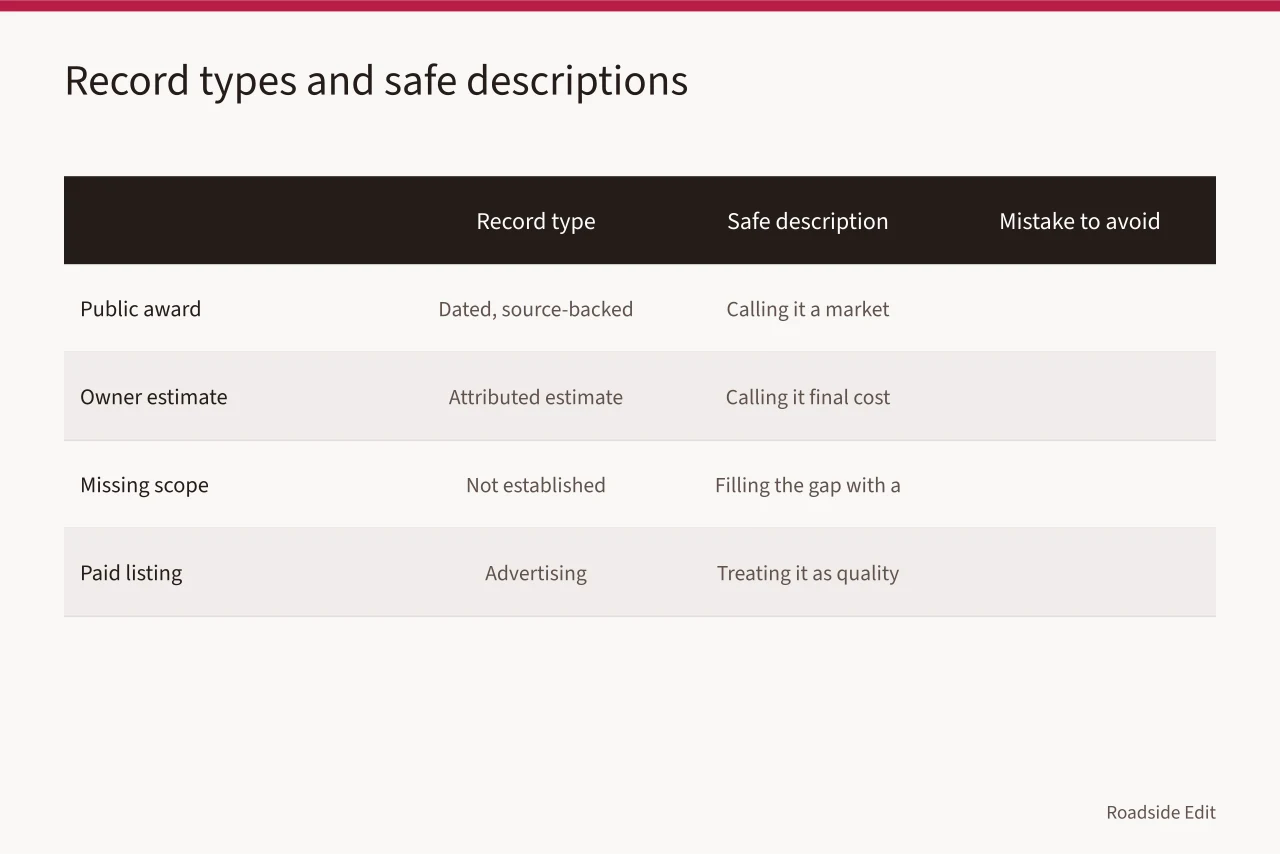
| Record type | Safe description | Mistake to avoid |
|---|---|---|
| Public award | Dated, source-backed amount | Calling it a market price |
| Owner estimate | Attributed estimate | Calling it final cost |
| Missing scope | Not established | Filling the gap with a guess |
| Paid listing | Advertising information | Treating it as quality evidence |
File the old figure, do not replace it
When new reporting changes an amount, the working record keeps both versions. Write the superseded figure with the date it was reported and the source that carried it, then add the new figure beside it.
A reader researching a 2027 grant award may need to know that a different number circulated first, and a record that shows only the current total cannot tell them.
This is the difference between a correction and an erasure. A correction says what changed and when. An erasure leaves the next editor unable to explain why an archived page and a live page disagree.
Set a review date for every figure that appears in an evergreen article. On that date, compare the source page against the sentence already published. If the source changed, state what changed in the article.
If the source did not change, leave the article's date alone. Refreshing a date without new reporting tells the reader something false about the content.
What a secondary-space label does and does not settle
The National Park Service notes that historically finished secondary spaces can still contribute to a building's overall historic character and finished appearance. Its guidance on secondary spaces supports a narrow editorial rule: the word secondary is a description of a space within a building, not a finding that a feature lacks significance and not a budget category.
A back-bar, a coat check or a restroom vestibule can carry original tile, laminate or chrome trim that matters to the record. Whether it does is a question for the survey and the primary record, not for the label. Name the survey source and date when the article describes a specific property.
Where the outside authorities stop
The Government Accountability Office's cost-estimating guide treats documented assumptions, a technical baseline and a defined purpose as parts of a credible estimate. That is the standard a source amount has to meet before an article compares or summarizes it. The guide estimates no diner project.
The Internal Revenue Service explains the historic rehabilitation tax credit in terms of qualifying expenses and certified historic structures. Keep any incentive separate from a reported project total, and route eligibility questions to a tax professional and the State Historic Preservation Office.
The Federal Trade Commission's endorsement guidance supports conspicuous disclosure where payment could affect how a reader weighs a listing. Disclosure explains the relationship. It does not verify the scope or the price.
Common questions
Can a public award amount be reused as a local estimate?
No. Keep it tied to its source, its date and the scope the source stated. If a reader needs a figure for a specific property, that comes from a professional estimate for that property.
Does a secondary-space label mean an interior feature has no historic importance?
Not necessarily. Significance depends on the specific facts and the record, so name the survey source and refer to the primary documentation.
Can a paid listing sit inside a budget table?
Yes, with conspicuous disclosure and no implied ranking. The disclosure explains the commercial relationship and says nothing about whether the amount is accurate.