Guides
Part of Modern Roadside Design Maintenance Plan 2027
Modern roadside design maintenance plan questions to ask before 2027 work starts
Modern roadside design care questions for 2027 help owners clarify maintenance scope, duties, evidence, costs, and escalation before work starts.
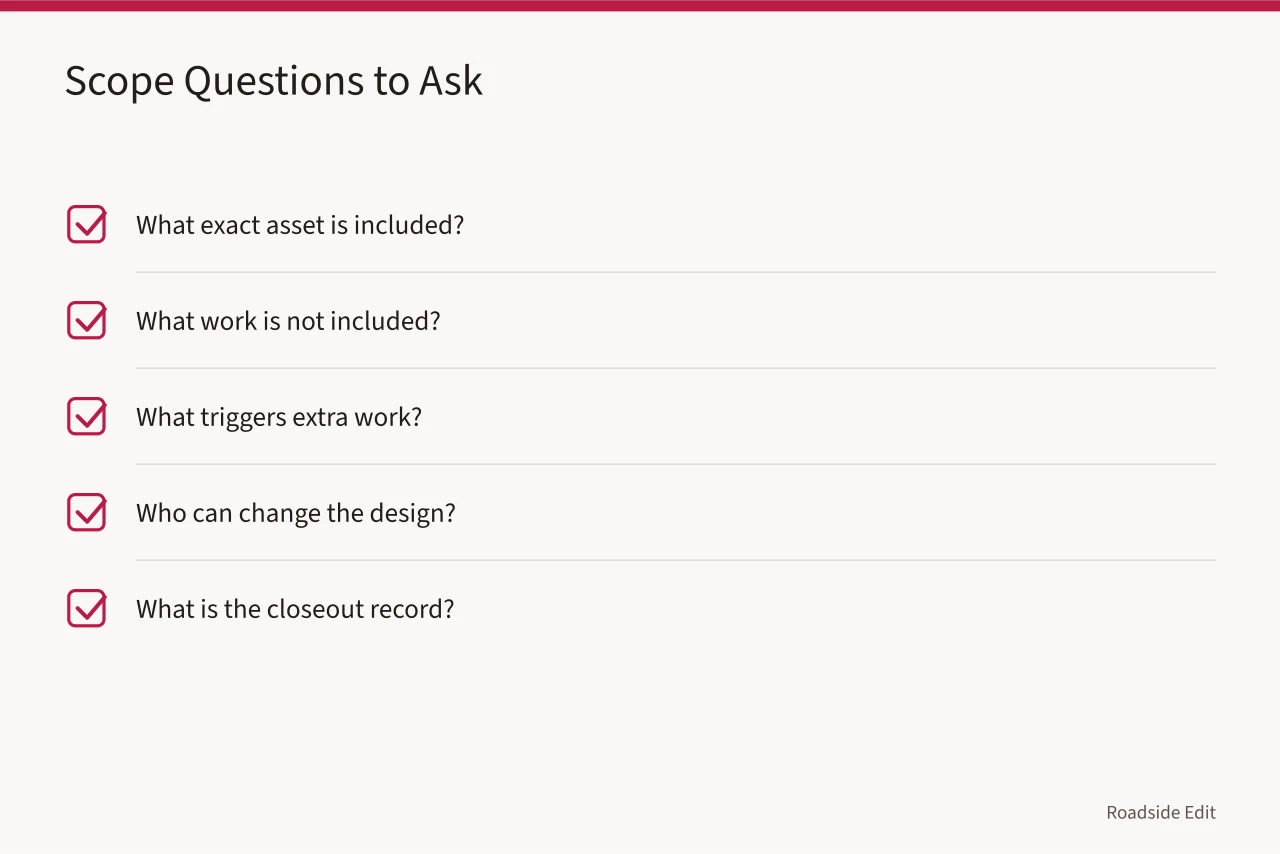
Before accepting a maintenance proposal, ask questions that expose the scope. The goal is not to force a vendor or owner into a fixed answer before a site review. It is to make sure the work, authority, and record are clear enough to compare responsibly.
What to take away
- Ask what is included and excluded in writing.
- Ask who can approve a change to the feature.
- Ask how routine findings become repair decisions.
- Ask what record is delivered after each visit.
Questions about scope
Start with boundaries. Does the proposed work cover cleaning, inspection, vegetation, material replacement, disposal, travel, documentation, or after-hours response? Which of those actions need owner approval? The Federal Highway Administration's roadside maintenance resources separate subjects such as drainage, vegetation, and signs. That is a useful reminder that a single phrase like "roadside maintenance" can conceal different skills, tools, and responsibilities.
| Ask this | Listen for |
|---|
Questions about condition
Ask how the person doing the work distinguishes observation from conclusion. A good answer identifies what will be recorded, who receives it, and what happens if the issue sits outside routine care. Be cautious of a proposal that promises a technical outcome without defining the site evidence or authority needed to make that judgment.
Also ask whether the quoted interval is a calendar promise or an adjustment after an event. A monthly visit can still miss a significant change if the work order has no event-triggered review.
Conversely, a short inspection after an unusual condition may show no extra work is necessary. The useful proposal explains the decision path instead of promising a result it cannot verify.
NPS Preservation Brief 47 says inspection intervals vary with climate, rainfall, existing conditions, and building use. Significant weather events can call for inspection. Read NPS Preservation Brief 47.
The brief covers historic building exteriors, not a schedule for every roadside asset. It gives an owner a follow-up question: what site condition or event would change the planned review interval?
Questions about continuity
Ask where photos, invoices, approvals, and changes will be stored when staff or vendors change. Request a simple file convention and a handoff date. The most expensive maintenance surprises often begin with a missing record rather than an obvious failure.
Questions about the evidence trail
Ask how each visit will be documented and how a reader links a photo to a particular asset. A useful answer gives the date, location, observation, action taken, and any task deferred for review.
It should also name limits, and a distant photo may show general condition but not why it occurred or what repair fits.
NPS documentation standards call for reliable source material with limitations stated so the information can be checked independently. Read the NPS documentation standards. Routine maintenance notes are not formal heritage documentation. The same plain-language practice helps: describe what was observed, mark what was not visible, and avoid turning a field note into a technical diagnosis.
| Question | A useful answer includes |
|---|---|
| How will the asset be identified? | Stable location or feature label |
| What evidence is saved? | Dated note, image, or approved work record |
| Who sees an escalation? | Named owner or decision role |
| How is a correction recorded? | New dated entry, not a silent overwrite |
Questions about future care
Ask whether the proposal identifies the history and conditions future workers need to know. That could be a prior inspection record, an existing-condition report, a list of material constraints, or a note about earlier work.
You do not need a large report for every task. Keep enough context so a new person does not repeat investigation already done.
NPS says historic structure reports can provide maintenance information and record research, investigation, and physical work for future users. See the NPS Historic Structure Reports overview. That source does not prescribe a plan for a commercial roadside feature. It supports asking how a routine record will carry forward useful findings without making unsupported claims about the property.
Before publishing a vendor profile or paid placement, keep the project process separate from advertising. A provider may state a service, but an owner should not convert that statement into proof of a condition, approval, or completed result.
Common questions
Why ask about exclusions first?
Exclusions show whether two proposals can be compared on the same scope.
Can a vendor decide whether to redesign an asset?
Only if that authority is written into the project process. Routine care and a design change are different decisions.
What should a visit record contain?
At minimum, it should include the date, location, observed condition, action taken, and open follow-up.