Guides
Part of How to compare modern roadside design options before you decide
Modern roadside design options comparison: a 2027 scope checklist for fair reviews
Compare guardrail, cable barrier, concrete barrier, crash cushions and breakaway posts on one set of fields before any roadside option is reviewed.
A comparison of roadside systems goes wrong in a predictable way. One option arrives with a route map, a maintenance note and a maker's test record. The others arrive as labels. The review then rewards the option that was documented hardest, not the one that fits the site.
This checklist fixes that. It does not pick a system and it does not settle local requirements. It shows whether each proposal carries the same information, so the next reviewer can compare like with like.
What to take away
- Write the shared problem first, in the words a road user would use, and keep every option pointed at it.
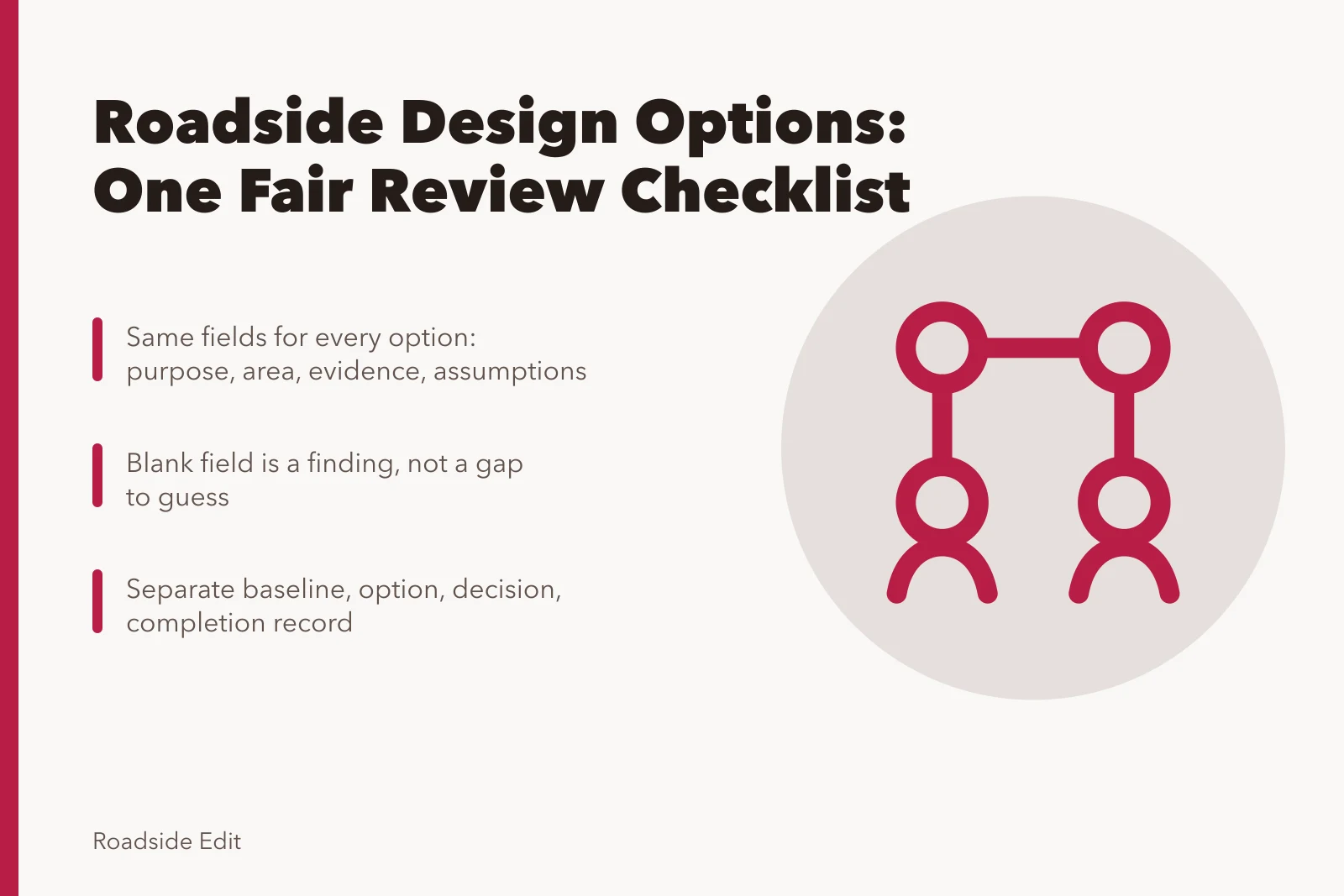
- Give each option the same fields: purpose, area, evidence, assumptions, care question, decision owner, next review.
- Treat a blank field as a finding. An empty cell is more honest than a confident guess.
- Separate four things that get blended: baseline condition, option, decision, completion record.
- Date the file and name who owns the next review, so a later reader can see why an option changed.
Name the options
Real systems turn up in these reviews again and again. Each has a public record you can request from the maker or the state DOT.
MGS guardrail. The Midwest Guardrail System runs W-beam rail on steel posts. FHWA and many state DOTs list it for new installations, and its test history is published.
High-tension cable median barrier. Tensioned cables on steel posts, used where the median is wide enough to allow deflection. It reduces cross-median crashes and needs scheduled tension checks.
Concrete median barrier. Precast or slip-formed, it separates opposing traffic and limits deflection on narrow medians. Installation needs lifting equipment or a slipform crew.
Crash cushions. QuadGuard by Trinity Highway and ABSORB 350 by Lindsay Transportation Solutions are impact attenuators for gore areas and fixed objects. Both carry MASH test levels, and both need replacement parts after a hit.
Breakaway sign supports. Telespar and OmniPost use breakaway or slip bases that yield when struck. They suit sign posts in clear zones and depend on correct bolt torque.
Roundabouts. FHWA promotes roundabouts as an intersection option, with published crash-modification factors by configuration.
Two reference tools sit behind all of these. The Roadside Safety Analysis Program (RSAP) estimates crash costs for roadside alternatives, and AASHTO publishes the Roadside Design Guide. Both are references. Neither approves anything for your site.
Check the comparison file
EPA's community-planning guidance lists the categories a plan should cover:
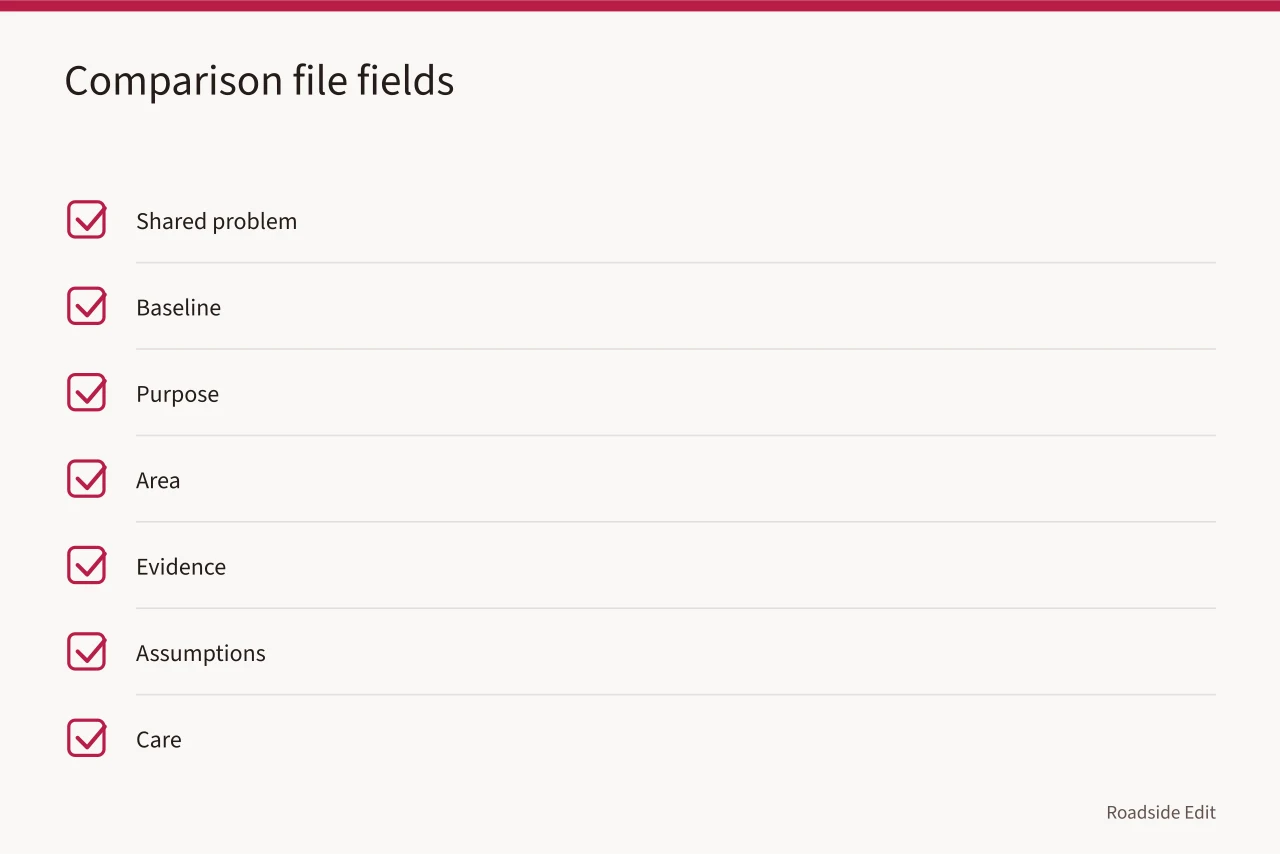
| Field | What goes in it |
|---|---|
| Shared problem | The user task or documented issue, in plain words |
| Baseline | Dated current-condition record and known gaps |
| Purpose | What this option is meant to do |
| Area | Which part of the site or approach is involved |
| Evidence | The source behind the option description |
| Assumptions | What is still unconfirmed |
| Care | Who inspects or updates it later |
| Decision | Who or what process takes the next step |
| Review date | When this file gets looked at again |
Apply the same test to every option
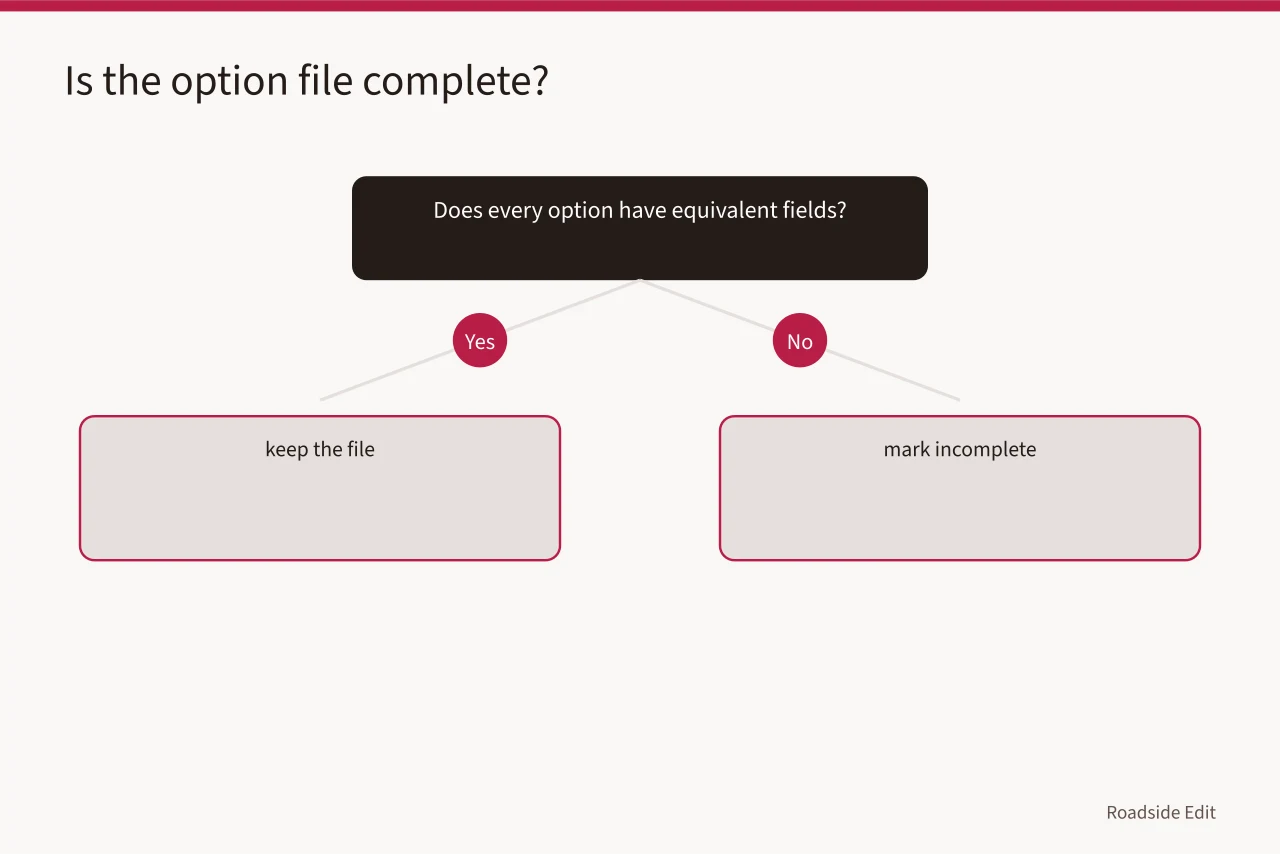
If one option has a route map, a maintenance note and a source record, the others need equivalent fields or the file is marked incomplete. Do not let a preferred option carry extra detail while the rest stay as labels.
Strip personal contacts, access details, private terms and unsupported business claims before the file circulates. A provider or sponsor can be named by its actual role. That role is not evidence the proposal suits the site.
Every option card gets a review date and a decision owner. When new evidence lands, revise the field and keep the earlier version. A later reader should be able to trace why the option changed.
Keep the record honest
The NPS documentation standards ask for reliable sources and stated limits. Apply that test to each option. A concept image shows an idea. It does not establish a current site condition, an approval or an outcome.
The National Archives guidance for digital photographic records explains why an image needs an ID, a date, a location and a caption. Keep those four with the file. A credit line identifies where an image came from. It cannot prove a claim about a different place.
The Federal Highway Administration alternatives-analysis guidance describes how alternatives get compared in a transportation context. Use it as a process reference. It is not a decision about this property.
Read it as an outsider would
Hand the file to someone who missed the meeting. They should be able to name the shared problem, see what each option claims to address, and find the record behind every factual sentence. If they cannot, the file is not finished.
Keep the baseline apart from the options. A baseline says what is known about the site now. An option describes a possible future action. A decision note records what a responsible party chose. A completion record reports only what a source says was done. Blending those four turns a proposal into an apparent fact.
Check that every option answers the same visitor task. A sign option and a route option may need separate comparisons if they solve different problems. Sharing a rendering is not a shared problem.
Date the checklist and add a revision line whenever an option changes, naming the source, the scope and the open question. That stops a new concept from making an old comparison look settled.
Common questions
What if only one option has enough evidence?
Say so in the file and list the evidence the other options still need. An incomplete comparison that names its gaps is more useful than a tidy one that hides them.
Can an option move forward before a final decision?
Yes. Label it advanced for review. That is different from approved, and different again from complete.
Why name a care role so early?
Because inspection and update work decide whether an option stays workable. Naming the role now saves a scramble later.