Guides
Part of How to compare modern roadside design options before you decide
Modern roadside design options: comparison questions to ask before 2027 reviews
Modern roadside options like bioswales, road diets, roundabouts, RRFBs, and permeable pavers need clear questions from U.S. teams before 2027 reviews.
Options become clearer when questions expose their limits. This comparison names real choices and asks what each one can and cannot settle before a 2027 review.
What to take away
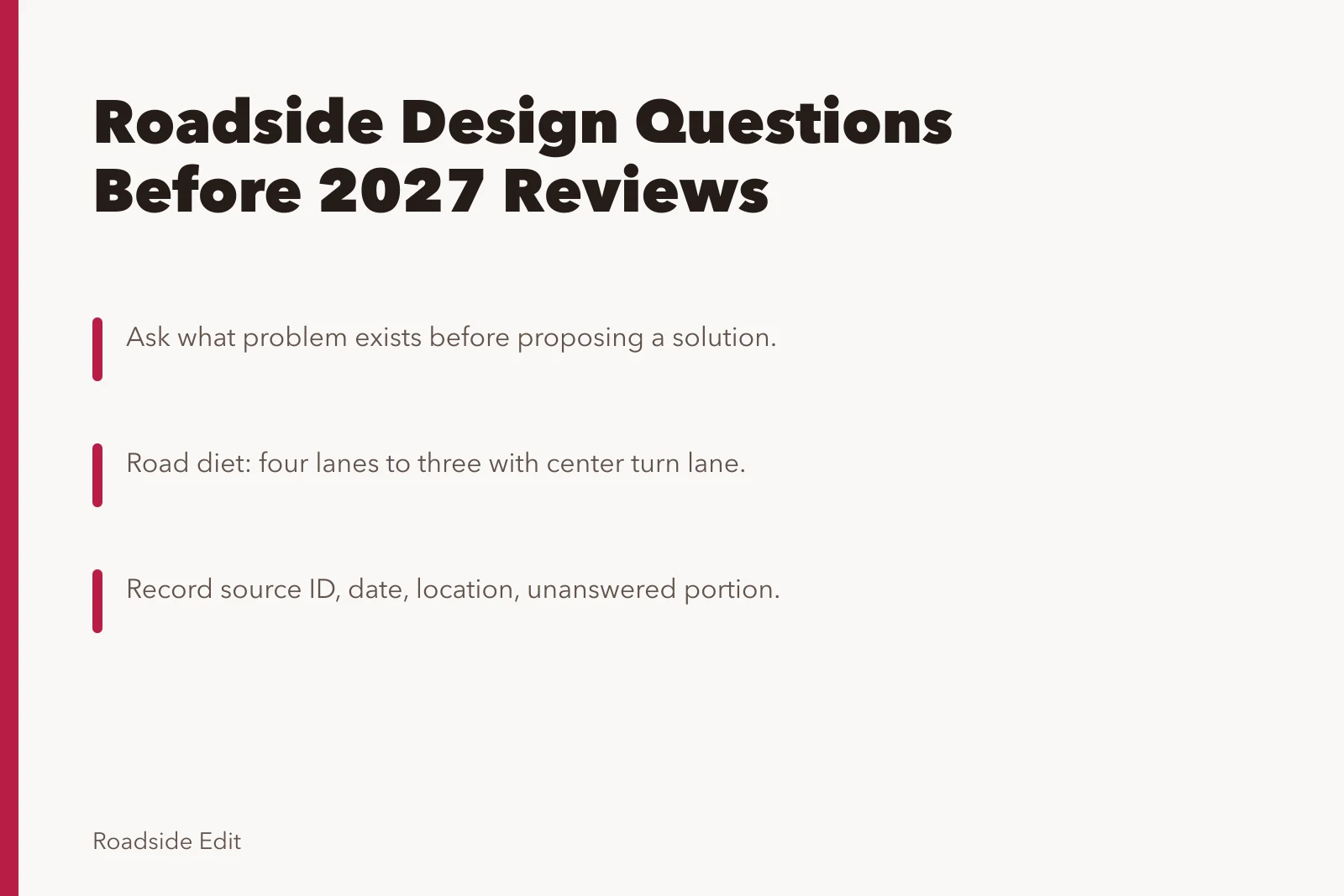
- Ask what problem exists before proposing a solution.
- Name the option, source, and known limit.
- Questions should identify a source or an information gap.
- An option can remain incomplete without being rejected.
- Keep current local-review questions with the proper process.
Compare real roadside options
FHWA describes alternatives analysis as occurring after a project need is identified and before a solution is selected. Review FHWA's alternatives-analysis applications. Use that sequence for each option below.
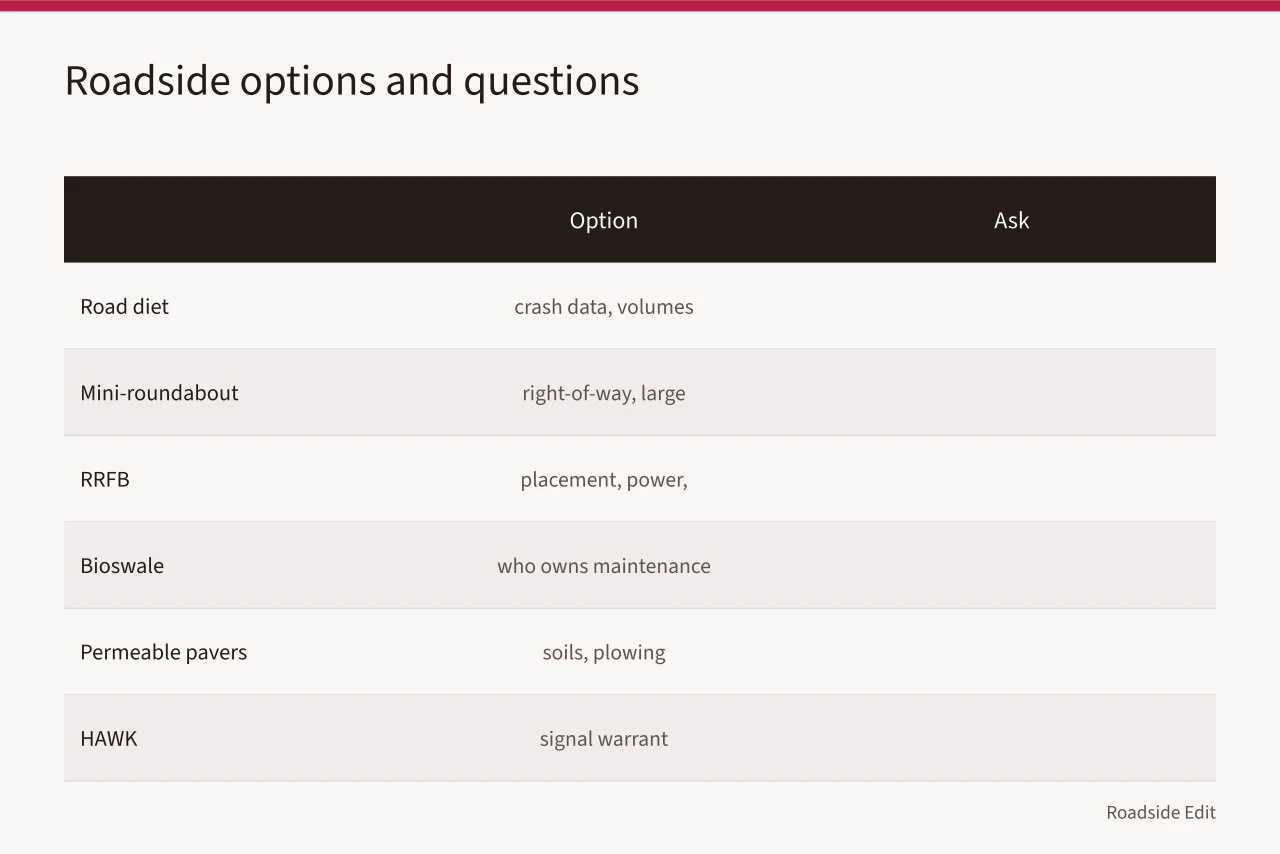
Road diet. FHWA promotes road diets that turn a four-lane undivided road into three lanes with a center turn lane. Ask what crash data and traffic volumes support it.
Mini-roundabout. FHWA lists mini-roundabouts for constrained intersections. They use a mountable center island. Ask whether right-of-way and large vehicles allow one.
Rectangular rapid flashing beacon (RRFB). FHWA recognizes RRFBs for uncontrolled crossings. They use user-activated amber lights. Ask about placement, power, and upkeep.
Bioswale or bioretention. The EPA Green Streets Handbook covers these practices for roads, alleys, and parking lots. Ask who owns maintenance.
Permeable pavers. The same EPA handbook covers permeable pavement for light-duty areas. They infiltrate stormwater and need vacuum sweeping. Ask whether soils and plowing allow them.
Pedestrian hybrid beacon (HAWK). FHWA lists the HAWK for higher-speed multilane crossings. Ask whether a signal warrant supports one.
Solar LED lighting. Carmanah and Sol sell off-grid solar lights for trails and parking. Ask about winter output and battery replacement.
EV charging. ChargePoint and Electrify America run public charging networks. NEVI funding ties corridors to station spacing and uptime. Ask about power and payment access.
These are starting points, not tested recommendations.
Keep the public version limited
For a public article, include the question, the source boundary, and the next review role. Keep private addresses, contacts, access procedures, bids, and security information in the project file. If a provider or sponsor is mentioned, disclose the relationship and do not treat it as evidence of a project result.
Give each question a date. An answer that was useful during an early concept discussion may not remain current after the site, ownership, operation, or local process changes.
Record the person or role responsible for following up on any unanswered question. Keep that assignment current after changes.
Keep the source boundary beside each question
The NPS documentation standards require reliable source material and clear limits. Record the source ID, date, location, and unanswered portion beside every question. A question should remain open when the available record cannot settle it.
The National Archives digital-photo guidance supports retaining descriptive information with images. A dated photo can record an appearance at that time. It does not show a hidden condition or predict performance.
The EPA Green Streets Handbook discusses design and green-infrastructure practices for roads, alleys, and parking lots. It is general guidance. It cannot choose an option for a particular roadside site.
When a later source answers a question, add a dated response instead of overwriting the first entry. This preserves the record of what changed.
Ask the questions in a sequence that a reviewer can use. Start with the site feature and location. Then identify the document or observation on hand. Next state the information that remains missing. Finish by naming the role that can answer the question or make the next decision.
Keep private contact details, access instructions, and unverified vendor claims out of the public question list. A public page can say that an item needs further review without exposing restricted project material.
Before publication, compare every answer with its source. If the statement has become broader than the record, reduce it and keep the exact question visible.
Use plain location names and dates in every answer. The next reviewer should find the feature and source without relying on a prior conversation or temporary folder.
Check the list before each revision. If a question remains unanswered, state the missing record and the review trigger. Do not let a later concept image make an unresolved condition look settled.
Common questions
Does a question need an immediate answer?
No. It needs an owner, a date, and a clear record of what would answer it.
Can two visually similar concepts have different purposes?
Yes. One may orient visitors while another may serve a documented building or operational role.
What if a local rule affects an option?
Refer the issue to the relevant current local source or reviewer rather than deciding it in a general article.