Guides
Motel exterior safety checklist: what to record before you decide to stop
Motel exterior safety checklist for 2027 helps U.S. readers record visible conditions, access limits, escalation questions, and responsible contacts.
This checklist is an editorial record for visible exterior conditions. It does not inspect a property, determine code compliance, authorize access, diagnose a defect, or tell anyone how to perform work. When an observation raises a safety question, the record should identify the responsible person and stop at the evidence it actually has.
What to take away
- Use an authorized, ordinary viewpoint. Do not climb, enter restricted areas, or test a surface.
- Record what is visible, its date, and the limits of the observation.
- Separate a visible condition from an inference about cause, risk, or repair.
- Escalate questions involving height, utilities, access, structural performance, or immediate safety.
- Keep commercial listings separate from safety evidence.
Before the walkaround
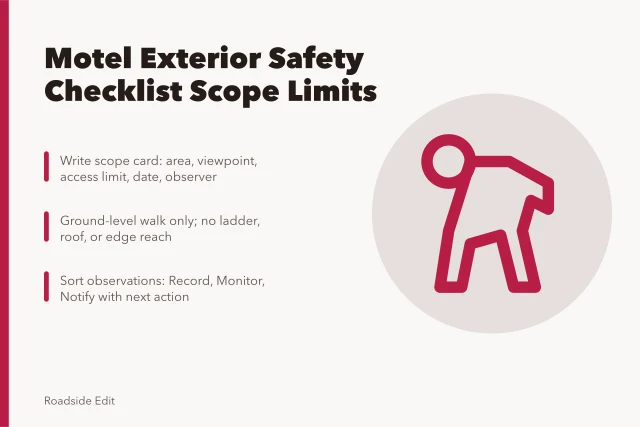
Choose a route observable from a public or authorized area. Bring a phone or camera for dated documentation, but do not create a hazard for a better image.
If a location is blocked, wet, elevated, poorly lit, or near traffic, it may be unsuitable for a routine observation. Note the access limit and ask the responsible party what review is appropriate.
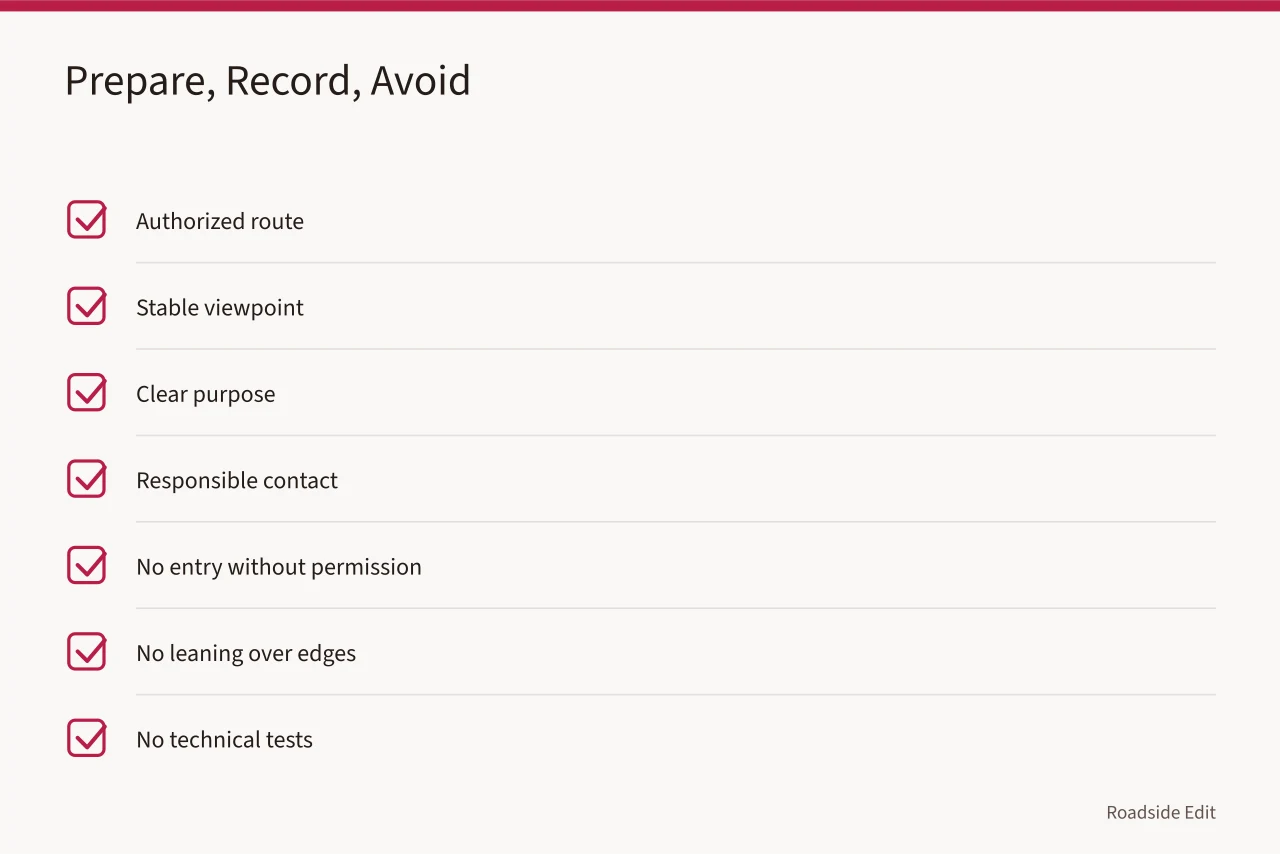
| Prepare | Record | Do not do |
|---|---|---|
| Authorized route | Date, weather, and observer role | Enter an area without permission |
| Stable viewpoint | Direction and exterior feature | Lean over an edge for an image |
| Clear purpose | Observation and open question | Attempt a technical test |
| Responsible contact | Who can answer the question | Treat a listing as an authority |
OSHA's Field Safety and Health Management System includes a walking-working-surfaces program. It protects employees from hazards in offices and field work. Read OSHA's walking-working-surfaces chapter.
This is an employee-safety program, not a motel inspection standard. Its useful boundary for this checklist: an editorial record should never encourage a reader to use an unsafe surface or exceed authorized access.
Exterior checklist
Work from general to specific. A broad sweep often identifies whether a closer, responsible review is needed without forcing an unsupported conclusion.
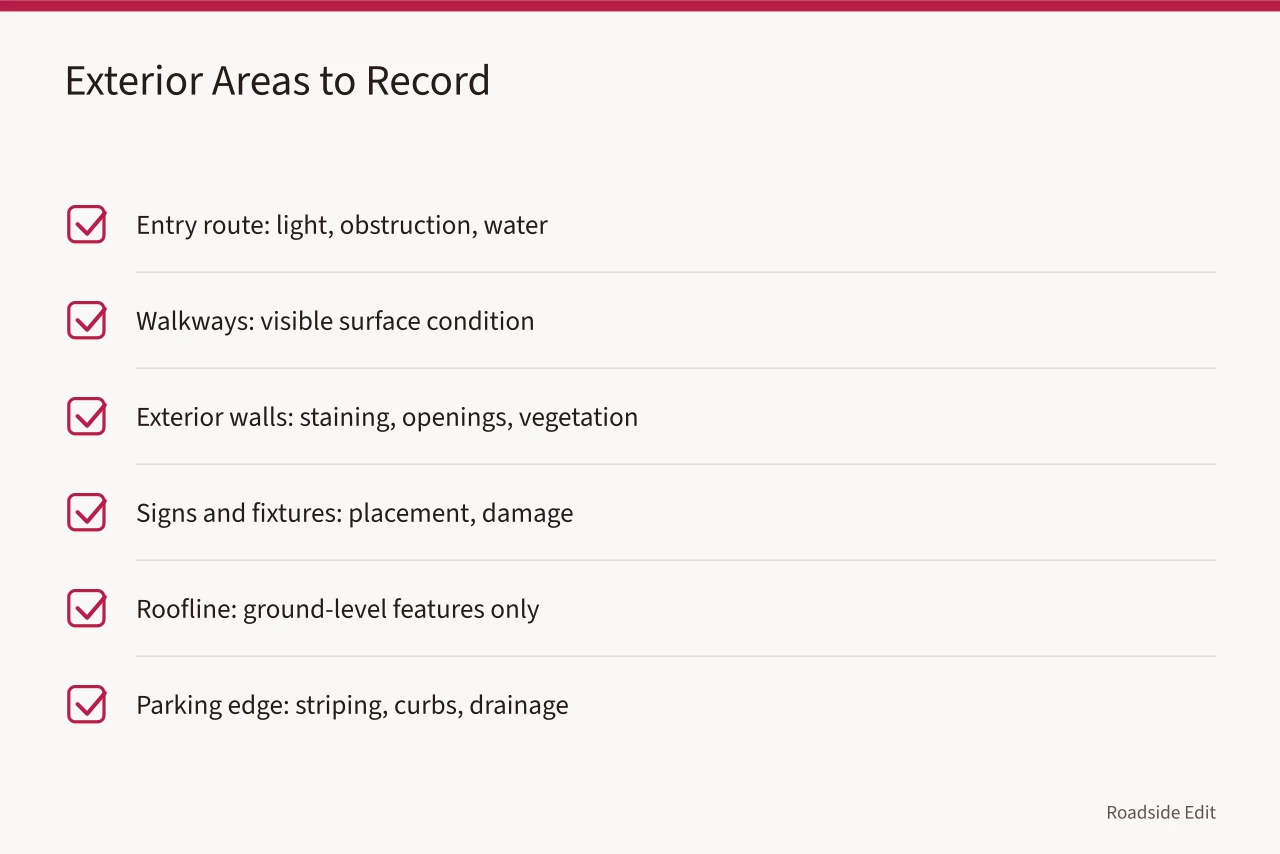
| Area | Record the visible fact | Leave open |
|---|---|---|
| Entry route | Light, obstruction, standing water, or uneven appearance | Compliance, cause, or remedy |
| Walkways | Surface condition visible from the route | Load capacity or hidden damage |
| Exterior walls | Staining, openings, loose-looking items, or vegetation | Material condition behind the face |
| Signs and fixtures | Placement, apparent damage, and clear access limits | Electrical status or approval |
| Roofline | Features visible from ground level | Roof condition or access decision |
| Parking edge | Striping, curbs, drainage appearance, and obstructions | Traffic-control or accessibility ruling |
Write observations in plain language
Write, "standing water visible near the south entry at 9:15 a.m." Do not write, "the drain has failed." The first statement has a time, place, and limit. The second claims a mechanism that usually requires additional information. Plain language helps a later owner, editor, or qualified reviewer understand what the record actually proves.
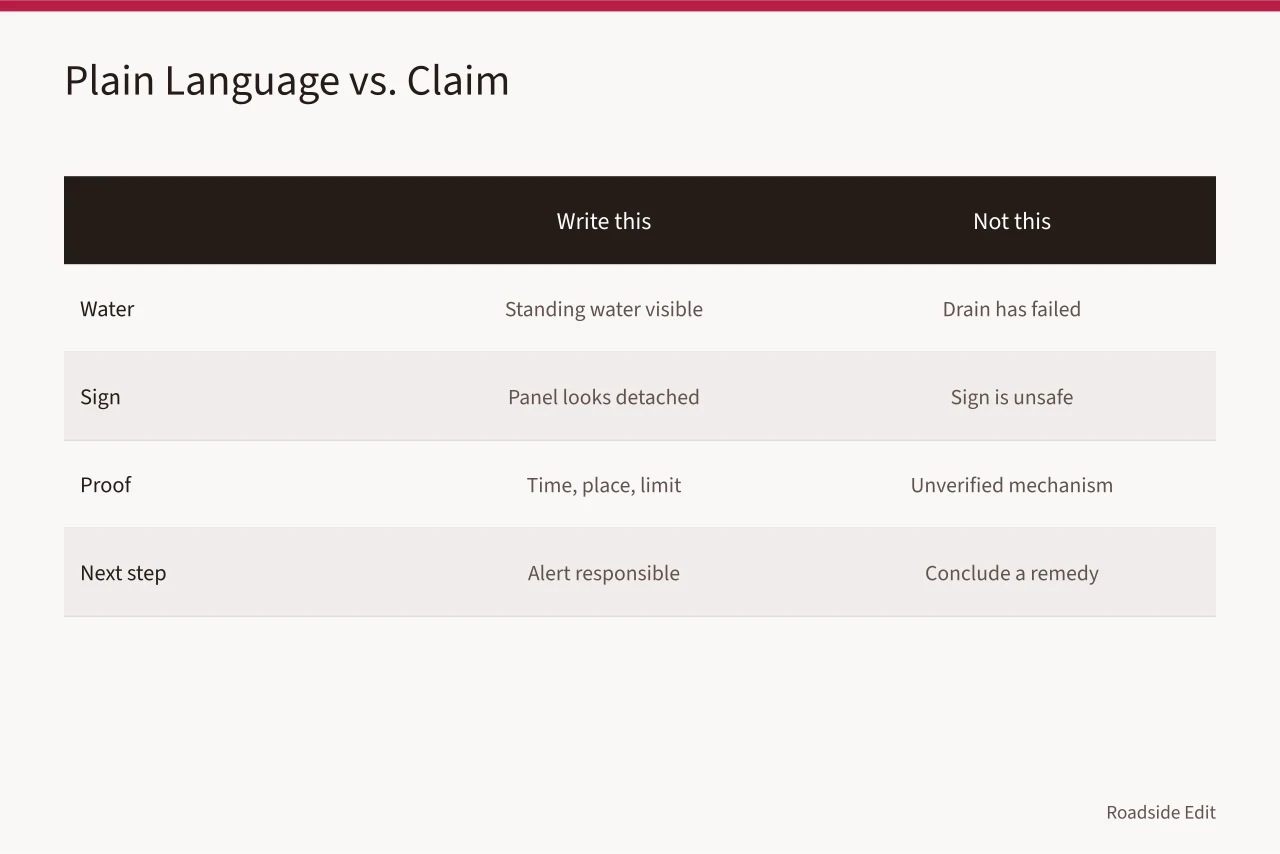
Use the same care with an apparently damaged feature. "A detached-looking sign panel is visible from the sidewalk" identifies a condition worth raising. It does not establish whether the panel is secure, whether the sign is energized, or what action is required. The right next step is to alert the responsible party and preserve the observation.
Decide whether to stop
Stop an ordinary walkaround and contact the responsible owner, relevant service, authority, or qualified professional when the question involves any of the following:
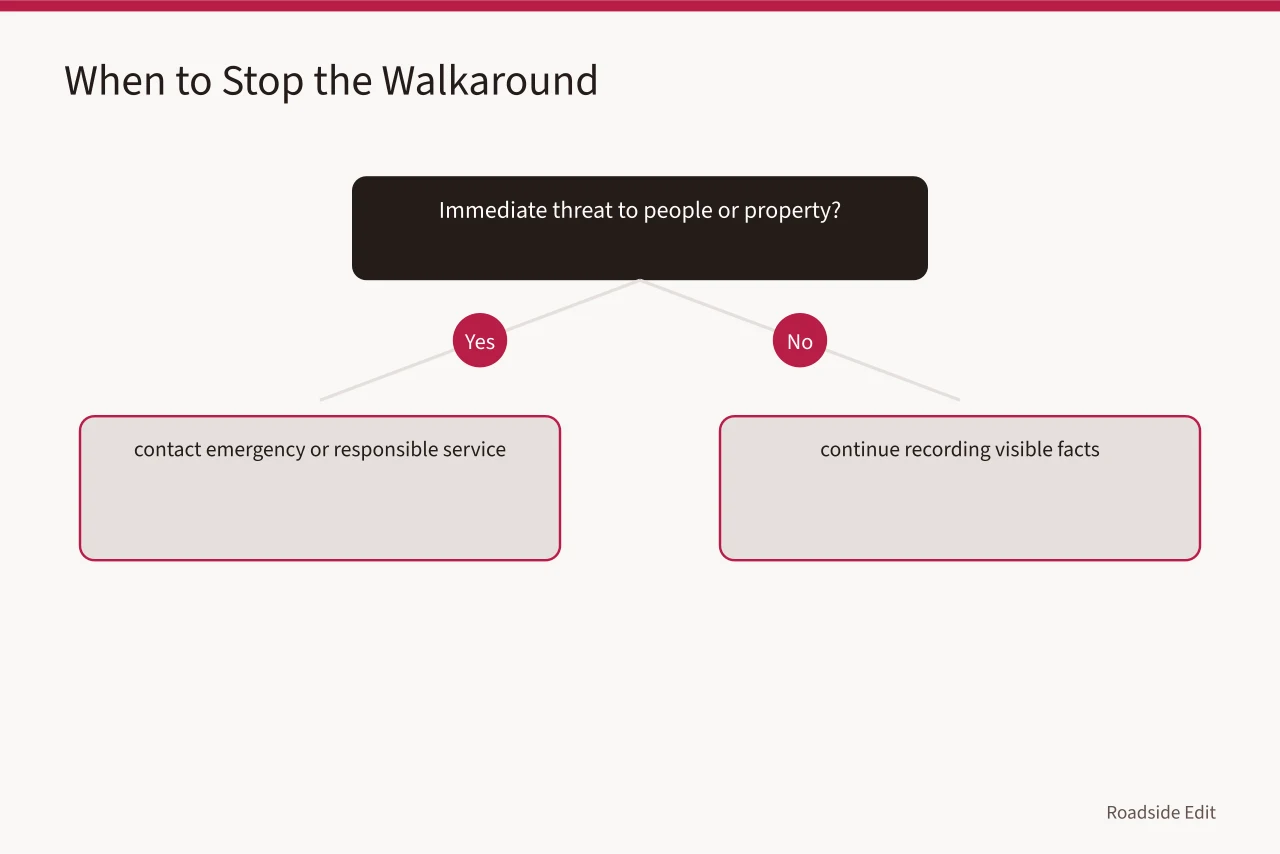
- an immediate threat to people or property;
- height, roof, ladder, scaffold, or elevated-access issues;
- utility, electrical, gas, fire-protection, or traffic concerns;
- a blocked route or a condition that cannot be observed safely;
- a property-specific structural, hazardous-material, permit, or code question.
An editorial article cannot evaluate emergency conditions. If a reader perceives an immediate danger, the appropriate action is to seek the relevant emergency or responsible service, not to continue collecting content for the site.
Keep a record that can be handed off
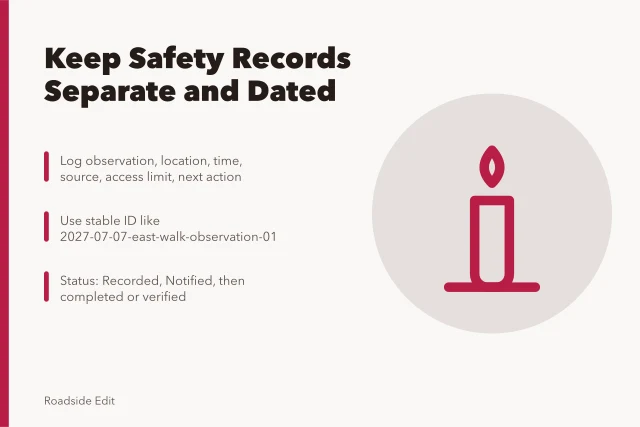
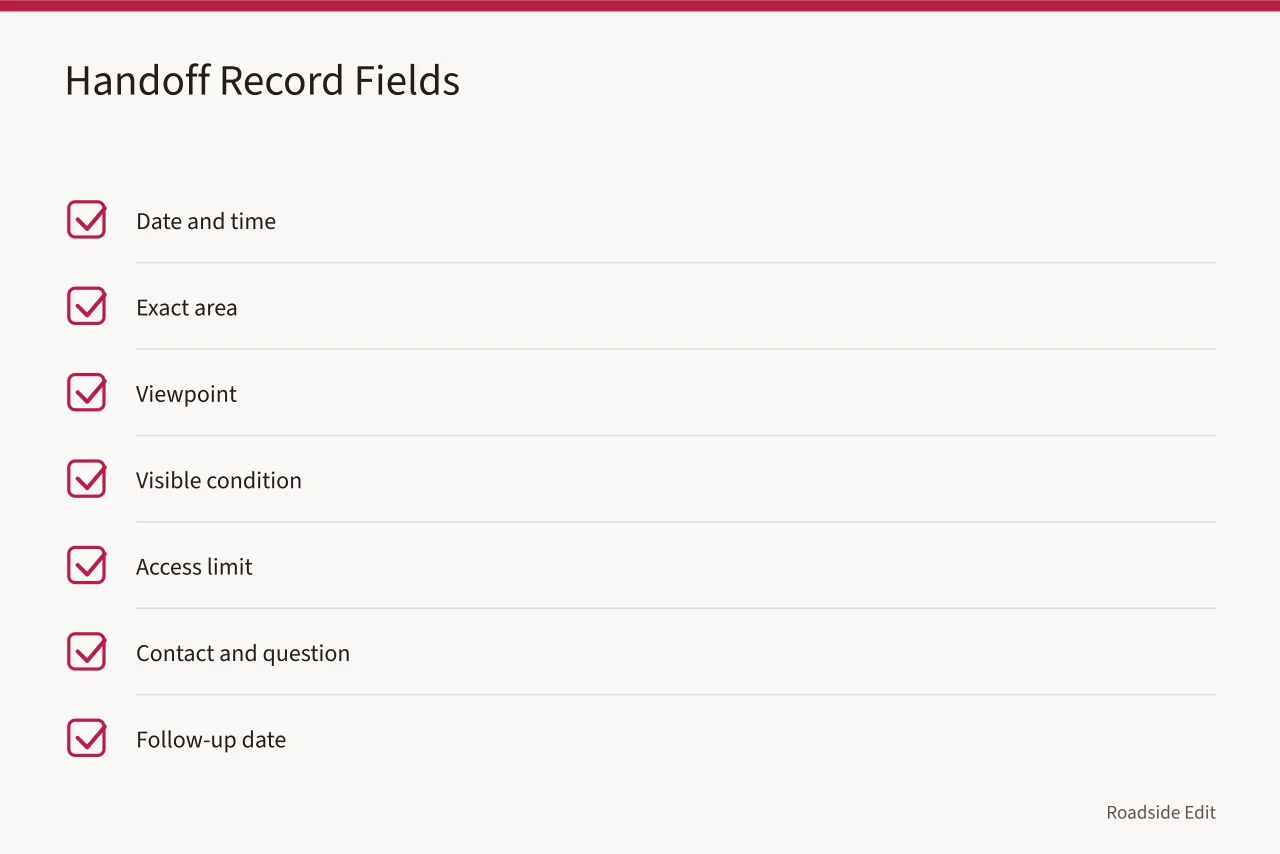
| Field | Example purpose |
|---|---|
| Date and time | Shows when the observation was made. |
| Exact area | Lets another person find the location. |
| Viewpoint | Explains what the image can and cannot show. |
| Visible condition | Keeps the entry factual. |
| Access limit | Explains why the observation ended. |
| Contact and question | Assigns the next responsible step. |
| Follow-up date | Prevents an open question from disappearing. |
Keep the original image and add later information as a dated update. Do not silently replace an early note with a later conclusion. If an owner supplies an explanation, label it as an attributed response and preserve the date. If a paid provider later submits a profile or placement, disclose it and keep it separate from the observation log.
Plan for weather and changing conditions
The same path can look and behave differently after rain, snow, wind, heat, darkness, a nearby event, or a change in site operations. Do not assume that a prior image proves present conditions. Instead, record the date and context each time. If weather or a temporary condition affects the route, postpone the observation or use a safer authorized viewpoint.
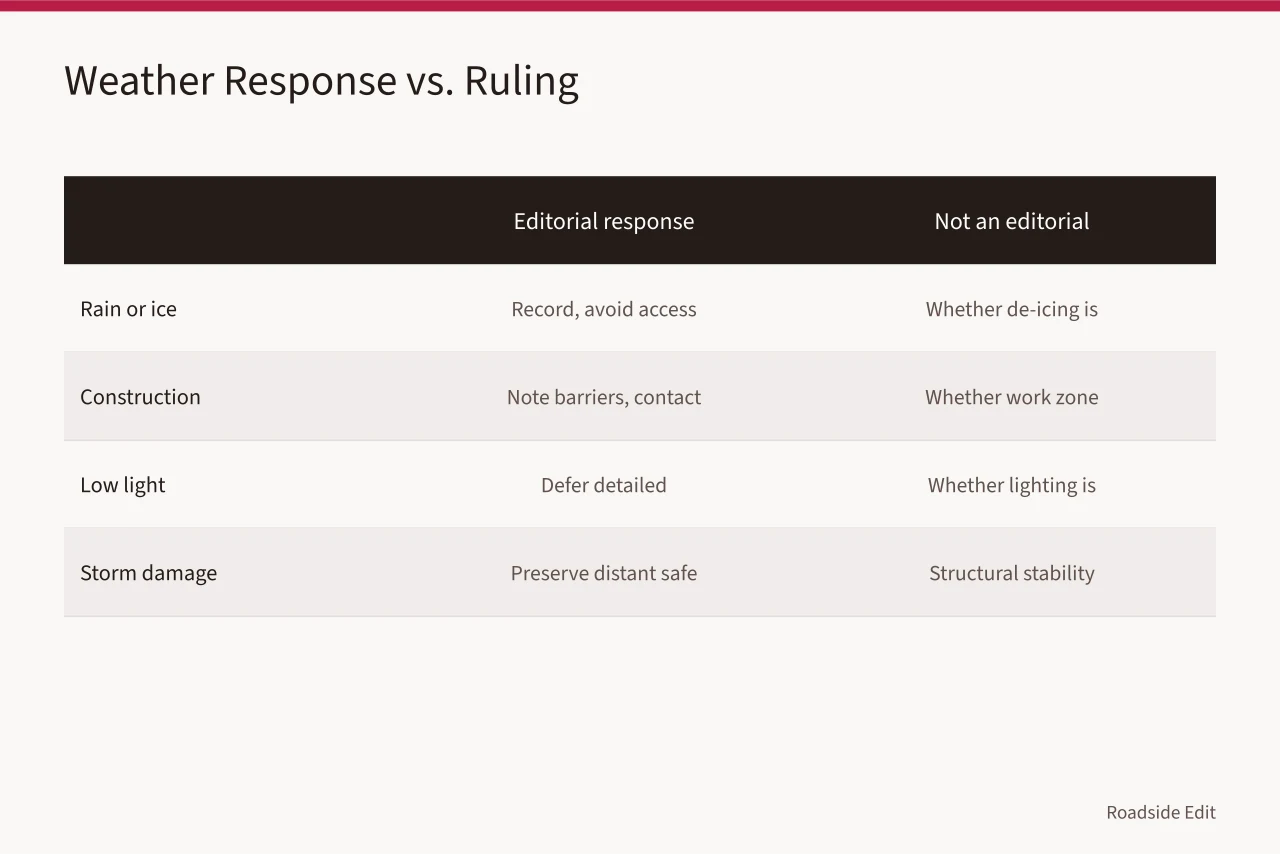
| Condition | Editorial response | Not an editorial decision |
|---|---|---|
| Rain or ice | Record the condition and avoid unsafe access | Whether de-icing is adequate |
| Construction activity | Note visible barriers and contact role | Whether a work zone meets rules |
| Low light | Defer a detailed observation | Whether lighting is compliant |
| Storm damage | Preserve a distant, safe view and alert responsible parties | Structural stability or repair method |
An article can explain why a dated record helps. It cannot issue a site-specific clearance.
If a route is partly blocked, describe the visible barrier and the limit. Do not step around it for a closer image.
If a condition changes while an editor is present, leave the area. Record the new circumstance from a safe point.
Use a contact ladder
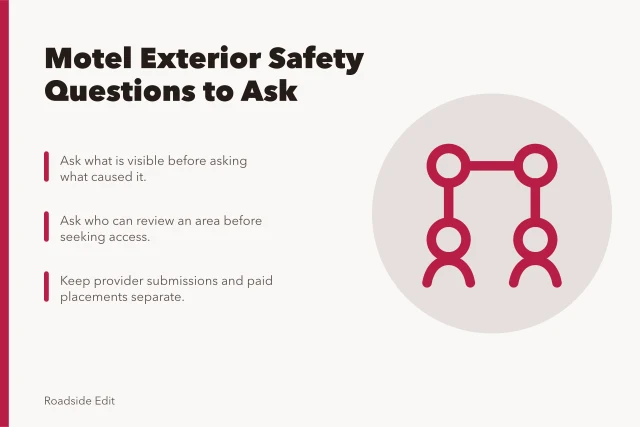
Not every question belongs to the same person. A contact ladder prevents a general editorial inquiry from becoming an improvised technical review.
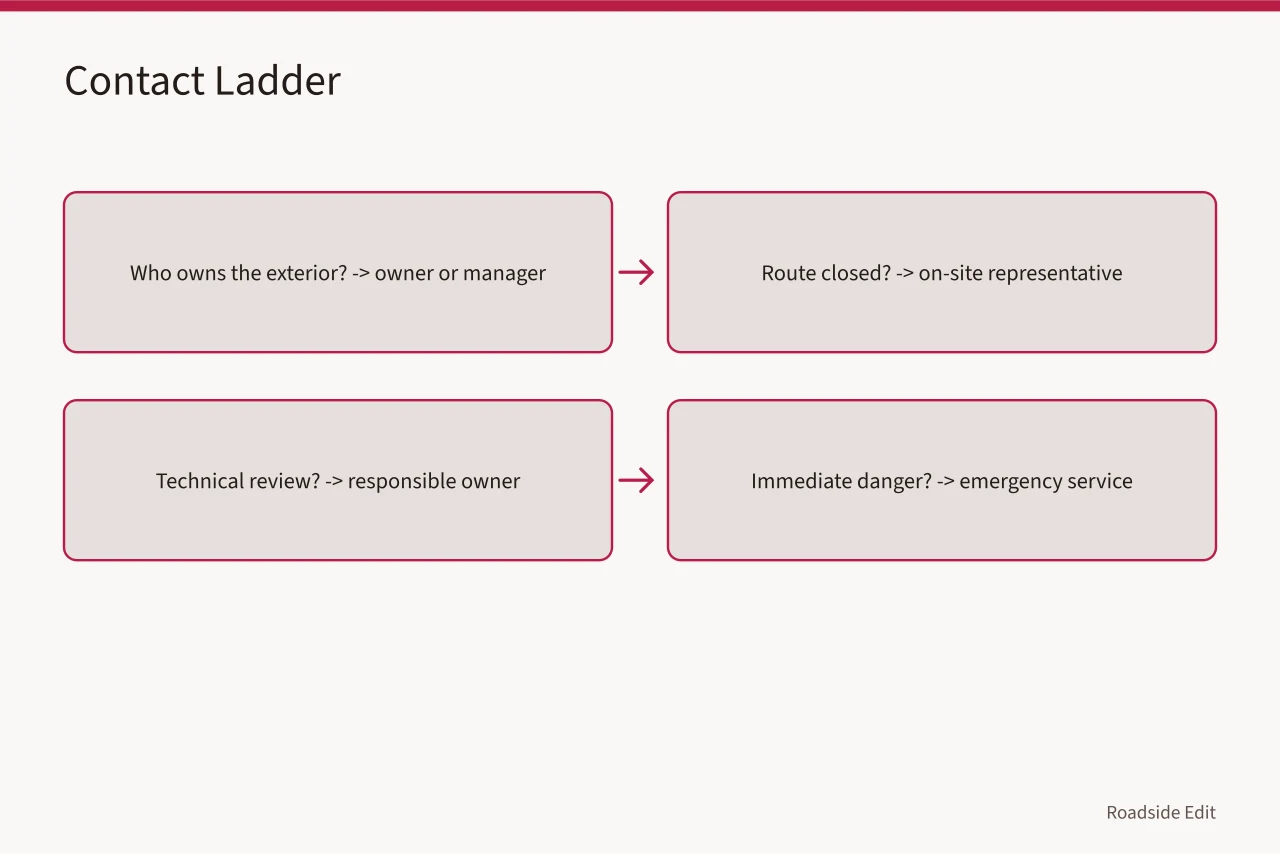
| Question | First contact | Possible next step |
|---|---|---|
| Who owns the exterior area? | Owner or authorized manager | Confirm access and record recipient |
| Is a route temporarily closed? | On-site responsible representative | Use a different authorized route |
| Does a visible condition need technical review? | Responsible owner | Arrange qualified assessment if appropriate |
| Is there an immediate danger? | Relevant emergency or responsible service | Follow its direction, not the article |
Use roles, not personal names, in public-facing files unless a named contact has consented. A good note says, "manager notified at 10:20 a.m." It does not expose phone numbers, private schedules, guest information, or details that could compromise site security.
OSHA's general requirements say employers must inspect walking-working surfaces regularly and maintain them in a safe condition. Review OSHA standard 1910.22. The rule addresses employers and workers, not a reader's public observation. It supports recording what is visible and referring review to the responsible person.
The ADA Standards for Accessible Design are technical standards for covered facilities. Consult the ADA Standards for Accessible Design. They do not decide compliance at a particular motel. They show why an image of a route cannot be labeled compliant or noncompliant by an editorial checklist.
FEMA's National Flood Hazard Layer provides federal flood hazard information for mapped areas. Check FEMA's National Flood Hazard Layer information. It does not determine a current safety condition or a property's project obligations. It is a defined source when a checklist raises a mapped flood-information question.
Review the checklist itself
At the end of each period, check that the route, terms, contacts, image permissions, and questions are current. Remove claims without a valid source. Keep older entries as historical records, but label them by date.
This matters especially when articles later add submitted business profiles. An old commercial description can give useful context, but it is not a current safety confirmation.
Create a separate editorial review column for every public statement. It should identify the source page, the claim it supports, the date it was checked, and whether a human reviewer confirmed the fit. That review step protects both readers and the site from accidental overstatement.
Keep the purpose narrow
This checklist is meant to help a publisher or property representative preserve useful observations. It is not a substitute for an emergency response plan, staff training program, occupational-safety procedure, property assessment, or local code review. Those activities require the people, authority, evidence, and conditions appropriate to the specific site.
Readers should also resist the urge to convert a short checklist into an all-purpose score. A clear note about one entry route does not evaluate the building, the business, its practices, or every possible condition. Narrow records are more honest and more useful because they can be checked later against the place and date they describe.
Publish carefully
General educational content can explain how to make an observation log. Property-specific images or statements need a confirmed source, appropriate permission, accurate caption, and a clear reason to publish. Do not name a business as a safety authority because it purchased placement, and do not use a listing as evidence that a property was inspected or treated.
The safest public conclusion is often a narrow one: a visible condition was recorded, its limits were stated, and a responsible party was asked to review it. That gives readers a useful next step without inventing expertise or certainty.
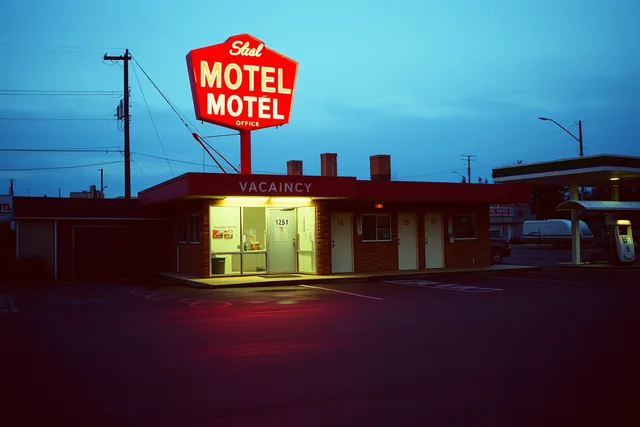
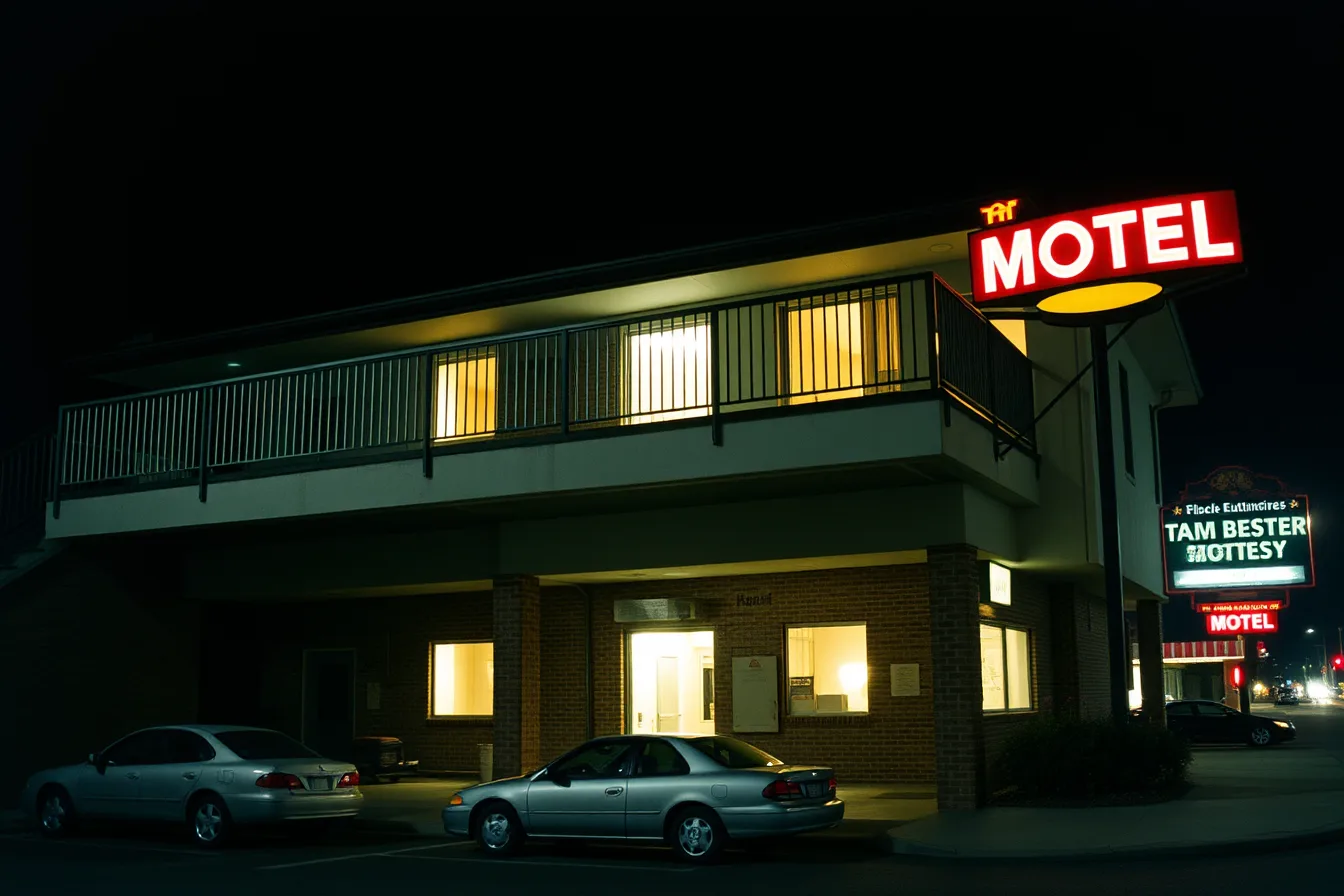
The image is illustrative. It does not establish a motel's current condition, safety, ownership, access status, or project result.
Common questions
Does this checklist authorize an inspection?
No. It is only a recordkeeping framework for observations made from an authorized and safe viewpoint.
What should an editor do with a possible safety issue?
Preserve the visible fact, state the limit, and direct the question to the responsible party or relevant service.
Can a property listing prove a condition is safe?
No. Listings and sponsored submissions are commercial information, not inspection evidence.
What should remain private?
Keep personal information, site-security details, restricted-access information, and unverified property-specific claims out of public editorial files.
In this guide
- How to build a motel exterior safety checklist that stops at what staff can seeMotel exterior safety scope checklist for 2027 helps U.S. readers record safe observation limits, urgent escalation steps, responsible contacts, and useful evidence.
- Motel exterior safety checklist comparison questions to ask before you escalateMotel exterior safety questions for 2027 help U.S. readers record visible facts, identify responsible escalation, and avoid unsupported safety claims.
- Motel exterior safety checklist: how to document warning signs in 2027Motel exterior safety warning signs for 2027 help U.S. readers document visible changes, weather context, evidence limits, and escalation paths.
- Motel exterior safety records: how to keep observations, notices and fixes separateMotel exterior safety records guide for 2027 shows U.S. owners how to preserve observations, notifications, access limits, corrections, and responsible handoffs.