Guides
Part of Motel exterior safety checklist: what to record before you decide to stop
Motel exterior safety records: how to keep observations, notices and fixes separate
Motel exterior safety records guide for 2027 shows U.S. owners how to preserve observations, notifications, access limits, corrections, and responsible handoffs.
A safety record is a trail of limited facts and responsible follow-up. It should show what a person observed from an authorized viewpoint, what was reported to the property, and what still needs a decision. It should not turn a photograph or a short staff note into a diagnosis, compliance finding, or repair specification.
This guide is for organized recordkeeping around a motel exterior. It does not replace emergency procedures, a site inspection, or professional advice. When there may be an immediate threat to people, contact the appropriate emergency service, utility, or responsible property contact first. Add the record after that first response is underway.
What to take away
- Preserve the original observation, including the viewpoint and access limit.
- Record when and how the responsible party was notified.
- Keep private operational details out of public files.
- Label reported, proposed, completed, and verified information differently.
- Add corrections as a new dated entry instead of rewriting the past.
Create a separate safety record, not a catch-all folder
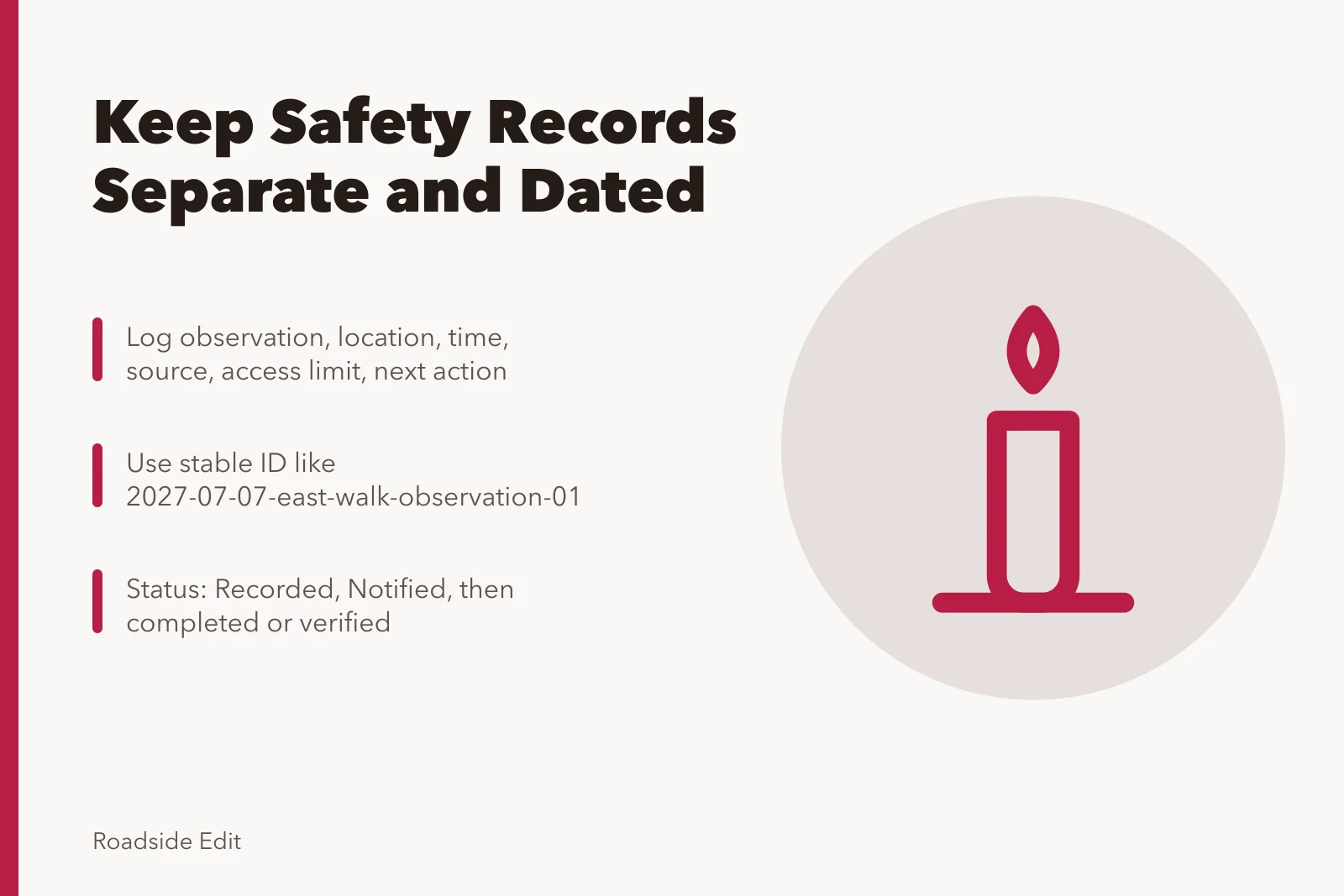
Maintenance, marketing, and safety records may concern the same building, but they answer different questions. A safety record needs a clear event or observation, a location, a time, a source, an access limit, and a next action. It should not be buried in a folder of general exterior photos.
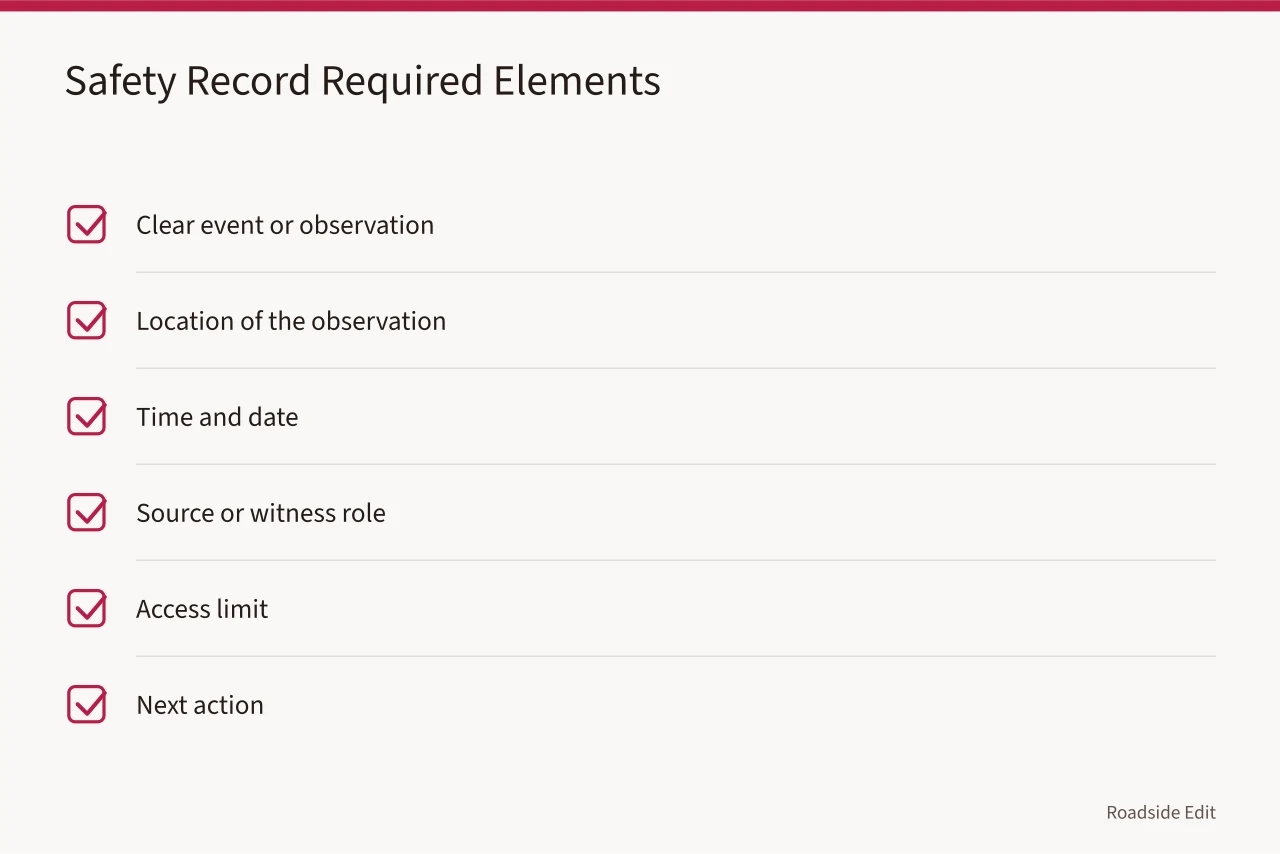
Give the file a stable identifier such as 2027-07-07-east-walk-observation-01. If an incident report or an urgent notification follows, use the same area and date stem. This lets the next manager find the related material without guessing which image belongs to which note.
The National Archives describes records management as control of information created or received during activity. Read the National Archives overview of basic records-management concepts. The federal guidance does not govern private motel files. Its useful principle is that a record needs context and control; a loose image without a date, location, or source is hard to use responsibly.
| File element | What it should answer | Do not use it to claim |
|---|---|---|
| Observation note | What was visible and where | Cause, severity, or legal status |
| Image record | Viewpoint, date, source, and caption | Hidden condition or safe access |
| Notification log | Who was contacted and when | That a condition was fixed |
| Response note | What the responder reported | Independent verification without evidence |
| Closeout note | What was reported complete and what remains open | A technical conclusion the file cannot support |
Capture the observation before the interpretation
Use plain language. Put the observable fact first, then the limit.
For example: "At 8:20 a.m., from the west parking row, a broken-looking light-cover piece was visible below the wall fixture outside room 116. No contact with the fixture was made." That shows a future reader where the report came from, not why the cover broke or whether the electrical system is safe.
Avoid copying a staff member's conclusion into the observation field. If a manager says, "The light is dangerous," record that as a reported statement and identify the speaker. If an owner later provides a repair invoice, place it in the response record. The chronology matters.
For each entry, capture these fields:
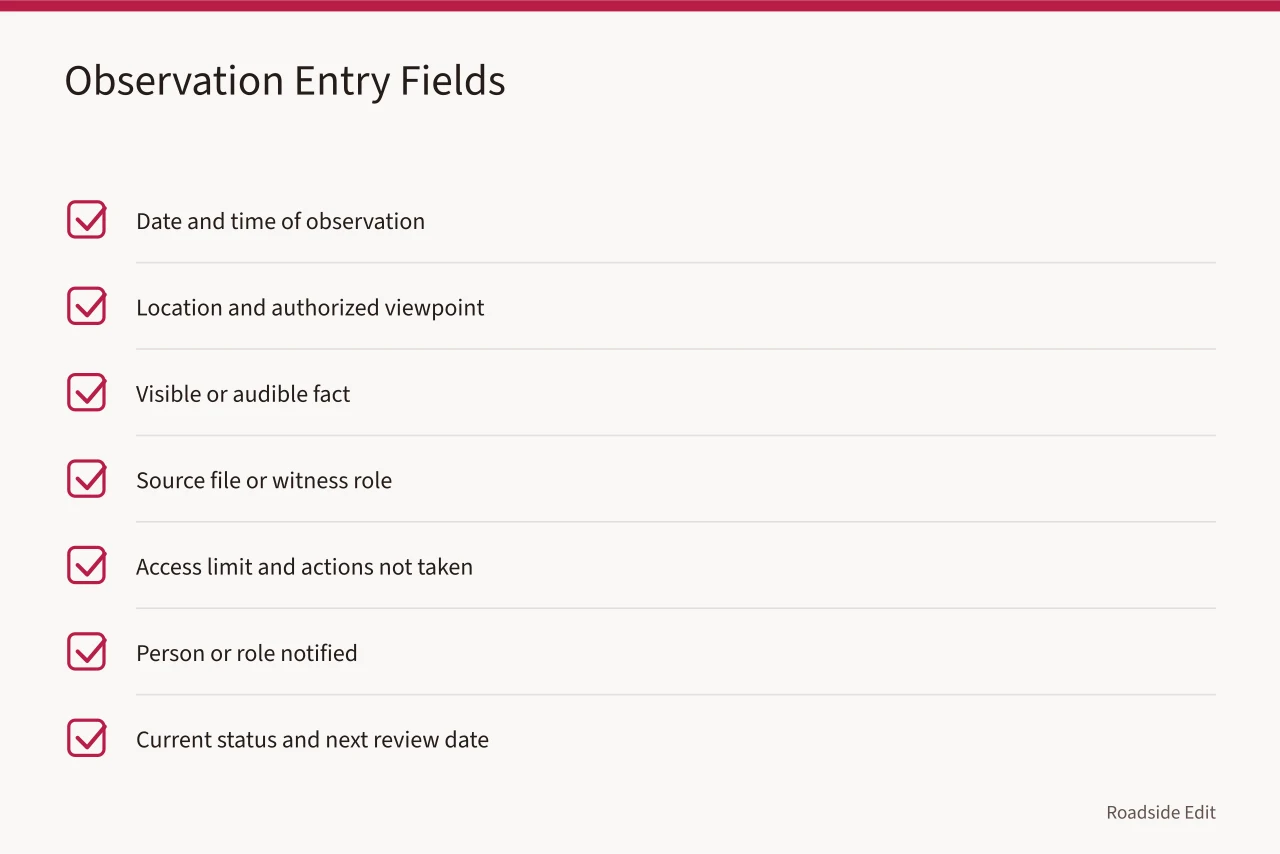
The entry can be short. It should be specific enough that another person can locate the area without relying on the writer's memory.
Record weather and exposure without making a weather claim
Weather can change what a person sees and how safe it is to gather a record. Note rain, heat, wind, darkness, standing water, or another relevant condition when it affects the observation route. Do not treat a one-time weather note as proof of a building problem or future risk.
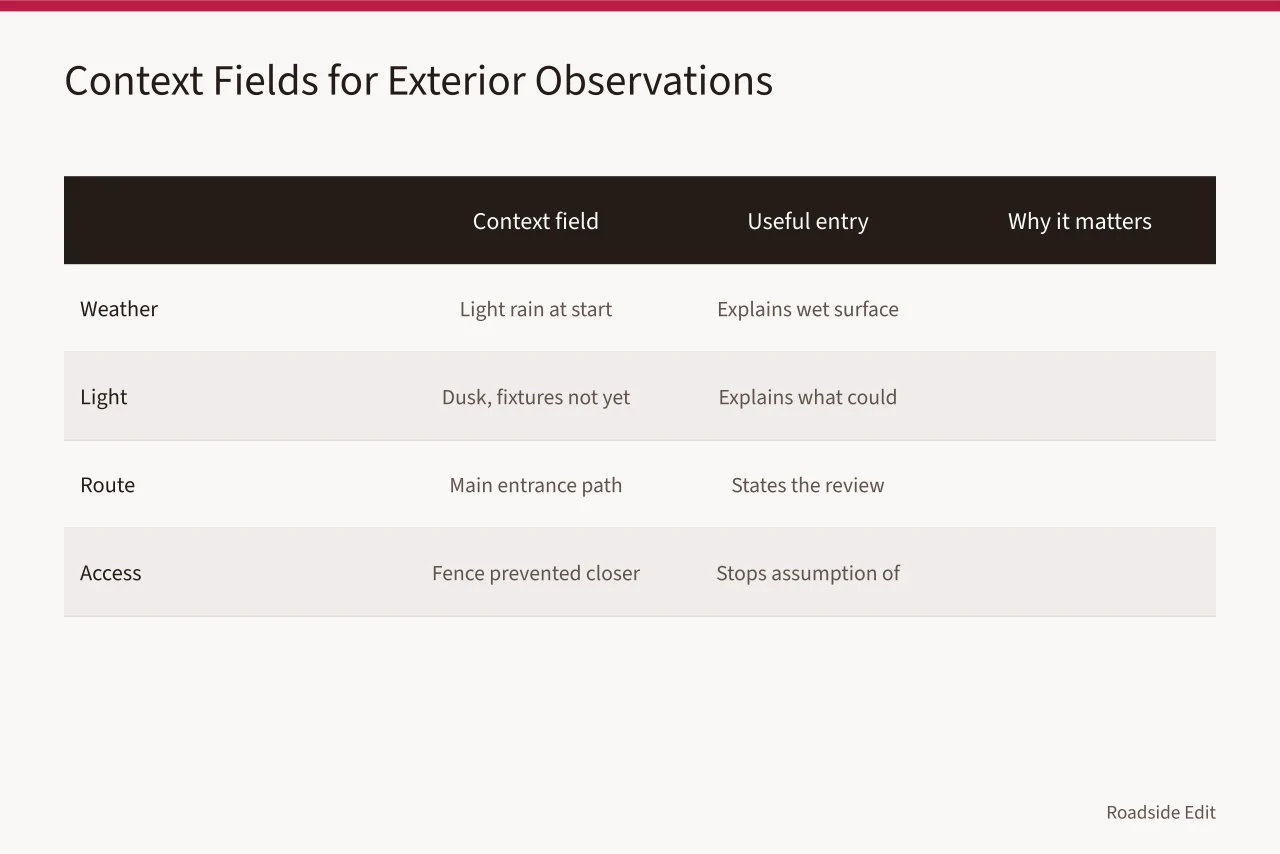
The National Institute for Occupational Safety and Health explains that outdoor-worker hazards vary by work type, region, season, and time outdoors. See CDC guidance for outdoor workers. This material concerns workers, not motel ratings. It supports a narrow documentation practice: include relevant exposure conditions in a safety record rather than assuming every exterior observation was made under comparable circumstances.
| Context field | Useful entry | Why it matters |
|---|---|---|
| Weather | Light rain at start of walk | Explains a wet surface or limited visibility |
| Light | Dusk, fixtures not yet on | Explains what could not be seen |
| Route | Main entrance path only | States the review boundary |
| Access | Fence prevented closer view | Stops a later reader from assuming full review |
Preserve the notification trail
Safety records are often most valuable after the observation is sent to someone else. Keep a notification log that says who received the report, the time, communication method, and requested next step. A text message, call, email, or service ticket can all be noted, but do not publish private phone numbers, codes, schedules, or employee details.
Use a simple status system:
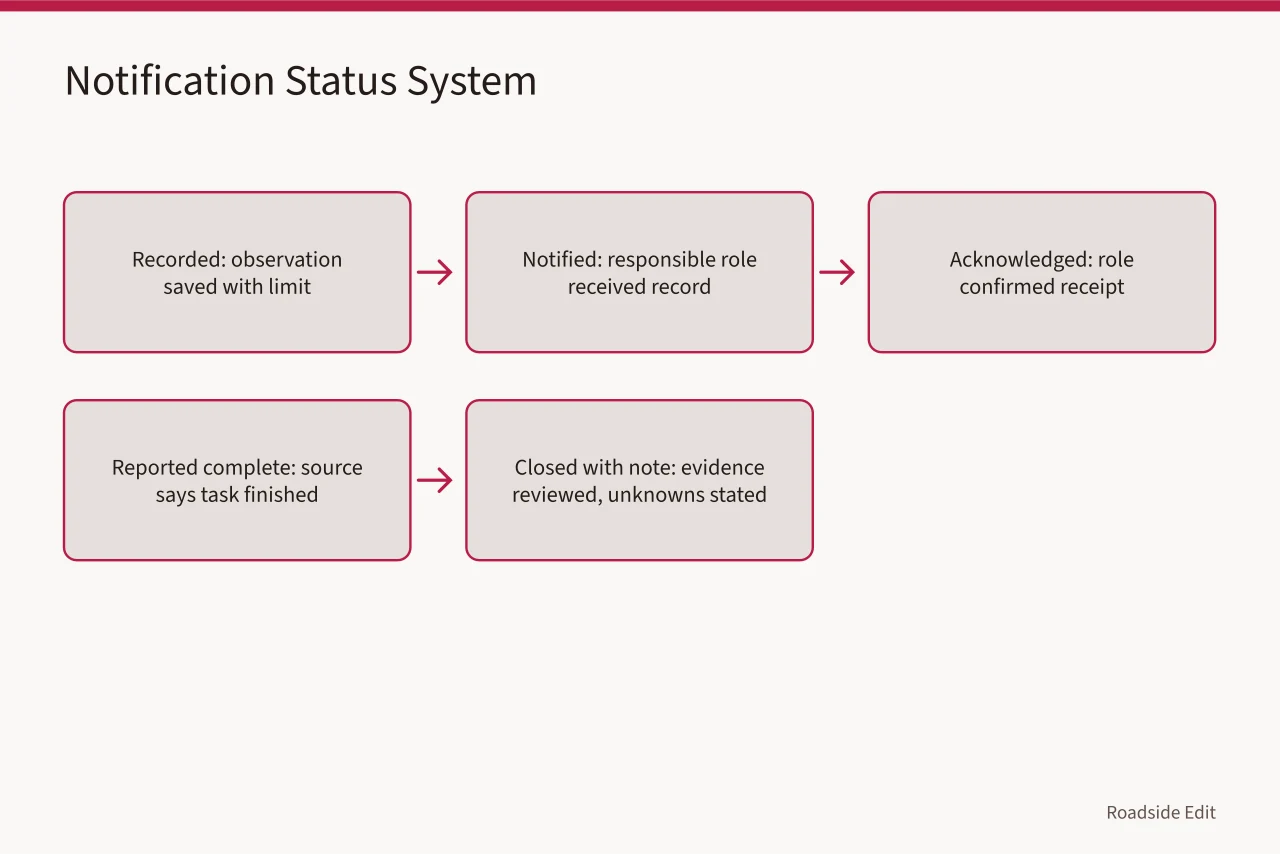
Reported complete is not the same as independently verified. If an invoice or provider message is the only source, say so. A candid record lets the owner decide whether further review is needed.
Keep access and compliance questions in their own lane
A public photo cannot establish whether an entrance, walkway, or parking feature meets a technical requirement. The record should preserve the physical observation and route the compliance question to the appropriate person. It should not announce that a named motel is compliant or noncompliant.
The 2010 ADA Standards for Accessible Design contain technical standards for covered facilities. They do not determine a particular property's status from a remote image. The practical records lesson is to write "route obstruction observed from this viewpoint" and identify the responsible contact, rather than make an unsupported accessibility finding.
If a person reports that a route was blocked, record the time, location, and source. Do not include a guest's name or health information in a public-facing record. Keep any privacy-sensitive information in the restricted operational system the owner has authorized.
Correct a safety record without hiding the first version
Later information can change an entry. A closer authorized review may clarify the location. A provider may say that a task is complete. A recorded time may be wrong. Do not overwrite the original note in a way that makes the history disappear.
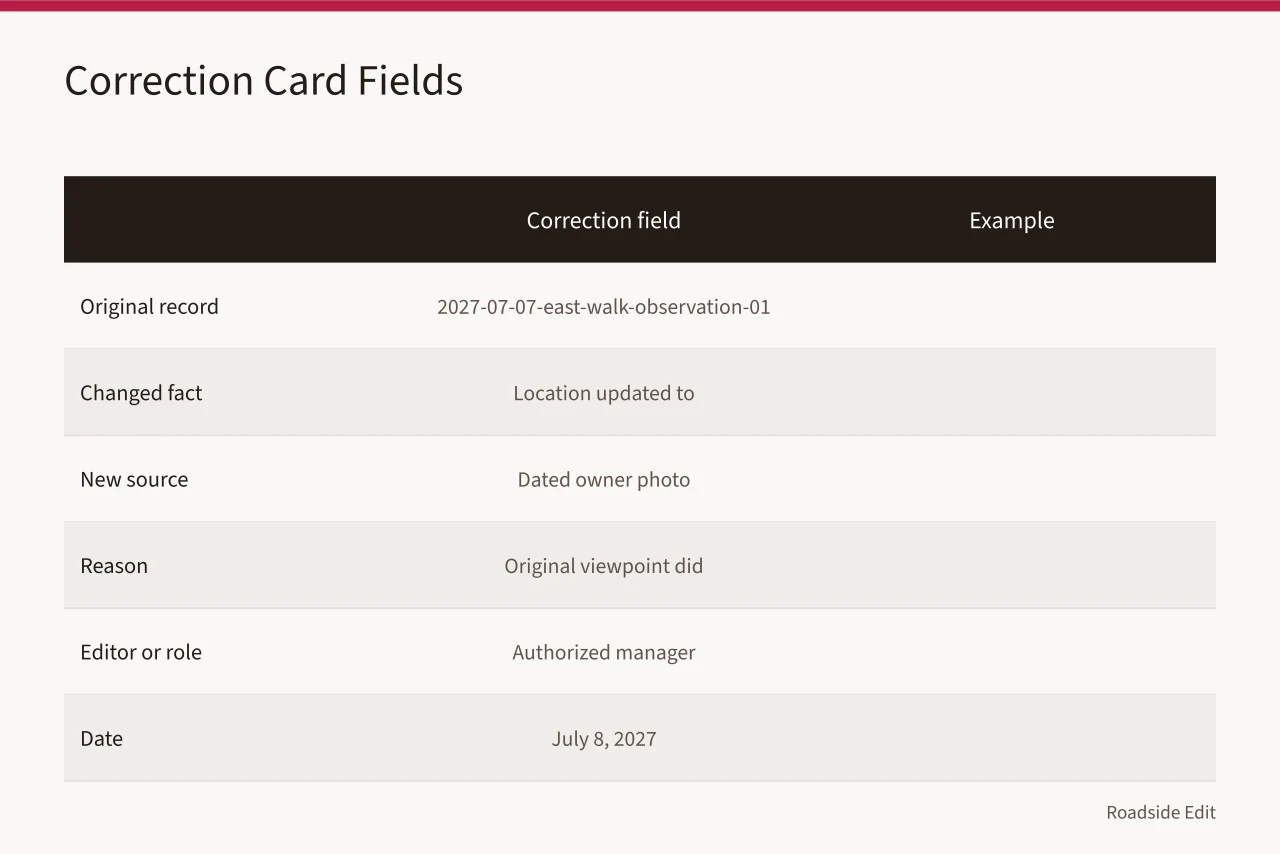
Add a correction card instead:
| Correction field | Example |
|---|---|
| Original record | 2027-07-07-east-walk-observation-01 |
| Changed fact | Location updated from east entry to east service door |
| New source | Dated owner photo received July 8 |
| Reason | Original viewpoint did not show door label |
| Editor or role | Authorized manager |
| Date | July 8, 2027 |
Keep the first record available and link the correction in the file index. This protects the integrity of the record and makes a later review much easier. A correction is not an admission that the process failed. It is evidence that the record was updated with better information.
Separate commercial material from safety evidence
Contractors, property managers, and local businesses may eventually submit descriptions, offers, or paid placement material. Preserve the date and author if it belongs in a commercial file, but never treat it as independent proof that a condition exists or that a service is appropriate.
The Federal Trade Commission says that advertising formatted to look like independent content should be recognizable as advertising. Read the FTC's native-advertising guide. The guide concerns advertising disclosures, not property safety. It supports a clear records boundary: label paid or submitted material and keep it separate from the evidence used for an editorial safety statement.
Prepare a restricted handoff packet
When an owner, manager, or facilities contact changes, create a handoff packet with only the information needed for the next decision. Include the current record index, active notifications, latest response notes, open questions, access limitations, and calendar for the next review. Exclude private contact lists and any security-sensitive material unless the recipient has a clear operational need and authorization.
Before sending the packet, make two checks. First, does every open record identify an owner? Second, does every closeout say whether completion was reported or independently reviewed? These two questions reveal most gaps quickly.
Common questions
Does a safety photo prove a hazard exists?
No. It shows a view from a place and time. Pair it with a location, source, access limit, and responsible follow-up, then let the appropriate person assess the property-specific question.
What should never appear in a public safety record?
Do not publish guest information, access codes, private contact details, security procedures, or an unsupported claim that a condition is safe, unsafe, compliant, or noncompliant.
How should reported repairs be recorded?
Name the source, date, and scope as reported. Use a separate verified label only when appropriate evidence has been checked by the responsible party.