Guides
Gas station preservation planning: build the evidence stack before you publish
Plan gas station preservation coverage in 2027 with evidence stages, source limits, public records, transparent reuse stories, image credits, and corrections.
Planning a gas station preservation story begins before a writer chooses a headline. Former stations may carry architectural, commercial, environmental, and community history, but those threads do not automatically produce the same conclusion. A careful feature identifies which question it can answer, what record supports the answer, and what still belongs to a property-specific public or professional process.
This is an editorial workflow for reporting on historic or former gas stations. It is not a site assessment, environmental opinion, eligibility decision, project plan, or construction recommendation.
What to take away
- Define the reporting question before collecting visuals and quotes.
- Separate historic documentation, current observation, a proposal, and a completed action.
- Use agency or archive records only for the claims they directly support.
- Label illustrations, supplied information, and sponsored material plainly.
- Keep a source ledger and correction path from the first draft onward.
Choose one answerable question
"Gas station preservation" can conceal several different stories: one article may cover a 1930s building documented in an archive, while another may cover an operator's current use of a former bay.
A third may cover a public meeting about a possible reuse, and a fourth may describe a former station's environmental assessment. The reader deserves to know which story they are getting.
Write the reporting question in one sentence.
For example: What does the available public record say about the Humble Service Station here? Or: What has the named organization proposed for a former station, and what stage has the proposal reached?
Avoid questions that assume the result, such as whether a building is "worth saving" or ready for a particular use.
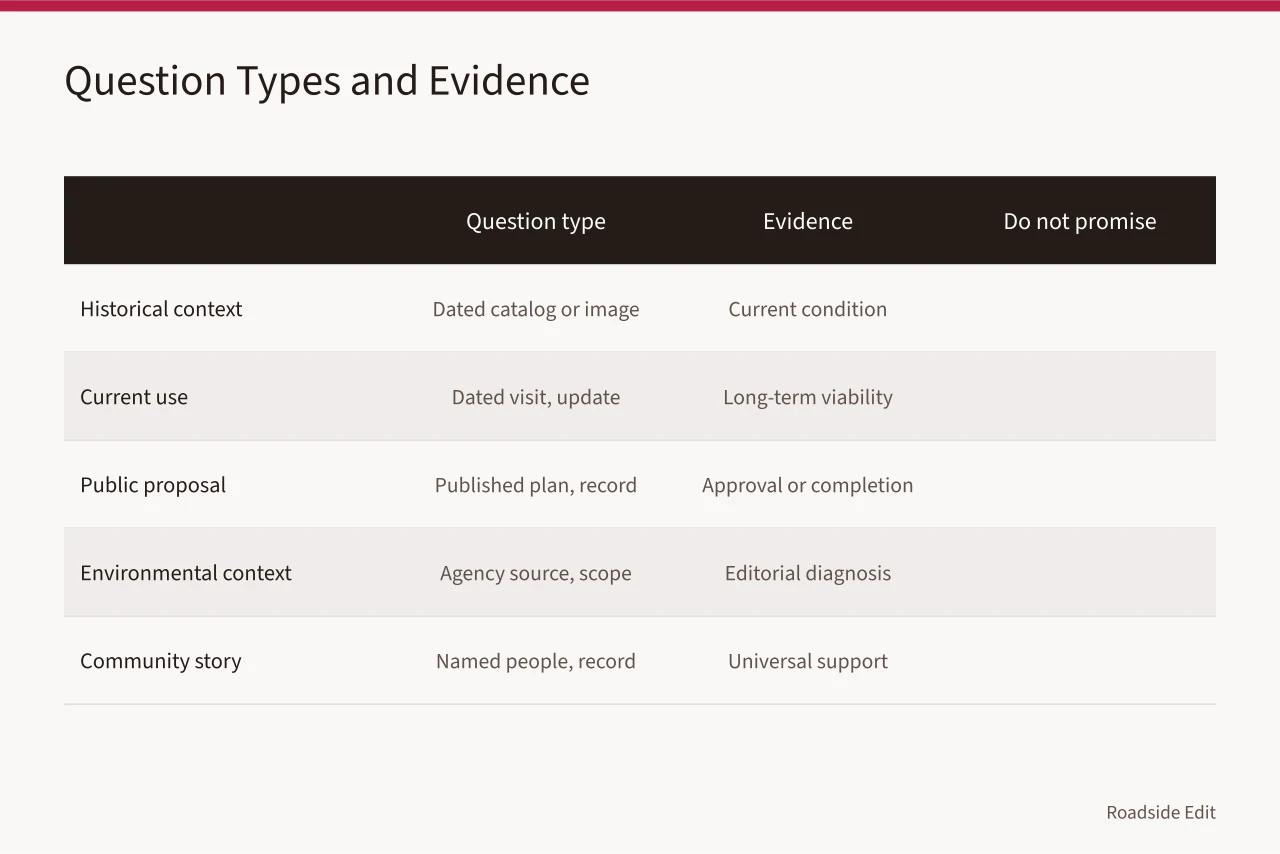
| Question type | Appropriate evidence | Do not promise |
|---|---|---|
| Historical context | Dated catalog, survey, or image | Current condition |
| Current use | Dated visit and attributed update | Long-term viability |
| Public proposal | Published plan or meeting record | Approval or completion |
| Environmental context | Agency source with stated scope | A diagnosis from editorial research |
| Community story | Named people and public record | A claim of universal support |
The Library of Congress catalog for the Humble Service Station identifies the resource as a Historic American Buildings Survey record and provides its survey number and early-gas-station design context. That is enough for a precise historical sentence about the catalog. It is not a current inspection or a finding about another station.
Build the evidence stack in stages
Planning goes wrong when a draft treats every source as having equal authority. A historical photo has a date, a survey identifies what it documented, and an owner interview conveys the owner's account.
A government page may explain a program or a named case; a site visit records what the writer saw; each source has value and a boundary.
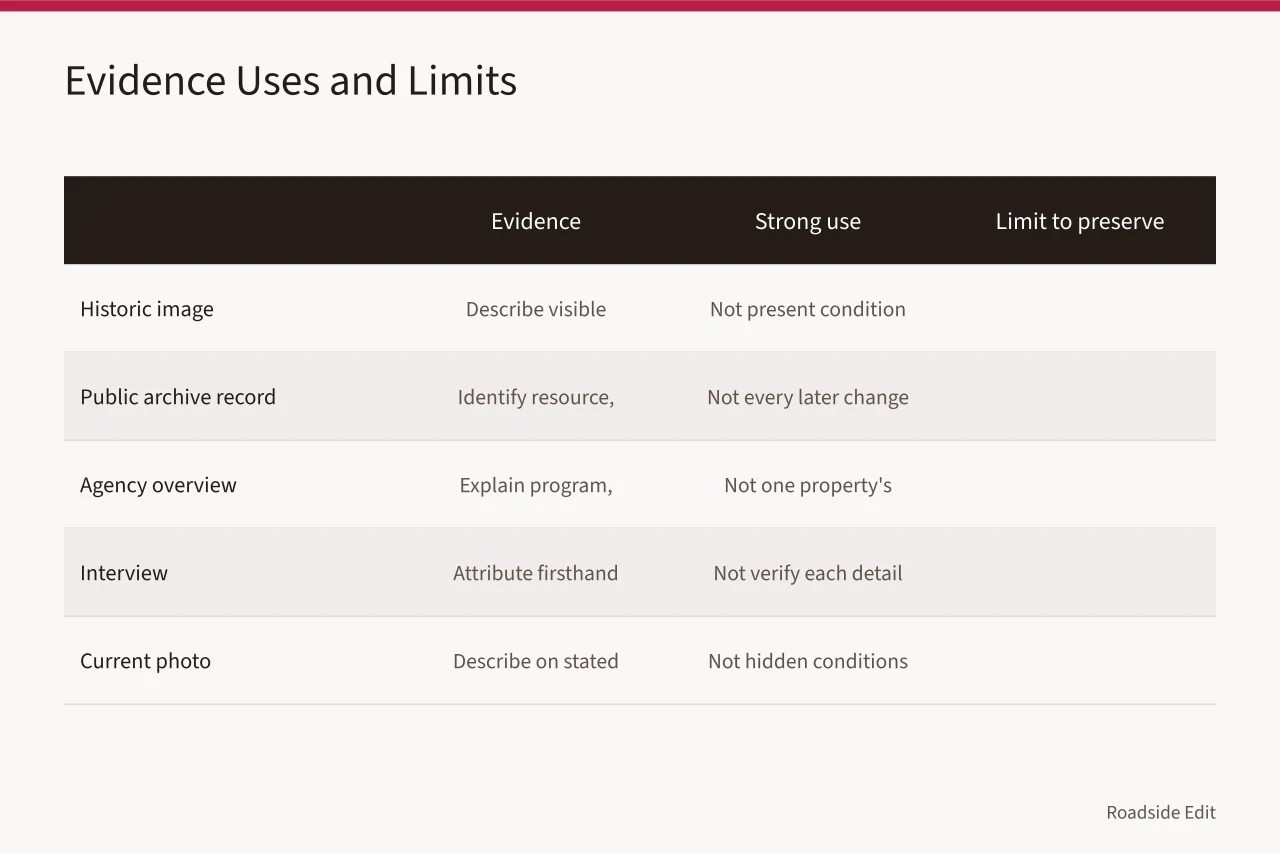
Create a working ledger before writing. Include the source page, access date, source type, exact claim, and limit. A sentence that cannot be connected to a record, observation, or attribution should be revised before it reaches the copy desk.
| Evidence | Strong use in an article | Limit to preserve |
|---|---|---|
| Historic image | Describe a visible feature on its date | Does not prove present condition |
| Public archive record | Identify the resource and stated history | Does not resolve every later change |
| Agency overview | Explain a program or general process | Does not decide one property's status |
| Interview | Attribute a firsthand account | Does not independently verify each detail |
| Current photo | Describe what appears on a stated date | Does not reveal hidden conditions |
This approach makes an article more compelling, not less. It lets the writer show how a former station acquired different meanings over time instead of relying on a single word such as "authentic" or "restored." It also gives a reader a fair sense of what has been verified.
Put dates at the center of the story
Many inaccurate roadside stories have a timing problem. A building may have been constructed in one decade, photographed in another, closed later, and discussed for reuse today. The article needs those moments in order.
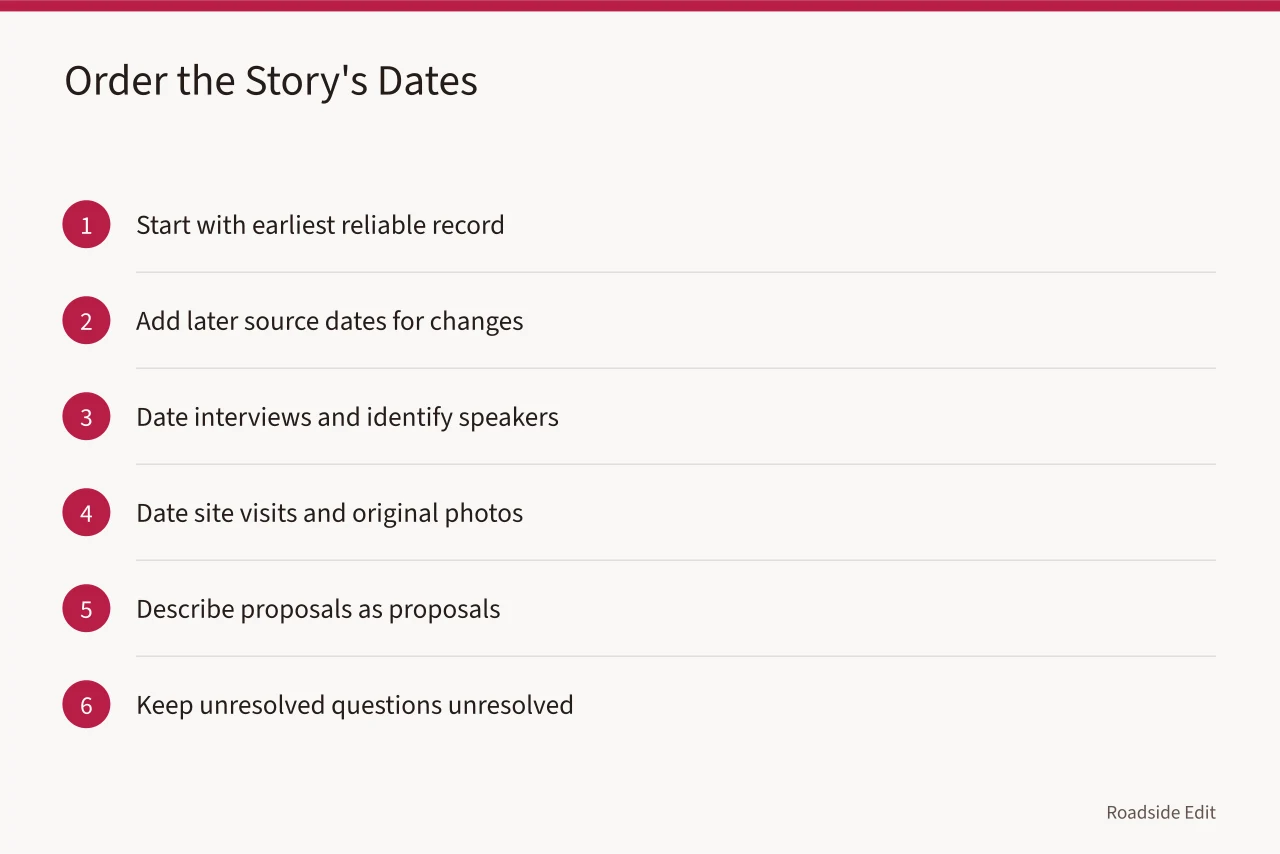
This sequence protects the reader from a tempting shortcut. A public announcement can be newsworthy even if it is not an approval. A historic photograph can be illuminating even if it does not prove a feature survives. Exact verbs make the difference: proposed, announced, assessed, funded, began, completed, opened, or observed.
Keep reuse coverage honest
Former gas stations often come up in discussions of future reuse. That topic can be lively when a station sits along a recognizable road or near a local commercial center.
A reuse story should not become a disguised feasibility study. The article can name a stated idea, the people advancing it, and the public material behind it, but not predict that the idea will happen.
An environmental question should remain a question until a property-specific record or assessment supports a narrower statement. A writer should not infer environmental status from vacancy, location, architecture, or an image. A paragraph about a potential reuse can note that property-specific assessment and the relevant agencies determine those facts.
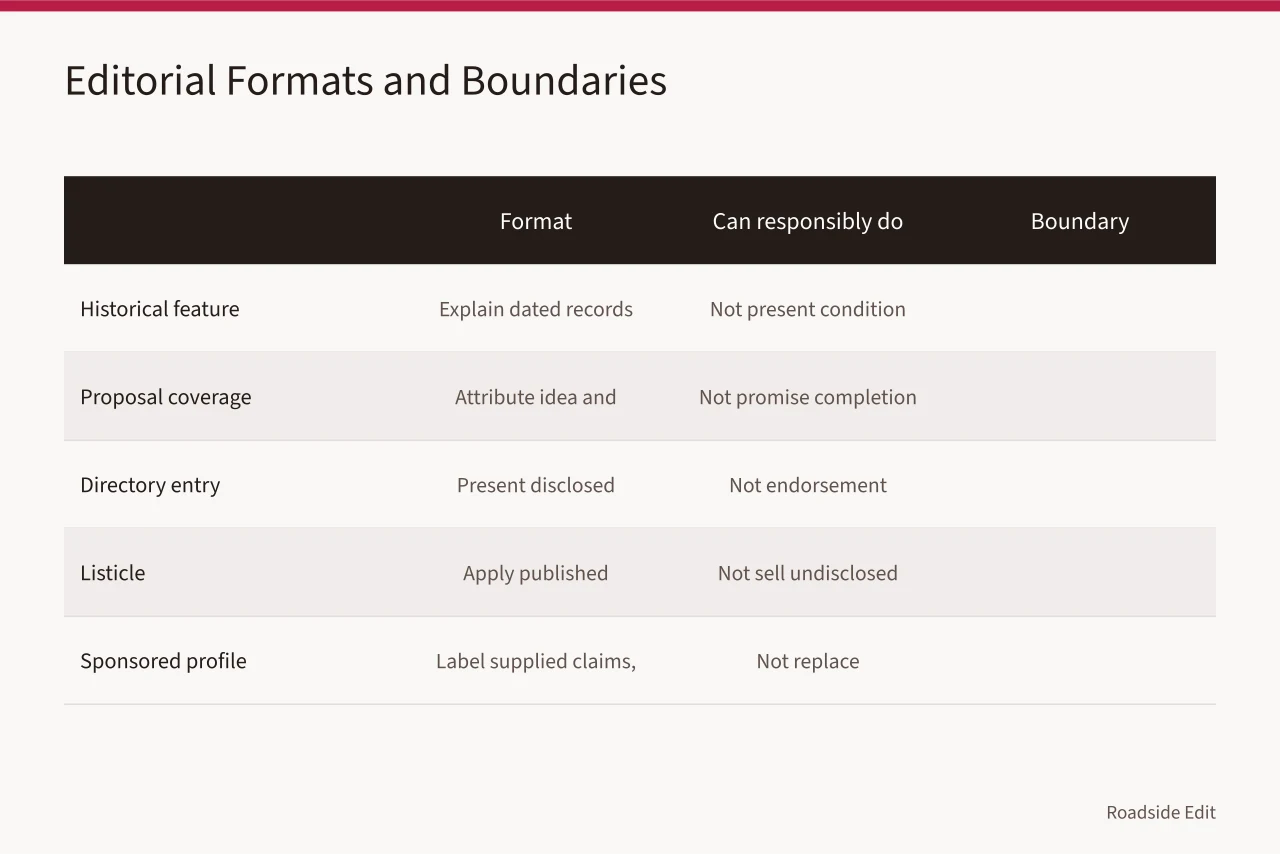
| Editorial format | What it can responsibly do | Boundary |
|---|---|---|
| Historical feature | Explain dated records and context | Not a present condition report |
| Proposal coverage | Attribute an idea and its stage | Not a promise of completion |
| Directory entry | Present disclosed business information | Not an endorsement |
| Listicle | Apply published inclusion criteria | Not sell an undisclosed rank |
| Sponsored profile | Label supplied claims and payment | Not replace fact-checking |
Clear commercial boundaries are useful to advertisers as well as readers. A paid profile can offer photography, background, and a stated current use. It should not purchase an undisclosed designation, ranking, or historical conclusion. Build that rule into the pitch, contract, and edit process.
Plan media as reporting material
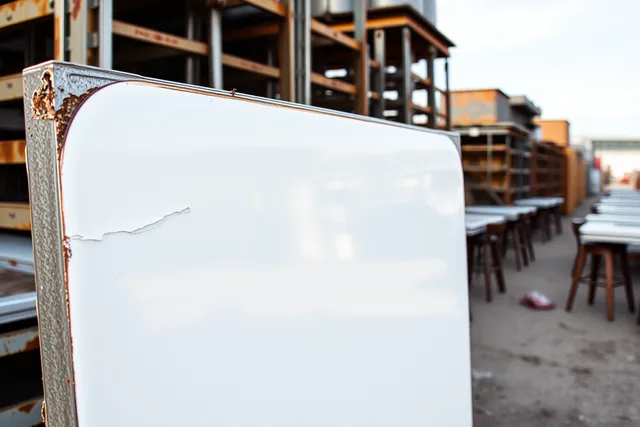
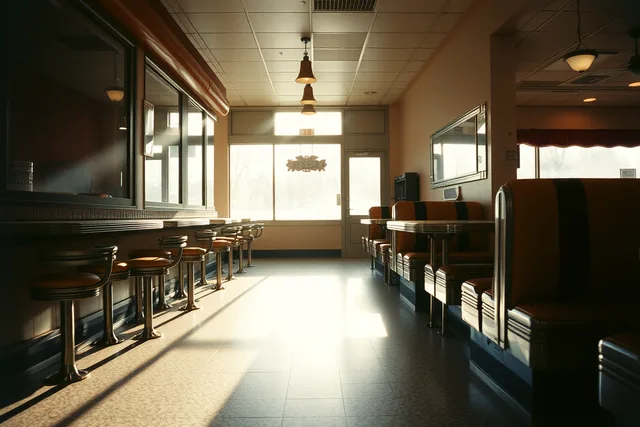
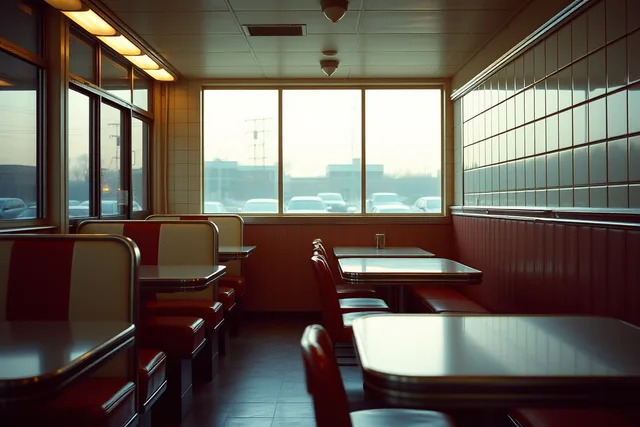
Photography shapes what readers think they know. Use images to add context, not to smuggle in claims. An old station photo can be beautiful and still be irrelevant to the particular property in the body text. The caption should name the source, say when possible when the image was made, and tell readers whether it is illustrative.
The image is illustrative. It does not document the condition, environmental status, history, or project stage of another property.
For original images, preserve the original file, photographer, visit date, location, and relevant consent notes. For archive or licensed material, preserve the source page and rights note. A caption should never identify an uninspected property by implication.
Use a practical editorial review
Run the article through three reviews. First, confirm the source for each material historical or project-stage claim. Second, look for claims that overreach: original, untouched, fully restored, ready, safe, approved, or best. Third, look for commercial language that belongs in a disclosed placement rather than an editorial conclusion.
Useful revisions are often small:
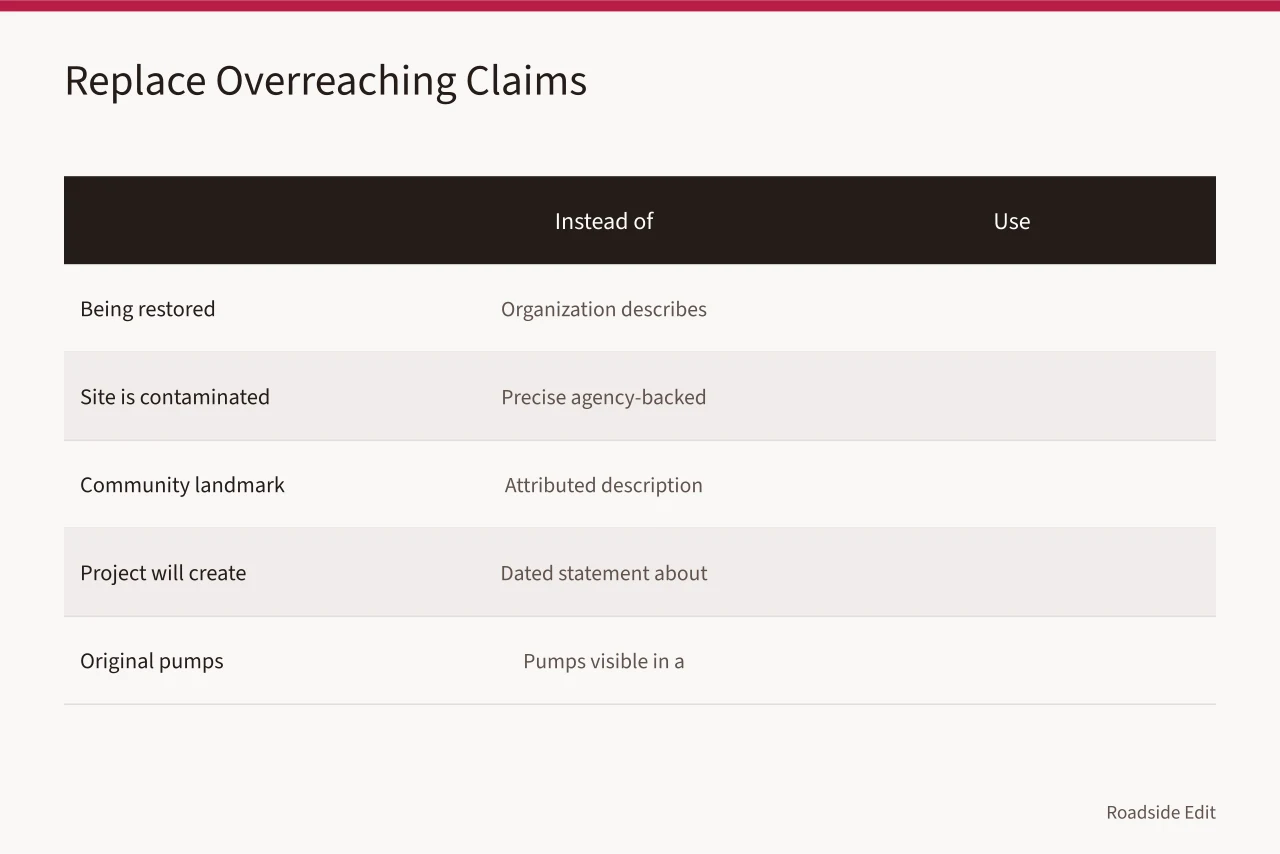
The intent is not to make every paragraph cautious in the same way. It is to make the key claims answerable. A direct, well-supported sentence is stronger than an expansive phrase that cannot survive a reader's question.
Prepare for corrections
Planning information changes. A project can move forward, pause, change ownership, or be replaced by another proposal. An archive may digitize a better image. A reader might provide a dated record that corrects the feature's history. Keep a corrections contact and a private log that records the original statement, new source, change, editor, and date.
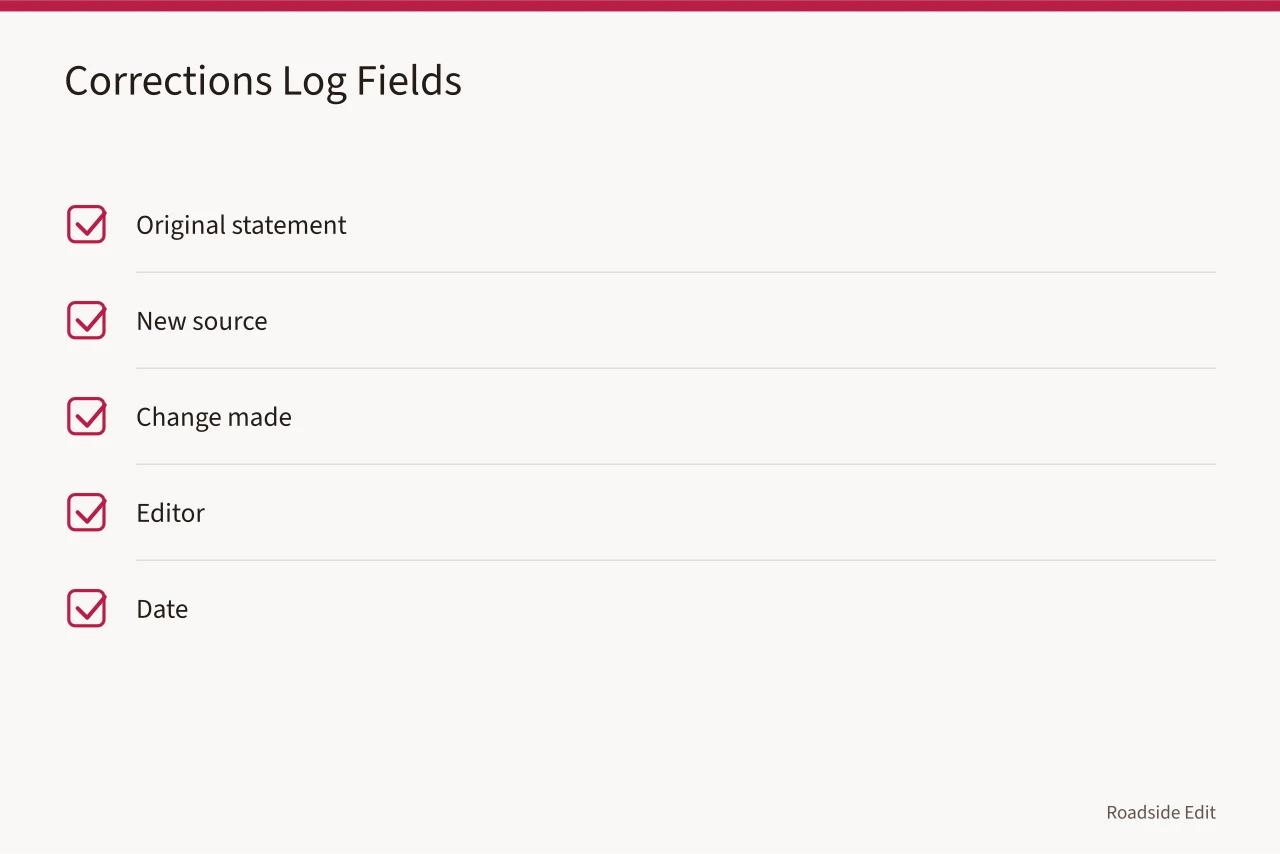
The National Archives records-management guidance gives a useful model for that private log: retain records in an organized way so a later editor can find the basis for a factual statement. For a preservation story, the file should separate research notes, correspondence, published public records, permissions, and editorial corrections. It does not make an editorial judgment for a specific property.
When evidence conflicts, identify whether each item is a firsthand record, a later account, or a summary. The National Archives explains what makes a primary source, including that a source can be primary for one question but not another. That distinction helps an editor preserve a useful owner recollection without treating it as proof of every historical detail.
Commercial disclosure deserves the same discipline. The Federal Trade Commission's endorsement guidance explains that material connections can need clear disclosure when they affect how people evaluate an endorsement. A sponsored station profile should therefore identify the paid relationship in plain language and keep independent reporting separate from supplied promotion.
When the new information affects a material fact, update the sentence and add a brief correction note. Do not silently convert a proposal into a completed project or leave an outdated claim because it makes the story neater.
Common questions
Can a writer say a former station is a brownfield because it is vacant?
No. A site-specific source or the relevant public process is needed. Vacancy and visual appearance do not establish environmental facts.
How should a feature cover a reuse proposal?
Name who made the proposal, date the source, describe the stated stage, and avoid language that promises approval or completion.
Can a business sponsor a feature about a former gas station?
Yes, with clear disclosure. Sponsor-supplied claims should be attributed, and payment should not control an undisclosed ranking or historical conclusion.
What if the public record and an owner account disagree?
Preserve both sources, seek additional support, and state the conflict when it matters. Do not choose the more dramatic version without evidence.
In this guide
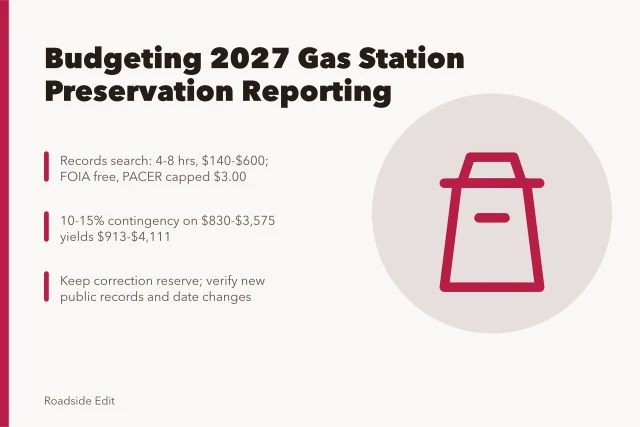
- Gas station preservation planning workflow: how to budget 2027 reporting tasksSet 2027 gas station preservation reporting line items: source checks, image rights, records, disclosure, corrections. Budget ranges and tools included.