Guides
Roadside design studio mistakes checklist: how to catch weak claims before you publish
Roadside design studio mistakes checklist for 2027: catch weak claims, unclear sponsorship, poor source records, image errors, and missing editorial limits.
Most weak roadside design articles do not fail because the writer lacks ideas. They fail because a small claim gets more certainty than its source can carry.
A route name becomes proof of a building's history, and a marketing description becomes a review. A photo credit becomes permission to reuse it, and a vague file name becomes the only record of a fact's origin.
This checklist is a prepublication review for articles about roadside signs, motels, service stations, corridors, renovation concepts, and local lists. It helps an editor catch mistakes before they reach readers. It does not approve a project, settle a legal question, establish property status, or replace a site-specific review.
What to take away
- Set a narrow reader question before collecting facts.
- Match every major statement to an exact source, date, place, and limit.
- Label paid or submitted material where a reader may mistake it for independent judgment.
- Treat image credit, access, and reuse rights as separate questions.
Mistake: writing toward a conclusion
An article often starts with an attractive conclusion: a roadside place is "worth saving," a new concept "fits the town," or a storefront "needs renovation." Those are opinions.
They become a problem when the draft treats them as settled facts, so start with the reader's question and the evidence the article can supply.
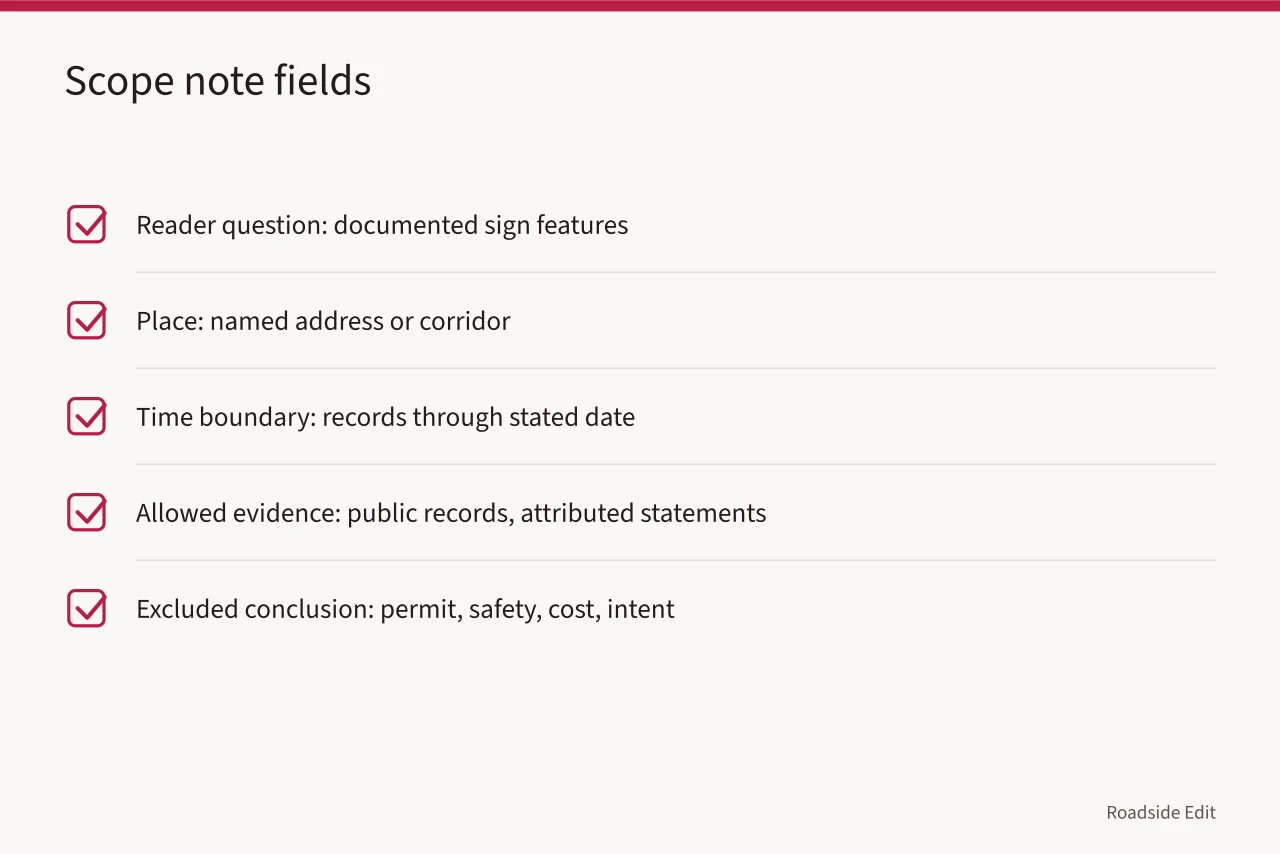
Write a scope note before opening a browser:
| Scope field | Example entry |
|---|---|
| Reader question | "What documented features distinguish this roadside sign from a generic replacement?" |
| Place | Named address, corridor segment, or public map reference |
| Time boundary | Records published through a stated date |
| Allowed evidence | Public records, institutional sources, attributed business statements |
| Excluded conclusion | Permit approval, safety, cost, owner intent, or construction advice |
Then inspect the title and introduction. A question about visual features should not end up making a claim about zoning or building condition. If the evidence shifts during research, revise the reader question. Do not stretch unrelated material to keep the original headline.
The most useful correction is usually less dramatic. Replace "this property is historic" with a sourced description of its documented age, route connection, or listing status. Replace "the owner plans to restore it" with an attributed statement that names the source and date. Readers can see the difference.
Mistake: keeping sources as loose bookmarks
Browser tabs and a folder of screenshots are not a research record. They make it hard for another editor to tell which page supported which line, whether the source was current, or whether the image file matches the credit.
National Archives guidance describes a records inventory as a descriptive listing that includes location and other relevant data, rather than a loose collection of individual documents. Read NARA's records inventory introduction. The rule is for federal records, not a magazine draft. The method works well for editorial research: use consistent fields so the source can be found and checked later.
Keep one source card for each material claim:
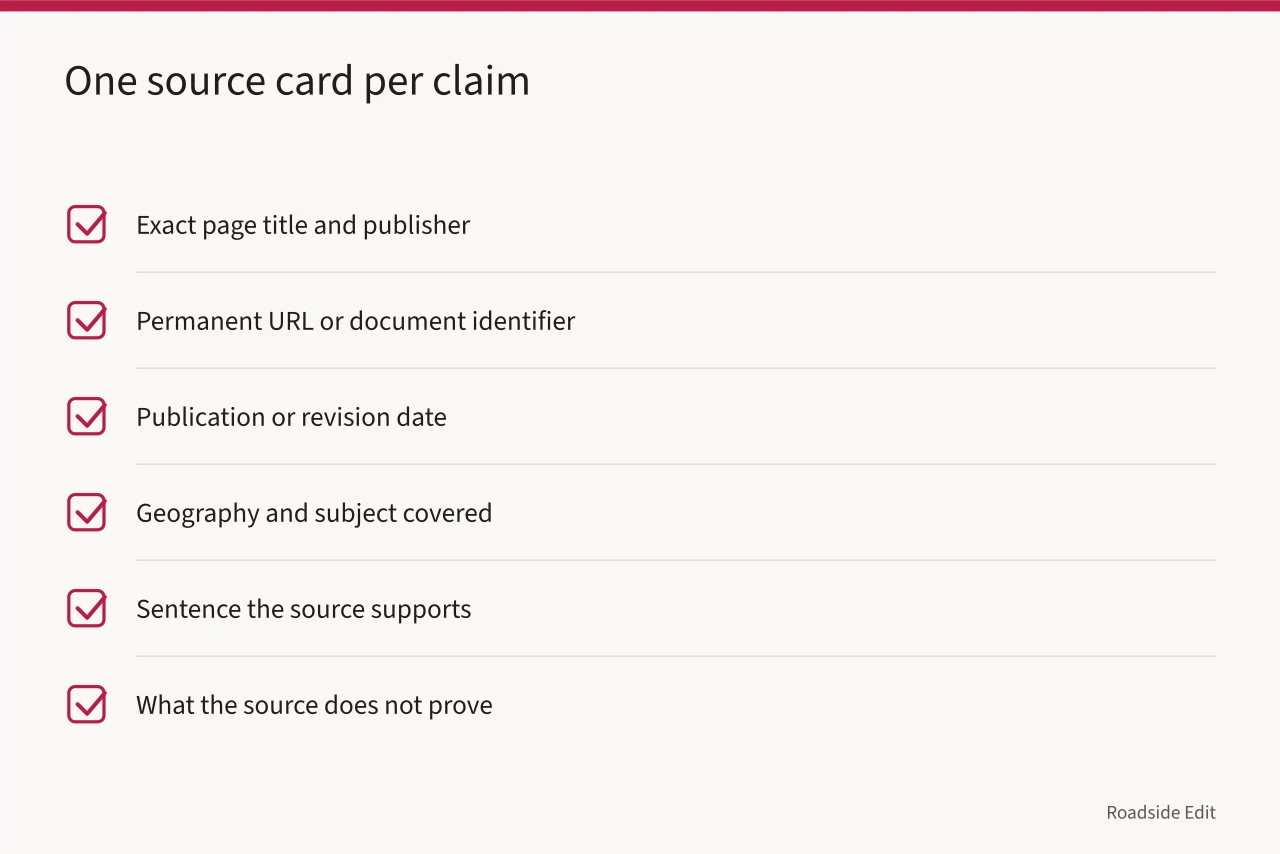
Avoid putting several claims under a single vague note such as "city history page." That shortcut invites a writer to use the source beyond its stated subject. It also makes corrections slow when an agency updates a page or a business changes its description.
Mistake: turning submitted copy into a review
Roadside directories and design roundups often include business descriptions, quotes, discount offers, affiliate links, or paid placements. That material can be useful, but it needs a different editorial label from independently verified reporting.
The Federal Trade Commission says a material connection between an endorser and a marketer should be disclosed clearly and conspicuously when it would affect how consumers evaluate an endorsement. Read the FTC's endorsement guidance.
The guidance covers endorsements and advertising practices but does not tell a publisher exactly how to design every article. It supports one editorial rule: place a clear disclosure close to the recommendation, link, or commercial statement it explains.
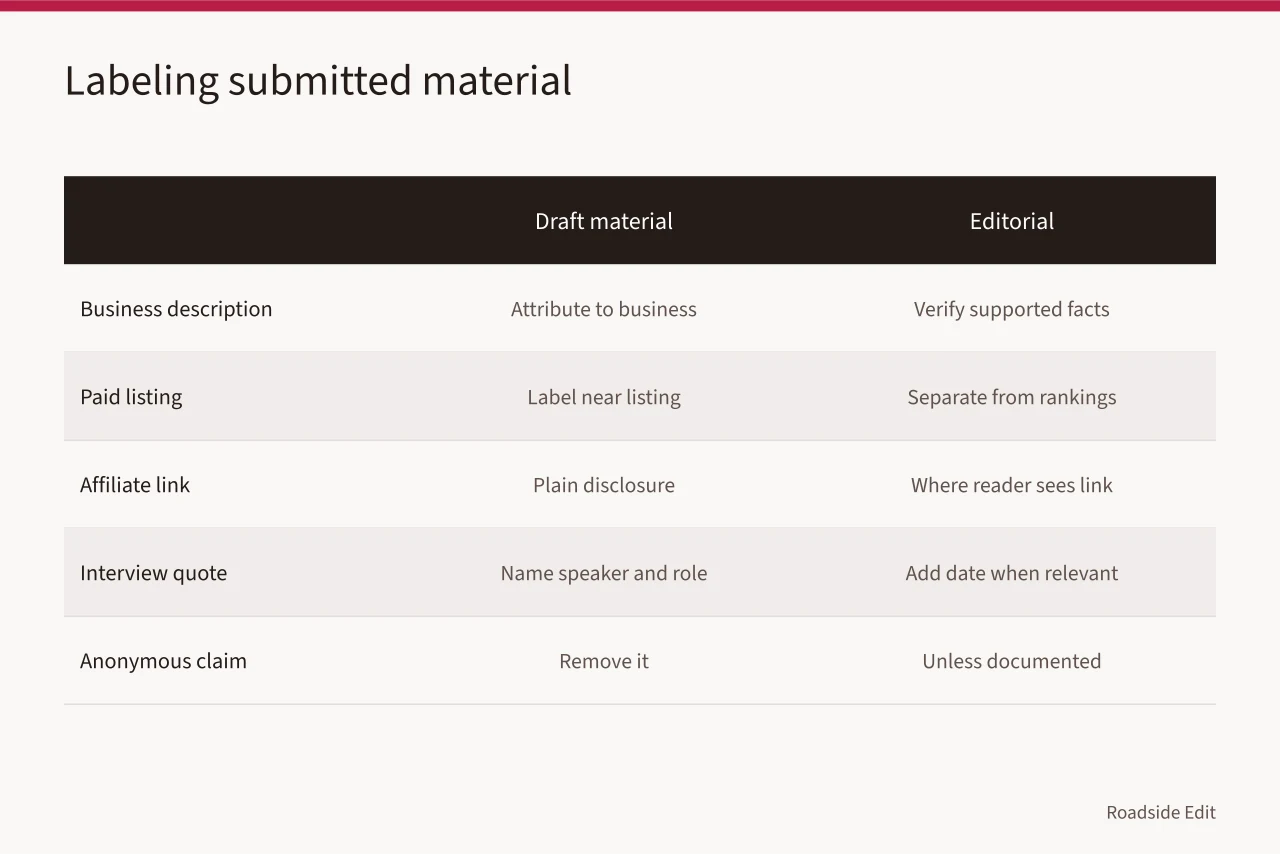
| Material in the draft | Editorial treatment |
|---|---|
| Business-submitted description | Attribute it to the business and verify only what a source supports |
| Paid listing | Label it near the listing and keep it separate from editorial rankings |
| Affiliate link | Use a plain disclosure where the reader sees the recommendation and link |
| Unpaid interview quote | Name the speaker, role, and date when relevant |
| Anonymous promotional claim | Remove it unless there is a good reason and a documented process for it |
Do not call a list "best" because its entries bought placement or sent flattering copy. A list may be sponsored, curated, or editorially ranked, but the method needs to be visible. If the method is not strong enough to explain in a sentence, do not make the ranking claim.
Mistake: asking a photo to prove too much
A photograph can show a view at a stated time. It cannot, by itself, confirm ownership, safety, access rights, a repair date, hidden damage, or a legal designation. Captions should make the photograph easier to understand without turning it into evidence for a claim it cannot carry.
Section508.gov defines alternative text as descriptive text conveying an image's meaning in digital content. Read the federal guidance on meaningful alternative text.
Write alt text for the image's role in the article. If the image gives visual context for a roadside form, say that. Do not hide a sales message, an unsupported condition claim, or a string of search terms in the alt text.
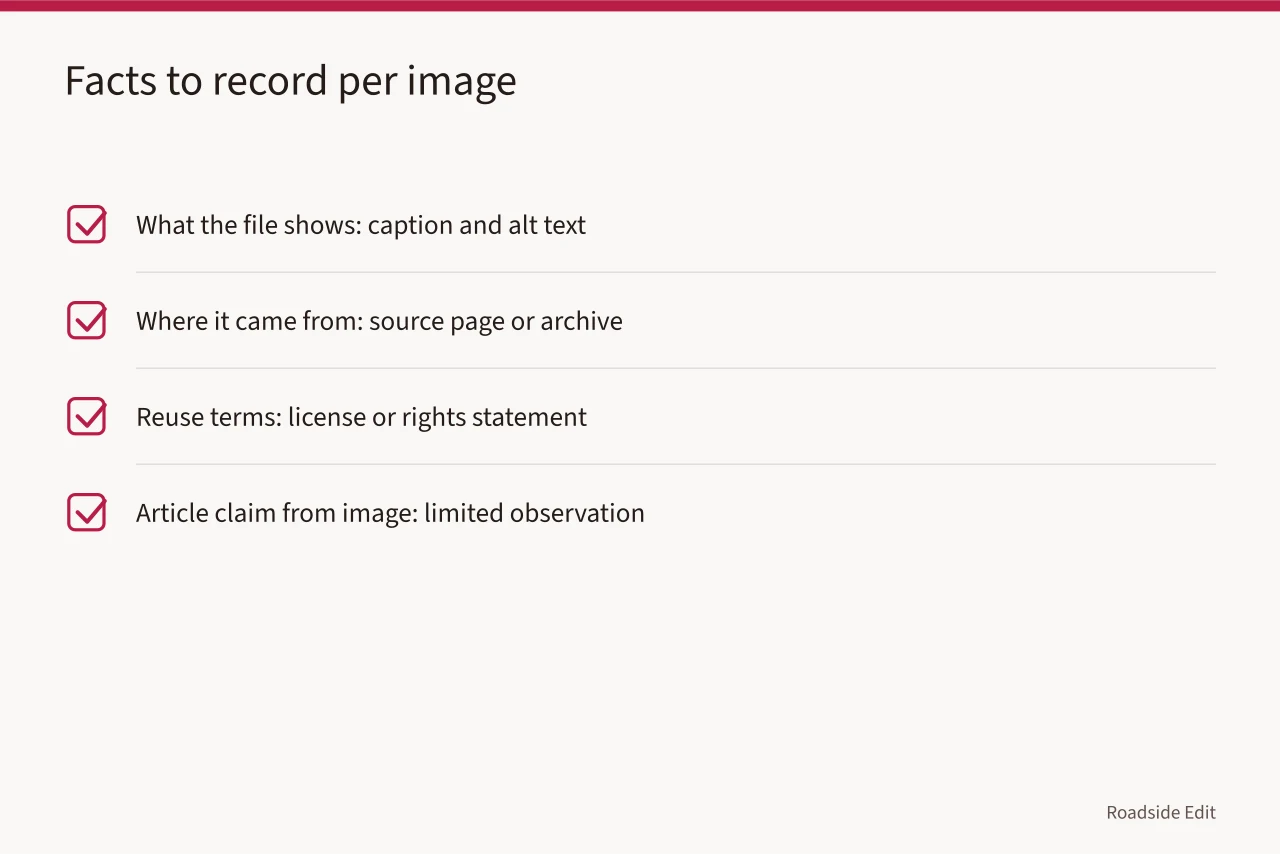
For every image, record these separate facts:
| Image question | Record needed |
|---|---|
| What does the file show? | Factual caption and alt text |
| Where did it come from? | Exact source page or archive item |
| What does the source say about reuse? | License, rights statement, or use terms |
| What does the article claim from the image? | A limited visual observation, if any |
Credit is about attribution. Permission is about rights. Those questions may have different answers, and a clear credit line does not resolve a reuse question by itself.
Mistake: assuming "fair use" is a label to add
Writers sometimes add "fair use" to a file note and move on. That is not a shortcut to a legal conclusion. The U.S. Copyright Office says courts evaluate fair-use claims case by case and that outcomes depend on a fact-specific inquiry. Review the Copyright Office Fair Use Index. This article cannot tell a publisher whether a particular use is fair.
The practical editorial response is modest. Prefer material with clear reuse terms. Save the page that states those terms. If the rights position is unclear, hold the image for review or choose a different one. Do not describe an image as public domain, licensed, or authorized unless the source says so.
Mistake: smoothing away uncertainty
Uncertainty can make copy feel less tidy, but deleting it creates a worse mistake. A research file may have a route association without a date. A newspaper report may quote a plan that never happened. A local history page may discuss a district without proving the subject lies inside it. The article should keep those gaps visible.
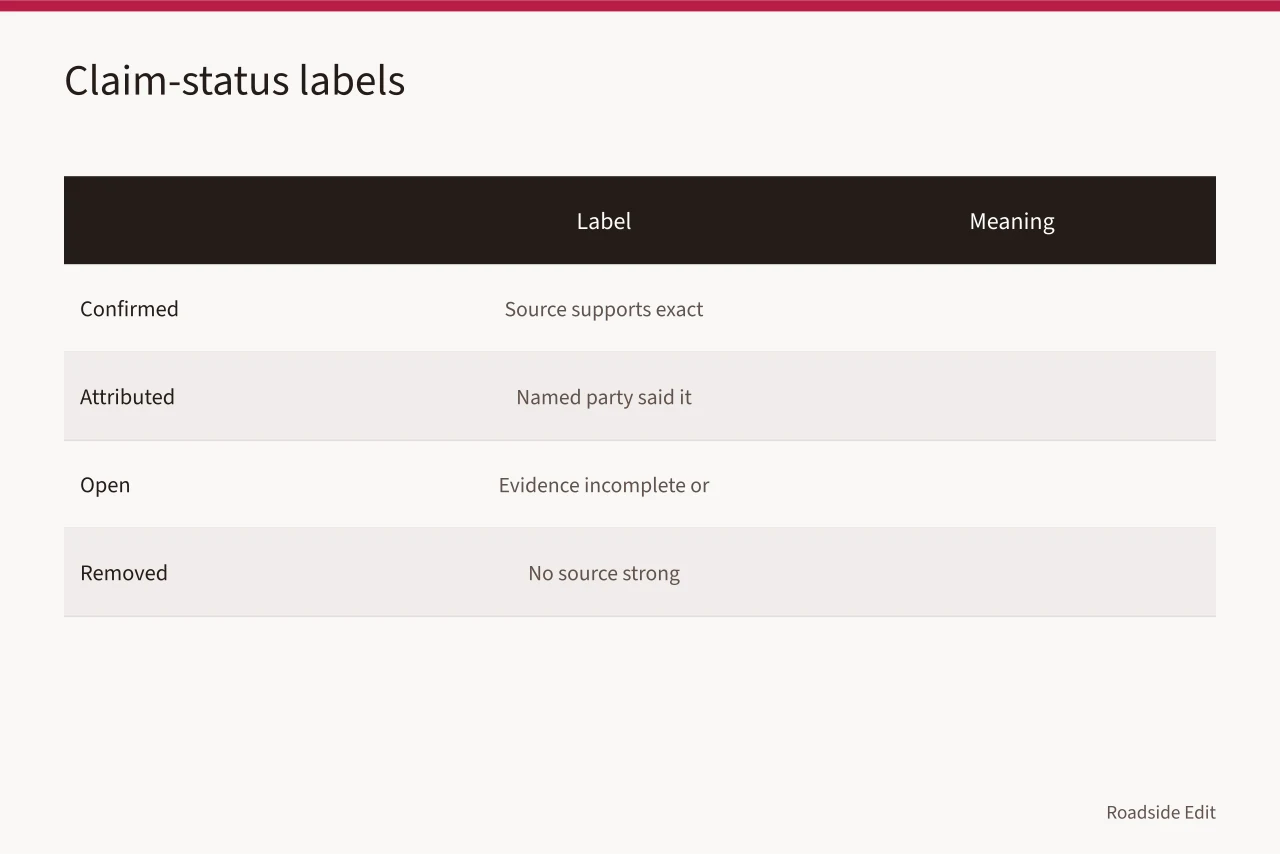
Use a claim-status label during editing:
- Confirmed: a source directly supports the exact statement.
- Attributed: a named person or organization made the statement, but the article does not present it as independently established.
- Open: the evidence is incomplete, conflicting, or out of date.
- Removed: the draft had no source strong enough to support the statement.
Labels belong in the working record, not always the published prose. Public copy can say "the city record does not identify a current permit" or "a business representative said in a dated statement."
The writer must not silently move an open claim into the confirmed column.
Mistake: publishing without a claim-by-claim read
Read the finished article as a skeptical reader would. Check the title, meta description, introduction, headings, tables, captions, and questions at the end. A careful body paragraph does not fix an overconfident headline.
Use this final pass:
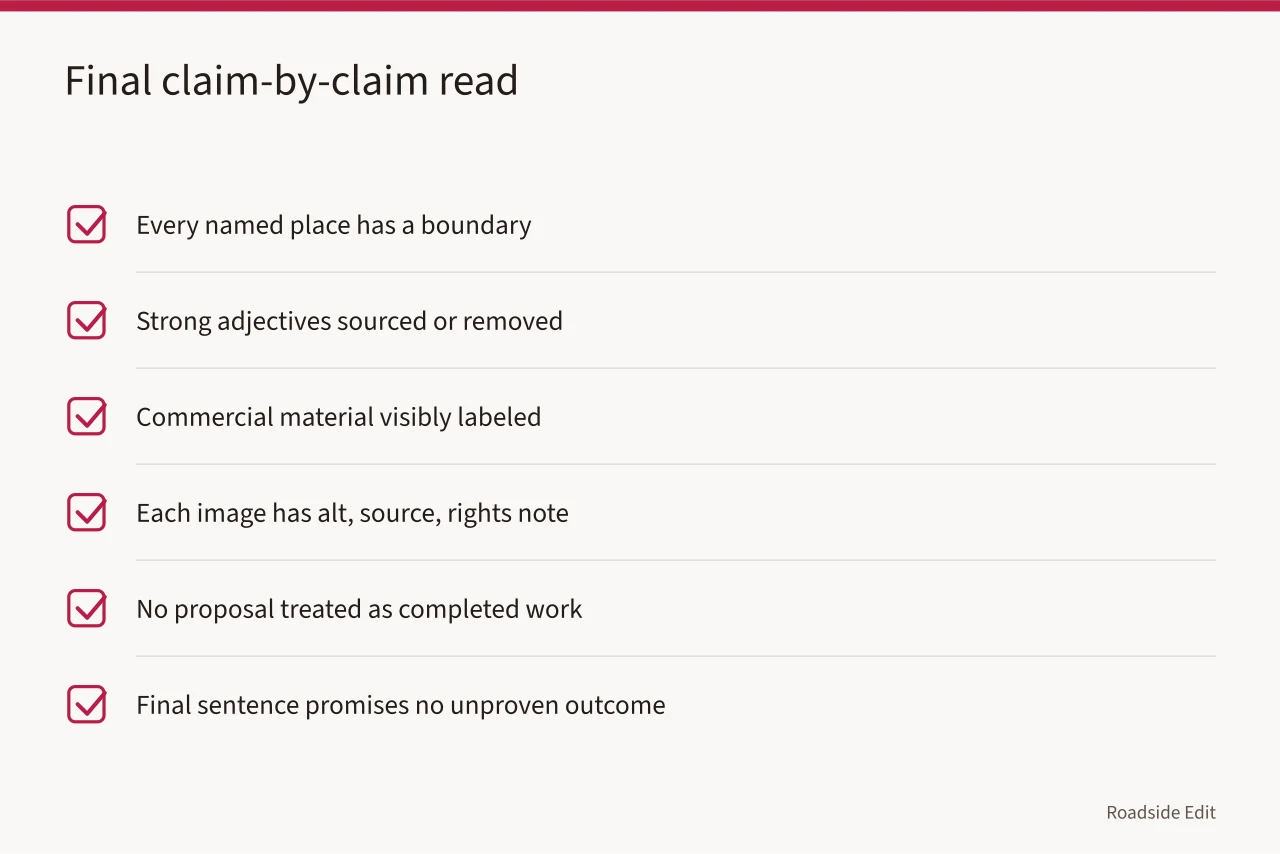
If an article fails any line, revise it before publication. A smaller, direct piece will usually earn more trust than a grand claim that collapses when a reader opens the source.
Common questions
Can an article include a business's own description?
Yes, if the article attributes the description and does not present it as independent confirmation. Any paid relationship or sponsorship should be disclosed where readers can understand it.
Is a photo credit enough to reuse an image?
No. Credit identifies the source. Reuse depends on the applicable rights, license, permission, or a legal analysis that this checklist cannot provide.
What should an editor do with a claim that has no direct source?
Remove it, rewrite it as an attributed statement, or keep it in the research file until a source can support it.