Reviews
Part of Roadside renovation cost planning: how to build public budgets that hold up
Roadside renovation cost questions to ask before you compare quotes
Compare the cost questions behind a 2027 roadside renovation, including scope, estimates, quotes, awards, contracts, change orders, and operating needs.
A roadside renovation can have several valid figures at once. An early planning range, a vendor proposal, a grant award, and a final paid amount each answer a different question. Trouble starts when an article treats them as interchangeable.
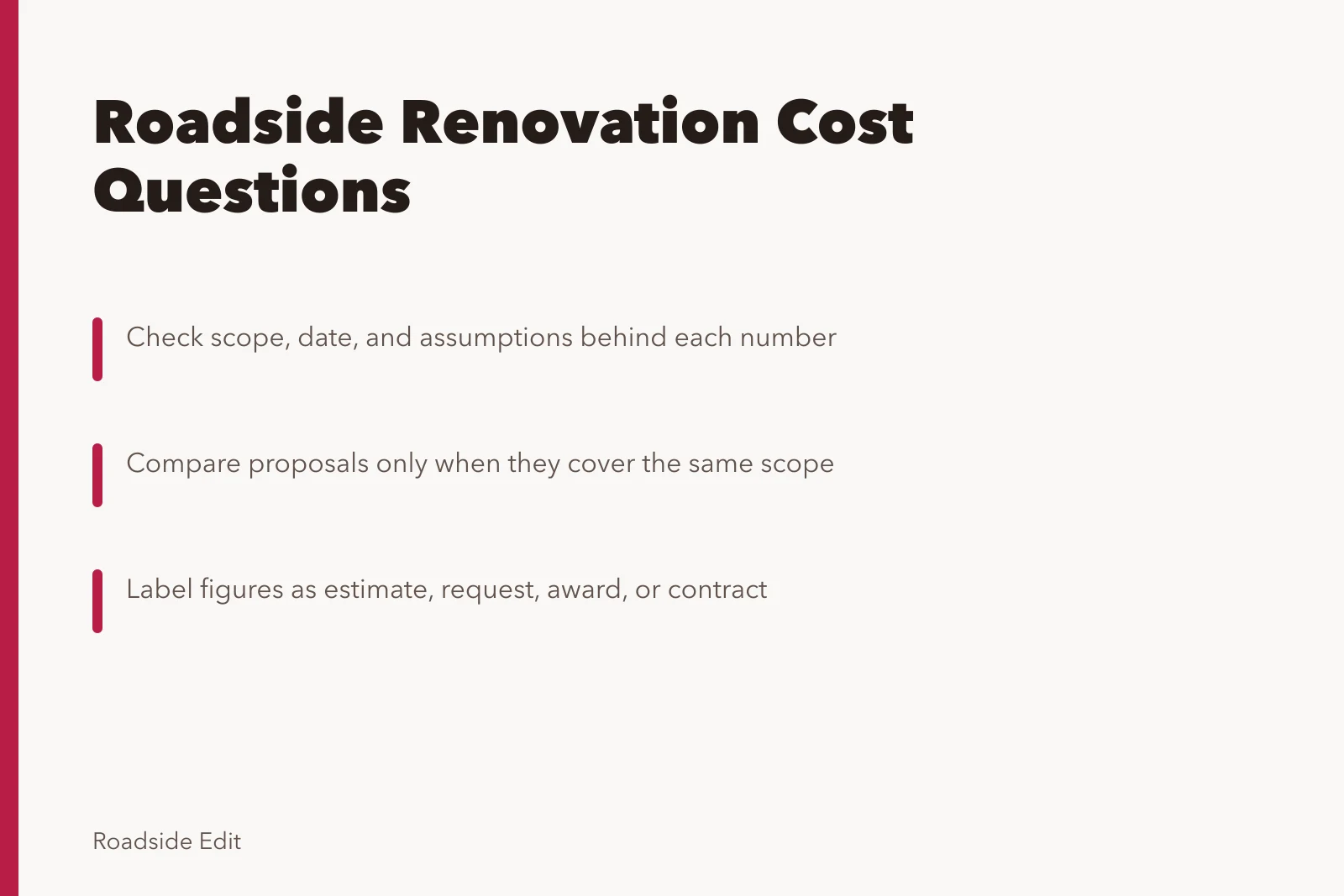
What to take away
- Ask what work, date, and assumptions sit behind every number.
- Compare proposals only after checking that they cover the same scope.
- State whether a public figure is an estimate, request, award, contract, or paid result.
What does this renovation number mean?
Start with the label, not the amount. A planning estimate is a working number to test whether an idea is plausible, while a contractor proposal prices a stated package of work.
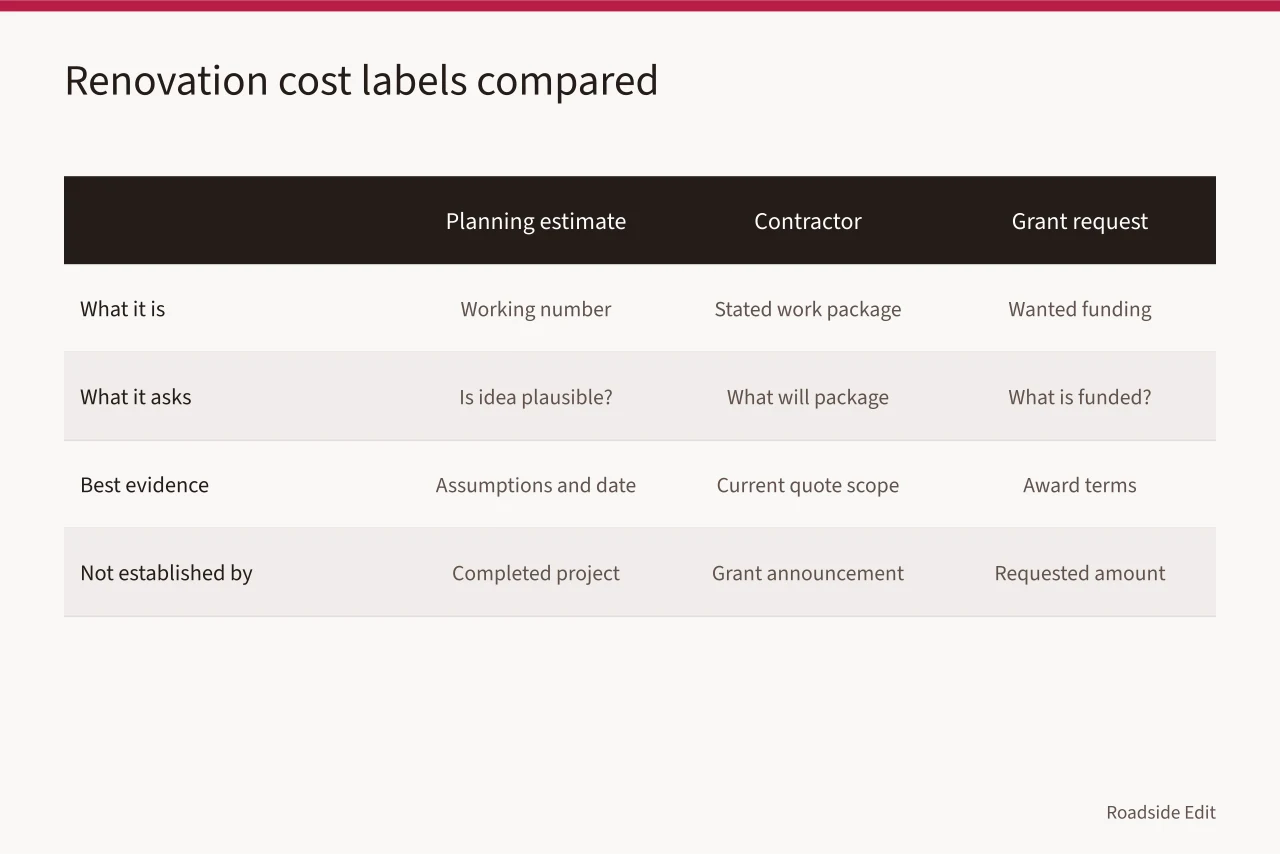
A grant request states what an applicant wants to fund, and an award means a funder agreed to support a defined activity, sometimes with conditions. None of those labels proves the final amount spent.
The useful question is narrower than "What will it cost?" A reader may ask whether a roof repair, parking change, sign replacement, accessibility item, or design service fits the stated figure.
If the source does not say, report that limit. Do not fill the gap with a nearby project, an old article's price, or another phase's total.
| Question | What it asks | Best evidence | Not established by |
|---|---|---|---|
| What may this phase cost? | Early planning range | Defined assumptions and date | A completed project elsewhere |
| What will this package cost? | Specific work package | Current quote or estimate scope | A grant announcement |
| What is funded? | Available dollars for an activity | Award terms or funding record | A requested amount |
| What changed? | Difference from earlier scope | Revision log and source | A new total without explanation |
| What must remain after construction? | Operating need | Maintenance and operating assumptions | A capital-only estimate |
The National Park Service sample preservation budget makes this distinction practical. Its example separates labor, materials, consultant or contractor costs, and other project costs for a grant application. Read the NPS sample budget worksheet.
It is not a price list or rule for every private project. It does show why a named work component tells a reader more than an unexplained round number.
How should you compare two proposals?
Put the documents side by side and read the inclusions before the totals. One proposal may cover demolition, permits, temporary protection, disposal, or a contingency allowance. Another may leave those items to the owner. A lower number can therefore describe less work, a different condition, or a different date for pricing.
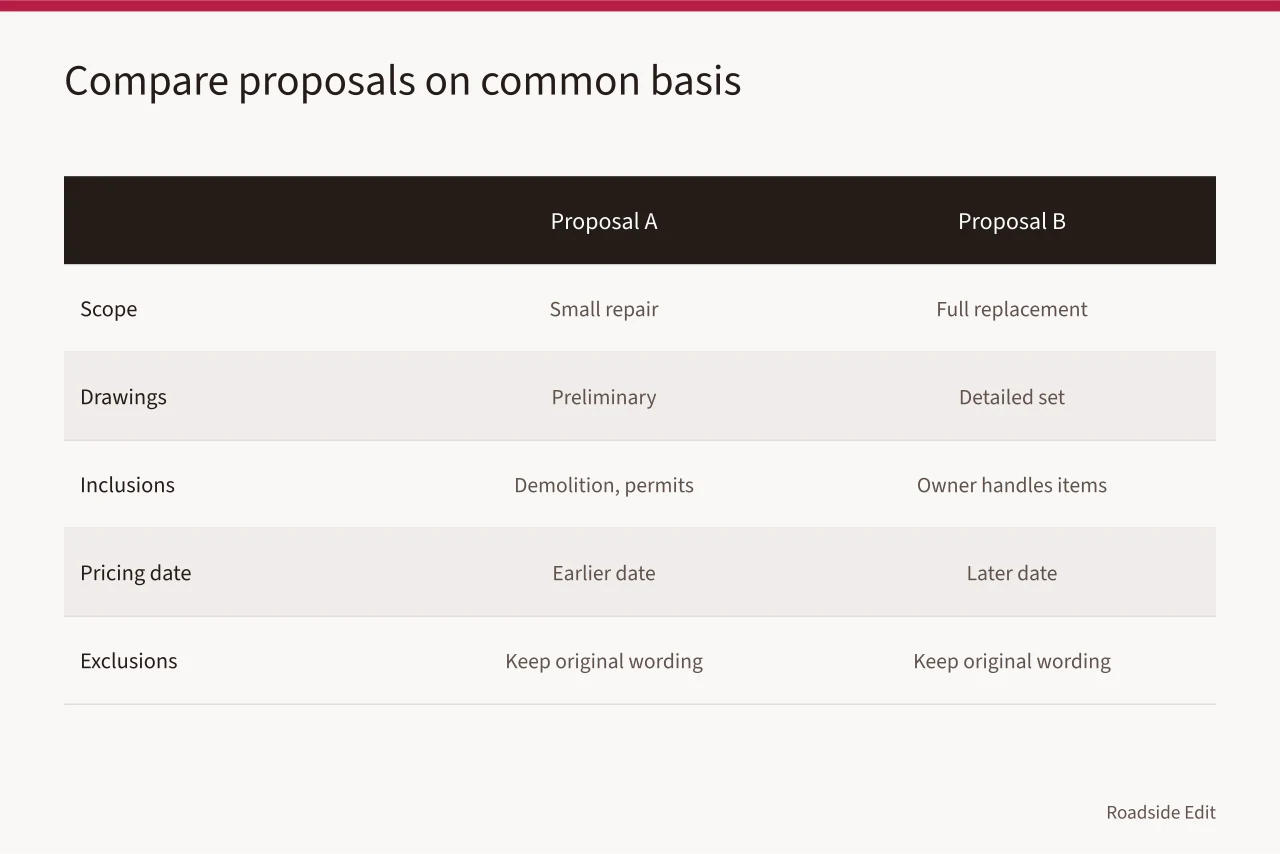
Any comparison needs a common basis. If one source prices a small repair and another prices a full replacement, those are not competing answers. If one proposal uses a preliminary drawing and another uses a detailed set, the same point applies.
Keep the original wording for exclusions and allowances. Those short clauses often explain the difference the headline total hides.
For public projects, the General Services Administration requires cost estimates and schedule information to be managed through formal project controls. See GSA's cost and schedule management directive. That federal directive applies to its own portfolio, not to every roadside property. Its underlying discipline is still useful: identify the estimate version, the date, and the scope that produced it.
| Source type | Accurate wording | Avoid |
|---|---|---|
| Early estimate | "A planning range is under review." | "The renovation costs..." |
| Funding request | "The organization requested support for..." | "The project is funded." |
| Award | "An award supports the stated activity." | "All work is covered." |
| Proposal | "A vendor proposed a price for..." | "This is the market price." |
What makes an estimate credible enough to publish?
A publication-ready estimate does not have to promise certainty. It should identify its source, purpose, date, and the main assumptions that matter to a reader. That can be as simple as saying that it is a preliminary planning estimate, based on a listed scope, and not a signed construction contract.
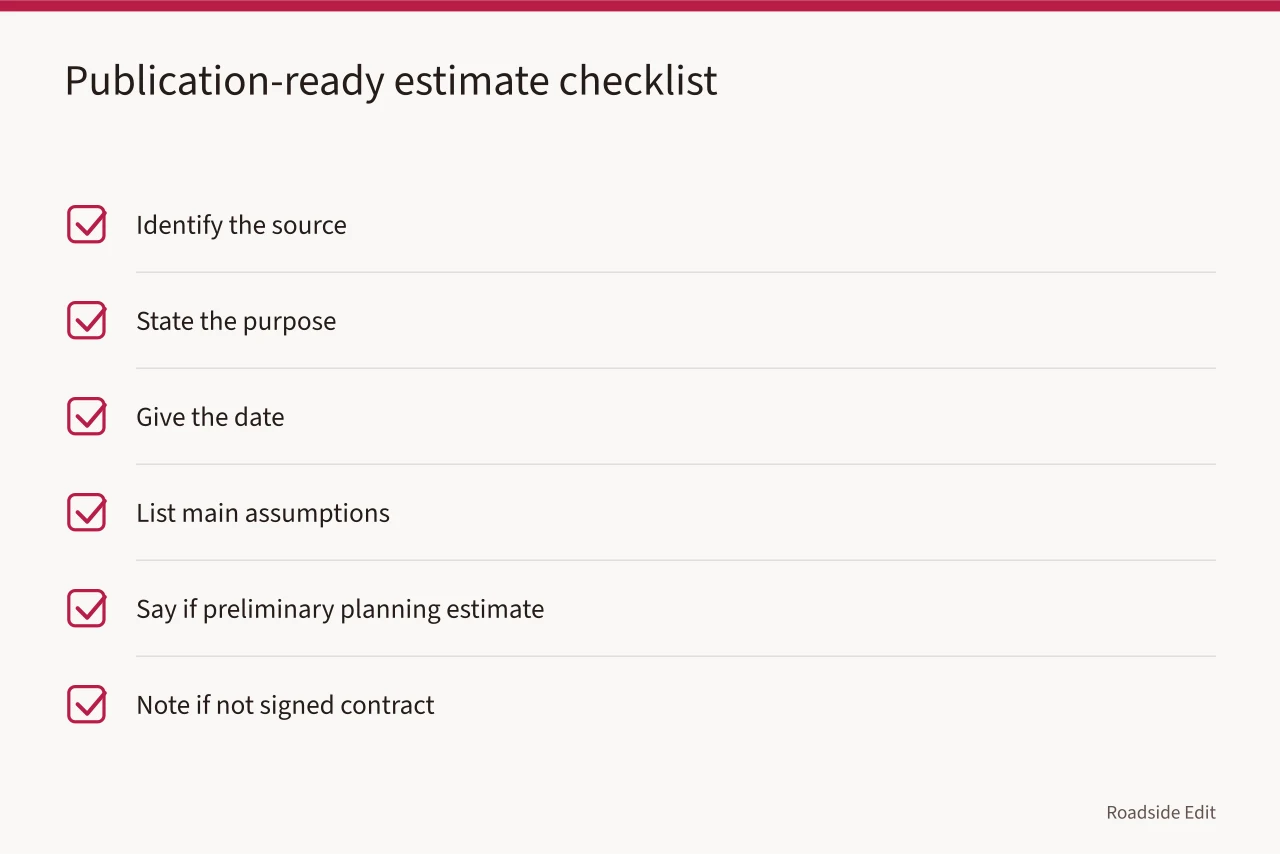
The Government Accountability Office's cost guide lays out a structured estimating process: define the estimate's purpose, document its technical baseline, and update it when conditions change. Consult GAO's cost estimating and assessment guide.
It addresses government programs, so do not use it to assert a local contractor's price. It supports careful wording about assumptions, revisions, and the difference between an estimate and an outcome.
Use a short cost note when the exact total is not public. For example: "The available record identifies a planning estimate but does not list a completed contract amount." That sentence informs readers without implying that the missing number is known. It also gives the editorial team a clear update point if a contract or final report later becomes public.
When is a price comparison fair?
A comparison is fair when the documents describe substantially the same decision. Check the following before drawing a conclusion:
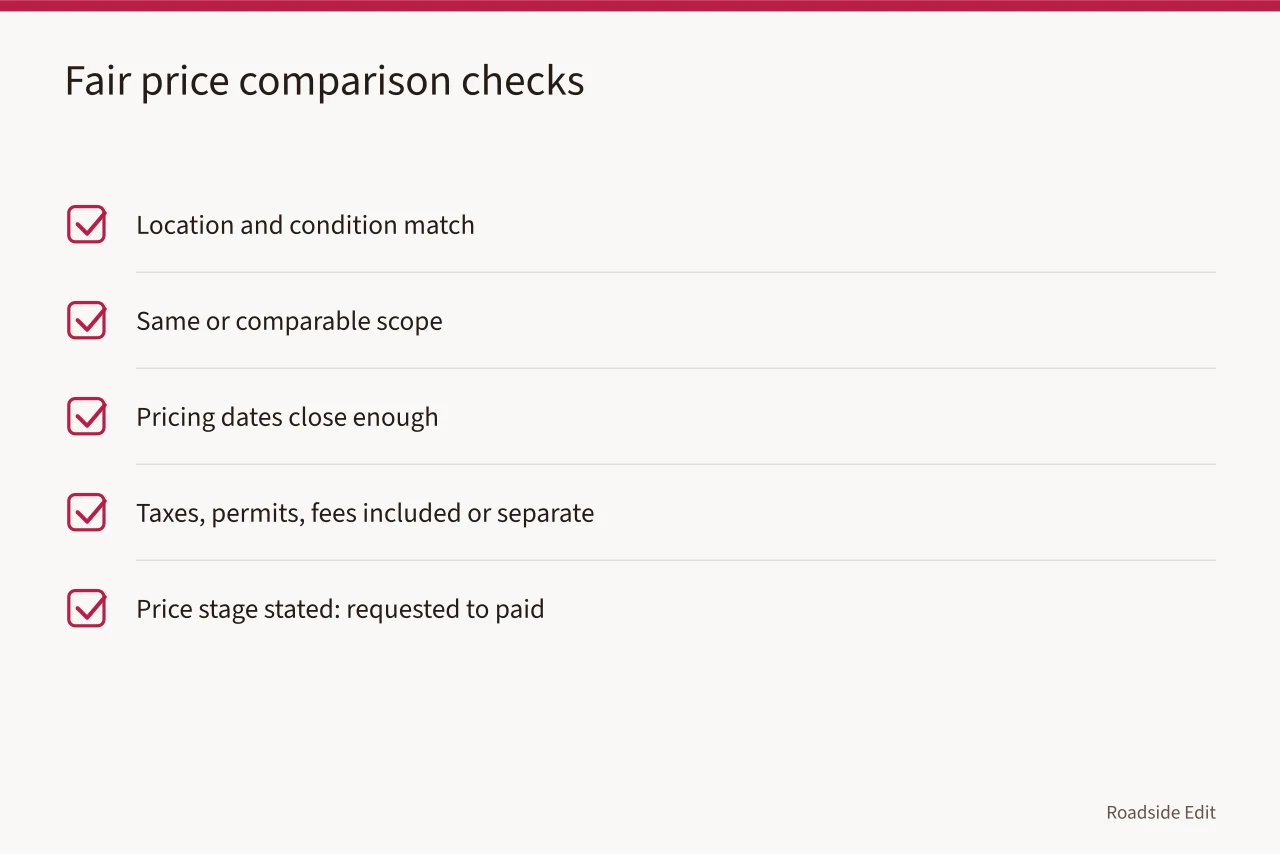
When a published price may influence a reader's expectations, the Federal Acquisition Regulation explains that proposal analysis helps determine whether a price is fair and reasonable in federal procurement; Review FAR guidance on proposal analysis. That rule governs federal acquisitions, not ordinary local renovation work.
A quoted amount needs its scope and basis before it supports a meaningful comparison.
How should an article handle later changes?
Do not replace an old figure with a new one silently. Keep both when they describe distinct stages, then explain the source of the change if the record provides it.
A revision may follow scope adjustment, a changed condition, a new procurement result, or a clarified allowance. If the record gives no reason, write that the reason was not stated.
A useful update includes the publication date of the earlier amount, the date of the newer source, and the source type for each. That trail prevents a grant request from being mistaken for a contract, or a preliminary estimate from being mistaken for a final cost. It also makes the page easier to revise without rewriting its history.
The image is illustrative only. It does not establish another property's price, condition, funding, or work scope.
A concise publication checklist
- Name the figure accurately.
- Attribute it to a dated source.
- State the work that is included, if known.
- Identify major exclusions or uncertainty.
- Avoid converting a request or award into a total project cost.
- Preserve the prior figure when an update reflects a new stage.
Common questions
Is the lowest quote always the best cost information?
No. First confirm that the scope, assumptions, timing, and exclusions are comparable. A lower proposal can cover a smaller package of work.
Can a project use an old estimate for a new article?
Yes, if it is dated, attributed, and labeled as historical or preliminary. Do not present it as a current price without a current supporting source.
Why separate operating costs from renovation costs?
They are different decisions. A completed physical project may still need a sustainable operating plan.