Costs
Part of Roadside renovation cost planning: how to build public budgets that hold up
Roadside renovation cost planning: how to keep budget notes honest
Roadside renovation cost budget notes for 2027 help readers track scope, evidence, revisions, and funding limits without turning estimates into promises.
Roadside renovation cost planning starts with one rule: a budget note should make an estimate easier to read, not make it sound more certain than it is. For a roadside property, the same total can mean early research, temporary protection, a design task, one contractor proposal, or a fully defined construction package. Those are not interchangeable.
This guide explains how to write and maintain an editorial budget record. It is not a contractor estimate, a commitment to fund work, or a substitute for property-specific review. Its purpose is to give a reader an honest answer to four questions: what the figure covers, when it was prepared, who supplied it, and what it leaves open.
What to take away
- Put a clear scope and source date beside every public dollar figure.
- Treat planning, design, construction, and operations as separate cost questions.
- Preserve old figures as revisions instead of silently replacing them.
- Describe funding according to the named activity, not the hope attached to it.
- Test assumptions against named references such as the GAO Cost Estimating and Assessment Guide or RSMeans data from Gordian.
Build the note around a decision
Begin with the decision the budget is meant to inform. A property owner may be deciding whether to commission a conditions survey. A nonprofit may be comparing repair concepts. A town may be deciding whether to seek funds for a defined first phase. Each decision calls for a different level of cost detail.
Write a short purpose statement before adding any dollar amount. For example: "This amount is a planning allowance for a survey, documentation, and two reuse options." That sentence protects the article from a common drift in which a limited study allowance becomes known as the entire renovation budget.
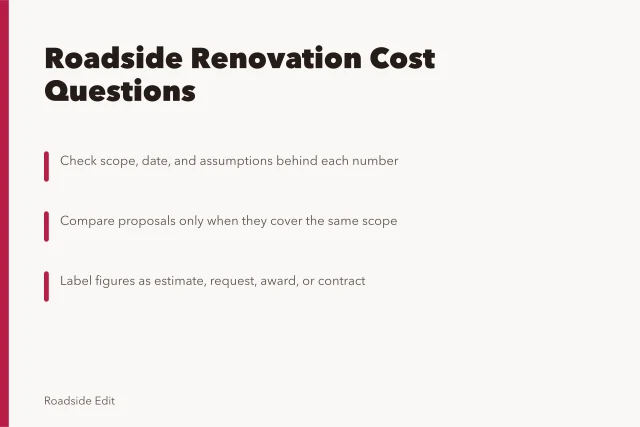
The GAO Cost Estimating and Assessment Guide describes a credible estimate as one grounded in a defined purpose and technical baseline. It also asks for assumptions, data, methods, schedule, and updates.
The guide concerns government cost estimates, not an individual roadside business. Its relevant lesson here is straightforward: a number cannot be understood without the basis that produced it.
For private roadside work, two tools often sit behind a first number. RSMeans data from Gordian gives regional construction cost ranges for trades and assemblies. Xactimate by Verisk prices repair line items from a database that insurers and contractors can share. Neither tool replaces a local bid or a site-specific scope.
Use categories that readers can test
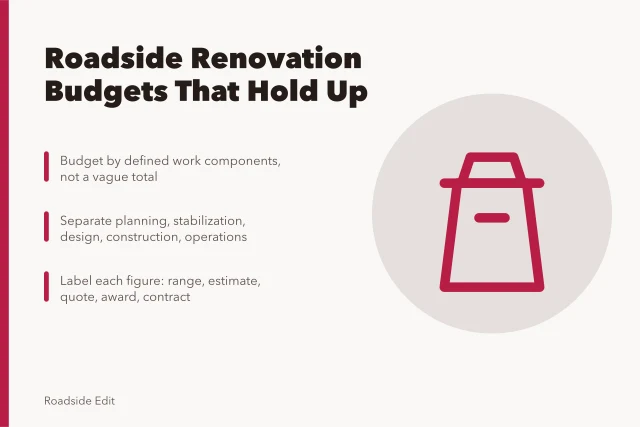
A total is easier to interpret when its major components remain visible. Categories do not have to predict every future expense. They should show which questions have been priced and which remain unresolved.
| Budget area | Evidence to retain | Editorial wording that stays accurate |
|---|---|---|
| Existing conditions | Survey date, observed area, known limits | "The figure covers the stated assessment work." |
| Short-term protection | Task list, duration, access limits | "The allowance addresses the listed temporary measures." |
| Design and review | Deliverables, meetings, revision limit | "The planning amount includes the named design services." |
| Construction pricing | Proposal date, drawings, exclusions | "The proposal prices the described package only." |
| Grant-funded work | Award notice, eligible activity, match rule, period of performance | "The award covers only the named eligible activity." |
| Opening and operations | Staffing, utilities, maintenance assumptions | "Operating costs are outside this construction figure." |
EPA's guide to leveraging resources for brownfield redevelopment discusses organizing project components and phases while identifying resources. It does not offer local renovation prices. It does support separating parts of a project so that a grant, service, or estimate is not portrayed as covering work it never named.
Roadside readers can check named programs before they cite a funding total. The National Park Service Route 66 Corridor Preservation Program offers cost-share grants for eligible Route 66 properties. A State Historic Preservation Office reviews federal undertakings under Section 106 and handles federal historic tax credit applications. Each program has its own eligible activities and match rules.
The National Trust for Historic Preservation runs preservation grants and the Preservation Leadership Forum. Both can help a local group find a funder, but neither turns a grant listing into a project budget.
That distinction matters when an article refers to a historic service station, motel, diner, sign, or roadside attraction. A source may document a specific planning task. Access, permits, stabilization, design, and construction may have no stated funding, and future operations may have none either.
The article should say exactly that. Report a small defined amount accurately rather than repeat a larger implied total that no record supports.
Keep an assumptions ledger
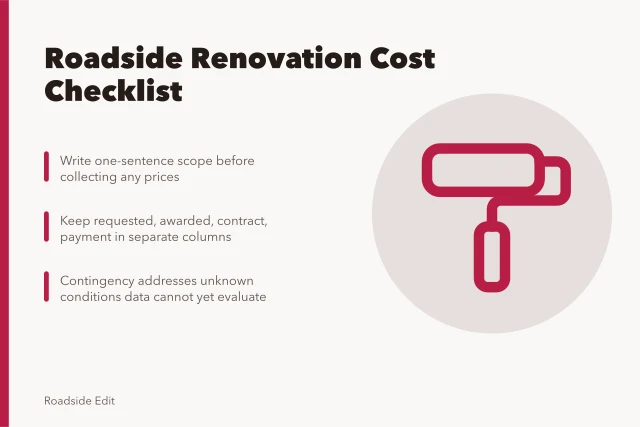
The ordinary spreadsheet cell is not enough. Every public figure needs a small source card or ledger entry, even if the article does not publish every internal note.
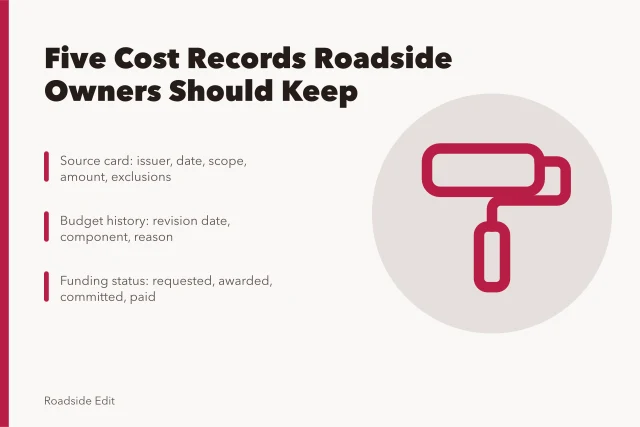
A useful entry records the issuer, document date, scope language, currency, and exclusions. It also records whether the figure is an award, request, estimate, invoice, or proposal.
Use the following fields for each revision:
- Source document and issue date.
- Amount or category, copied without rounding unless the source does so.
- Defined activity or deliverable.
- Stated assumptions and exclusions.
- Status at the time of publication.
- The article paragraphs that rely on the record.
Original, date-stamped material is usually the best starting point for checking a budget claim. In budget reporting, an executed agreement, award notice, dated proposal, invoice, or public meeting record can be closer to the underlying event than a later retelling.
That does not make every original record current or complete. It tells an editor where to begin checking a claim.
An old proposal can explain what someone priced on a specific date. It cannot establish a current market price, a final contract, or completed work.
If a source does not say whether permits, testing, insurance, utility work, or financing are included, mark the question as not stated. Filling gaps with a familiar percentage or a number borrowed from another property creates a fact the source did not provide.
Publish revisions as a record, not a rewrite
Budget changes are normal. A new survey may uncover missing information. A site visit may narrow the work. A funder may limit an award to a particular eligible activity. The editorial problem starts when the article swaps in a new total without saying what changed.
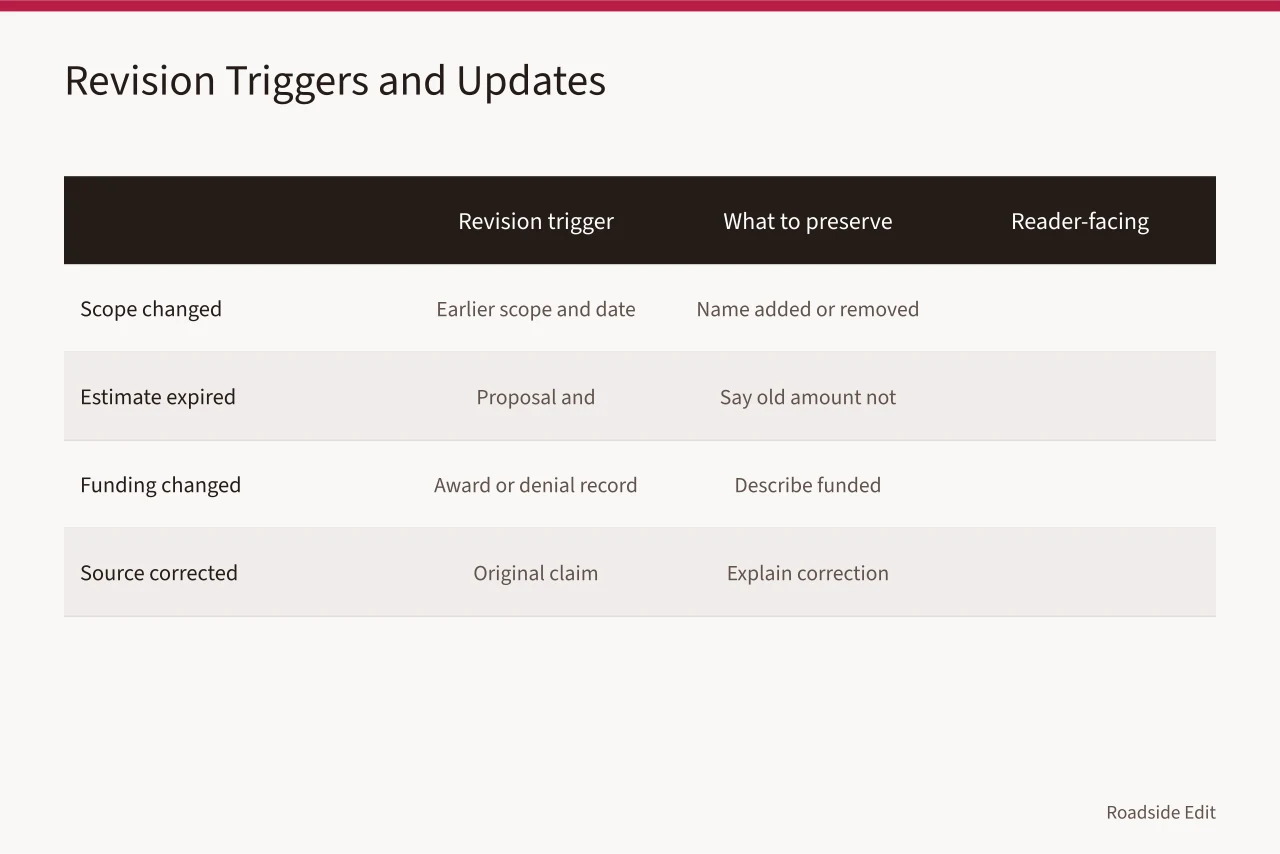
| Revision trigger | What to preserve | Reader-facing update |
|---|---|---|
| Scope changed | Earlier scope statement and date | Identify the added or removed activity. |
| Estimate expired | Original proposal and expiration date | State that the old amount is no longer current. |
| Funding decision changed | Award, denial, or amendment record | Describe the named funded activity. |
| Match requirement changed | Original award terms and revised terms | State the new match or eligibility limit. |
| Source corrected | Original claim and correction | Explain the factual correction plainly. |
The National Archives revised-budget instructions address changes to cost categories and project periods in a grant-administration setting. A private roadside project does not become subject to that process through an article citation. Still, the document illustrates why a revision record should identify changed categories and timing rather than hide changes inside a replacement total.
For a public article, a one-sentence update note often works: "Updated September 2027 to reflect a revised scope that separates survey work from construction pricing."
Avoid announcing that a project is "fully funded" or "moving ahead" unless a source says it broadly enough to support that claim. One award may matter greatly while still leaving major work unfunded.
Separate editorial disclosure from cost evidence
An agency, owner, contractor, funder, or sponsor may have useful documents. Its connection to a project can also affect how readers weigh its claims. Attribute price and schedule statements to the named party. Disclose a paid relationship when it is relevant to a recommendation, review, or placement.
The FTC's endorsement guidance says a connection between an endorser and marketer should be disclosed when it could affect the weight or credibility people give the endorsement. A disclosure does not turn a sponsor's statement into independent evidence. It lets readers judge the statement with the relationship visible.
This is especially useful for list articles and profiles. If a company supplied a price, donated a service, or paid for placement, label that fact near the affected material. Keep the budget evidence separate: source date, scope, exclusions, and status still need to be clear.
Prepublication check for a budget article
Before publishing, read the article as a person trying to decide what the number means.
- Does each figure name its source date and stated purpose?
- Can a reader tell a planning allowance from a construction estimate?
- Are grant awards described by their eligible activity?
- Are exclusions and unanswered cost questions visible?
- Does the update note identify a real change rather than imply a fresh total is final?
- Is any financial relationship disclosed where it affects a recommendation or claim?
- Does a named program, such as the NPS Route 66 Corridor Preservation Program or a State Historic Preservation Office tax credit, match the activity it is said to fund?
A useful budget note leaves uncertainty in place where the evidence leaves uncertainty. The article stays dependable after the next proposal, award, or scope change when the record shows what changed.
Common questions
Is an awarded grant the same as a renovation budget?
No. Report the amount and the eligible activity stated by the award. Do not infer that it pays for all later work unless the source directly says so.
Can a dated contractor proposal be cited?
Yes, if the article identifies it as a proposal, gives its date and scope, and avoids presenting it as a current universal price.
When should an article's number be changed?
Change the article when a source changes the stated scope, status, funding decision, or amount. Keep a note explaining the update.
Which named references help a roadside budget note?
Use the GAO Cost Estimating and Assessment Guide for estimate structure, RSMeans data from Gordian for regional construction costs, and Xactimate by Verisk for repair line items. For grants and tax credits, check the National Park Service Route 66 Corridor Preservation Program, a State Historic Preservation Office, and the National Trust for Historic Preservation.