Guides
Roadside renovation cost planning: how to build public budgets that hold up
Build a 2027 roadside renovation cost plan that separates scope, assumptions, phases, funding, estimates, changes, and truthful public budget updates.
The most misleading roadside renovation budget is a single figure with no stated boundary. Readers may assume it covers design, access, permits and stabilization.
It may cover construction, fixtures, contingency and opening costs. The project team may mean a preliminary allowance for one small exterior task. Both sides can act in good faith and still describe different things.
This guide to roadside renovation cost planning helps owners, community groups and editors organize cost information for an existing roadside property in the United States. It is not an estimate, a bid, an appraisal, a grant determination or advice on a specific project. Costs depend on the property, scope, market, approvals and site conditions.
What to take away
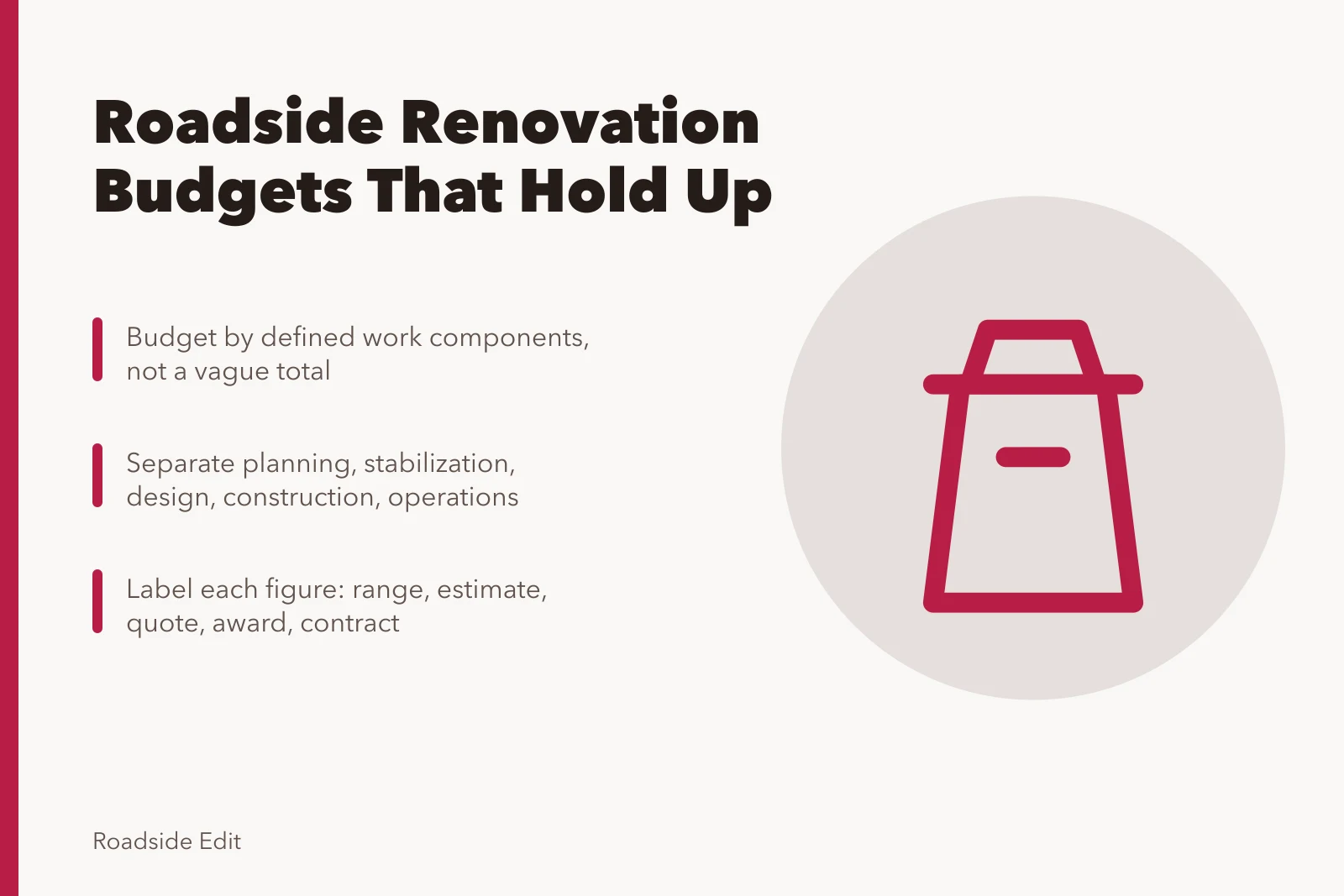
- Budget by defined work components, not by a vague total.
- Record the source, date and scope behind each figure.
- Note the exclusions, assumptions and intended decision too.
- Keep planning, stabilization, design, construction and operations in separate categories.
- Say whether a number is an order-of-magnitude figure, a planning estimate, a quote, an award or a signed contract.
- Do not present a funding announcement as proof that all work is funded or approved.
- Put a labelled typical range beside each scope item, with a date.
Begin with the question behind the number
Before asking what a roadside renovation costs, name the decision the number must serve. A team may need to decide whether to order a records review, stop a leaking roof, compare two reuse ideas, apply for a planning grant or write a procurement package. Each decision needs a different level of detail.
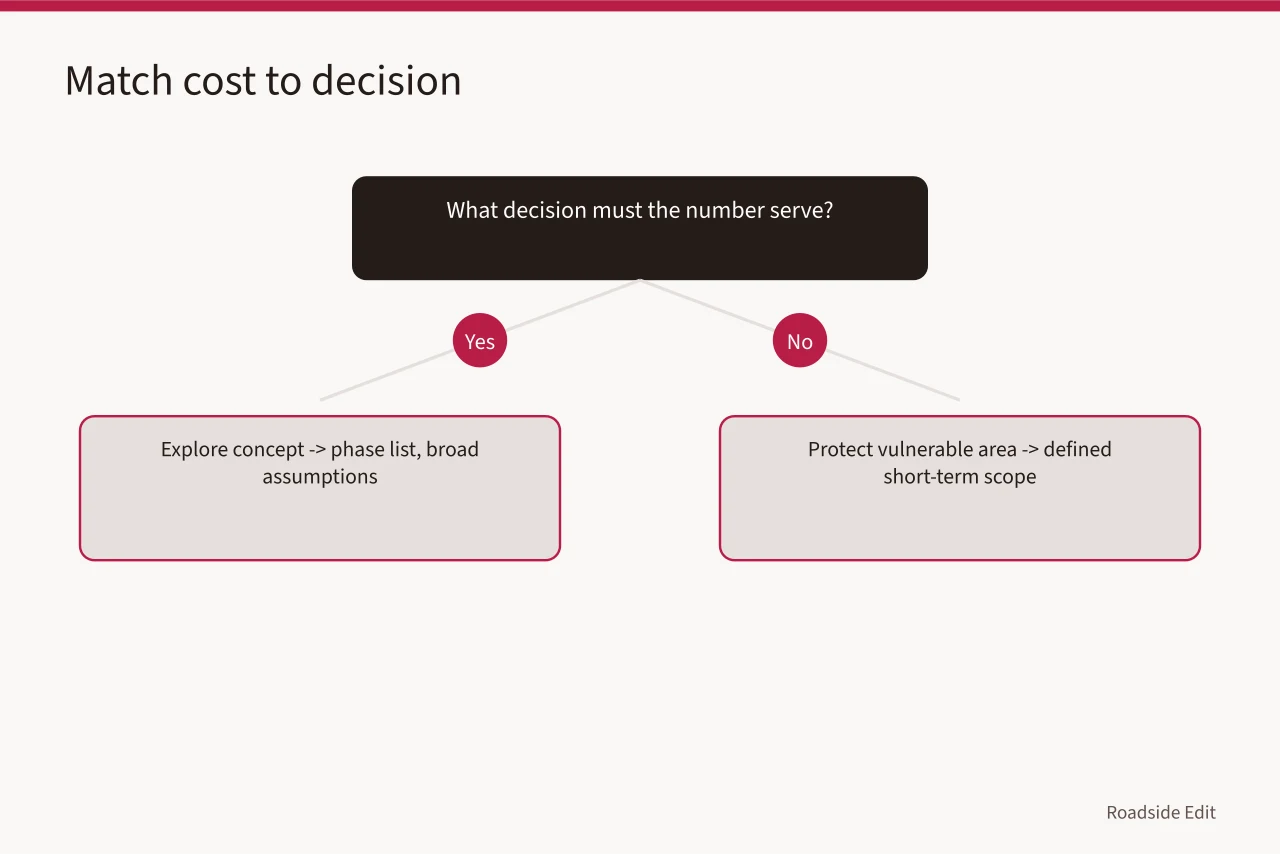
A preliminary allowance can test whether a reuse direction deserves more study. It should not be reported as a construction budget. A contractor proposal can price a defined task, but it is not a total project price unless the document says it covers the whole project.
| Decision | Appropriate cost information | Dangerous shortcut |
|---|---|---|
| Explore a reuse concept | Phase list and broad assumptions | Quoting a final project cost |
| Protect a visible vulnerable area | Defined short-term scope | Calling it restoration |
| Seek project funding | Itemized eligible tasks | Treating an award as full funding |
| Procure work | Current documents and detailed requirements | Reusing an early planning figure |
| Price a single trade | A current quote with an expiration date | Applying one trade's rate to the whole building |
Published unit-cost data gives a starting benchmark. Gordian updates its RSMeans building construction cost data every year, and a regional line item beats a national average. It is still not a bid. A local contractor quote for the same scope beats both.
Define the scope before estimating
An estimate should name the work area, the work items and the information behind them. It should also state exclusions, access conditions, timing and assumptions. If a cost depends on an unverified condition, flag the uncertainty instead of folding it into a headline number.
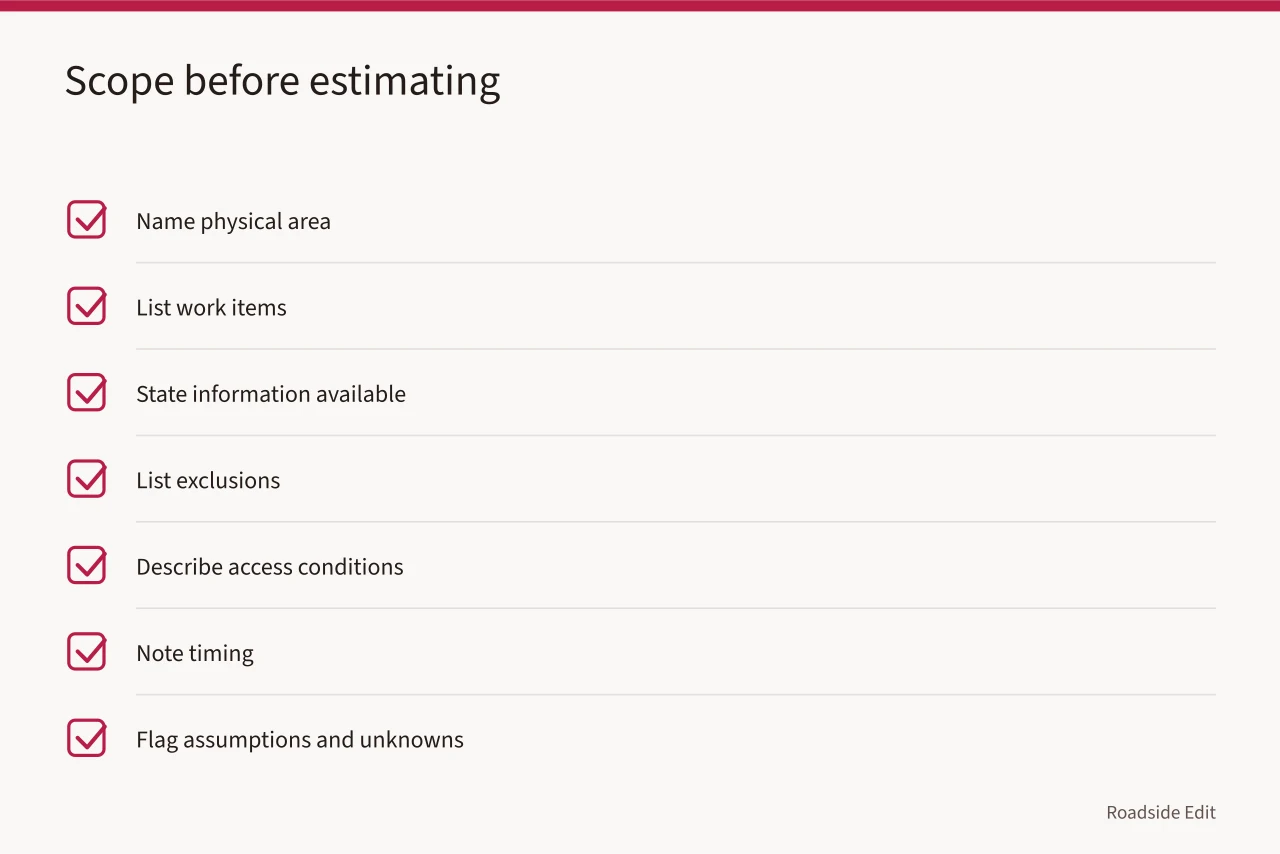
GSA's cost-management directive for its Public Buildings Service says estimates should address the proposed project scope and document design assumptions when details are not shown. Review GSA's cost-management requirements.
That directive governs a federal program, not a private roadside renovation. The transferable principle is simple: a cost figure should tell a reviewer what it assumes.
Planning estimate dated June 2026 for temporary weather protection at the north elevation, based on owner-supplied photographs and no interior access; excludes design, permitting, concealed conditions, and work at other elevations.
Better than "The building needs $X in repairs."
Scope language sets the benchmark. A repointing estimate should say whether it covers 400 square feet of wall face or the whole building, and whether mortar analysis is included.
Typical U.S. ranges as of 2026, before site conditions:
- Asphalt shingle roof replacement on a small roadside building: typically $5 to $9 per square foot installed.
- Standing-seam metal roofing: typically $10 to $18 per square foot.
- Masonry repointing: typically $12 to $30 per square foot of wall face.
- Historic wood window restoration: typically $600 to $1,500 per window.
- Neon sign restoration: typically $5,000 to $40,000, driven by transformer work, tube fabrication and lift access.
- Phase I environmental site assessment: typically $2,000 to $5,000; a Phase II with soil or groundwater sampling, typically $10,000 to $30,000.
- Lead paint and asbestos survey on a small building: typically $500 to $3,000.
Separate costs by phase
Older roadside properties often need several kinds of work before any public-facing reuse begins. Put each kind in its own row so an evolving project does not appear to carry one fixed price.
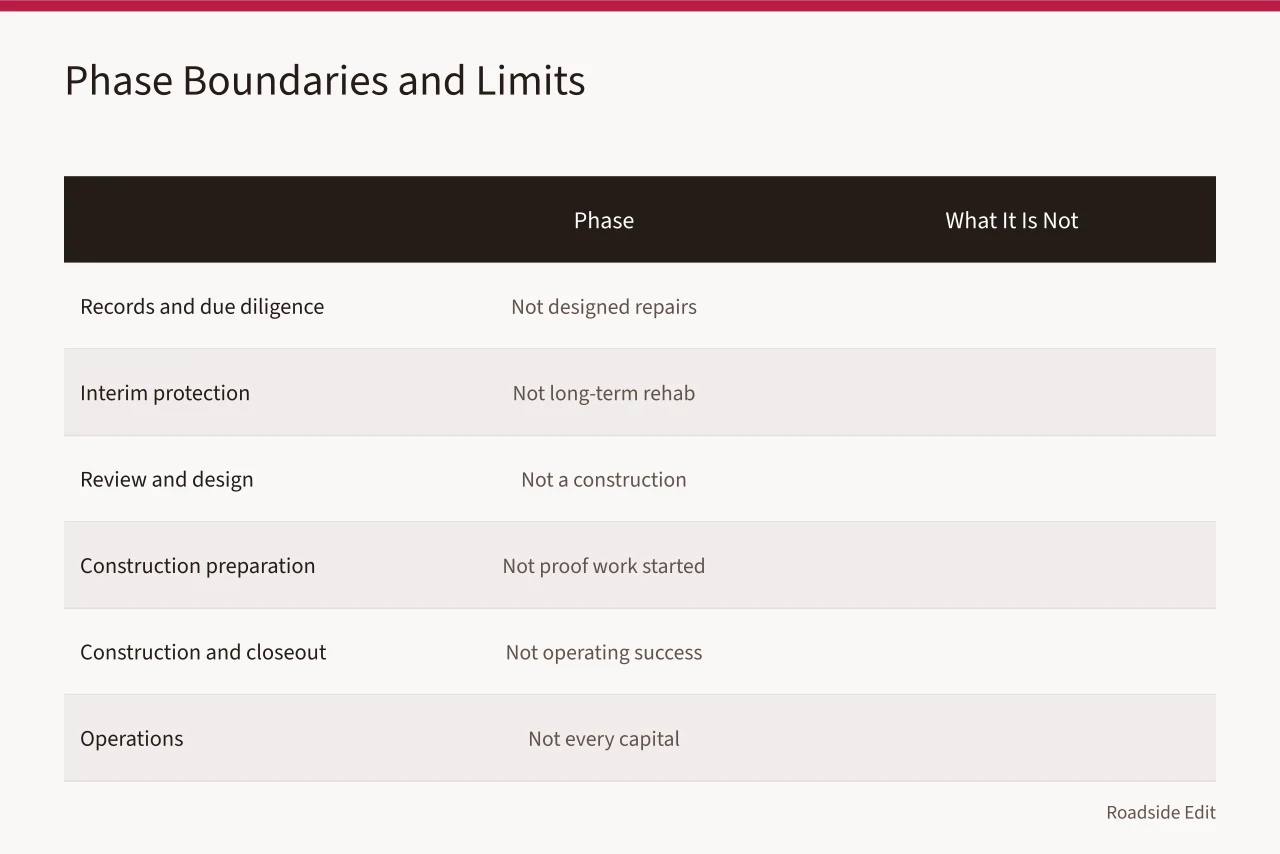
| Phase | Common items to identify | Editorial boundary |
|---|---|---|
| Records and due diligence | Research, current-condition questions, authorized access | Not evidence that repairs are designed |
| Interim protection | Security, weather protection, limited stabilization | Not proof of long-term rehabilitation |
| Review and design | Surveys, consultations, drawings, project management | Not a construction award |
| Environmental and regulatory review | Phase I assessment, asbestos survey, Section 106 consultation | Not a construction approval |
| Construction preparation | Detailed scope, pricing, procurement, approvals | Not proof work has started |
| Construction and closeout | Contracted tasks, inspections, documentation | Not a claim about operating success |
| Operations | Staffing, utilities, maintenance, programming | Not part of every capital estimate |
Phase spending is uneven. Records review and a conditions survey on a small roadside building typically run $5,000 to $25,000. Interim weather protection typically runs $10,000 to $60,000, driven by roof area and lift or scaffold access.
Design fees typically land at 8 to 15 percent of construction cost, and small rehabilitation jobs sit at the high end. Construction contingency is usually 10 to 20 percent during design and 5 to 10 percent once bids are in.
The categories can overlap, but the records should show when and why. Do not hide an estimate revision by changing the category title after publication.
Keep estimates at their actual maturity
An early number carries more uncertainty because less is known about scope and conditions. A later number may rest on more complete information, but it can still change when the work changes. Describe the estimate type in ordinary language and do not attach false precision to it.
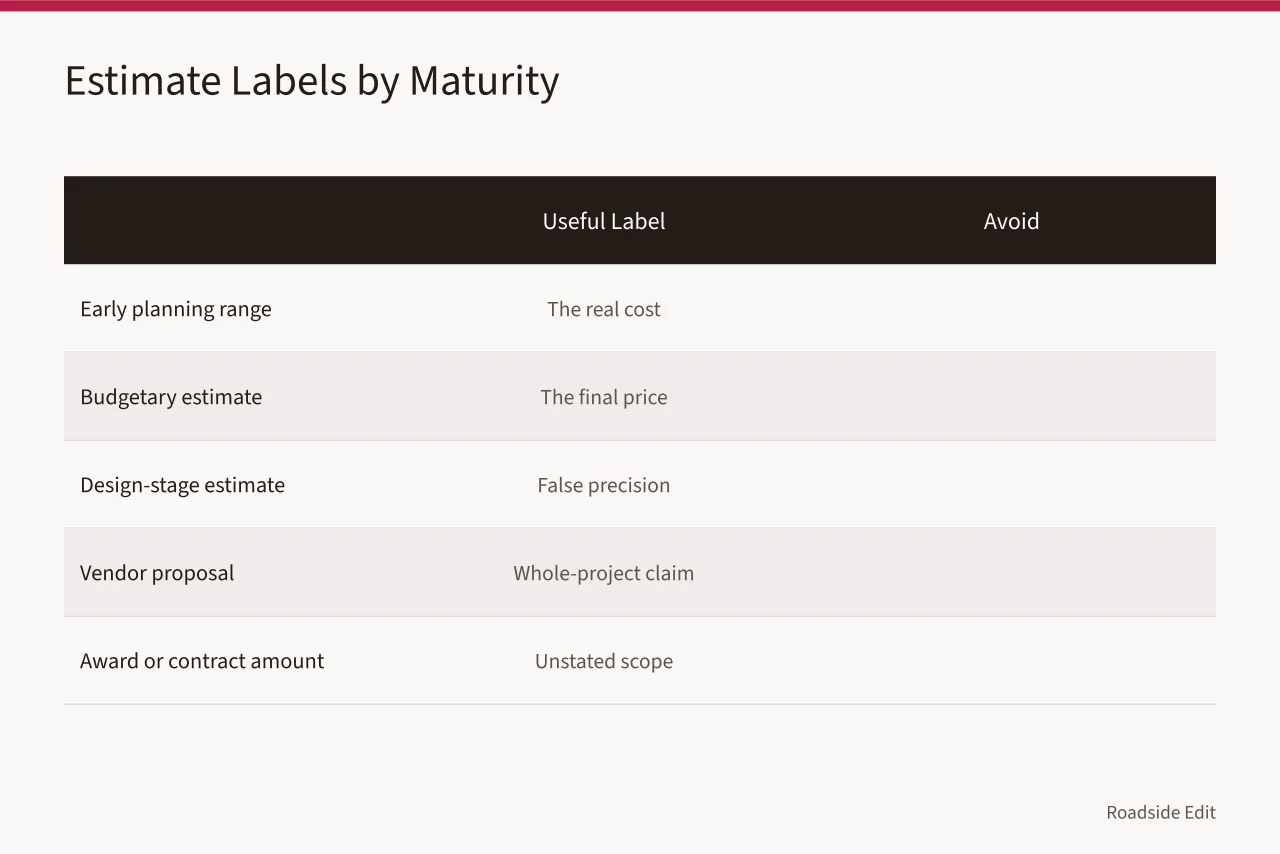
Useful labels include:
- Early planning range based on stated assumptions.
- Budgetary estimate after a defined scope and available-condition review.
- Design-stage estimate tied to named documents and date.
- Vendor proposal for a stated package and expiration date.
- Award or contract amount for a stated agreement.
Avoid labels like "the real cost" or "the final price" unless a final, relevant project record actually supports them. Even a signed contract may exclude later owner changes, separately purchased equipment or operations.
Build a cost card for every public figure
For every number an article might mention, keep a cost card with these fields:
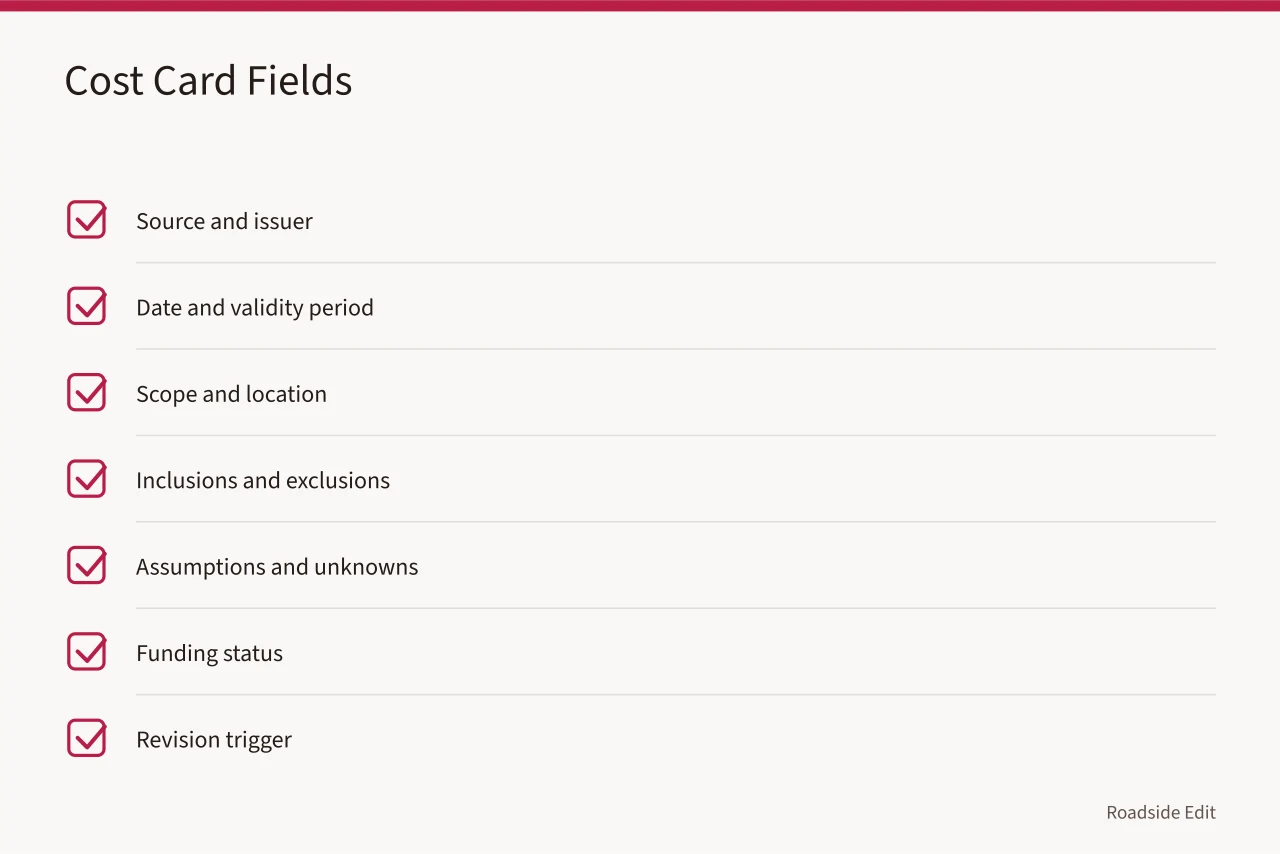
| Field | Why it matters |
|---|---|
| Source and issuer | Shows who supplied the number |
| Date and validity period | Reveals whether it may be stale |
| Scope and location | Prevents a small task becoming a whole-project claim |
| Inclusions and exclusions | Shows what readers should not assume |
| Assumptions and unknowns | Makes uncertainty visible |
| Funding status | Separates a request, award, commitment, and payment |
| Benchmark reference | States whether the figure was checked against published unit costs such as RSMeans data |
| Revision trigger | States when the figure must be reviewed |
If the source is a paid placement, an owner quote, a grant announcement or a consultant presentation, identify it accurately. Attribution does not weaken the story.
It lets readers tell a proposal from a neutral project record. Keep public language separate from internal decision material so confidential commercial details do not become an accidental editorial claim.
Treat funding as a stack, not a verdict
Funding can be more complex than an estimate. One source may pay for research, another for a specific repair, and the owner may fund operations separately.
A source identifying one contribution is not proof that every later phase has committed funding. Keep each funding record with its stated eligible activity, timeline, conditions and issuing organization.
Real programs attach conditions to dollars. The Federal Historic Preservation Tax Incentives program gives a 20 percent credit for a certified rehabilitation of an income-producing historic building. It gives 10 percent for non-historic buildings placed in service before 1936.
The National Park Service and the Internal Revenue Service run the credit. Listing in the National Register of Historic Places usually comes first, and a State Historic Preservation Office reviews the work against the Secretary of the Interior's Standards for Rehabilitation.
Section 106 of the National Historic Preservation Act applies when federal money, permits or licenses touch a historic property. It triggers a review, not a payment.
Federal transportation dollars reach roadside properties through the Transportation Alternatives set-aside of the Surface Transportation Block Grant program. State departments of transportation award it for preservation and rehabilitation of historic transportation facilities, including older gas stations and motor courts.
HUD's Community Development Block Grant can fund commercial rehabilitation in blighted areas, and at least 70 percent of each grant must benefit low- and moderate-income people. USDA Rural Development's Community Facilities program offers loans and grants for essential facilities in rural areas.
The National Trust for Historic Preservation runs preservation grant programs, and its Preservation Leadership Forum publishes project case studies. Main Street America works through local programs, and many of them run facade grants, design help and small-business lending.
Corridor-specific money exists too. The National Park Service Route 66 Corridor Preservation Program has made matching cost-share awards for small rehabilitation projects on roadside-era buildings along the route. Confirm the current appropriation cycle with the program before you cite it in a budget.
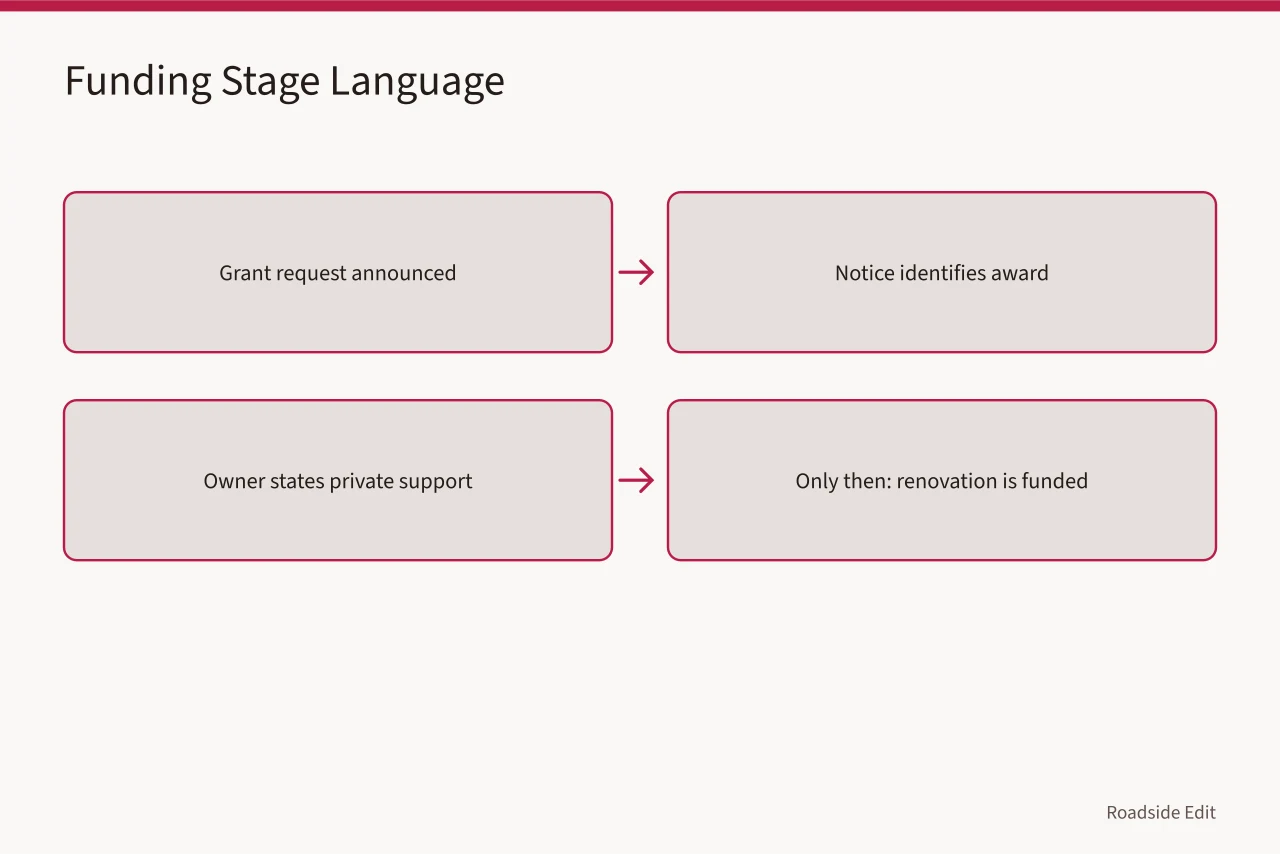
In public copy, name the source and the exact stage: "The organization announced a grant request for planning."
A notice identifies an award for the stated eligible work, or the owner states that private funding will support the proposed phase. Do not say "the renovation is funded" unless current records establish the whole represented scope and available funds.
Account for the work that is not construction
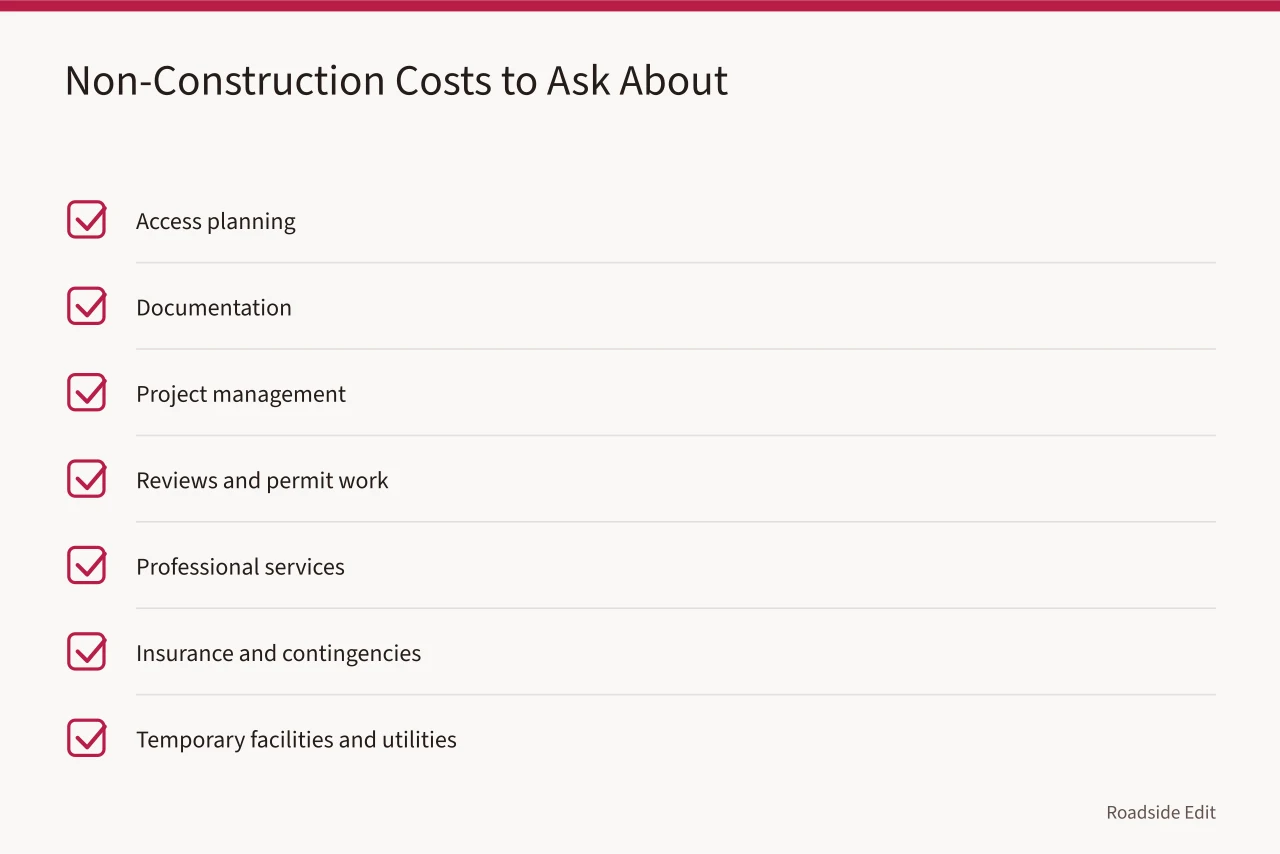
A construction-looking number can omit tasks that decide the outcome. Access planning, documentation, project management and reviews rarely appear in a square-foot price. Neither do permit work, professional services, insurance or temporary facilities. Utilities and opening operations are usually separate too.
Do not add a generic percentage from an unrelated project. Ask the source whether those costs are included and keep the answer in the record.
This discipline protects smaller projects. A team may sensibly fund a first-step records review before it can define a repair package. That is not a weak budget; it is an honest one. Call it a planning phase, not a promise of full rehabilitation.
The U.S. Government Accountability Office's cost-estimating guide describes estimates built from a technical basis, assumptions and data. It gives no cost for a roadside renovation. It does support showing the basis and limits of each number before presenting it as useful context.
The National Archives' records-management overview describes organizing records so they remain retrievable and usable. Preserve the source, date, scope and category behind a public figure. That makes later changes explainable without pretending a planning number, an award and a contract are the same record.
When a business provides a budget statement in paid material, disclose the relationship. The Federal Trade Commission's endorsement guidance addresses material connections that may affect an endorsement. Disclosure tells readers who supplied the figure, and it does not make that figure an independently verified budget.
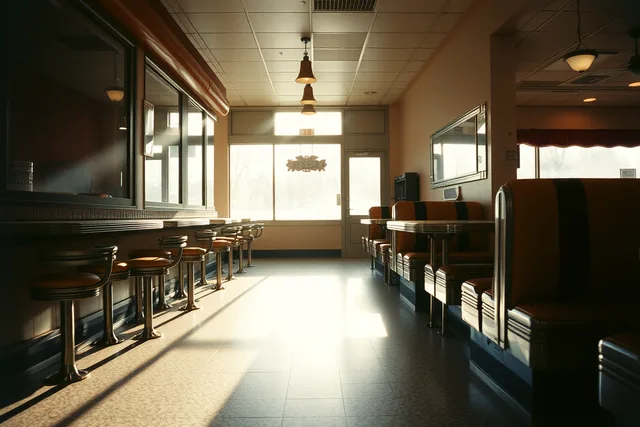
The image is illustrative only and does not represent another property's cost, condition, ownership, or project status.
Use change control instead of silent rewrites
When scope changes, add a dated revision note. State which component changed, why it changed, which source supplied the update and whether the public description needs to change. Do not replace an earlier estimate without keeping the previous date and scope in the internal record.
An article does not need to publish every internal figure. It does need to avoid a false story of certainty. A narrow update that says a planning estimate is being refined beats an old number that implies the project is ready to proceed.
Publish a budget statement that readers can use
Before publishing, test each sentence:
- Does the source support this exact amount or category?
- Does the sentence identify whether the figure is preliminary, awarded, contracted, or spent?
- Could a reader mistake this phase for the whole project?
- Are the date, scope and material exclusions available?
- Would the statement remain true if a pending approval or funding decision changes?
If the answer is no, narrow the sentence or remove the number. Accurate cost communication helps prospective partners and advertisers understand the project without turning an early plan into a promise.
Keep a dated archive copy of the published statement and its source card. That makes later corrections factual, quick and visible to the responsible editor.
Common questions
Is a planning estimate the same as a project budget?
No. A planning estimate may test a defined idea. A project budget should identify the scope, phases, assumptions, funding, and level of certainty it represents.
What does a roadside renovation actually cost?
There is no single figure. Full rehabilitation of an older commercial building typically runs $150 to $400 per square foot in most U.S. markets as of 2026, before environmental remediation or new utilities. A single trade, such as roofing or repointing, is easier to price.
Can a grant announcement be described as funding the renovation?
Only if the source confirms that the grant covers the full represented renovation scope. Usually it is safer to name the specific funded activity.
Which funding source fits a roadside project?
It depends on ownership and use. A for-profit owner with a listed building can pair the 20 percent federal rehabilitation credit with a state credit. A local government may use Community Development Block Grant or Transportation Alternatives funds. A rural nonprofit may look at USDA Community Facilities. A State Historic Preservation Office is the first call in every case.
Should an article publish a contractor quote?
Only with permission and enough context to prevent readers from treating a limited, dated proposal as a universal price or complete project budget.
In this guide
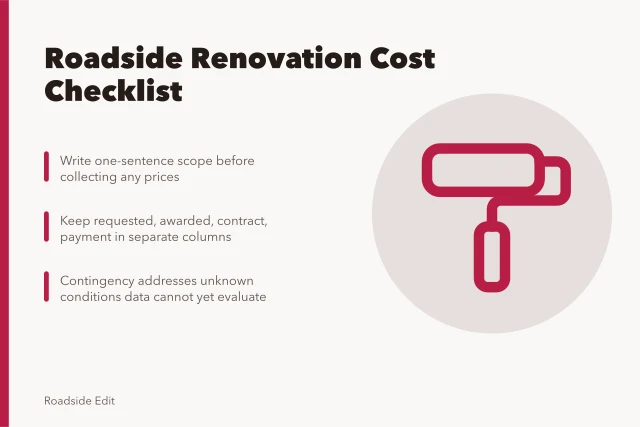
- Roadside renovation cost planning: build a scope checklist before you set the totalA roadside renovation budget holds up when each figure carries its own scope, date and funding stage, from proposed request to paid invoice.
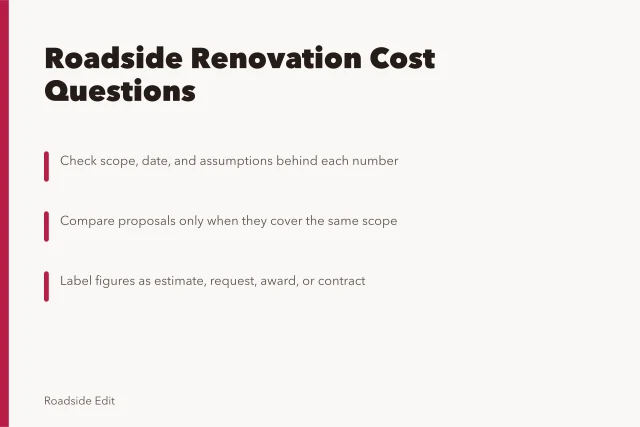
- Roadside renovation cost questions to ask before you compare quotesCompare the cost questions behind a 2027 roadside renovation, including scope, estimates, quotes, awards, contracts, change orders, and operating needs.
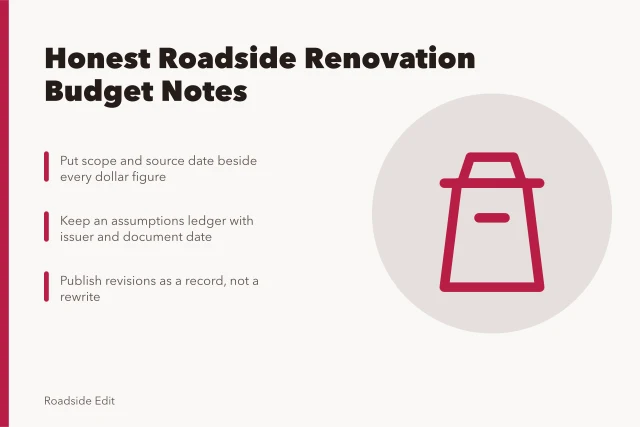
- Roadside renovation cost planning: how to keep budget notes honestRoadside renovation cost budget notes for 2027 help readers track scope, evidence, revisions, and funding limits without turning estimates into promises.
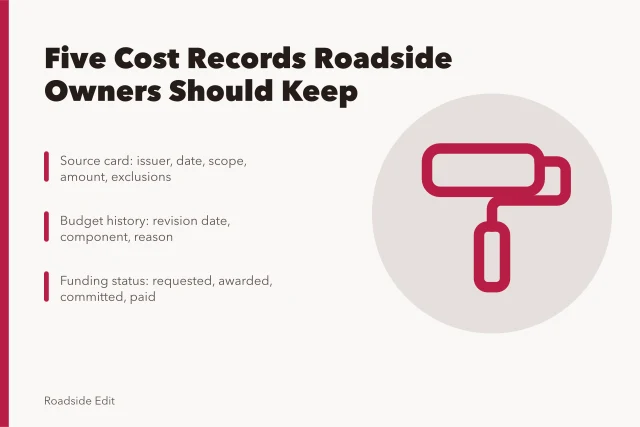
- Roadside renovation cost planning: five records every owner should keepOrganize 2027 roadside renovation cost records with a source card, scope log, budget history, funding-status notes, and responsibility list for each phase.