Guides
Part of Roadside renovation cost planning: how to build public budgets that hold up
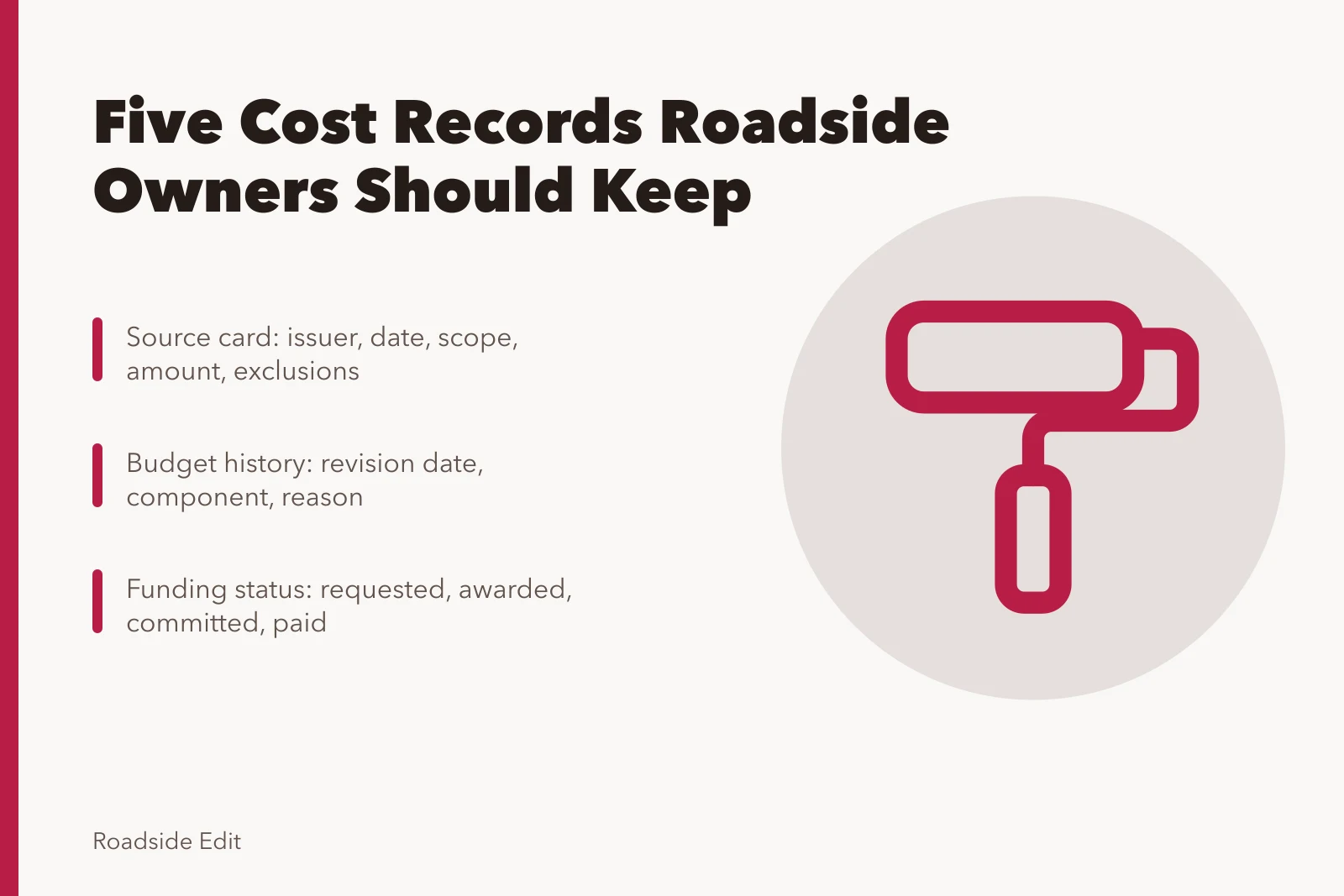
Roadside renovation cost planning: five records every owner should keep
Organize 2027 roadside renovation cost records with a source card, scope log, budget history, funding-status notes, and responsibility list for each phase.
Cost records let a roadside renovation explain a changed figure without pretending the earlier one never existed. Five records carry the cost planning. Tie each amount to its scope, date, and decision. A motor court roof quoted in March and re-bid in June keeps both entries and the reason.
What to take away
- Store costs with the scope, source, date, and responsibility that produced them.
- Keep original and revised figures together in a dated history.
- Track project budget, funding status, and payment status as separate fields.
- Tie scope to character-defining features, so a neon sign, canopy, or cabin repair stays visible in the math.
- Label each figure as a grant request, award, estimate, contract, or payment.
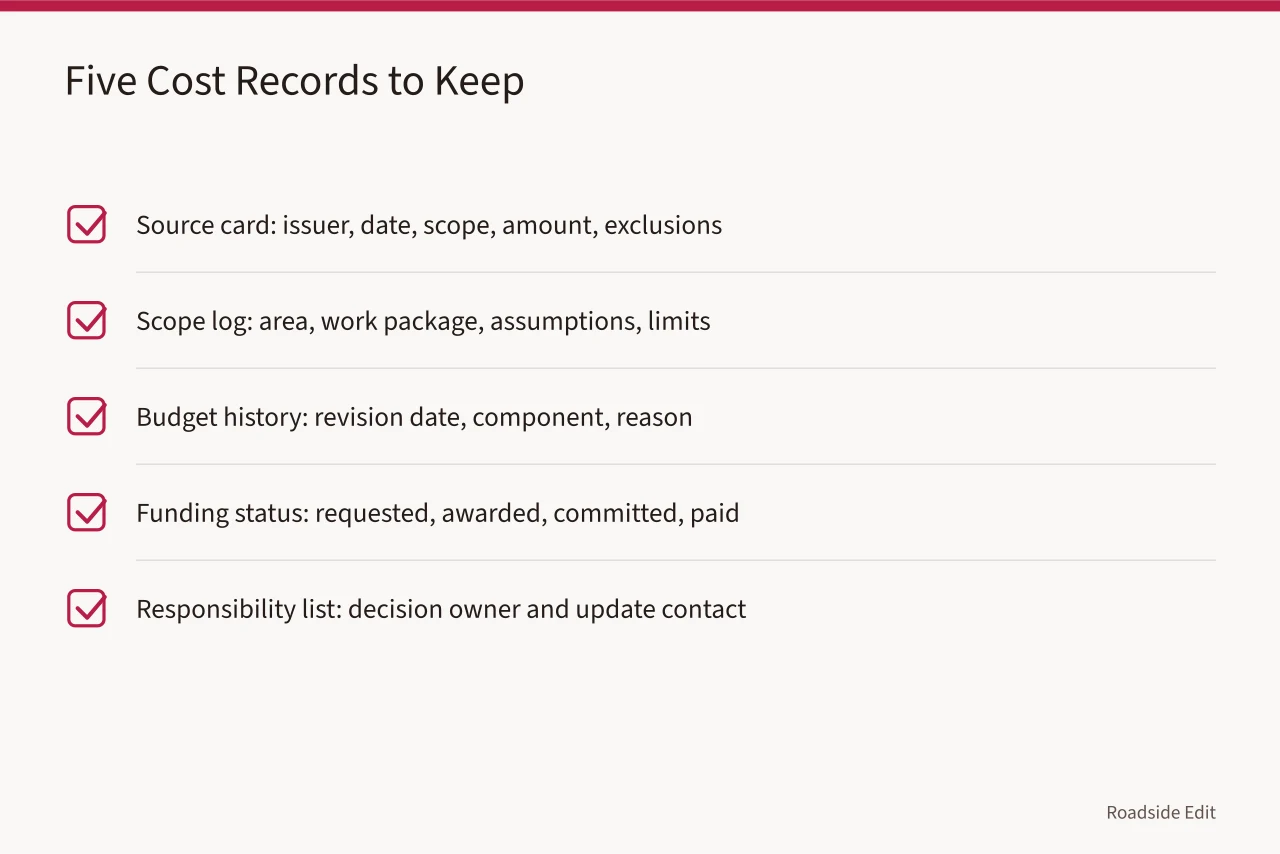
Maintain five cost records
| Record | Minimum fields | Purpose |
|---|---|---|
| Source card | Issuer, date, scope, amount, exclusions | Shows what a figure actually says |
| Scope log | Area, work package, assumptions, limits, character-defining features | Keeps cost tied to work |
| Budget history | Revision date, component, reason | Makes changes auditable |
| Funding status | Requested, awarded, committed, paid | Stops funding claims from drifting |
| Responsibility list | Decision owner, update contact, preservation office contact | Shows who can confirm a change |
NPS project-management definitions describe a plan that records scope, schedule, budget, roles, and responsibilities in the referenced federal project context. Review the NPS project-management definitions. It is not a required form for a local roadside project, but it keeps cost information tied to responsibility and scope.
For a property listed in the National Register of Historic Places, or one inside a locally designated district, most of these records get a second reader. Section 106 of the National Historic Preservation Act of 1966 applies when a federal agency funds, permits, or licenses the work.
State historic preservation offices run that consultation. Their comments belong in the responsibility list, not in a separate email folder.
The federal rehabilitation tax credit returns 20 percent of qualified rehabilitation expenditures on a certified historic structure. A separate 10 percent credit covers non-historic buildings placed in service before 1936. Record the certification date next to the amount, because an unapproved application is not yet money.
Historic Preservation Fund grants move through the National Park Service to state and tribal historic preservation offices. A grant cycle deadline is a funding-status field. So is the period of performance, which often runs two to three years after award.
Keep a public-claim log
For each article statement about money, record the exact wording, publication date, source card, and review date. If the source changes, revise the statement and keep a correction note. This prevents a preliminary figure from surviving as an unqualified claim after the project moves to a later stage.
Preservation budgets usually shift in stages: condition assessment, design review, construction documents, construction. A figure from the assessment stage does not describe the last one. Say which stage a number belongs to.
Use a restricted internal folder for documents that should not be published: private proposals, detailed vendor data, or sensitive ownership materials. The public article can still report a limited, supportable fact when authorized, but it should not expose a document simply to make a budget claim sound more precise.
Set a regular review date for active figures. This matters when a proposal has an expiration, a funding condition, or a scope dependency that may change. A grant award letter with a two-year expenditure deadline is a common example.
Retain the basis for a number
The U.S. Government Accountability Office's cost-estimating guide describes the technical basis, assumptions, data, and other elements that make an estimate understandable. It sets no cost for a roadside project. It keeps the basis behind an amount, so a reader does not treat an isolated number as a full price.
AACE International classes estimates from Class 5, a concept-level range of roughly minus 30 percent to plus 50 percent, to Class 1, a definitive range near minus 10 percent to plus 15 percent. Write the class next to the number. A Class 5 figure and a Class 1 figure can describe the same sign.
The National Archives' records-management overview explains the need to organize records so they can be retrieved and used. For a cost file, retain the source, date, category, scope, and exact claim used on the public page.
A later editor can then tell a target, an award, an estimate, a contract, or a payment apart instead of smoothing the categories into one total.
If a contractor or business supplies financial copy in a paid profile, state the relationship near the claim. The Federal Trade Commission's endorsement guidance discusses material connections that may affect an endorsement. Disclosure does not turn the statement into independent reporting; it tells the reader where the figure came from.
Preservation consultants typically quote 5 to 15 percent of construction cost for combined Section 106 consultation and historic tax credit applications in most markets. Treat that as a planning range, not a bid, and keep the proposal that produced it.
When a figure is updated, keep both entries. State why the change happened when the record says so, such as a revised scope or a new project phase. Do not infer a cause from the difference alone. The aim is a traceable budget history, not a story about whether the cost rose or fell.
Before publishing a financial update, run a closing review: check the number's source date, clear category, named property or project, and what it includes. Check whether the source calls it a proposed budget, grant request, award, estimate, or payment.
If a detail is missing, state the limit or omit the amount. An honest incomplete record beats a precise-looking summary that joins unrelated figures.
The same review should name one person responsible for future corrections. That person can ask the project contact for a current source, change the public wording when needed, and keep the older entry in the file. This preserves continuity without treating earlier planning information as a current commitment.
The image is illustrative only and does not serve as a cost record for another site.
Common questions
Who should own the cost record?
Name the person or organization responsible for confirming changes, while respecting any confidential financial information. On a historic tax credit project, that is usually the owner's accountant or the consultant holding the Part 2 and Part 3 submissions to the National Park Service.
Are invoices the same as estimates?
No. An invoice records a billed amount for a defined event. An estimate describes anticipated cost under stated assumptions, and its class and range belong with it.
Can a record be brief?
Yes. A compact source card works when it states scope, date, source, limitations, and the next review point.