Guides
Part of Roadside renovation cost planning: how to build public budgets that hold up
Roadside renovation cost planning: build a scope checklist before you set the total
A roadside renovation budget holds up when each figure carries its own scope, date and funding stage, from proposed request to paid invoice.
A roadside renovation budget is useful only when a reader can see what the number covers. This checklist turns loose figures into a dated record. It is not a construction estimate, an approval, or a contract amount.
What to take away
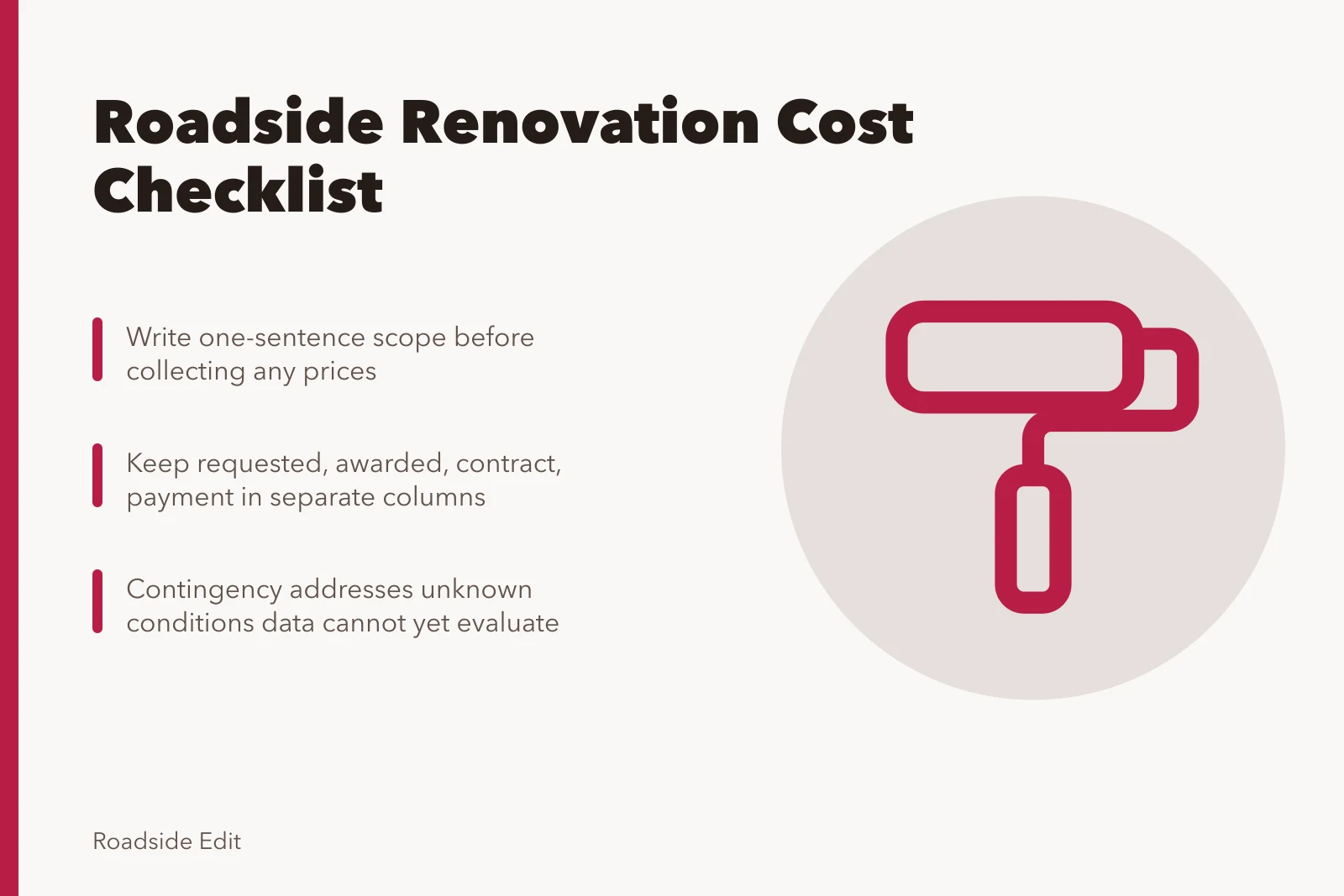
- Write the scope before you collect prices, and name the building area, storefront, roof section, sign, or drainage run it covers.
- Keep the source, issue date, exclusions and revision history beside every figure, not only beside the total.
- Hold proposed, requested, awarded, contracted and paid amounts in separate columns even when the dollars match.
- Tie each contingency line to the specific unknown it answers, and label any reserve you cannot explain as unexplained.
- Confirm the current compliance requirement with your State Historic Preservation Office or local landmarks commission, not with an article.
Start with the work, not the total
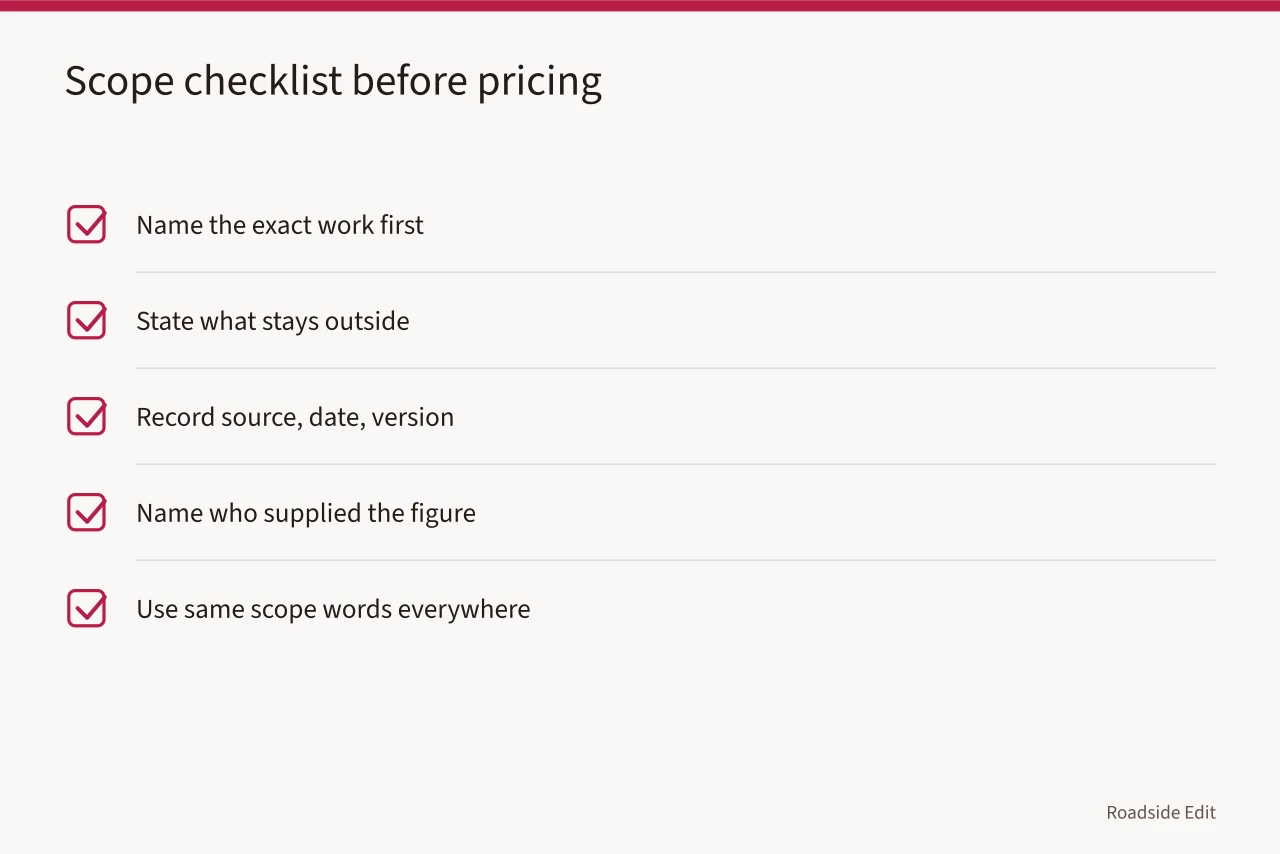
Write one sentence naming the work before you gather prices. If the plan covers only a storefront, a roof section, a canopy soffit, a drainage run or an access route, say so. A reader should never have to guess whether a figure applies to the whole property.
The National Park Service asks preservation grant applicants to make the proposed work clear and tie each budget item to the project narrative. Read the NPS application guidance.
That guidance governs its own program, not your project. It still works as an editorial test. If a line cannot be explained plainly, it is not ready to publish as a project fact.
Use the same scope words in the estimate title, the table and the article. A later revision can then show whether the amount moved because of price, quantity, access, a new condition, or a different task. A bigger number does not by itself mean a bigger project.
| Ask before listing a cost | Record in the budget |
|---|
Build the cost record in parts
Roadside work splits into packages a reader can inspect:
- survey days
- travel
- documentation
- permit review
- fabrication
- installation Do not force every project into the same rows. Use the categories the record actually shows.
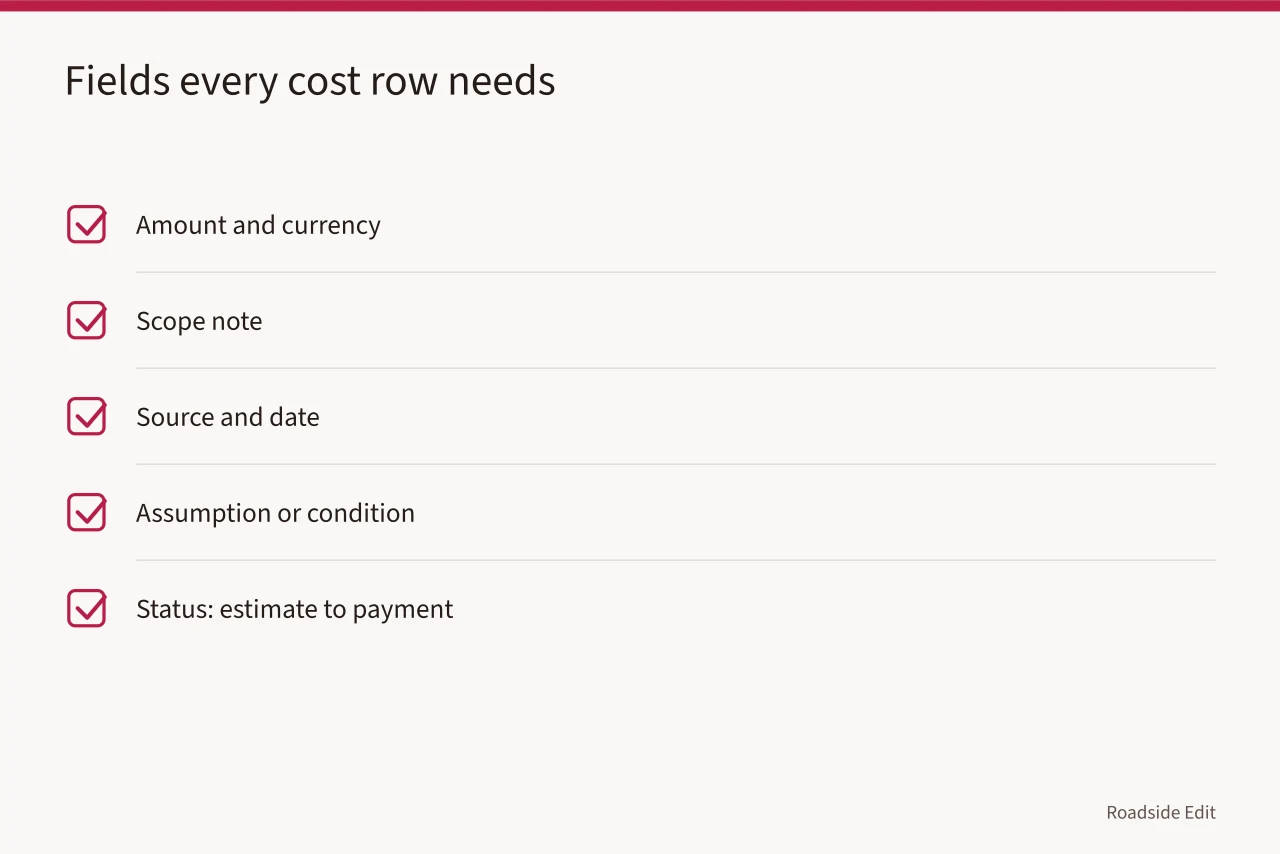
For each row, keep the source wording where it identifies the work. Add an editor note only to explain a term or separate an allowance from a confirmed price. Replacing a specific phrase with a vague label such as "site improvements" makes later checking harder.
| Cost record field | Why it belongs there |
|---|
The U.S. The Government Accountability Office lists steps in its cost-estimating guide:
- purpose
- scope
- schedule
- technical baseline
- work breakdown
- assumptions
- data
- methods
- risk analysis
- updates See the GAO cost-estimating guide.
That guide concerns federal programs. The transferable rule is simple: a number gets more understandable when its basis is visible.
State assumptions and uncertainty plainly
Every early estimate rests on facts that may change. Access may be limited. Existing conditions may be undocumented. A fabricator may have quoted one option only. Put those conditions next to the line they affect, not in a private email.
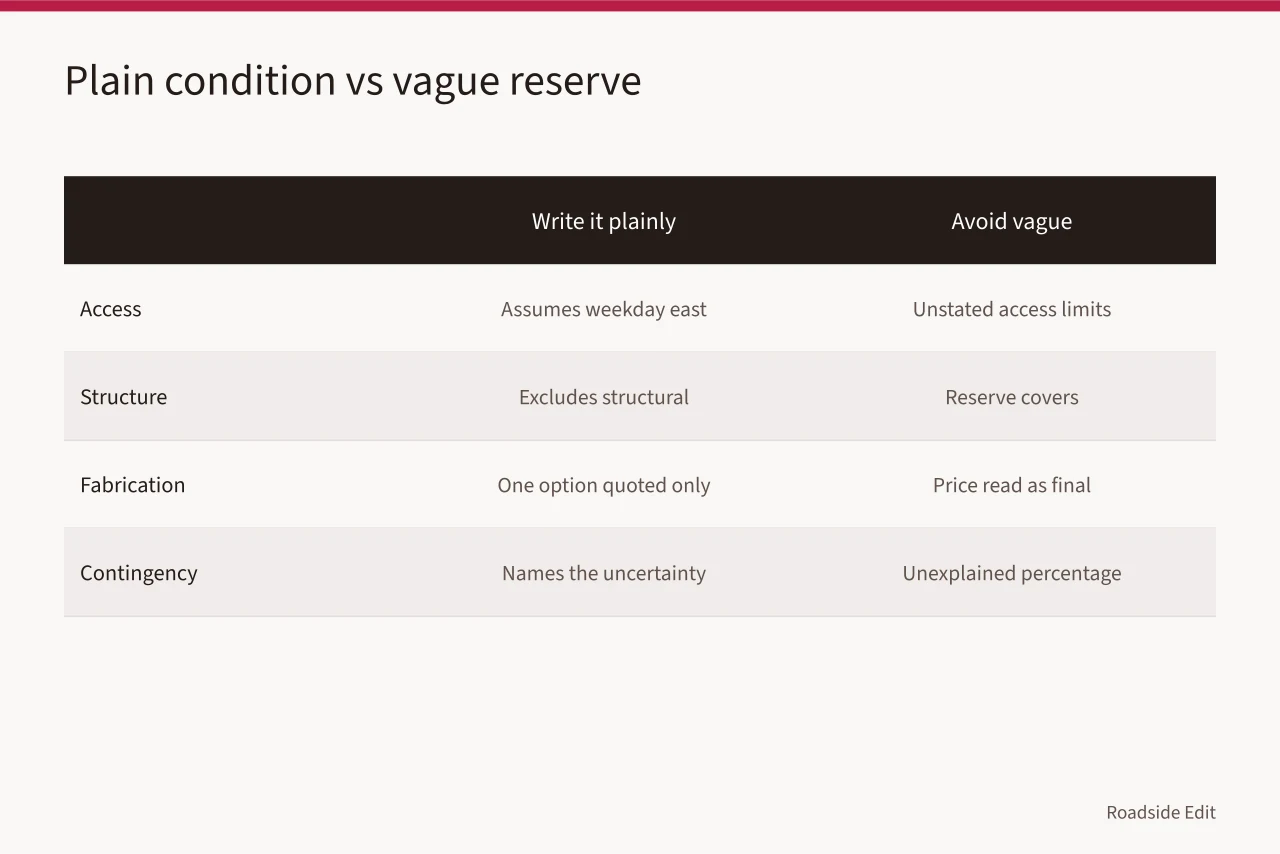
EPA's feasibility-study cost guide describes contingency as an allowance for unknown or unforeseen conditions that available data cannot yet evaluate. Review EPA's cost-estimate guide.
That description does not authorize a standard percentage for a roadside renovation. It does show why a published contingency should name the uncertainty it answers.
Write conditions as direct sentences. "This planning figure excludes structural investigation." "The proposal assumes weekday access to the east elevation." Do not claim a reserve will cover every surprise. If the record does not explain a reserve, label it unexplained rather than inventing a reason.
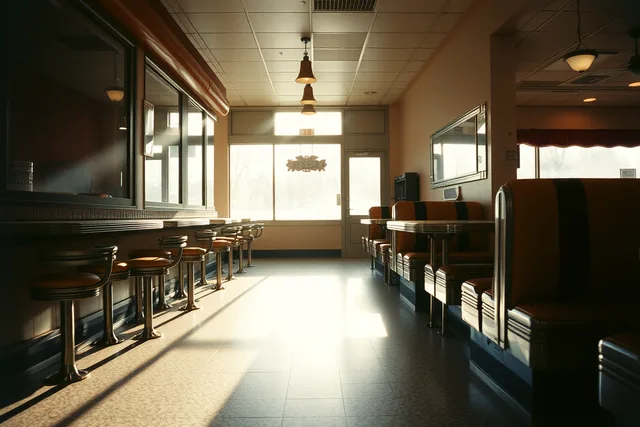
The photograph is historical context. It documents nothing about the scope, condition, funding or budget of any property in a current neon sign restoration plan.
Separate funding stages from cost stages
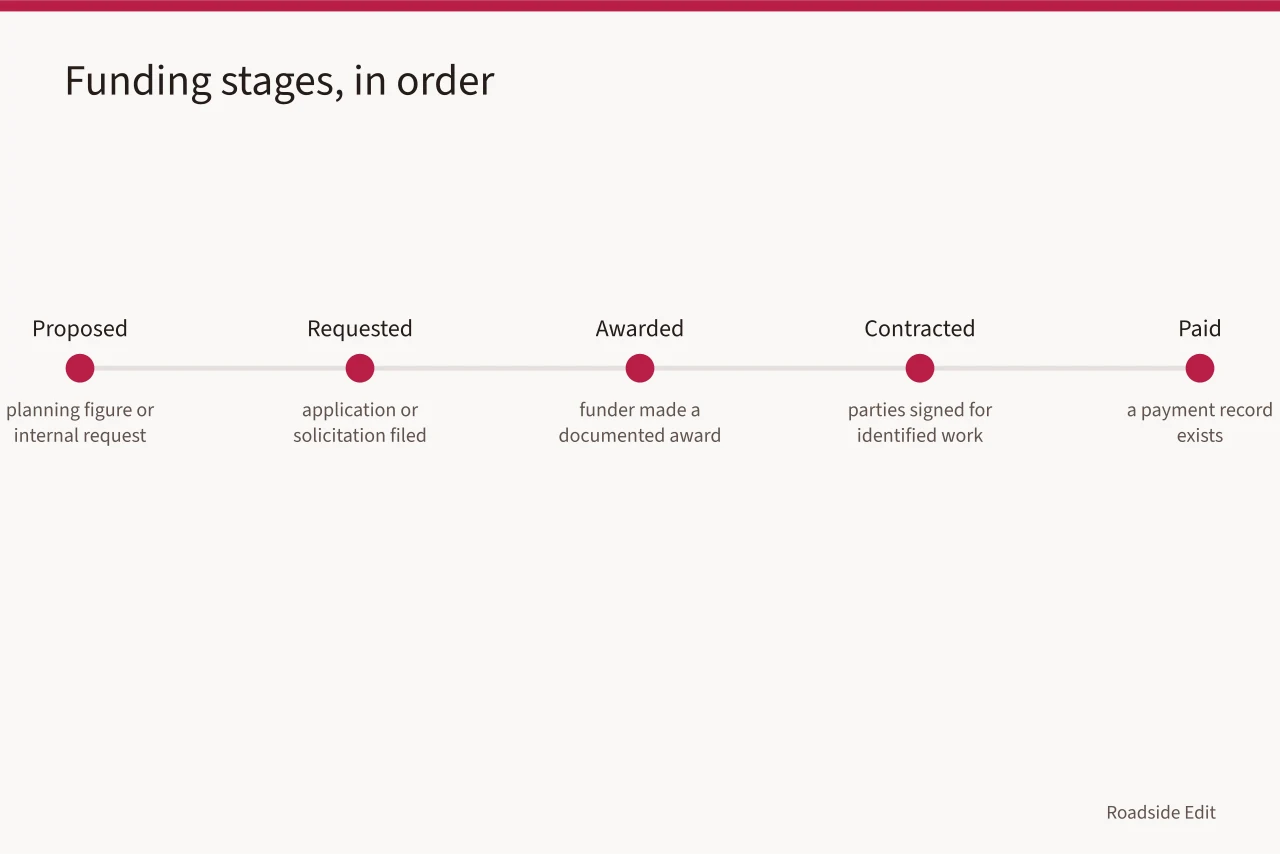
An estimate answers a different question from an award. A contract answers a different question from an invoice. Give each its own field, even when the dollar amount is identical. This is how a submitted application stops being reported as "secured" funding.
| Label | Use it when the record shows |
|---|
The GAO describes reliable estimates as comprehensive, well documented, accurate and credible, and notes that risk and uncertainty analysis shows how a figure moves when assumptions move. Read GAO's project-estimate findings.
For an article, that means the published wording must match the evidence in hand. Never convert a proposal into an award, or an award into money spent.
Keep a revision trail readers can follow
Date each version and keep the earlier figure in the project file. When a total changes, describe the trigger: revised drawing, new bid, discovered condition, or a scope decision. Explain what changed without guessing why a supplier or agency decided as it did.
Use a short review log:
- List the source documents behind the current version.
- Check each amount against its source.
- Compare the current scope to the prior scope.
- Mark each change as price, quantity, condition, timing, or scope.
- Delete public claims the record no longer supports.
This log also keeps old articles honest. If a later document supersedes the amount, update the article, add the new date, and leave enough context for a reader to see why the figure moved.
Publish a budget statement that does not overreach
Name the figure's source and its limits: "The owner supplied a planning estimate dated May 2027 for the listed exterior repairs; it excludes interior work and anything found after further investigation." Replace the example with your actual record before publishing.
Do not call a number "the renovation cost" unless it covers the stated renovation. Do not report an unpaid amount as spent. Do not add a predicted final total to make the piece sound finished. The cleanest account is often the shorter one that says what the documents do and do not show.
Common questions
Does this checklist prove an estimate is accurate?
No. It organizes the evidence so a responsible team can judge it. Accuracy depends on scope, source data, assumptions, conditions and later changes.
Should a grant award and a contractor proposal share a row?
No. They describe different stages. One identifies funding, the other a price or proposed work. They can relate to each other without being the same record.
Can an article publish a total before construction starts?
Yes, if it labels the figure as an estimate or planning amount, gives the date and scope, and never presents it as a final paid cost.