Guides
Part of How vintage diner interior options compare on condition and disclosure
Vintage diner interiors options comparison: what to check before you publish
A pre-publication comparison of six vintage diner interior options, with the evidence each one needs and the sourcing claims a writer must not make.
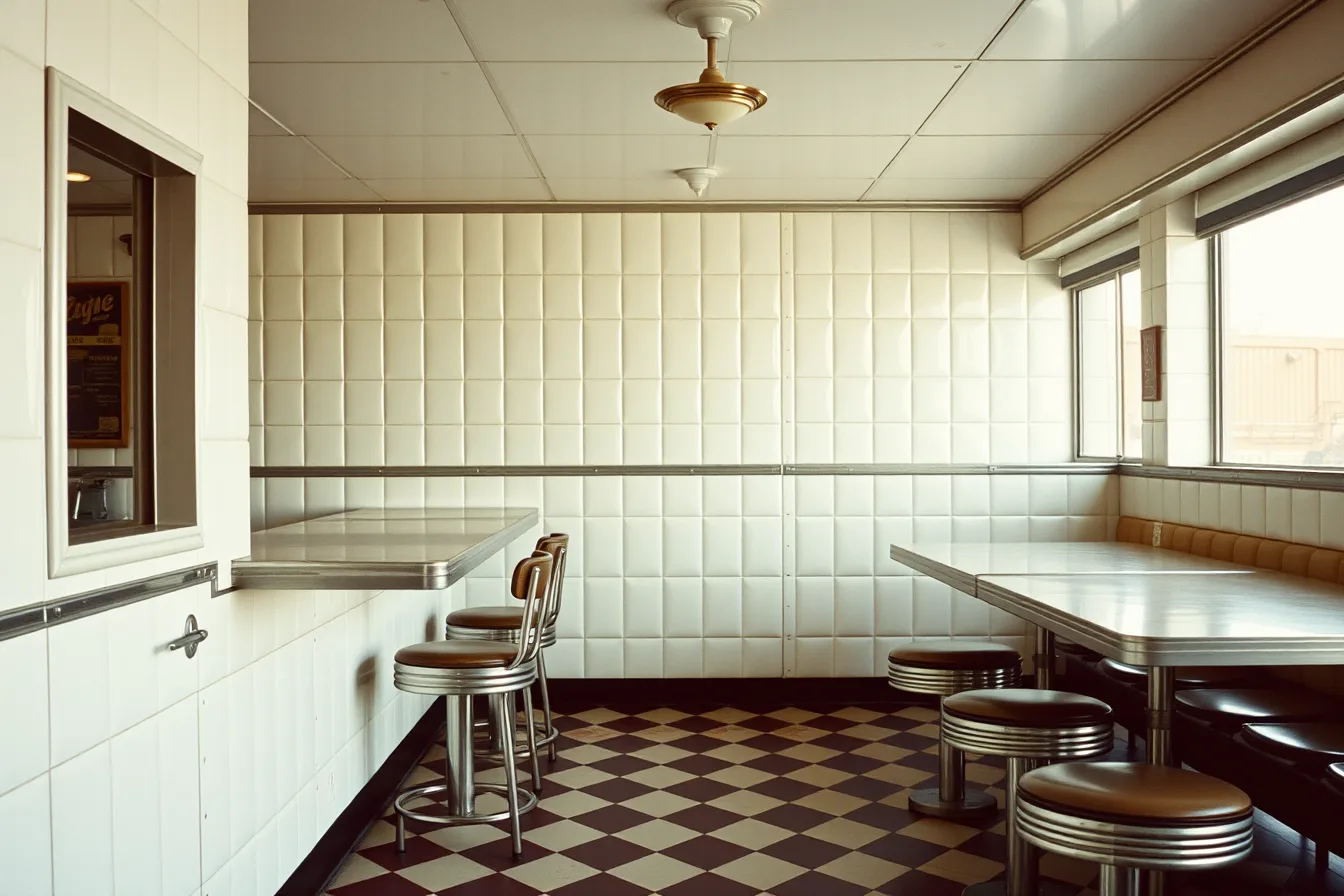
A diner interior is not one subject. It is enamel wall panels, a counter, booths, and neon. It is floor tile and service openings. It is whatever was re-created later. Comparing options means comparing the evidence behind each of those, one at a time.
What to take away
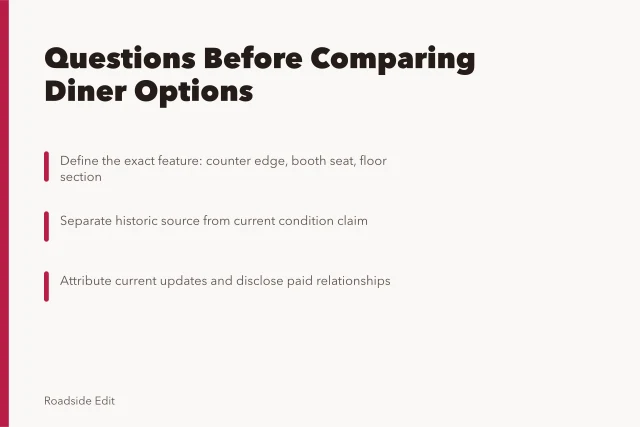
- Name the option before comparing options: enamel, counter and booths, neon, floor, opening, or re-creation.
- Give every historical or treatment label a dated source.
- Keep field observation, a supplied account, and your own reading in three separate places.
- A preservation standard is not a recommendation for a specific diner.
- Disclose paid or business-supplied material beside the claim it touches.
The six options, and what each one needs
Most diner interior stories collapse six separate questions into one. Split them and the evidence gap becomes visible.
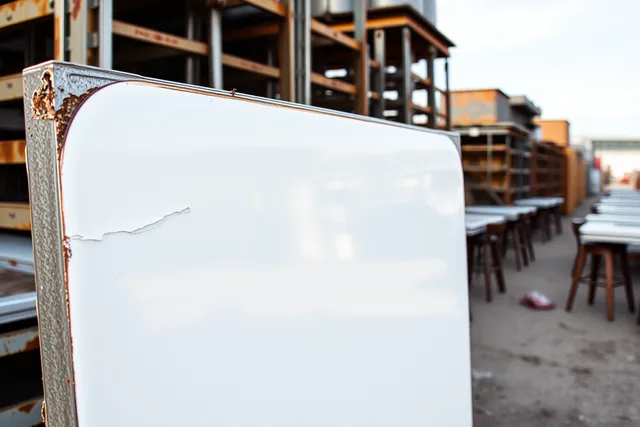
Porcelain-enamel wall panels. Panels were bolted to a frame and finished at a factory, so the enamel is original to the panel, not to the building. A dated shop drawing or a panel stamp supports a claim about the finish. Over-painting hides the surface a reader came for.
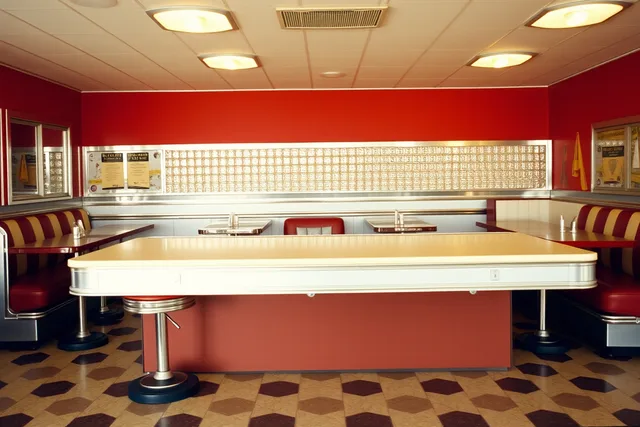
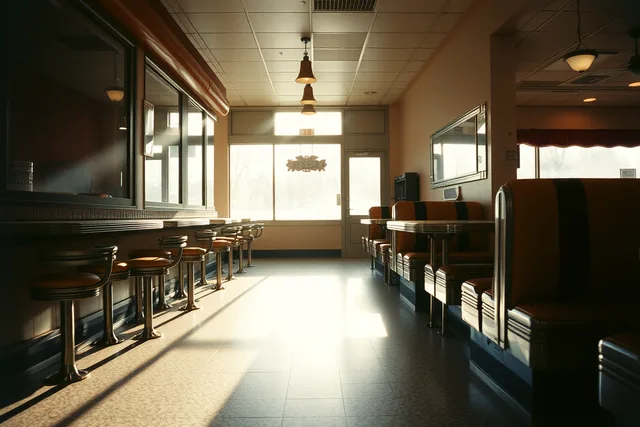
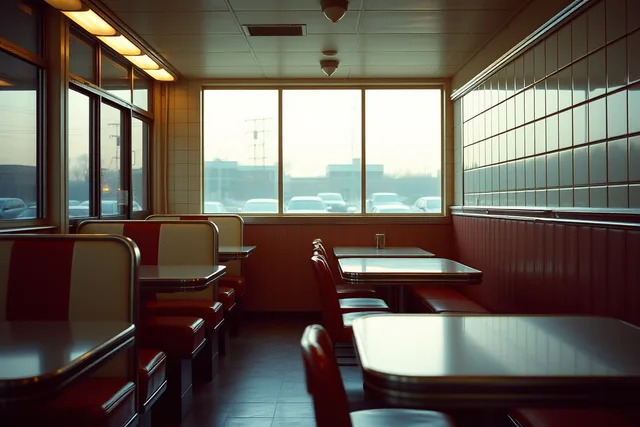
Counter and booth bank. Counter runs, stools, and booth backs were often replaced in place over decades. Laminate and chrome-edge trim date a booth better than the room does. One replaced booth does not date the bank.
Neon. Tube diameter, gas, and transformer load identify a sign era. A 1960s box sign with a plastic face is not the same object as a 1950s porcelain-enamel station sign, and the two are dated differently. Replacing neon with LED ends the original material.
Floor. Quarry tile, terrazzo, and vinyl sheet each carry a different replacement history. A floor covering laid over an earlier one is a record, not a loss.
Service openings. Pass-throughs, pick-up windows, and door positions were cut and closed as service changed. A wall opening is a construction event with a date, and it is often the easiest feature to date.
Re-creation. A rebuilt feature is a new object. The National Park Service reconstruction treatment standards place reconstruction on documentary and physical evidence, not on conjecture. That sets the bar for calling something a reconstruction.
The pass-condition table
Run every claim through this before it goes to an editor.
| Option | Pass condition | Do not claim |
|---|---|---|
| Enamel panels | Dated shop drawing, panel stamp, or finish evidence | That over-paint is reversible or that the panel is original to the building |
| Counter and booths | A record covering that counter or booth bank | That one booth dates the whole bank |
| Neon | Tube diameter, gas, transformer load, or a dated sign survey | That a replacement tube is original, or that LED matches the original light |
| Floor | A record of the covering and what lies beneath it | That the visible floor is the first floor |
| Service openings | A construction date for the opening or its closure | That the current layout is the original layout |
| Re-creation | Documentary and physical evidence for the form | That a re-created feature is historic fabric |
| Whole room | One source per feature, each dated | That the room has a single history |
Read the record before you write the label
A photograph shows a counter. A historic survey names a room. A business describes a later change. These answer different questions, and combining them produces "the original counter was restored" when no source establishes origin, work, and date together.
The Library of Congress primary-source analysis guide works in sequence: observe, reflect, then investigate. Describe the visible fact first. Write down the question it raises. Find a separate source before attaching an explanatory label.
Write the gap instead of closing it
When the record stops, say where. "The records reviewed do not establish the installation date" is a finding. It beats calling a feature original because it looks old, and it gives a contributor a narrow line to correct.
The National Archives primary-source explanation makes the point that a source's role depends on the question asked. A treatment discussion can be useful context for one feature. It is not evidence that a different feature shares that history or those options.
Name the authority, not the ruling
Whether a diner interior can be altered, and under what review, is set by the adopted ordinance and the reviewing body. That is the State Historic Preservation Office, a local landmarks commission, or the agency running Section 106 review for a federally involved project. Confirm the applicable standard with that office.
Condition, ownership, and eligibility claims need dated field evidence from a survey, not an inference from a photograph. Name the survey and point to the primary record.
Mark supplied and paid material
A business may hand you photographs and an account of options it weighed. Attribute the material, date it, and say who provided it. If the business paid for placement or has another material connection, disclose it next to the related content.
The Federal Trade Commission's endorsement guidance says a material connection that could affect how readers weigh a recommendation must be disclosed clearly and conspicuously. The disclosure gives context. It does not verify the option or the result.
Check the headline against the body
Read the headline, the body, the captions, and the disclosure as four separate documents. They should describe the same evidence boundary. A careful paragraph cannot repair a headline that promises an original feature with no source behind it. A contextual photograph should not quietly become evidence for the property under discussion.
Common questions
Does this checklist decide whether to repair or replace?
No. It sorts the evidence behind each option and marks what still needs a property-specific assessment by a qualified professional.
Can a business supply option details?
Yes, with attribution, a date, supporting evidence, and a disclosure where a material connection exists. Supplied information is not independent verification.
What if the record is incomplete?
State the limit, or leave the claim out. An incomplete record is a finding, not a licence for a confident conclusion.