Reviews
Part of How vintage diner interior options compare on condition and disclosure
Vintage diner interiors: questions editors should ask before comparing options
Vintage diner interior options questions for 2027 help editors compare repair, replacement, material claims, historical context, and source limits.
Questions can make an options article more accurate without asking it to choose a treatment for a real diner. The goal is to test the claim behind each option: which feature is involved, what evidence describes it, what period the evidence covers, and what still needs a qualified, property-specific review.
What to take away
- Ask what record supports the exact option named.
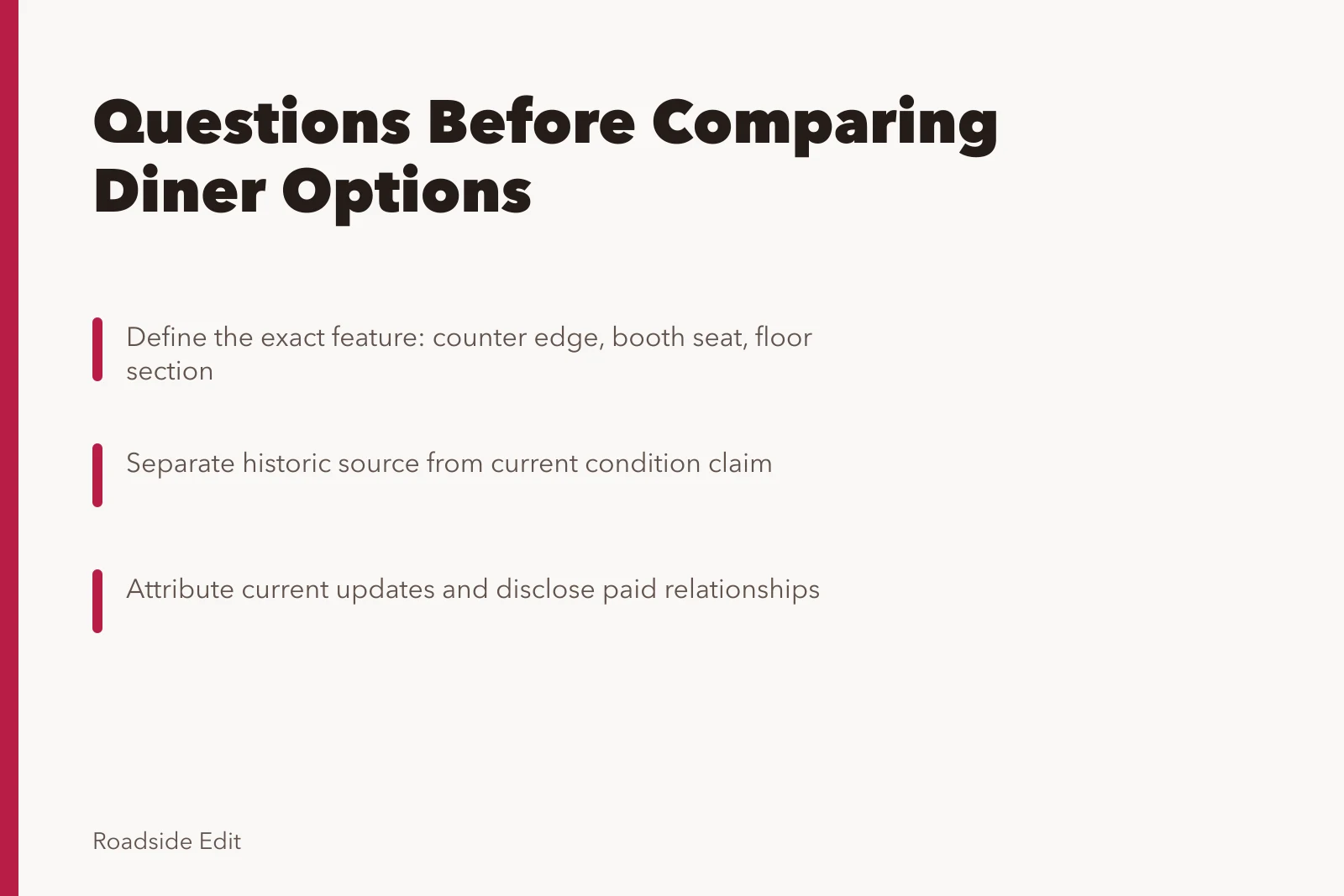
- Define a feature before using broad words such as repair, replacement, or match.
- Separate a historic source from a current condition claim.
- Do not turn material guidance into a recommendation for another property.
- Keep business accounts attributed and paid relationships visible.
Start with the feature question
The first question is not "Which option is best?" It is "What exact feature is being discussed?" A whole diner is too broad. A counter edge, booth seat, floor section, ceiling finish, or wall panel is a clearer subject. The record can then be tested against that defined feature.
The National Park Service guidance on historic wood flooring and substitute materials says repairable historic flooring should be repaired. The required match for replacement depends on the material and the space's role.
That supports a narrow editorial question: does the article name the source context before generalizing a material choice? The guidance does not decide what another diner should do.
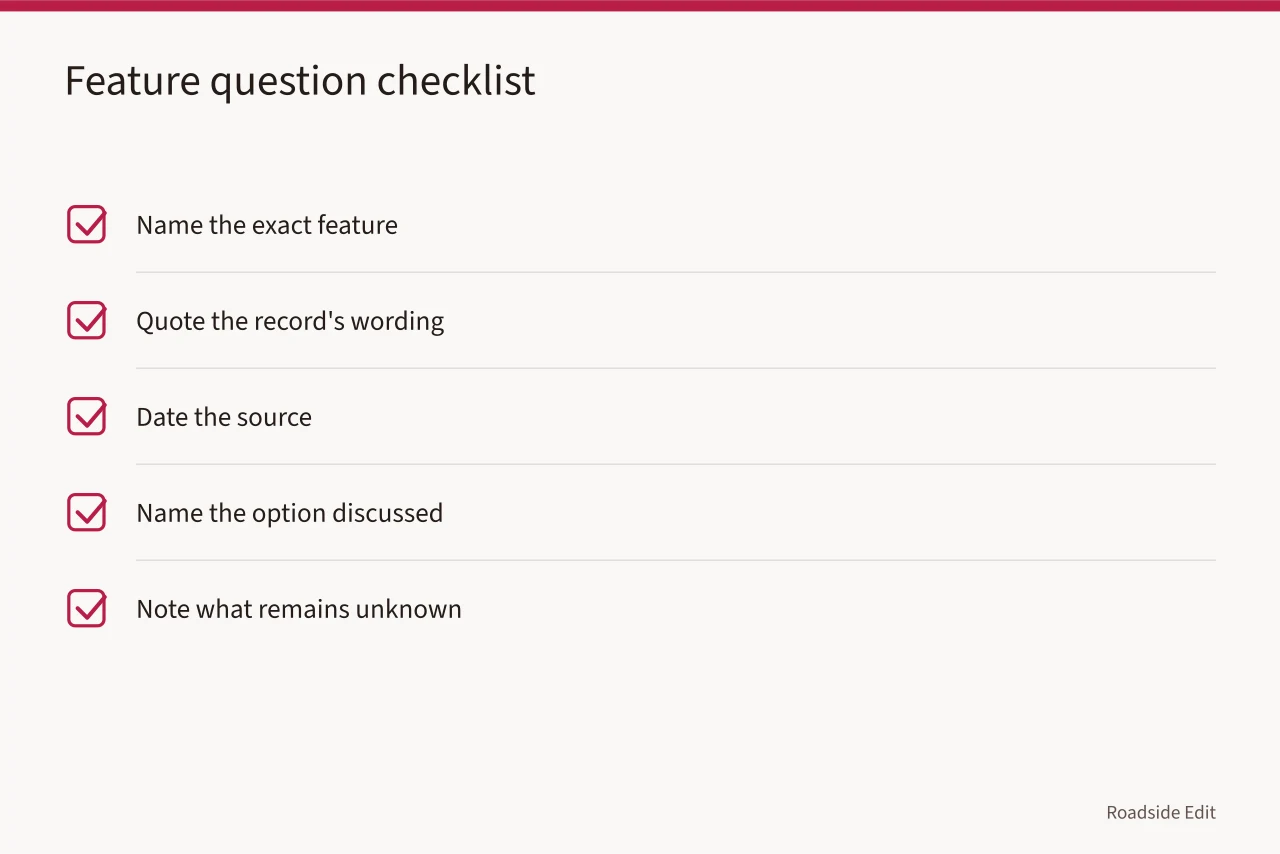
| Question | Record to seek | What the answer can support |
|---|
Compare claims, not properties
An article can compare two published descriptions. It should not rank two diners as more authentic, better preserved, or more appropriate without a defined method and evidence for that exact claim.
One source may describe a floor in a preservation-program setting. Another may show a booth in a current business image. Those sources do not answer the same question.
The National Archives primary-source explanation notes that whether a source is primary depends on the question being asked. A historic image can answer what was visible on its date. It cannot establish current condition, repairability, cost, or suitability at a different location.
Use a comparison note rather than a conclusion: "The records describe different features and time periods, so the article presents them separately." That sentence is useful because it tells readers why a tempting comparison was not made.
Question every material-match claim
Words such as "matching," "compatible," "replacement," and "original" sound factual but each needs a source and a defined context. Ask: who used the word, what material or feature did they mean, and did the source describe appearance, function, history, or a program requirement? If a source is silent, use a visible description instead.
The Library of Congress primary-source analysis guide puts observation before reflection and investigation. Use that sequence in an options article. Describe the visual detail. Identify the question. Then look for a record before calling it original or assigning it a treatment history.
Keep current updates in their own lane
An owner or business may report a recent change, available service, or option considered. That information can be relevant. Attribute it, give it a date, and keep it separate from historical records. A current statement is not independent proof of a room's entire history.
If a listing includes payment, free goods, or another material relationship that could affect how readers weigh a recommendation, disclose it next to the claim. The Federal Trade Commission's endorsement guidance says such material connections should be disclosed clearly and conspicuously. The disclosure adds context; it does not verify the option or project outcome.
Make an unanswered-question column
For each option, record the missing evidence. It may be a dated photograph, a survey, a project document, or clarification from a responsible party. Publishing an open question is often more valuable than creating a confident story from a visual similarity.
Common questions
Does a visually similar material prove a match?
No. A general article should describe the evidence and avoid declaring compatibility for a specific property.
Can an article call an option affordable?
Only with a clearly defined, comparable, and dated basis. In most cases, describe the source without ranking the option.
What is the safest way to use a current update?
Attribute who supplied it, state the date, preserve its limits, and add a disclosure where applicable.