Guides
Part of Historic motel restoration case study method: how to document a project honestly
How to keep historic motel restoration case study records that hold up
Historic motel case study records for 2027 explain how to organize source logs, media credits, status notes, corrections, permissions, and sensitive material.
A case-study folder should let a later editor see exactly where a sentence came from and why it was used. It should also keep private and sensitive material out of the public article.
What to take away
- Save the original source, not only a paraphrase.
- Give each record a role, date, status, and limitation.
- Separate public copy from private project material.
- Keep corrections as additions to the record.
Create a source register
The National Archives' historic-preservation electronic-records reference report notes that some archival files have access restrictions or copyright limits. Read the National Archives reference report. That is an important editorial reminder: online access does not erase source limits, permissions, or the need to credit an item accurately.
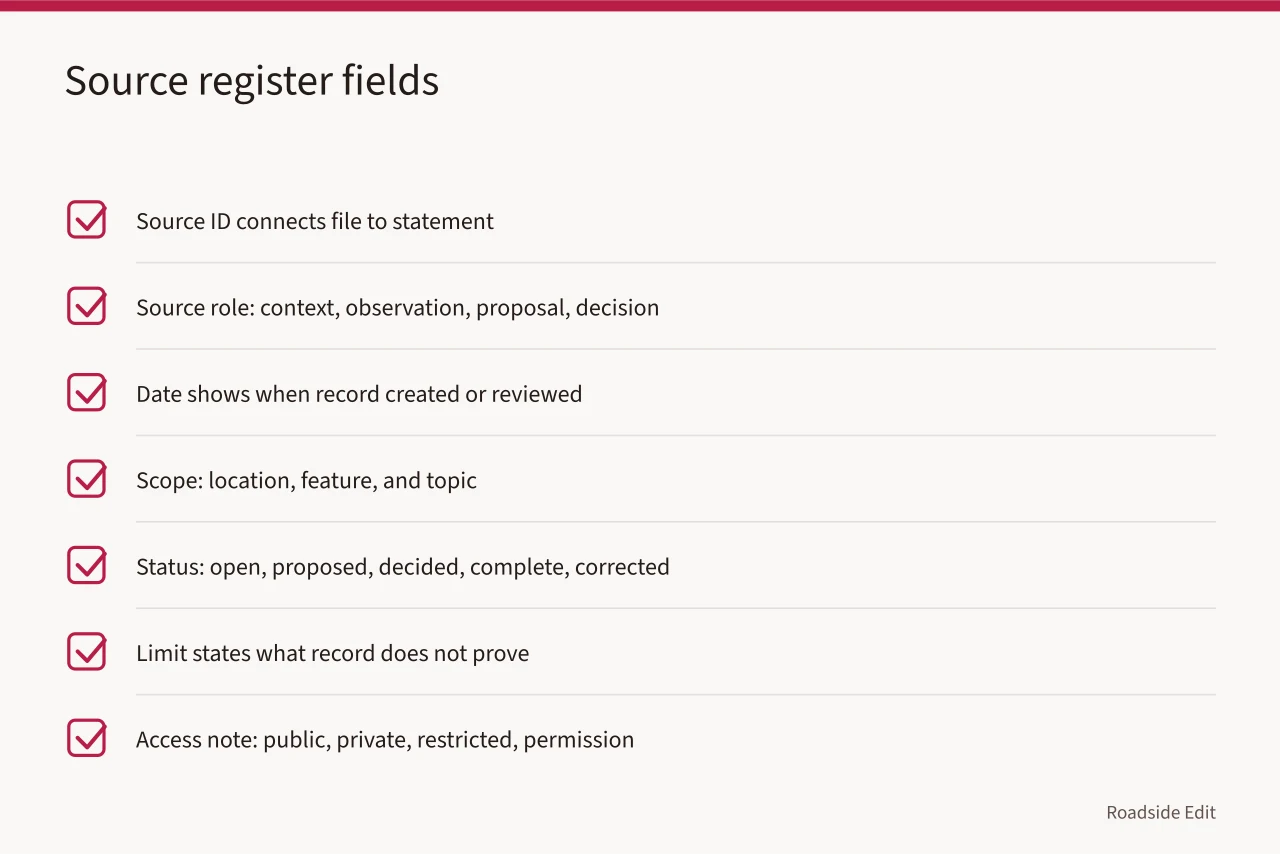
| Register field | Example purpose |
|---|---|
| Source ID | Connects the file to a statement in the draft |
| Source role | Historical context, observation, proposal, decision, completion, or media |
| Date | Shows when the record was created or reviewed |
| Scope | Identifies the location, feature, and topic it covers |
| Status | Open, proposed, decided, reported complete, or corrected |
| Limit | States what the record does not prove |
| Access note | Public, private, restricted, or permission required |
Protect sensitive material
Keep owner contact data, security information, private budgets, access procedures, and confidential proposals out of the public file. A public case study can explain a process without reproducing sensitive details. When someone asks to correct or remove content, preserve a private note that records the request and the action taken.
For a handoff, include the current draft, source register, image credits, known gaps, and corrections log. The next editor should not need to reconstruct the difference between a fact, a business statement, and a planning question.
If an article uses a file supplied by a contributor, save the submission date and the contributor's description in the private record. Public credit should remain accurate, but the internal record should also identify how the editorial team received the material.
Note any later permission change.
Give every item a source role
The National Archives guidance on digital photographic records describes the importance of identifying and descriptive information for photographs. For a case-study register, give each image an ID, date, place, source page, and caption. The same record should say whether the item is media only, historical context, or evidence for a particular limited statement.
| Record role | Supports | Does not prove alone |
|---|---|---|
| Archive image | Depicted appearance at a date | Current condition |
| Project proposal | Intended scope | Approval or completion |
| Decision note | Documented choice | Work occurred |
| Completion report | Reported work and date | Long-term outcome |
The NPS documentation standards require sources and limits that allow later verification. If a case-study statement has no source ID, remove it from public copy or mark it as unverified. A clean limitation is better than an attractive but unsupported detail.
Build a correction path
The NPS historical documentation guidelines discuss source identification and reporting results. A correction line should identify the old statement, new source, date, and the precise part of the article that changed. Keep that line in the source register so later contributors do not recreate the old error.
Prepare records for a later editor
The handoff folder should include the current draft, source register, image credits, correction notes, and a brief gap list. The next editor should be able to distinguish a record that documents a fact from a record that only asks a question. If the original source is unavailable, retain that limitation rather than passing along a paraphrase as proof.
Public copy can be shorter than the private file, but it must retain the date, credit, and limits needed to keep statements accurate. Do not use a case-study article as a storage place for project access details or private contacts.
Make a dated inventory before each update. It helps identify missing originals, changed labels, and corrections that need to be carried forward.
Use one stable record ID throughout the draft, source log, and correction note.
Keep original source files under that same ID for consistent retrieval.
Common questions
Can a public source still have usage limits?
Yes. Check the source's rights and access information before publishing media or substantial material.
What should a correction note say?
Date, changed statement, source that prompted the change, and the reason for the update.
Is a media credit the same as a citation?
No. A credit identifies the image source. A citation supports the nearby factual claim.