Guides
Part of Historic motel restoration case study method: how to document a project honestly
How to build a historic motel restoration case study checklist that holds up
Historic motel case study checklist for 2027 helps writers organize sources, dates, observations, decisions, corrections, media credits, and stated limits.
A case-study checklist keeps a writer from turning a group of images and project notes into a confident story without a source trail. Use it before publishing, not as a substitute for property-specific review.
What to take away
- Give each fact a source, date, and role.
- Separate visible observations from diagnoses and decisions.
- Track what changed and what remains unknown.
- Credit every image as media, not as evidence about another property.
Collect the core record
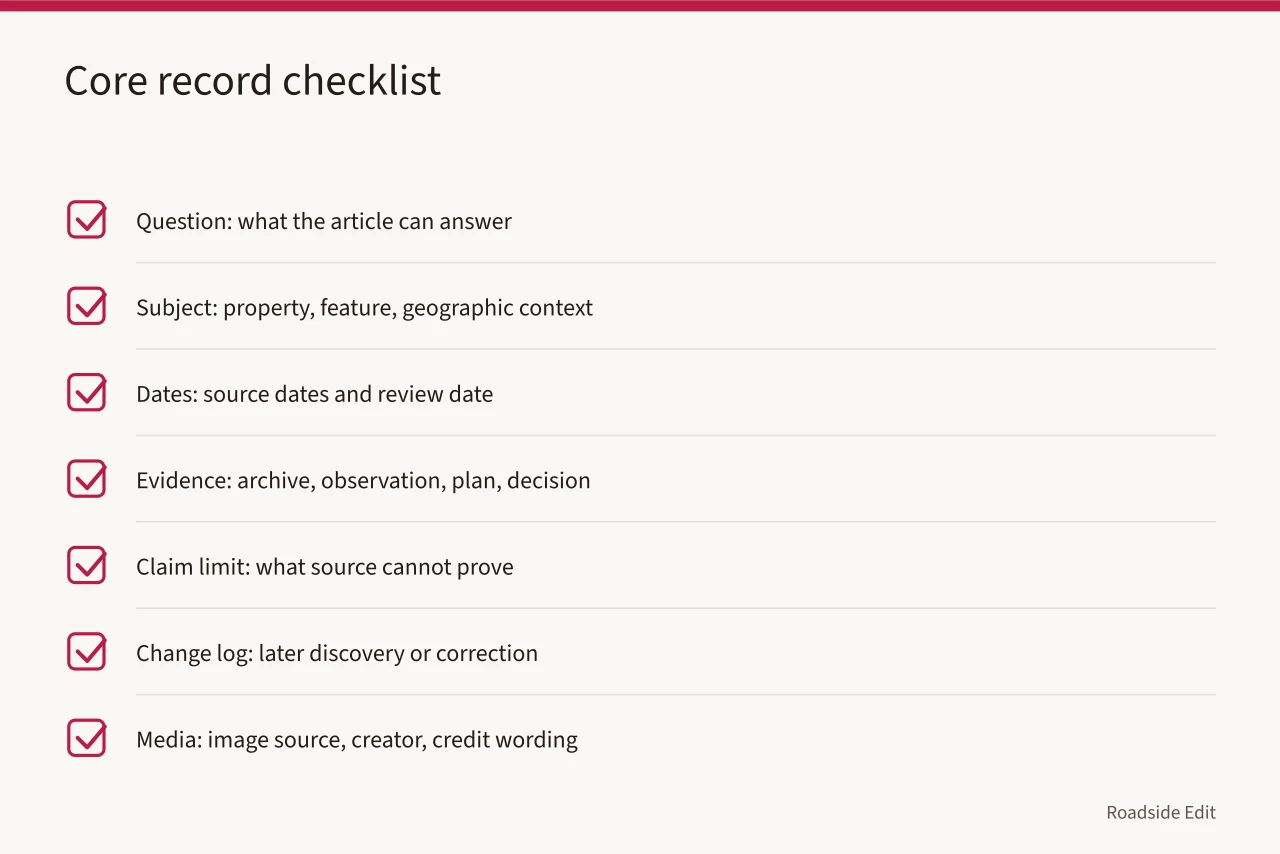
NPS instructions for its Historic Property Project Documentation process call for baseline information, current-condition documentation, treatment decisions, and a before-and-after completion record. Review NPS HPPD completion guidance. That process is not a template for a private motel, but it shows why a case study should distinguish preexisting information, documented changes, and reported completion.
| Check | Record to keep |
|---|
Run a final check
Read each property statement with the record beside it. Does the source cover the same location, date, and subject? Does a proposal appear as proposed rather than complete? Does a photo receive a credit without being used as a technical diagnosis? If the answer is no, reduce the claim or write an explicit limitation.
Keep a private checklist for permissions, contact information, and sensitive material. Public copy should not expose private access details, personal data, or unverified disputes.
Before saving the final version, check that the title, caption, image filename, and source-register ID all refer to the same item. This small cross-check catches a common editorial error: a correct credit attached to the wrong image or property statement.
Record the checker's name and date in the private log.
Test the claim against the evidence
The NPS documentation standards call for accurate material from reliable sources with limitations stated so readers can verify the information. Use that as the final test for a case-study checklist. The source must cover the same property, feature, date, and claim. If it covers only one of those items, narrow the sentence.
| Claim type | Record to check | Limit to state |
|---|---|---|
| Past appearance | Dated image or archive item | Image does not establish the present |
| Proposed scope | Plan or decision document | Proposal does not prove completion |
| Reported work | Completion record | Record may not establish later result |
| Supplied statement | Attributed participant material | Not independent confirmation |
The National Archives guidance for digital photographic records describes using identifying and descriptive information with image files. Record a stable image ID, source page, date, place, and short caption. The media credit identifies where an image came from. It should not be used as technical evidence about a different property.
Keep final review notes outside the article
Record the review date, checker, source gaps, and permission questions in the private project file. Public copy needs the results: accurate claims, limited conclusions, and clear credits. That separation lets an editor update the article later without exposing private details.
The NPS project documentation overview describes documentation that informs planning and design decisions. A case-study checklist does the same editorial job by making the sources and open questions available to the people who need to review them.
Give every review a narrow result
Finish each review with one of three results: the record supports the limited claim, the record does not support it, or a different source is needed. Avoid a blank field that later invites someone to write a conclusion from memory. A short, dated result makes the next review faster and protects the final article from casual additions.
If the source is supplied by an owner or business, keep the original file and label the source role. The contribution may be useful. It becomes a factual case-study claim only when the wording matches what the source actually establishes.
Common questions
Must a case study have every historical record?
No. State the scope of the research and the gaps that remain.
Can a single photo establish a project timeline?
Only for what the image itself documents. Pair it with dated records before drawing a broader conclusion.
What is a correction log?
A dated note that explains what changed, which source changed it, and how the article was updated.