Guides
Part of Historic motel restoration case study method: how to document a project honestly
Historic motel restoration case study questions to ask before you write
Historic motel case study questions for 2027 help writers test source scope, dates, observations, decision status, claimed outcomes, and missing documentation.
The best case-study questions test the record before they ask for a conclusion. They help writers avoid confusing a historical image with a current observation, a proposal with completed work, or a business statement with independent evidence.
What to take away
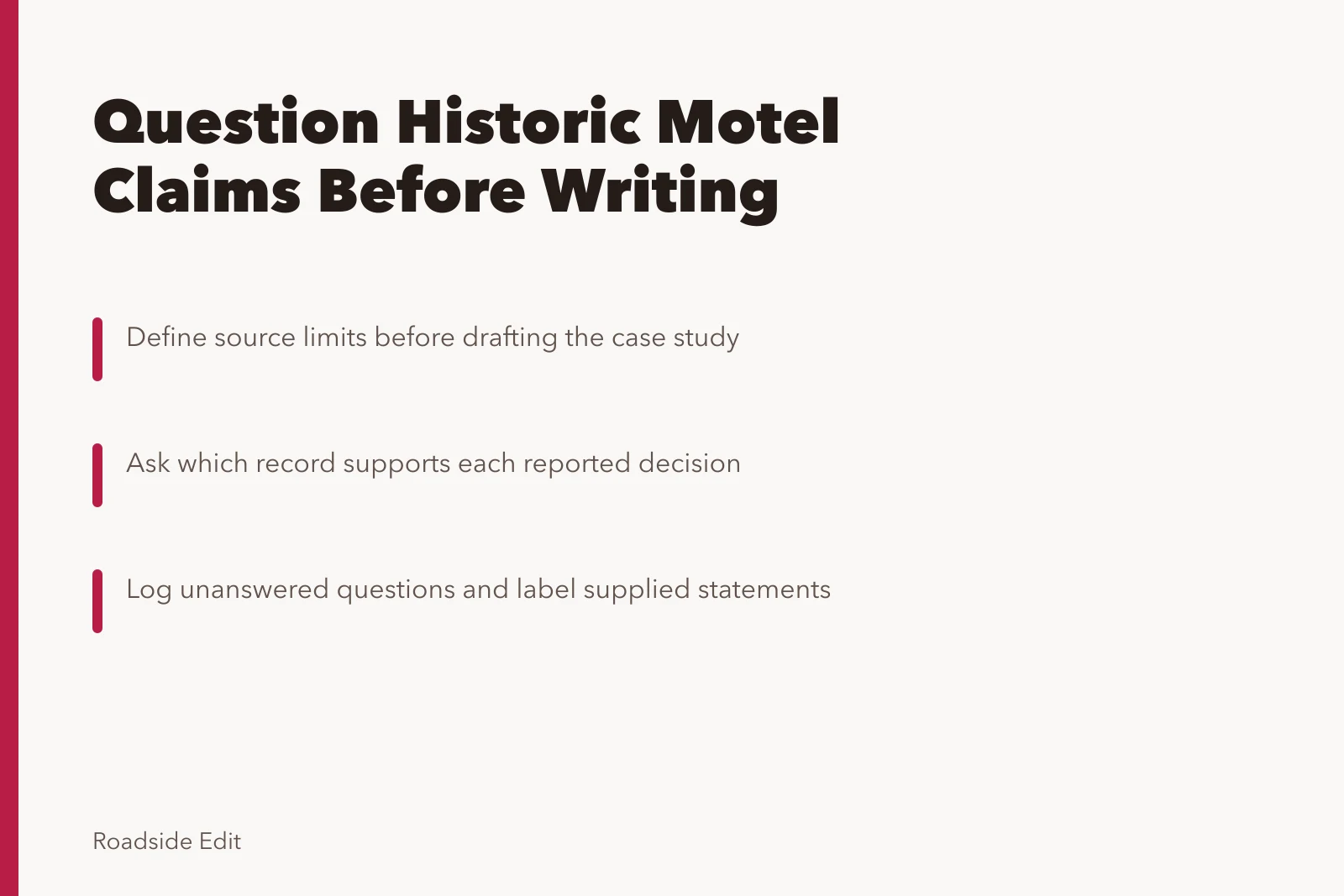
- Start with questions that define source limits.
- Ask which record supports a reported decision or change.
- Keep unanswered questions visible at the end of the article.
- Use neutral language when evidence is incomplete.
Ask source-first questions
NPS historical-documentation standards say documentation should have defined objectives and recorded sources so later researchers can verify or locate what was found. Read the NPS historical documentation standards. That principle makes a practical editing test: if a reader cannot tell where a fact came from, the case study needs a clearer record.
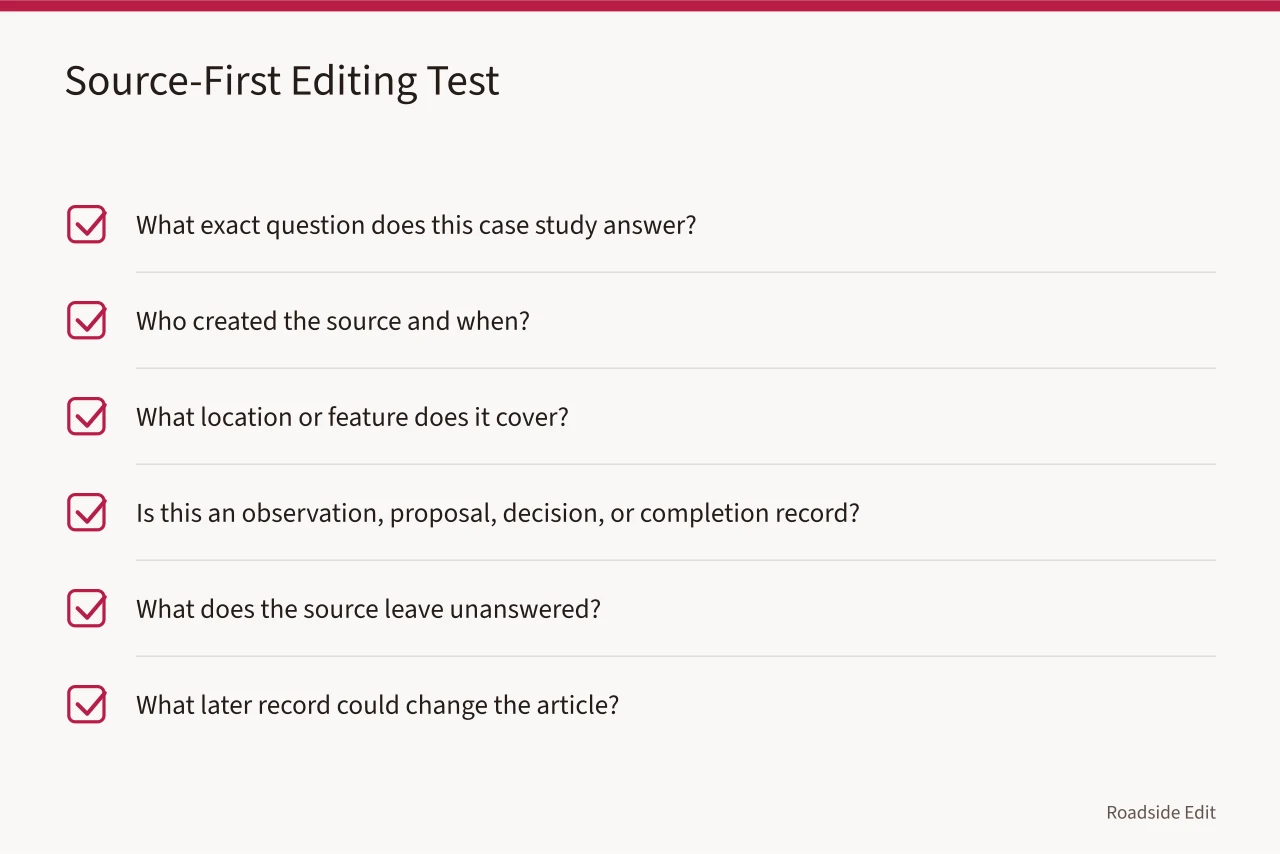
| Question | Why it matters |
|---|---|
| What exact question does this case study answer? | Prevents a broad promotional conclusion |
| Who created the source and when? | Establishes provenance and time frame |
| What location or feature does it cover? | Stops a source from being generalized |
| Is this an observation, proposal, decision, or completion record? | Keeps status accurate |
| What does the source leave unanswered? | Creates an honest limit |
| What later record could change the article? | Builds a correction path |
Make a question log
Keep questions in a separate section while researching. Do not let a hoped-for answer leak into the draft. For example, write "Is there a dated record for this paint color?" rather than "The original color was blue." When an answer is found, add the source and date. When it is not found, record the gap.
This format also helps with contributed or sponsored material. A business can supply a statement, but the article should label it as a supplied statement until another relevant record supports it.
When an answer depends on a specialist review, write the question plainly and identify the missing role. A case study can report that a question exists. It should not imitate a technical opinion that the available record does not contain.
Order questions before writing conclusions
Start with identity, then time frame, then evidence. A question such as "What does this image depict?" should come before "What change does it prove?" The NPS documentation standards explain that documentation needs reliable sources and clearly stated limitations. A question log helps a writer keep those limits visible.
| Question stage | Useful prompt | Record to retain |
|---|---|---|
| Identity | What feature is named in the source? | Caption or source description |
| Time | What date does the item establish? | Source date or stated uncertainty |
| Scope | Which part of the property does it cover? | Location note or map |
| Status | Is work proposed, decided, or reported done? | Dated project record |
The Library of Congress guide for using primary sources recommends observation and questions before interpretation. For a motel case study, describe what the record visibly says or shows. Then add the question that needs a different source or a qualified reviewer.
Preserve a question after it is answered
When new evidence answers a question, do not overwrite the early line. Add a dated answer, source ID, and note about what changed. The NPS historical documentation guidelines discuss source identification and the treatment of conflicting information. A visible trail makes it possible to check how the case study reached its conclusion.
Keep an unanswered-question register
An open question needs a date, source ID, location, and next review trigger. It might await a file from an archive, a permission response, a site-specific assessment, or a documented decision. State that need without predicting the outcome. The record stays useful because it tells the next person exactly where the research stopped.
For public pages, publish only the question and the factual limit when the missing details are private. A clear boundary can explain why the article does not offer a recommendation without exposing a project's internal information.
Review the register before publishing. Each open question should point to the record that created it and the role expected to answer it.
Common questions
Can a question log appear in a published article?
Yes. A short limits section can explain which questions remain open without sharing private project details.
Is an interview automatically a verified source?
No. Identify the speaker, date, and scope of the statement, then distinguish it from independently documented facts.
What if records disagree?
Describe the conflict, cite the competing records, and avoid choosing a winner without a justified basis.