Guides
Part of Historic motel restoration case study method: how to document a project honestly
Historic motel restoration case study warning signs to catch before 2027
Historic motel case study warning signs for 2027 flag weak sources, missing dates, uncredited media, silent revisions, and promotional overreach.
A polished case study can still be weak if the records do not support its story. The warning signs below are editing prompts. They are not claims about a person, business, or project.
What to take away
- A confident sentence needs a record that matches its location, date, and scope.
- A project example is not an instruction for a different property.
- A photo credit and a project source have different jobs.
- Corrections should be dated, not hidden.
Look for source drift
NPS describes its Preservation Tech Notes as case studies that provide practical information on traditional practices and innovative preservation techniques. Browse NPS Preservation Tech Notes. A technique example can help frame a question, but it does not prescribe the same treatment for another motel. The record must still match the subject of the claim.
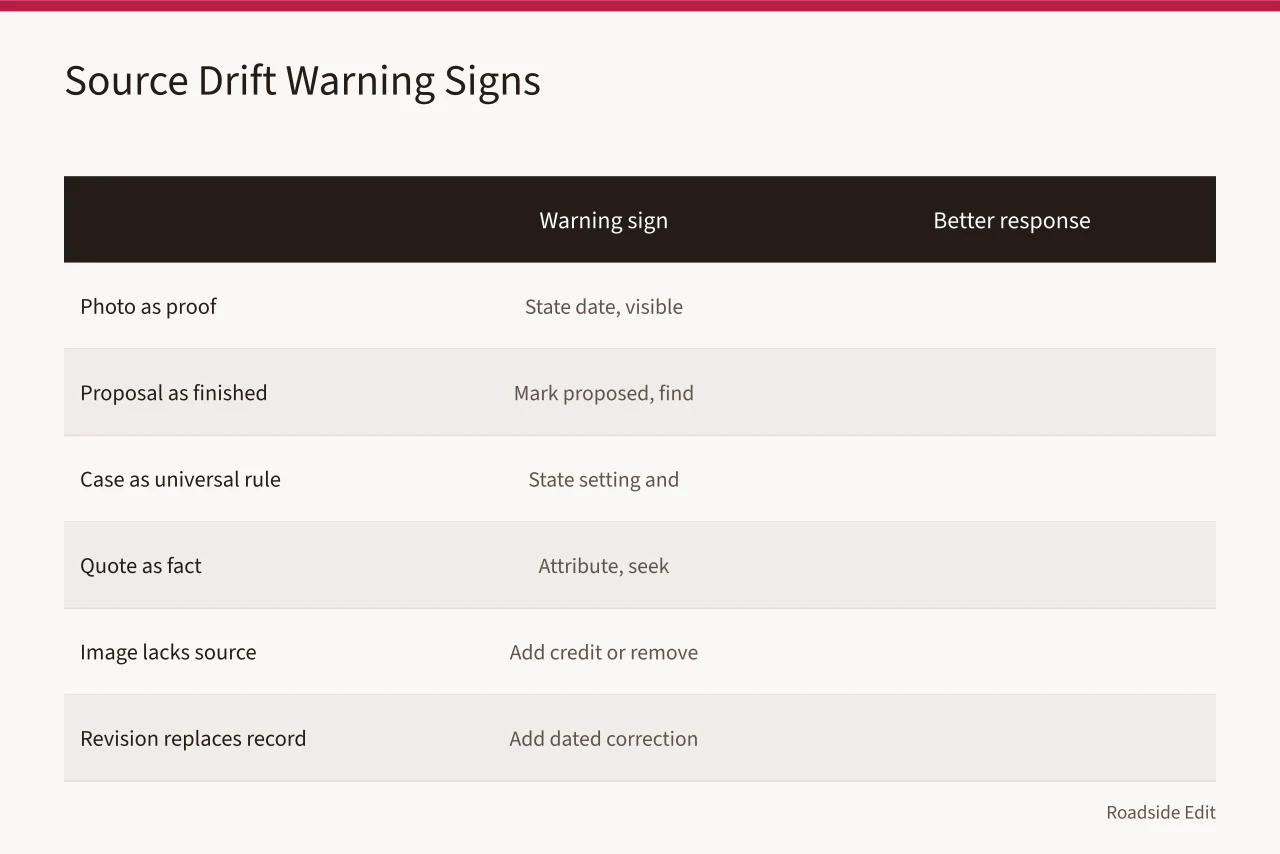
| Warning sign | Better response |
|---|---|
| A photo is used as proof of current condition | State its date and what it visibly shows |
| A proposal is written as finished work | Change the status to proposed or locate a completion record |
| A case example becomes a universal rule | State the source's setting and limit |
| A business quote becomes a factual conclusion | Attribute the quote and seek relevant support |
| An image lacks a source page | Add a credit or remove the image |
| A revision replaces the prior record | Add a dated correction note |
Keep the conclusion proportional
End with what the sources establish, not the largest conclusion the writer can imagine. "The cited materials document a change in the sign's reported scope" is precise. "The project revived the motel" is not, unless the evidence directly supports that outcome.
When a case includes a paid placement, label the relationship and keep it outside the factual conclusion. Advertising can identify a business. It cannot validate an unverified project claim.
Use an editor's hold when a sentence cannot be traced to a source, an attributed statement cannot be checked, or a new record contradicts the draft. A hold is better than a smooth but unsupported narrative, and it creates a clear task for the next review.
Stop source drift before it reaches the conclusion
The NPS documentation standards state that documentation should use reliable sources, describe limits, and permit independent verification. A draft fails that test when a citation is placed near a statement it does not actually support. Move the citation to the supported claim, reduce the wording, or remove the unsupported sentence.
| Warning sign | What to check | Editorial response |
|---|---|---|
| Uncredited image | Source page and creator information | Add a credit or remove it |
| Broad conclusion | Scope of the cited record | Narrow the conclusion |
| Project claim | Status and completion source | Use proposal or reported-work language |
| Correction missing | Date and new evidence | Add a correction note |
The NPS historical documentation guidelines describe source identification and methods for handling records. Keep the source ID and correction date in the working file. Readers do not need every research note, but they should not see an unexplained change in the facts.
Separate a case example from advice
The NPS Historic Property Project Documentation overview describes documentation used to inform planning and design. A case example can show how records were handled. It cannot determine what another motel should do. State that limit wherever a reader might otherwise mistake a historical example for a recommendation.
Use an editor hold for unsupported material
Place a sentence on hold when the cited source is missing, the claim has changed since the source date, or an attributed statement cannot be verified. The hold is not a rejection of the project. It is a note that the article needs a more specific record before it can make the claim.
Keep the hold in the private review file with the source request and date. This preserves the reasoning and prevents a later edit from restoring the same unsupported sentence.
If a record appears after publication, add it through a dated correction. Do not replace the prior text without leaving a visible explanation for readers.
Common questions
Is a before-and-after image enough to prove success?
No. It can document appearance at two times, subject to date and location confirmation.
Should a case study remove mistakes after publication?
Correct them with a dated note so readers can understand the change.
Can a product be named in a case study?
Only when the source supports that it was used or proposed. Do not imply endorsement or performance.