Guides
Part of Historic motel restoration case study method: how to document a project honestly
How to write historic motel restoration budget notes for 2027 without inventing totals
Historic motel case study budget notes for 2027 show how to describe fees, funding references, stated scope, revisions, and financial limits without invented totals.
Financial information needs more restraint than most case-study details. A listed award, proposal, invoice, or funding program usually shows one part of a record. It does not automatically reveal total cost, cash paid, tax result, or business benefit.
What to take away
- Name the document type before discussing a figure.
- Keep the stated scope next to every amount.
- Do not calculate a return from partial records.
- Mark missing and private information clearly.
Describe the source before the number
NPS presents its tax-incentive case studies as examples of projects that successfully used a specific federal 20% credit. See NPS tax-incentive case studies. That page does not establish eligibility or financial results for another property. Use such material as program context, not as a shortcut to claims about a motel's cost or outcome.
Record the limits
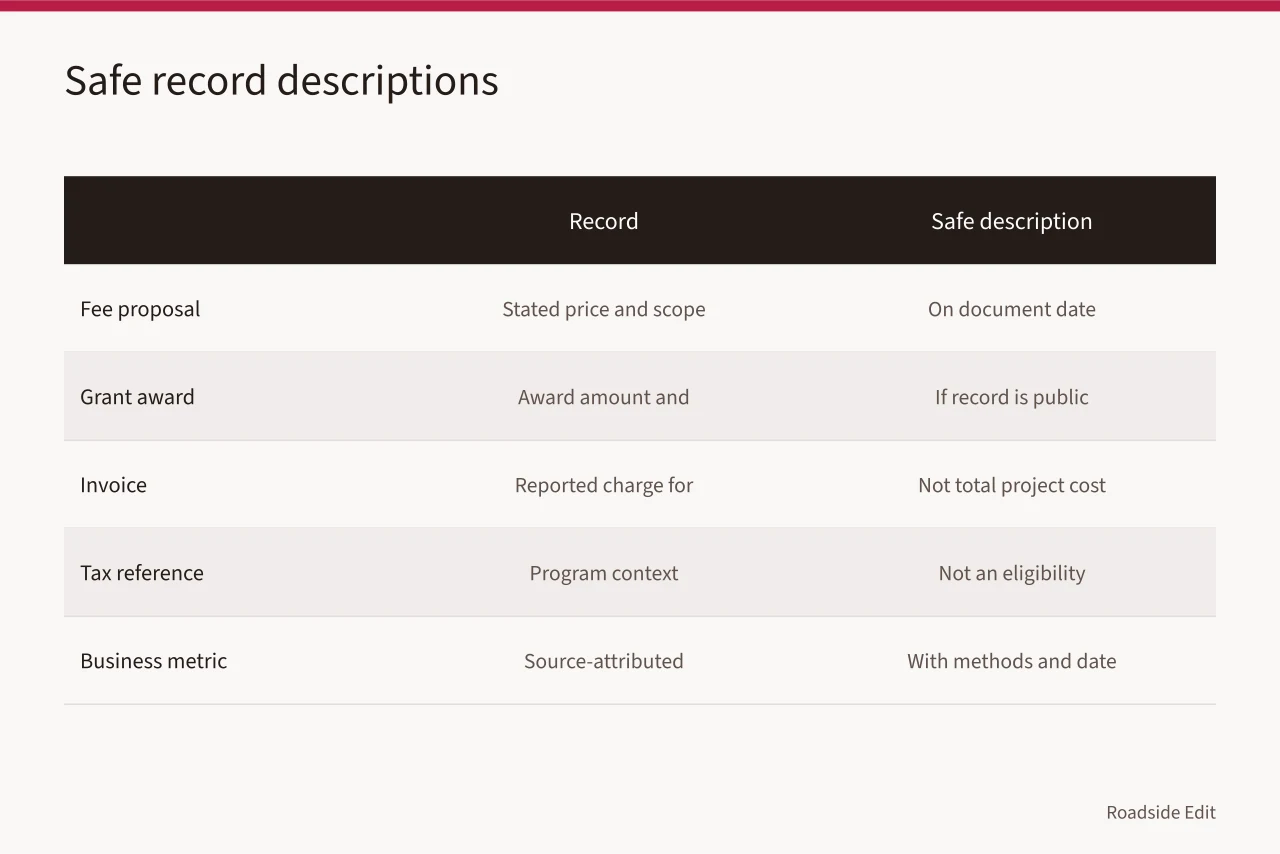
Add a financial-limits note below the table. State whether records are partial, supplied by a participant, not independently verified, or withheld for privacy. Do not use adjectives such as affordable, profitable, or high-value unless a defined source supports the measurement.
If a budget changes, preserve the original figure and give the revised record its own date and scope. The gap between two figures may reflect different work, not an overrun or saving.
Use a separate note for in-kind work, donated material, or a sponsor contribution. Those entries may be important context, but they should not be turned into a dollar amount unless a reliable public record states the amount and its terms.
If an amount is rounded, state who rounded it, when, and why. Never turn a rough public figure into a precise calculation. The detail protects readers from mistaking an editorial summary for an audited financial record.
Keep the scope and status beside a figure
The GSA guidance on managing project costs explains that estimates are developed and managed as scope becomes clearer. A case study should therefore name the record type, date, source, defined scope, and limitations beside any amount. A number without those fields is not useful evidence.
| Financial record | What it can state | What it cannot establish |
|---|---|---|
| Award notice | Public award amount and program | Total project cost |
| Estimate | Proposed cost for stated scope | Authorization or finished work |
| Invoice | Reported charge for named item | Future performance |
| Tax program page | General program context | Individual eligibility or outcome |
The NPS historical documentation guidelines describe source identification and documented methods. Apply the same habit to budget notes. If a figure comes from a participant conversation, call it a supplied statement rather than a verified project result.
Do not calculate what the source does not show
The NPS documentation standards require limitations to be clear enough for independent review. A partial figure cannot prove profit, return, financing terms, or the final project total. If no public property-specific amount exists, say that no verified figure was located.
Write a revision note when a figure changes
Keep the original figure visible in the private record. Add the new date, the new source, the scope that changed, and the status of the revision. A change may reflect a different work package or timing, not a savings or overrun. A public article should describe that limit instead of asking readers to infer a financial story from two numbers.
The same rule applies to funding references. An award can provide relevant context, but it does not prove all project costs were covered or that a financial result followed.
Add the review date to every financial note. A number that was accurate for one date can be misleading after a revised scope or later decision.
Keep the document title with the entry too.
Use the source date as the reference point.
Common questions
Can a case study quote an estimate?
Only with a clear source, scope, date, and appropriate permission. Label it as an estimate.
Does a tax-credit example predict a benefit?
No. Eligibility and tax results require project-specific review.
What if financial records are private?
Say that financial information was not published or verified, and do not fill the gap with an estimate.