Guides
Part of How to choose a historic motel restoration provider in 2027
Historic motel restoration: 7 provider selection questions to ask in 2027
Seven provider selection questions for historic motel restoration in 2027, with a table separating a process answer from a result you can verify.
A provider who answers a question well is not the same as a provider who has done the work. The seven questions below are built to tell those two apart before you sign anything.
What to take away
- Ask all seven questions in the same order, in writing, to every candidate.
- A process answer describes steps. A result answer names a document, a date and a role.
- Ask what would change the scope. The trigger is often more useful than the price.
- Keep each reply with its date and author. A later answer replaces nothing.
- Route permit, compliance and eligibility questions to the State Historic Preservation Office or local landmarks commission.
The seven questions
Ask these of a masonry conservator, a neon fabricator, a documentation consultant or a survey team. The role changes; the questions do not.
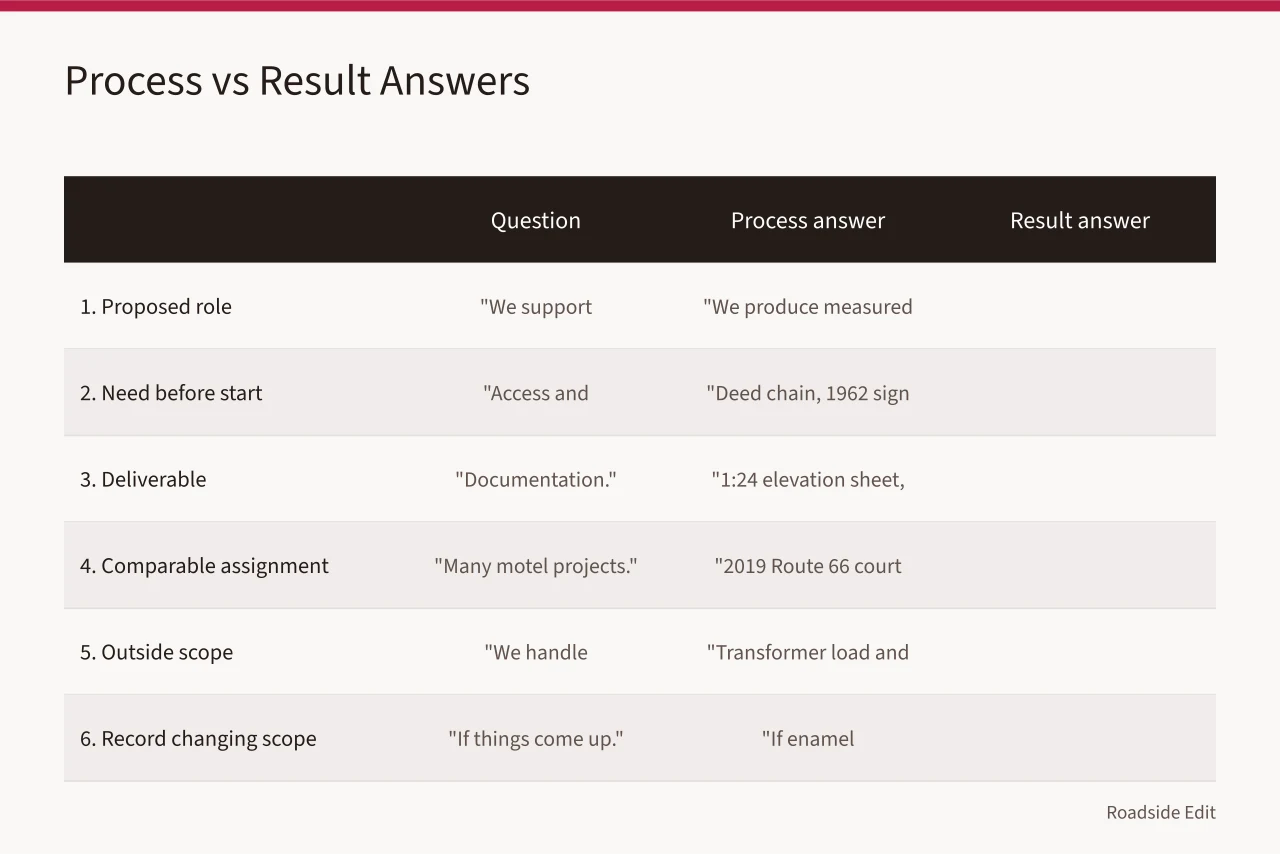
| # | Question | A process answer sounds like | A result answer sounds like |
|---|---|---|---|
| 1 | What is your proposed role on this project? | "We support preservation projects." | "We produce the measured drawings; the engineer stamps the canopy." |
| 2 | What do you need before you start? | "Access and background." | "Deed chain, the 1962 sign permit, and two clear survey days." |
| 3 | What will you deliver? | "Documentation." | "A 1:24 elevation sheet and a condition report by 14 March." |
| 4 | What comparable assignment can you describe? | "Many motel projects." | "The 2019 survey of a Route 66 court in Tulsa; I was field lead." |
| 5 | What is outside your scope? | "We handle everything." | "Transformer load and any tank work go to a licensed electrician and the environmental authority." |
| 6 | What record would change your scope? | "If things come up." | "If the enamel proves over-painted, the cleaning phase becomes a repaint." |
| 7 | How will revisions be recorded? | "We keep you posted." | "Dated revision sheet, your written approval before the next phase." |
Question 4 is the one candidates answer loosely. Ask for the property, the year and their specific role. A portfolio image proves a building exists, not who did what to it.
Why the split matters
A process answer survives any subject. It reads as content and costs you a line. A result answer can be checked against a record, and that is the whole point of asking.
The National Park Service documentation standards ask for reliable source material and stated limits, so a second person can verify the work. Read the Secretary of the Interior's Standards and guidelines. Hold a proposal to the same test: what source, what limit, what would let someone else check it.
Where the NPS permit model helps
The NPS archaeology permit application asks for a statement of capabilities, past performance and CVs for proposed leadership. See NPS information for applicants. That is a narrower process than a motel project, but the shape is useful: capability, prior work, named people.
The NPS Historic Property Project Documentation process ties existing property information to scope and design decisions. Review the NPS documentation overview. Use it to press a candidate on which records they would actually read.
A historic structure report can pull together research, field investigation, observed conditions and records of physical work. Read the NPS historic-structure-report overview. A candidate may be hired for one of those inputs. Nothing in the conversation should imply they will produce all four unless the scope says so.
Worked example: a 1957 porcelain-enamel sign
Say a candidate answers question 5 with "we handle everything." You are looking at a porcelain-enamel panel with chipped edges and a rusted can.
The honest answer separates the trades. Cleaning and stabilization of the enamel is one scope. Transformer load and any rewiring go to a licensed electrician working to the AHJ.
Any ground disturbance near a former tank island goes to the environmental authority. The candidate who names those three handoffs is more useful than the one who claims the whole job.
Write the split into the scope, then ask question 6 again against it.
Keep the answers as dated evidence
Save the original reply, any follow-up, the date and the stated limits together. If an answer changes after a new document, record the change rather than overwriting the first statement. That trail lets a second editor compare like with like.
The same discipline applies when you interview the people who will read the exterior itself. Motel exterior hiring questions cover the field side of the same shortlist.
Common questions
Should every candidate get the same seven questions?
Yes, when the requested role is comparable. Add role-specific questions only where the assignment differs, and mark them as additions so the answers stay comparable.
Is a reference enough to confirm qualifications?
It is one piece of evidence. Record what the reference can confirm, such as a role and a date, and what remains unverified, such as who held the stamp.
Can these questions replace local review requirements?
No. They organize a conversation. Permit approvals, eligibility findings and compliance rulings sit with the State Historic Preservation Office or the local landmarks commission under the adopted ordinance.
What if a candidate will not name a comparable project?
Note the refusal and ask for a work sample instead. Confidentiality is a real limit, but a candidate who names nothing has given you a process answer to question 4.