Guides
Part of How to choose a historic motel restoration provider in 2027
How to build a historic motel restoration provider selection checklist
A historic motel restoration provider selection checklist keeps scope, evidence and terms comparable before you compare price or sign anything.
A hiring checklist earns its keep when every provider answers the same defined request. It is not a credential check, a scorecard, or permission to start work. Build it around scope, evidence and open questions.
What to take away
- Name the feature before you name the fee: canopy soffit, dry-stand pipe, porcelain-enamel sign face, neon tube run.
- Ask what the provider measured or read, and on what date.
- Compare scope line by line before you compare price.
- Log every response as pending, selected, declined or revised.
- Keep the first version when scope changes.
Write the request before you shop
One page. Property, feature, decision, material you already hold. A provider should know whether this is research, documentation, a repair scope or construction. Never ask for a diagnosis of an unseen condition by email.
NPS grant guidance treats plans, specifications, qualifications and prior experience as separate parts of project planning. Read NPS Tribal Heritage Grant application information. That page governs one grant program, not private hiring. The lesson is to keep planned work, needed role and supporting evidence apart.
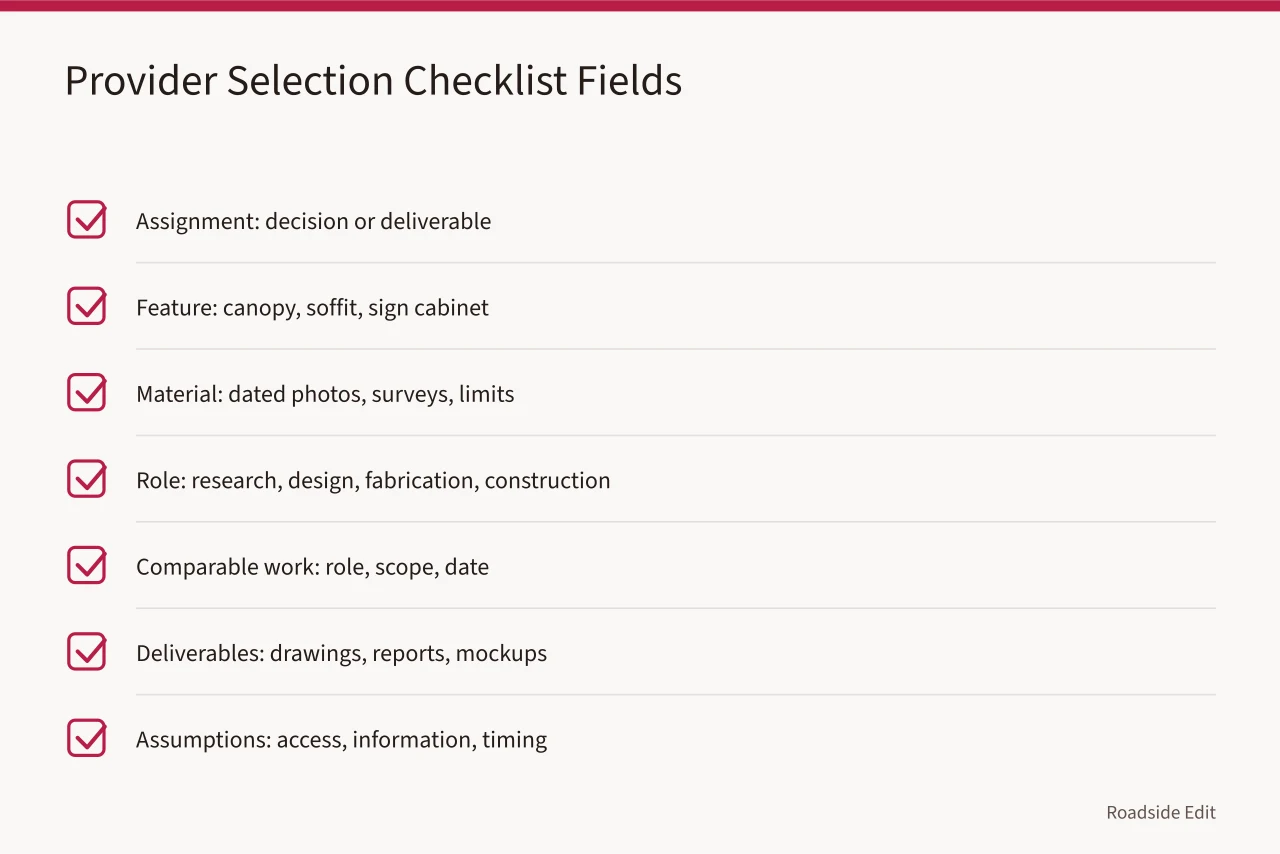
The checklist itself
| Item | What to record |
|---|---|
| Assignment | The decision or deliverable, stated in one sentence |
| Feature | Canopy, soffit, sign cabinet, tube run, booth, forecourt drain |
| Material | Dated photos, earlier surveys, known limits |
| Role | Research, design, specialty review, fabrication, construction |
| Comparable work | Role, scope, date, and what a third party can verify |
| Deliverables | Named drawings, reports, meetings, mockups |
| Assumptions | Access, existing information, timing, dependencies |
| Exclusions | Work clearly not included |
| Terms | Fee basis, revision process, proposal date |
| Status | Pending, selected, declined, revised |
Compare scope before price
The NPS Historic Property Project Documentation process links existing property information to later scope and design decisions. Review the NPS documentation overview. A hiring request sits earlier in that sequence. It can ask a provider to state a proposed role and deliverable. It cannot stand in for a property-specific decision.
Documentation standards call for reliable source material and stated limits that let another person verify the work. Read the NPS documentation standard. Hold proposals to the same bar: what material the response used, its date, the scope, the exclusions, and the point that would force a revised proposal.
An NPS overview of historic structure reports shows how research, investigation, observed conditions and a record of physical work combine in one planning document. Read the NPS historic-structure-report overview. A checklist does not require that document. It helps you tell a records request from a field investigation.
Two responses rarely match on the first pass. Reconcile these four lines before any number means anything.
| If responses differ on | Do this first |
|---|---|
| Work area | Ask each provider to name the boundary or feature covered |
| Deliverable | List the drawing, report, meeting or mockup offered |
| Assumptions | Record access, source material, timing, dependencies |
| Price basis | Identify allowance, fixed fee, hourly rate, or other stated term |
Keep evidence in its own column
A portfolio image shows context. It does not prove a role at your property. Ask for the source that ties the work to a date, a scope and a claimed role.
Where a response is thin, mark the field open and ask again. Do not fill the gap with a score.
Save the decision trail
Keep the request, each dated response, every clarification, the selection status and each scope revision. That file explains later why a response was not comparable, or why the selected role shifted. It also stops an old proposal from being read as a current commitment.
Review responses in one table
Put every response in the same columns. If one includes measured drawings and another offers a site visit, flag that difference. Never read the two prices as comparable.
Before you decide, confirm the final document states what will be delivered, what it rests on, and what it leaves out. Log the status. Keep the earlier version when scope changes.
Common questions
Should the checklist name a preferred firm?
No. The checklist exists to make a defined role comparable across bidders. A named favorite turns it into a scorecard, and a scorecard hides the gaps you built the list to find.
Can a photo prove a provider's past role?
No. A photo is context until a reliable project record ties it to a role, date and scope. Ask for that record before you count the work as comparable.
What if two proposals use different fee terms?
Copy the original wording first, then add neutral notes showing what needs clarification. Do not convert one basis into another yourself; ask the provider to restate it in their own terms.
Who confirms compliance requirements?
Your State Historic Preservation Office, local landmarks commission or permitting authority, under the adopted ordinance. Confirm with them before scope is fixed, not after.