Guides
Historic motel restoration options for 2027: how the four treatments compare
Historic motel restoration options compared for 2027 explain preservation, rehabilitation, restoration, and reconstruction without choosing a treatment.
Historic motel restoration options are often described as if they are interchangeable. They are not. Preservation, rehabilitation, restoration, and reconstruction are distinct frameworks with different relationships to existing material, later changes, a particular historic period, and a proposed use. An article can explain those distinctions without deciding what a named property should do.
This guide helps writers, owners, local researchers, and prospective partners compare the language used around treatment options. It does not assess physical condition, select a treatment, approve work, determine funding eligibility, or give technical advice for a particular motel.
What to take away
- An option label is not a project decision.
- The evidence, significance, condition, intended use, and applicable requirements shape a treatment discussion.
- A source about one motel feature does not establish a whole-property option.
- Preserve the difference between existing conditions, historical records, and proposed changes.
- Use a decision record to explain what the available information does and does not support.
Start with the framework, not the slogan
Words such as "restore" or "save" can make a project sound clear while hiding important choices. A sign, guest-room wing, office, parking court, or site feature may have a different record and a different question. Before comparing treatment terms, identify what part of the property the source actually covers.
| Weak description | Better comparison boundary |
|---|---|
| "The motel needs restoration." | "The article compares treatment terms but does not select one for this property." |
| "The original look should return." | "The file must identify the relevant period and the evidence for that appearance." |
| "The site can be reconstructed." | "The article does not establish whether a lost resource can be accurately documented." |
| "Rehabilitation is cheaper." | "The article does not compare costs without a common, documented scope." |
The National Park Service's treatment guidelines say that choosing a treatment requires careful consideration of historical significance, physical condition, proposed use, and regulatory requirements. Review the NPS treatment-selection guidance. That federal guidance is not a decision for a named motel. It provides a useful checklist of the information that a responsible comparison cannot skip.
Four treatment terms in plain language
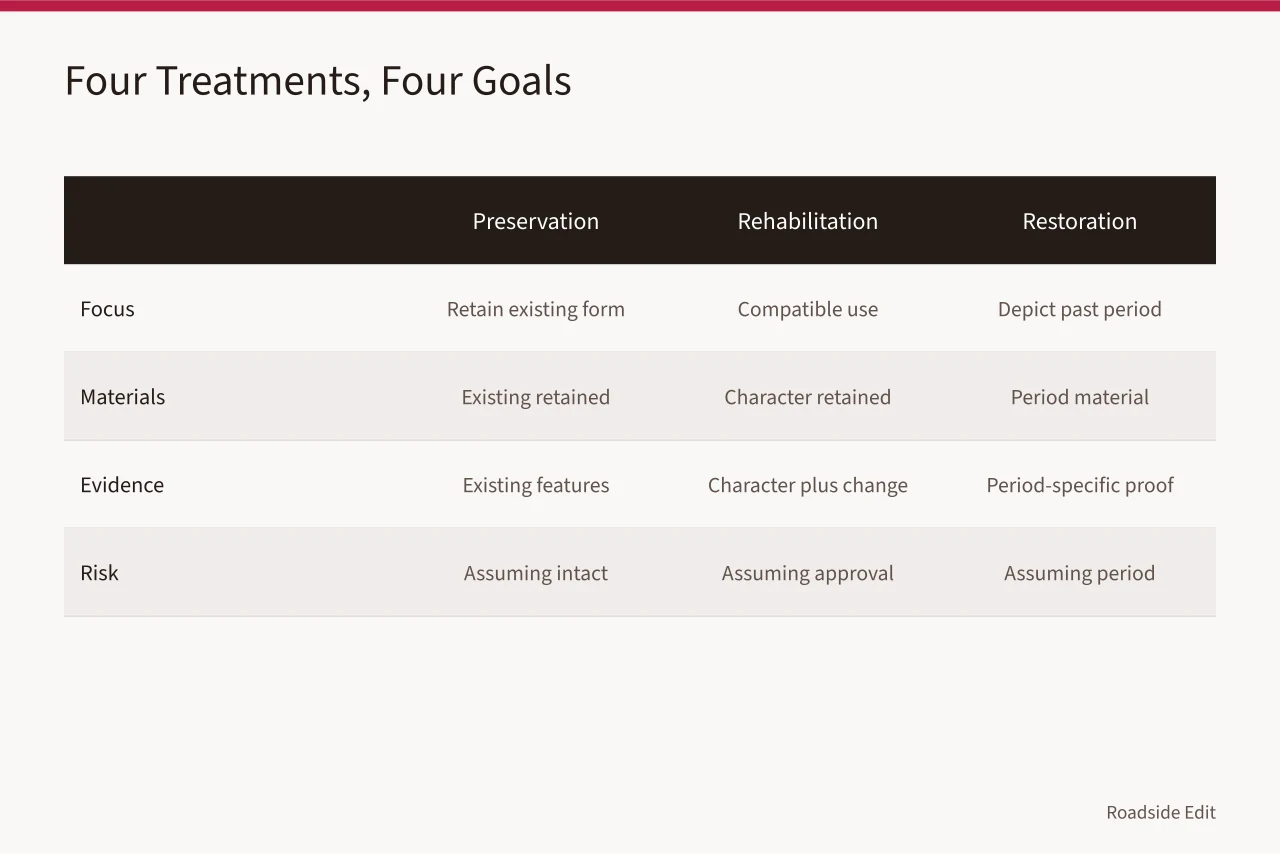
The terms below summarize the basic distinctions. They should be used with a source and a stated property boundary, not as marketing labels.
| Term | General focus | Article should not assume |
|---|---|---|
| Preservation | Retaining existing form, materials, features, and later changes where relevant | That every feature is intact or needs the same response |
| Rehabilitation | Supporting compatible use while retaining historic character | That an addition, alteration, or replacement is automatically appropriate |
| Restoration | Depicting a property at a particular past period using adequate evidence | That a preferred past appearance is sufficiently documented |
| Reconstruction | Re-creating a non-surviving resource for a defined purpose | That a missing resource can be recreated without conjecture |
The terms describe different goals. They are not rankings for every property. A useful comparison says which term a source uses, what it means in that source, and what additional information would be needed before applying it to a real decision.
Compare the evidence each option needs
Options should be compared by their evidence burden. An existing material, a dated photograph, a floor plan, a public record, an image caption, or an oral history can contribute different kinds of information. None should be extended beyond its source role.
| Question | Useful record | Limit to keep |
|---|---|---|
| What exists now? | Lawful dated observation or appropriate condition record | A photo may not show hidden systems or causes |
| What existed at a past period? | Dated historic photo, drawing, account, or inventory | One view may not document the whole site |
| What changed later? | Sequential records with dates | A later change may have significance of its own |
| What is proposed? | Specific public plan, application, or owner statement | A proposal is not completed work |
| What can be verified? | Source with clear authority and scope | An article is not an assessment |
The article should record the difference between "shown," "described," "proposed," and "unknown." These verbs are more useful than a broad claim that an option is correct.
Preservation as a comparison point
Preservation is commonly used to describe a focus on retaining existing form, integrity, and materials. It can include ongoing maintenance, repair, and stabilization. It does not mean that every decision is frozen or that a present image proves the condition of every feature.
When a source uses preservation language, ask:
- Which materials, features, or spaces does it identify?
- Does it say whether later changes are part of the record?
- Is the source describing a treatment concept, a project proposal, or completed work?
- What condition evidence is actually available?
An article can say that preservation is one framework under consideration. It should not say that a motel "will be preserved" unless a reliable record states that decision and its scope.
Rehabilitation and a compatible use
Rehabilitation is often the term that readers encounter in programs, proposals, and redevelopment discussions. It concerns retaining historic character while allowing alterations or additions for a compatible contemporary use. That does not make it a universal answer for every old building.
Separate these three claims:
| Claim type | Example |
|---|---|
| Historical description | "A source describes the motel's earlier use." |
| Current observation | "A dated image shows an exterior feature." |
| Proposed option | "A named source discusses a future use or alteration." |
Do not turn the first two claims into proof of the third. An article needs its own record for a proposed use, its limits, and any status it claims.
Restoration and a defined period
Restoration refers to a defined historic period, not simply making a property look old. It raises questions about the evidence for the selected time, materials from other periods, and the relationship between interpretation and historic fabric. A source that identifies an early year or an old image does not automatically establish an appropriate restoration period.
Use an evidence table:
| Record | Date | What it supports | What it does not settle |
|---|---|---|---|
| Historic photograph | Date stated by source | The visible view at that moment | Unseen rooms or present condition |
| Advertisement or postcard | Date stated by source | Language, imagery, or a business claim | Physical materials or operating history beyond its message |
| Plan or drawing | Document date | Layout shown in that record | Whether every element was built or remains |
| Current public record | Record date | Current status as stated | A treatment recommendation |
The table gives a writer a way to discuss restoration without inventing the missing evidence.
Reconstruction and the highest evidence burden
Reconstruction is the least appropriate term to use casually. It refers to creating a non-surviving resource. An article should not use it for ordinary repair, replacement of a component, or a new design that takes inspiration from a historic motel.
Before using the word, ask:
- What resource is said to be non-surviving?
- Which historical records describe its form, features, and setting?
- Is the source discussing a concept, an approved project, or completed work?
- What degree of uncertainty remains in the documentation?
If the file cannot answer these questions, the article can still describe the source material. It should not call the outcome reconstruction.
Create a neutral options comparison
A neutral comparison does not choose an option. It lays out the decision factors and the source limits. Use a matrix instead of an opinion paragraph.
| Factor | Preservation | Rehabilitation | Restoration | Reconstruction |
|---|---|---|---|---|
| Existing material | Retention is central | Retention remains important | Material from the selected period is central | New material depicts a lost resource |
| Use question | Existing or limited new use | Compatible continuing or new use | Interpretive purpose may matter | Interpretive purpose is central |
| Record need | Existing features and changes | Existing character plus proposed change | Strong period-specific evidence | Extensive documentation of the lost resource |
| Article limit | Do not infer condition | Do not infer project approval | Do not infer a chosen period | Do not infer accurate recreation |
This matrix is an editorial tool. It does not substitute for a property review, official requirement, or professional judgment.
Avoid false comparisons
The following patterns create misleading content:
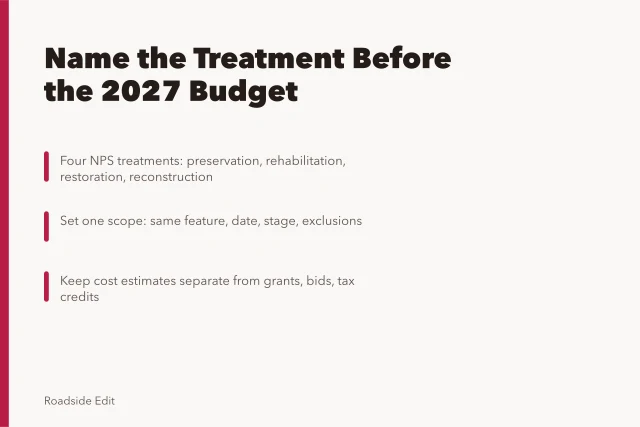
- Comparing cost without the same scope, date, and estimate stage.
- Treating an historic image as a current condition assessment.
- Using one source about a sign to decide the fate of a whole motel.
- Calling a public announcement proof of completed work.
- Treating a broad treatment term as a legal approval.
When the records do not support a comparison, say so directly. That is not a weak conclusion. It tells readers which question remains open.
The NPS treatment standards explain that preservation, rehabilitation, restoration, and reconstruction have different purposes and treatment considerations. Review the NPS treatment standards. A comparison article can explain these terms. It should not select one for a named motel unless a specific, reliable record documents the decision.
NPS documentation standards call for reliable source material and stated limitations that allow independent review. See the NPS documentation standard. State whether a record describes an existing feature, historic evidence, a proposed option, a decision, or completed work. This prevents a source about one stage from being read as proof of another.
The NPS Historic Property Project Documentation process connects existing property information with later scope and design decisions. Review the NPS documentation overview. The article's role is to make the evidence and options legible before that project-specific decision process.
A clean handoff for an options article
Before publication, save a short record with the property and feature named, the treatment terms discussed, the source for every substantive definition, the historical or current evidence available, the limits, and the event that would justify an update. This gives a later editor an explanation of why the article stayed neutral.
Common questions
Which historic motel treatment option is best?
This article does not choose one. A treatment discussion depends on the property, evidence, condition, intended use, and applicable requirements.
Does a historic photo justify restoration?
Not by itself. A photo can show a dated view, but it may not document the whole property, materials, later changes, or the evidence needed for a treatment decision.
Is rehabilitation the same as reconstruction?
No. Rehabilitation retains historic character while allowing compatible alterations or additions. Reconstruction concerns re-creating a non-surviving resource and has different evidence demands.
In this guide
- Historic motel restoration options checklist: what to record before 2027A field checklist for recording historic motel features, evidence dates, treatment terms, contractor bids and open decisions before any restoration option is named.
- Historic motel restoration questions to answer before 2027 decisionsHistoric motel restoration options questions for 2027 separate evidence, existing material, proposed use, and treatment language before conclusions are made.
- Historic motel restoration options: set one scope before you compare 2027 budgetsHistoric motel restoration options and 2027 budget steps: name preservation, rehabilitation, restoration, reconstruction, tax credits, grants, and one shared scope.
- Historic motel restoration options: warning signs your 2027 claim went too farHistoric motel restoration options warning signs for 2027 identify claims that confuse repair, replacement, treatment language, or a final decision.
- How to keep historic motel restoration options records straight through 2027Correction trails, conflicting records and rejected alternatives keep a historic motel restoration options file honest and audit ready through 2027.