Guides
Part of Historic motel restoration options for 2027: how the four treatments compare
Historic motel restoration questions to answer before 2027 decisions
Historic motel restoration options questions for 2027 separate evidence, existing material, proposed use, and treatment language before conclusions are made.
Options questions help a writer compare preservation language without turning an incomplete record into a treatment recommendation. They are prompts for research and editorial review, not conclusions about a specific motel.
What to take away
- Ask which record supports a treatment term.
- Separate present features from a desired historic appearance.
- Identify the proposed use only when a source states one.
- Treat unresolved questions as valid results.
Ask evidence-first questions
NPS training material distinguishes preservation, rehabilitation, restoration, and reconstruction by their relationship to existing material, additions, particular historic periods, and lost resources. Review the NPS treatment-options lesson. The material does not decide which option a motel needs. It supports asking what evidence exists before an article compares the terms.
| Question | Why it matters |
|---|
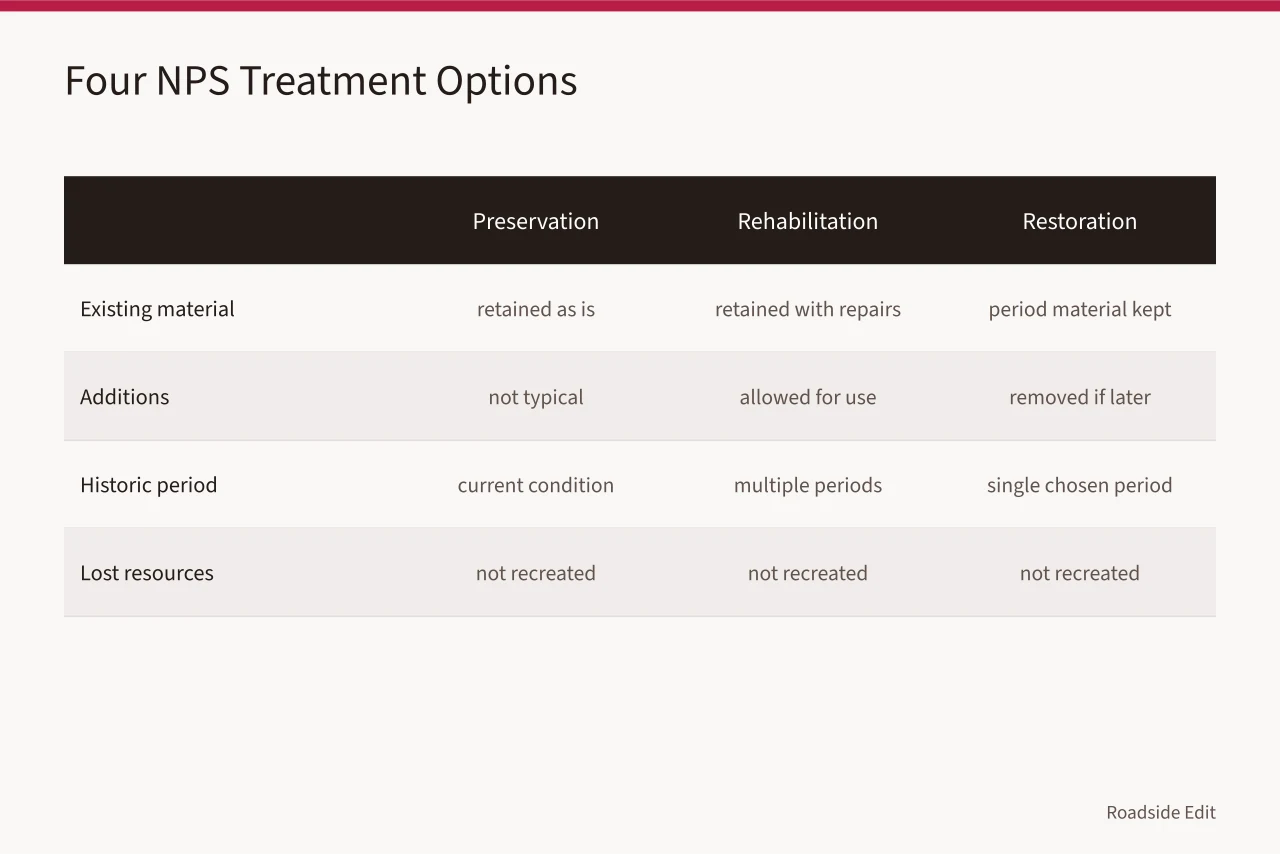
Keep a question log
Use a simple entry: question, source checked, date checked, answer, and limitation. Write "not established in reviewed material" when that is the answer. Do not change the question merely to make an article feel finished.
Keep comparison questions separate from approval questions. A writer can ask how two framework terms differ without implying that an owner, agency, or review body has selected one. If the question concerns permission, code, condition, or a specific scope of work, direct it to the appropriate documented source instead of answering it from a general treatment page.
Add the response date beside every answer and retain the specific source link for later editorial review.
Ask what the material can establish
The NPS treatment standards define the four treatment approaches and explain their distinct purposes. Review the NPS treatment standards. Use a source-backed term as a research question, not as a conclusion about this motel. A reader should be able to tell whether the article is explaining a framework or reporting a property decision.
The Library of Congress primary-source process starts with observation before reflection and questions. Use the Library of Congress analysis guide. Start with visible text, date clues, feature boundaries, and the source's own wording. Then write the question the item raises. This order keeps a postcard or image from doing work it cannot support.
Sort questions by their next record
| Question type | Next useful record | Do not treat as proof |
|---|---|---|
| Period question | Dated photo, drawing, or inventory | A preferred visual style |
| Feature question | Source that identifies the feature | An unseen interior or system |
| Proposal question | Dated plan or public decision record | A general treatment page |
| Status question | Current, attributable record | An undated marketing statement |
NPS documentation standards require reliable source material and clear limits that allow checking. See the NPS documentation standard. The answer "not established" should remain in the question log when the evidence is incomplete. It is better than a tidy conclusion that cannot be traced.
Keep a neutral answer
State what the available record supports. Then state what it does not establish. If the question reaches a site-specific condition, approval, code, or project scope, do not answer it from a general source. Point the editorial file toward the kind of record needed instead.
Before publishing an answer, add a final review line identifying the question, source title, source date, and property feature. Then name the answer and limitation. If any field is missing, revise the answer to the smaller claim the source can support.
A question log preserves uncertainty in a form another editor can understand and gives a future writer a list of records worth finding, not an invitation to repeat an unsupported statement.
Keep that review line with the published draft record.
Common questions
Can an historic image answer a treatment question?
It can show a dated view. It may not document condition, unseen features, later changes, or a treatment choice.
What is the best first question?
Ask what property and feature the cited record actually identifies. That boundary controls every later comparison.
Should a question list include technical issues?
It can record them, but an article should not answer property-specific engineering, code, or condition questions without appropriate support.