Guides
Part of Historic motel restoration options for 2027: how the four treatments compare
Historic motel restoration options: warning signs your 2027 claim went too far
Historic motel restoration options warning signs for 2027 identify claims that confuse repair, replacement, treatment language, or a final decision.
Options content becomes misleading when an article turns a broad treatment term into a property finding. The warning signs below help writers separate a visible feature, a source-backed treatment concept, and a decision that has not been documented.
They also flag the four historic motel restoration options when a sentence names one without saying who chose it. A 2027 claim that picks an option needs the record behind the pick.
What to take away
- Do not call a repair or replacement choice a whole-property treatment.
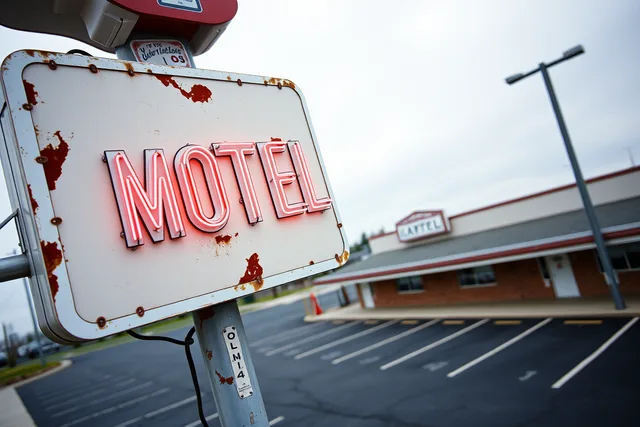
- Do not diagnose condition from a public image.
- Use the wording a reliable source actually supports.
- Keep proposal, approval, and completed work in separate categories.
- Name the option in play: preservation, rehabilitation, restoration, or reconstruction.
- Match the option to the records you hold, not to the look you want.
The four treatment options, by name
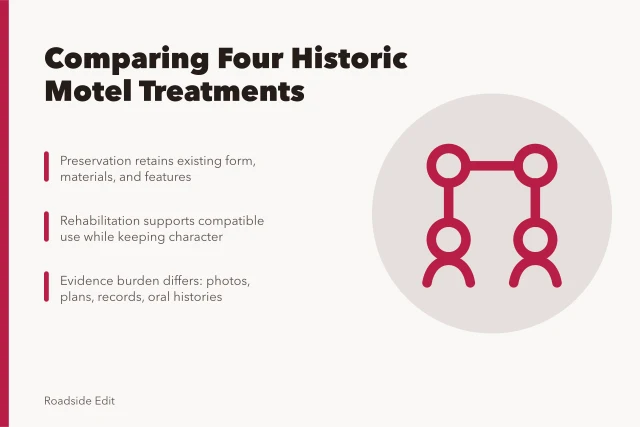
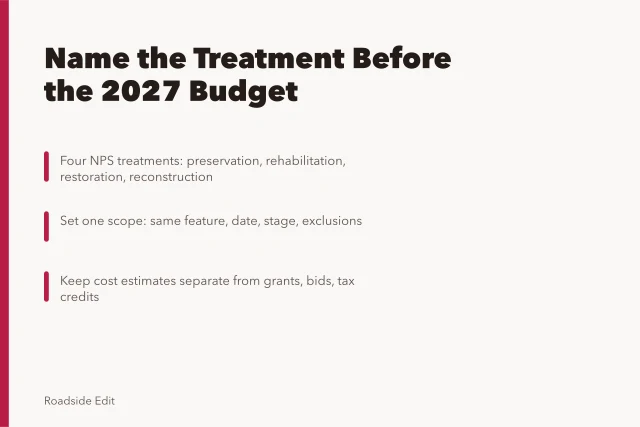
NPS Technical Preservation Services defines four treatment approaches for historic buildings. Each answers a different question about a motel, and each needs a different record before a writer can name it.
Preservation sustains a property in its existing form, materials, and integrity. It suits a motel that still rents rooms, with its office, siding, and sign largely intact. The work is maintenance and repair, and the record needed is a condition survey of existing material.
Rehabilitation allows a compatible use while keeping the features that carry the property's significance. It fits a motel converted to apartments, offices, or a hostel, and it is the option tied to federal tax credits.
A certified rehabilitation of an income-producing historic structure can earn a 20% federal income tax credit on qualified rehabilitation expenditures. Those expenditures must exceed the greater of $5,000 or the building's adjusted basis. Non-historic buildings placed in service before 1936 can qualify for a 10% credit instead.
Owners who sell within five years face partial recapture of the credit.
Restoration returns a property to one chosen period by removing later layers and rebuilding missing features. It suits a motel run as a museum or an interpretive site, where visitors come for a single date. It demands documentary evidence of that period, and one old photograph cannot fix the date.
Reconstruction rebuilds a property that no longer exists with new construction. It applies to a motel whose office or neon sign burned or was demolished. NPS notes it is used least often and requires the most documentary evidence: drawings, photographs, and physical remains.
| Option | What it does | Fits | Record needed | Public fact |
|---|---|---|---|---|
| Preservation | Sustains existing form, materials, and integrity | A motel still renting rooms with intact fabric | Condition survey of existing material | Repair is the first option NPS lists for historic windows |
| Rehabilitation | Keeps significant features, allows a compatible use | A motel converted to apartments or offices | Significance evaluation and scope of work | 20% federal credit; threshold is $5,000 or adjusted basis |
| Restoration | Depicts one chosen period and removes later work | A motel run as a museum | Documentary evidence of the chosen period | Removal of later features is part of the treatment |
| Reconstruction | Rebuilds a property that is gone | A motel whose office or sign was lost | Drawings, photographs, physical remains | Used least often, with the heaviest documentation burden |
A property must be listed in the National Register of Historic Places, or certified as contributing to a registered district, before the 20% credit applies. A writer who calls a motel historic should point to that listing or certification, not to a photograph.
Watch the repair-and-replacement leap
NPS guidance on historic windows says repair should be the first option considered and describes conditions in which replacement may be appropriate. Read the NPS window-treatment guidance. That guidance concerns historic windows, not every motel feature, and it shows why a source about one component should not decide an entire property.
Preservation Brief 9, The Repair of Historic Wooden Windows, covers the same ground in more detail and is free to download from nps.gov.
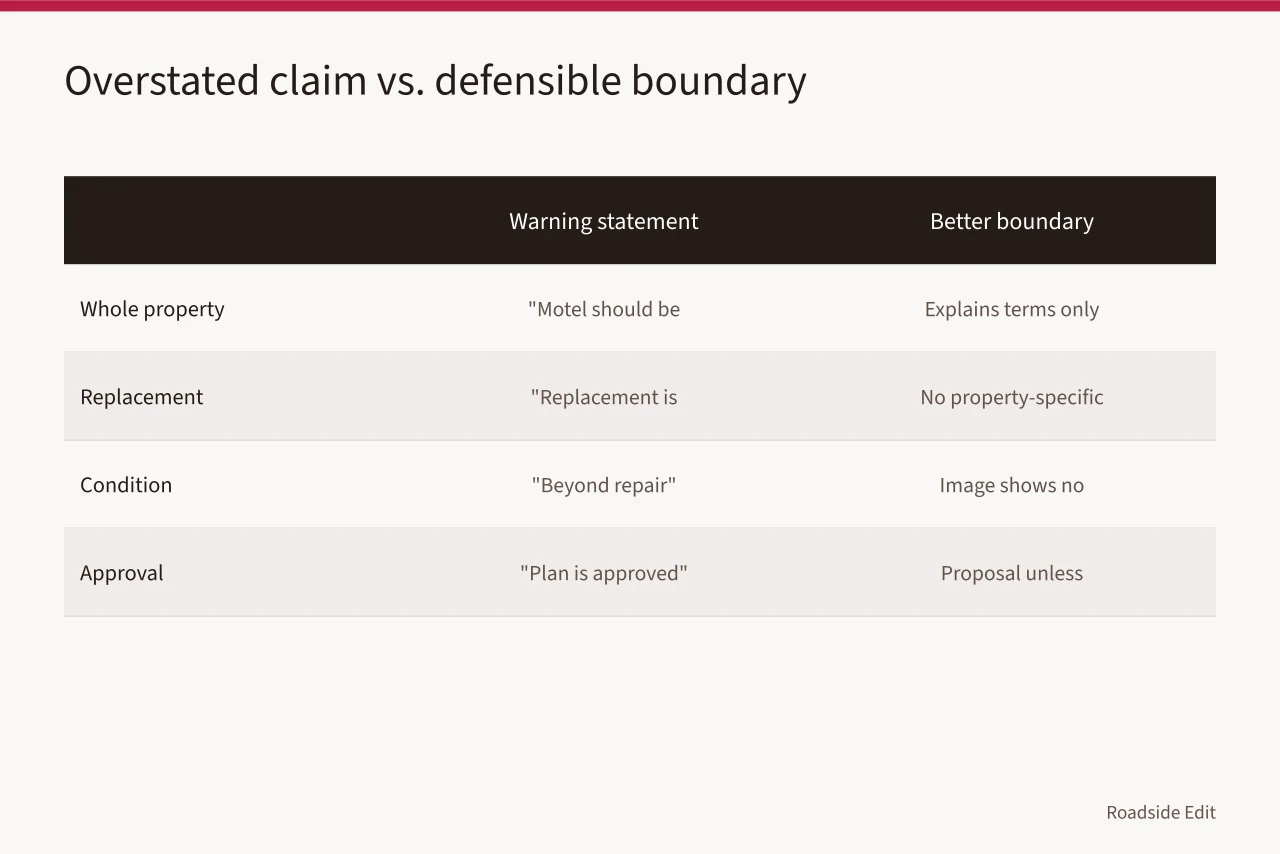
| Warning statement | Better boundary |
|---|---|
| "The motel should be restored." | "The article explains treatment terms and does not choose one." |
| "Replacement is required." | "The cited material does not establish a property-specific requirement." |
| "The feature is beyond repair." | "The image does not assess cause, extent, or repair feasibility." |
| "The plan is approved." | "The source describes a proposal unless it records an approval." |
Watch for period drift. A writer may use a single old image to claim that every later material should be removed, even when no source establishes a selected period, a full property history, or a treatment decision. Use the image for the view and date it actually documents. Do not make it a substitute for an options analysis.
The same limit applies to nostalgic descriptions, public comments, and sales language. They may be worth recording as context, but they do not authorize treatment or establish a technical conclusion.
Identify the claim that went too far
The NPS treatment standards define four different preservation approaches. Review the NPS treatment standards. A general definition is useful for explaining language. It cannot select an approach for a particular motel without records that address the property, feature, condition, use, and decision process.
NPS documentation standards call for reliable source material and stated limits that allow another person to verify a claim. Read the NPS documentation standard. A public photo can support a description of its visible view. It does not support a diagnosis, a repair method, or a whole-property conclusion.
| Warning in the draft | Editorial action |
|---|---|
| A source names one component | Limit the sentence to that component |
| An image suggests a condition | Describe only what is visible and dated |
| A plan describes future work | Label it as a proposal unless completion is documented |
| A treatment term appears without a source | Explain the term or remove the claim |
| An option is defined but not chosen | Name the option and keep the choice open |
Keep proposals separate from decisions
The NPS Historic Property Project Documentation process links existing property information to later scope and design decisions. A treatment article should show the same sequence (See the NPS documentation overview).
For the 20% credit, a state historic preservation office reviews the application in three parts: evaluation of significance, description of the rehabilitation, and certification of completed work. A part 2 filing is a proposal. Only a part 3 approval records that the work was done as described.
Evidence can explain an option, and a proposal can describe a possible action. A decision requires a record identifying the property and scope; completed work requires a record that says it occurred.
Correct the sentence, not just the citation
When an article goes beyond the source, change the wording. Do not leave a strong claim in place with a link that does not prove it. The repair is simple: name the evidence, state the limit, and remove the unsupported recommendation.
Keep a brief editorial note with each correction. Name the original sentence, source checked, property feature, and reason the wording changed. That record keeps the same overstatement from returning in a later rewrite, and it separates a treatment definition from a claim that someone chose that treatment for a motel.
Read the revised sentence aloud against the source. If the scope, date, or decision status is missing, shorten the claim again. Save that review result with the article file.
Common questions
Which treatment option fits a motel that still rents rooms?
Rehabilitation, in most cases. It keeps the features that carry significance and lets the property keep earning income, which is what the 20% credit requires. Check the significance evaluation before naming it.
Does a source about windows decide what to do with a motel sign?
No. It can explain a repair-or-replacement principle for the component it discusses. A sign needs its own records and scope.
Can an article call a proposed option final?
Only when a reliable source records a final decision and identifies its scope. A plan, statement, or concept is not enough.
What if the motel building is already gone?
Reconstruction is the only option left, and it needs drawings, photographs, or physical remains of the missing structure. Without that evidence, a page can describe the loss but cannot call the result a reconstruction.
What is the safest description of an unknown condition?
Describe only what is visible in the dated record and state that it does not establish cause, severity, or a work recommendation.