Guides
Part of Historic motel restoration options for 2027: how the four treatments compare
Historic motel restoration options checklist: what to record before 2027
A field checklist for recording historic motel features, evidence dates, treatment terms, contractor bids and open decisions before any restoration option is named.
A motel file usually starts with a photograph and a guess. The guess is the problem. Before anyone writes "restoration" next to a 1958 motel court, the record has to say which feature is being discussed, who said so, and when.
What to take away
- Name the feature before the treatment: a pole sign, a canopy soffit, a room wing, and a parking court carry different records and different terms.
- The National Park Service treats preservation, rehabilitation, restoration, and reconstruction as four separate approaches, not four intensities of one idea.
- Every entry needs a source date and a stated limit. A 1962 postcard shows a sign face; it does not show today's condition.
- A blank field is a finding. Mark it "not established" and name the record that would close it.
- Keep earlier entries when a later source disagrees. A dated correction is stronger than a silent overwrite.
Build the feature record
One row per feature, not one row per property. A motel is a collection of dated assemblies: brick veneer on the room wing, curtain-wall glazing at the office, a butterfly roof over the canopy, porcelain enamel on the sign cabinet, laminate and chrome-edge trim in the booths.
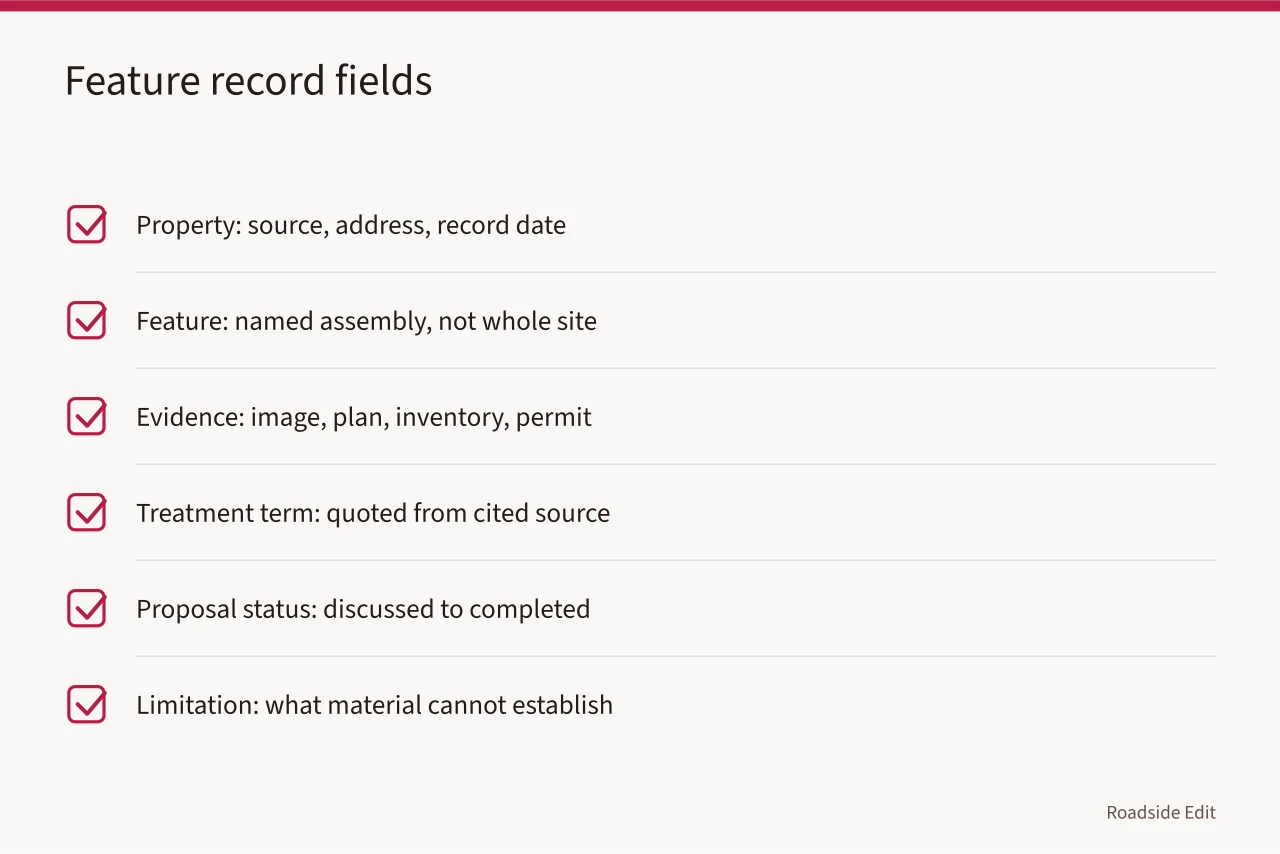
Each was installed in a different year by a different trade, and each survives or fails on its own.
| Field | What to record | Worked entry |
|---|---|---|
| Property | Source name, street address, record date | "Sunset Court, Route 66 corridor, surveyed 2026-04-11" |
| Feature | Named assembly, not the whole site | "Canopy soffit, east bay" |
| Evidence | Image, plan, inventory, permit, or field observation | "1961 chamber of commerce photo, north elevation" |
| Treatment term | The term the cited source used, quoted | "Rehabilitation (NPS guidance, 1992)" |
| Proposal status | Discussed, proposed, approved, completed, unknown | "Discussed only" |
| Limitation | What the material cannot establish | "Does not show soffit material or condition" |
The treatment term column is where most drafts go wrong. The Park Service describes preservation as appropriate where distinctive materials, features, and spaces are essentially intact, and it asks for a documentation plan before that work begins. Read the NPS preservation-treatment guidance.
That is a condition statement, not a verdict on your motel. Only a survey with dates can say whether the conditions hold.
Keep the four terms apart
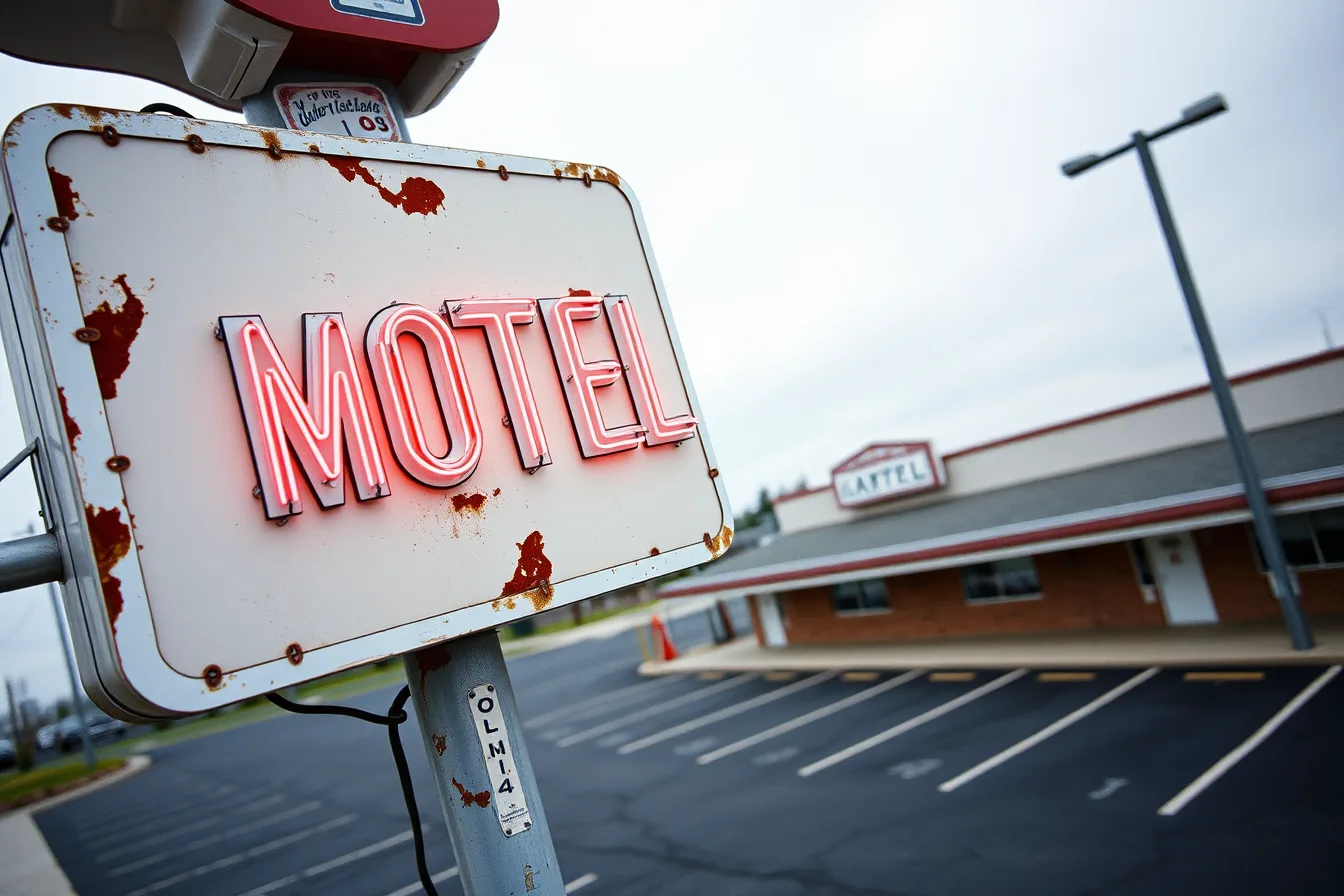
Preservation, rehabilitation, restoration, and reconstruction describe different relationships between old fabric and new work. Review the NPS treatment standards. A neon tube replaced with an LED array is not restoration of the sign, whatever the sign looks like at dusk. A rebuilt pump island is not preservation of the island.
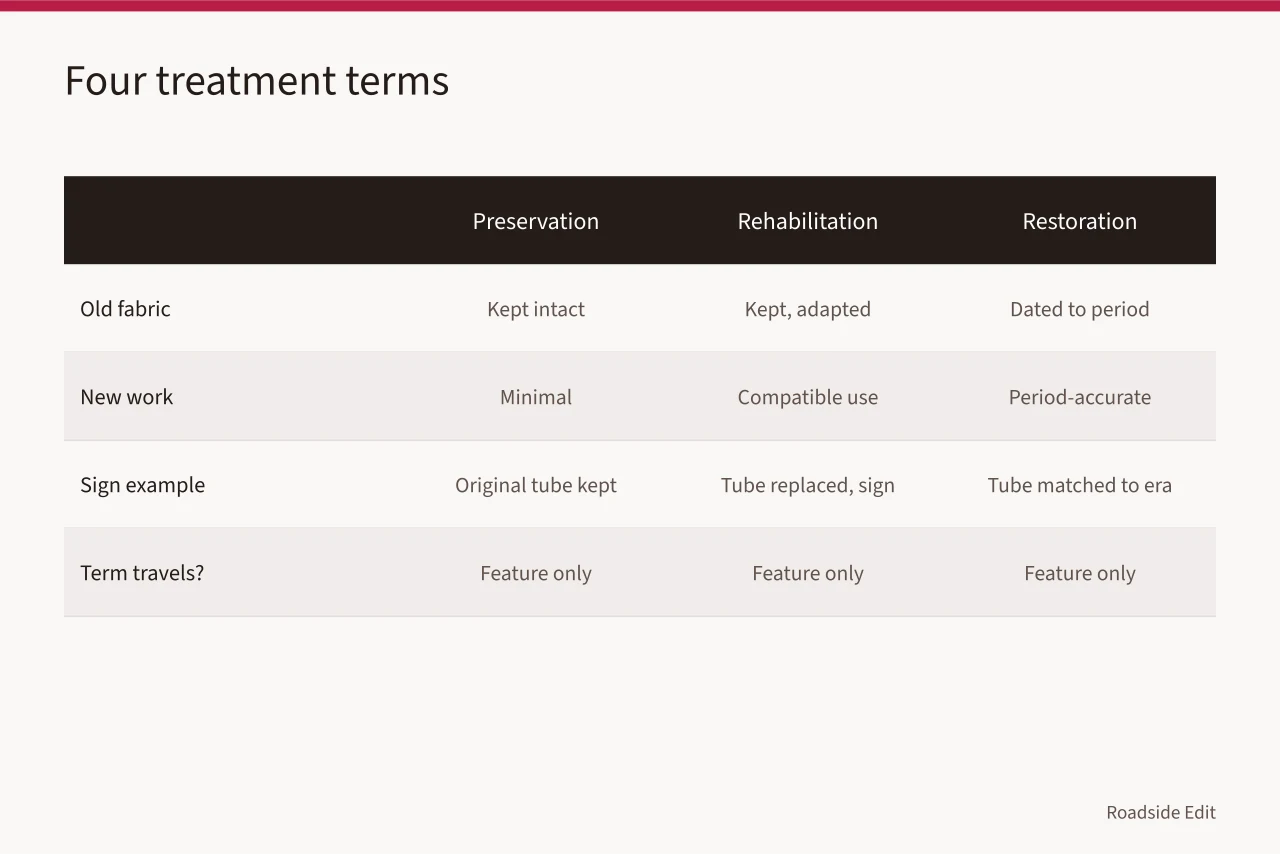
Write the term the source used and the feature it covers. If a state historic preservation office inventory says "restoration" about a lobby, that word does not travel to the room wing.
Set the evidence boundary
Each record type proves a different thing. Keep them on separate lines and state the limit in the same row, not in a closing disclaimer.
| Record type | What it can support | Where it stops |
|---|---|---|
| Historic image | A visible feature and its date | Current condition, hidden fabric, material composition |
| Field observation | Present appearance from a lawful viewpoint | Original date, prior alterations, interior fabric |
| Public document | Issuer, date, and stated project scope | Whether the work was carried out |
| Oral or published account | Period wording and local usage | Scope, approval, and completion |
The NPS heritage documentation standards ask for reliable sources and stated limits so a reviewer can check the work independently. Read the NPS documentation standard. A limit attached to its own row travels with the claim. A limit in a footnote gets separated from it.
Write the handoff note
Close the file with five lines: property, feature, working question, source list, open decision. Then say what record would change the answer. A dated elevation drawing could settle a canopy's construction date. A building permit could settle whether a proposal became work.
Use status labels that cannot be misread. "Framework" means the article explains a term. "Proposal" means a source describes a possible action. "Decision" needs a record naming who decided and what it covers. "Completed" needs a source saying the work happened.
The Park Service's Historic Property Project Documentation process links existing property information to later scope and design decisions. See the NPS documentation overview. A planning checklist sits before that stage and identifies what is missing without calling anything selected.
Two more habits keep the file usable. Date every version, and keep the superseded entry visible with a correction note. When a later survey renames a feature or moves a period, the earlier reading stays in the record with its own date.
For the option-by-option side of the same motel, where the four terms are compared against each other, use the restoration options comparison.
Common questions
Does the checklist pick a treatment?
No. It records what is known about each feature so a treatment conversation starts from evidence. The choice belongs to the property owner and the reviewing authority, not to the file.
What goes in the limitation field?
State what the source cannot prove. A 1962 postcard cannot show current condition, a whole-site scope, or whether a proposal was ever built.
Can a short article use this?
Yes. A property name, a feature boundary, a source date, and one honest limit improve a 200-word piece as much as a long one.
Who confirms what the rules require?
Your state historic preservation office or local landmarks commission, under the ordinance it administers. Requirements vary by state and municipality, so confirm with them before treating any term as settled.