Guides
Part of Historic motel restoration options for 2027: how the four treatments compare
How to keep historic motel restoration options records straight through 2027
Correction trails, conflicting records and rejected alternatives keep a historic motel restoration options file honest and audit ready through 2027.
An options record earns its keep the day a second source contradicts the first. What matters then is whether the file shows the contradiction or hides it.
What to take away
- Write the source's own treatment term, then a plain note of what it means for this motel.
- Label every entry framework, alternative, proposal, decision, completed work, or unknown.
- Keep rejected alternatives in the file with the reason they were set aside.
- Never overwrite a claim. Add a dated correction above it and leave the old wording visible.
- Log what each source cannot establish, not only what it says.
The status label is the whole record
Most options files fail at one field. A treatment definition gets filed beside an approved scope, and a year later nobody can tell which was which.
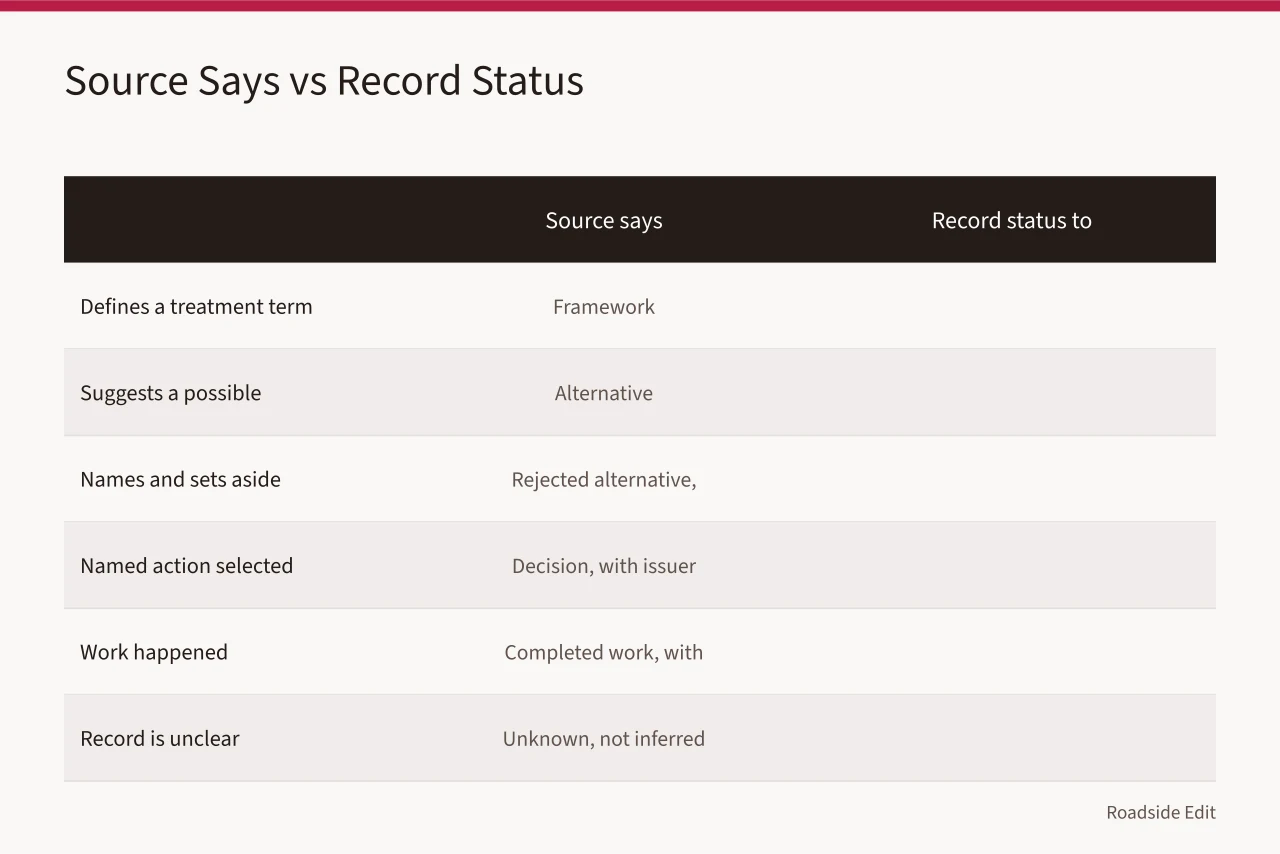
The mapping below is the working core of the file. Read the left column as what a document actually does, and the right column as the only label you may attach.
| Source says | Record status to use |
|---|---|
| Defines a treatment term | Framework |
| Suggests a possible approach | Alternative |
| Names an approach and sets it aside | Rejected alternative, with reason |
| A named action was selected | Decision, with issuer and scope |
| Work happened | Completed work, with date and source |
| The record is unclear | Unknown, not inferred |
The National Park Service treats preservation, rehabilitation, restoration and reconstruction as four separate approaches, so the term a source uses is not interchangeable with the others. Review the NPS treatment standards. Keep the source's word and add your own gloss beside it.
NPS also defines ultimate treatment and use as a narrative that analyzes a structure's treatment and use, and allows an alternative to be presented where a planned treatment would adversely affect it. Review the NPS ultimate-treatment definition.
That is a planning term from a federal framework. It is not a decision about a privately owned motel, and filing it as one is the commonest error in these files.
Rejected alternatives are the part worth keeping
A file that holds only the chosen treatment tells a reader nothing about why the others lost. Keep the runner-up proposals, the date each was set aside, and the constraint that killed it.
On a Route 66 motor court the usual casualties are a replaced neon fascia, a rebuilt canopy soffit, and a repainted porcelain-enamel sign face. Each was once a live proposal. Each has a reason it was dropped, and that reason is often the only surviving evidence of a condition survey nobody filed.
A rejected alternative is not a failure of the file. It is the record that a choice was made rather than assumed.
Corrections go on top, never underneath
When a later document changes a date, a feature, a term or a status, write a dated correction entry before you touch the sentence it corrects. State the old claim, the new source, and what changed.
Do not replace a proposal with wording that reads as though the work happened. Do not delete a superseded date. An import or a careless edit will flatten the difference, and the flattened version is the one that gets cited.
Where two records still disagree, leave both standing until a reliable source settles it. The NPS Historic Property Project Documentation process ties existing property information to scope and design decisions. See the NPS documentation overview. Those decision records stay separate from the source material that explains a general treatment framework.
One row, one claim, one limitation
Give every row its own source title, URL, source date, property feature and stated limit. NPS documentation standards ask for source material a second person can verify and for limits stated openly. Read the NPS documentation standard.
The limitation field does the quiet work. A 1962 postcard establishes that a neon fascia existed and how it was shaped. It does not establish tube diameter, transformer load, or whether the sign was ever rewired. Write that down, because the next reader will otherwise assume the postcard settled it.
A media credit is its own row. It proves where the image came from, never what a treatment should be.
Common questions
What is the difference between a framework and a decision?
A framework explains how a term is used, as the NPS treatment standards do. A decision is a documented determination for one named property and one stated scope, with an issuer and a date.
Should an options record include rejected alternatives?
Yes, whenever a source documents them. Label each as an alternative or a rejected alternative with the reason it was set aside, never as approved or completed work.
Can a photo credit support an options claim?
No. A credit identifies the image source. A treatment claim needs the document that describes that framework or decision, with its own date and limitation.
What if the source never states a status?
Enter unknown and drop the stronger claim from the article. A framework presented as a property outcome is the error the status field exists to catch.