Guides
Part of Modern roadside design fundamentals: a 2027 guide to arrival, identity and lighting
Budget notes and methods for keeping 2027 roadside lighting costs honest
Roadside lighting budgets for 2027 need dated placeholders, named fixture schedules, and separate lines for equipment, controls, and maintenance.
What to take away
- A luminaire price is not a project cost. Access, power, permits and design sit on their own lines.
- Escalate 2025 public bid tabs with a published city cost index instead of a remembered percentage.
- Check every fixture against the DesignLights Consortium list before the schedule is locked, because rebate eligibility follows that list.
- Label each figure as allowance, estimate, approval, invoice or reported record, and keep the label attached when the scope changes.
- Keep the old row when a revision lands. A replaced entry with a date is the only audit trail a later reviewer can check.
Set 2027 dollar placeholders
No public source publishes one 2027 roadside lighting price. Build dated placeholders, then replace them with bids.
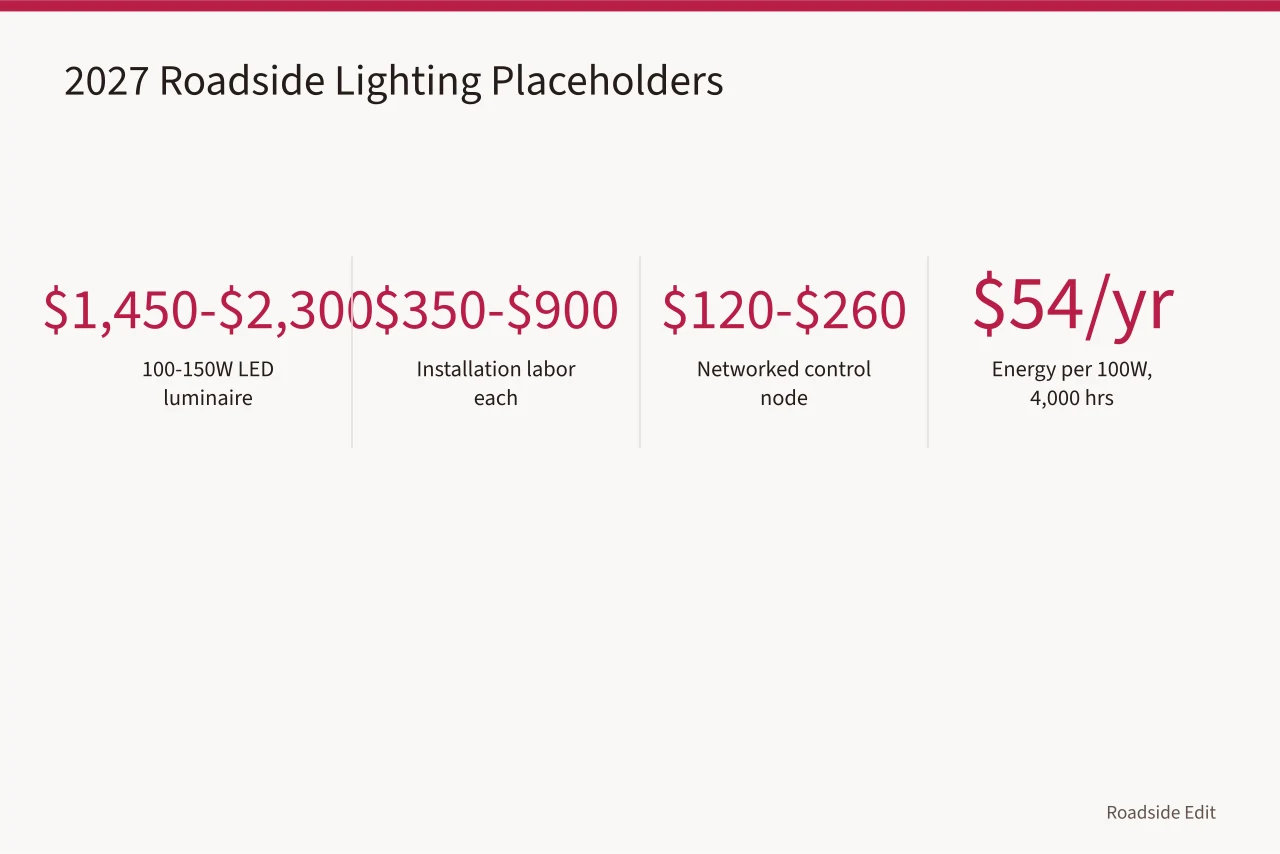
The ranges below are planning numbers, not quotes. They assume about 4% yearly escalation from 2025 public bid data. Substitute your own index and rate.
| 2027 line | Planning range | Method or public fact |
|---|---|---|
| 100 W to 150 W LED roadway luminaire | $1,450 to $2,300 each | 2025 bid tabs escalated at 4% per year |
| Installation labor per luminaire | $350 to $900 each | Gordian RSMeans Data city cost index |
| Networked control node | $120 to $260 each | DLC listed controls, quote-based |
| Energy per 100 W luminaire, 4,000 hours | $54 per year | EIA 2027 commercial price near 13.5 cents per kWh |
| Maintenance per luminaire | $45 to $110 per year | Inspection and spot replacement allowance |
At 15 cents per kWh the same 100 W luminaire runs about $60 a year. Write the rate and the hours assumption next to the energy line, not in a footnote.
Name the tools and providers
| Tool or provider | Concrete fact | Action |
|---|---|---|
| Gordian RSMeans Data | Subscription construction cost database with city cost indexes. | Escalate 2025 labor and equipment lines to 2027. |
| EIA Short-Term Energy Outlook | Free federal forecast for U.S. commercial electricity prices. | Set the energy line at cents per kWh. |
| DesignLights Consortium Qualified Products List | Free database of LED fixtures that meet efficiency and quality thresholds. | Check rebate eligibility before locking a fixture schedule. |
| Acuity Brands | Sells roadway luminaires through local reps, not public list prices. | Request written budgets by model and control option. |
| Signify | Philips RoadFocus and LumiStreet lines are DLC listed. | Ask for fixture, driver, and warranty line items. |
| Leotek | GC2 and GreenCobra fixtures appear in municipal bids. | Use public bid tabs to test your per-fixture placeholder. |
| Dialight | StreetSense and Vigilant lines target roadway and high-mast work. | Separate high-mast access costs from fixture cost. |
Record exterior-lighting scope
DOE's Federal Energy Management Program publishes acquisition guidance for several exterior-lighting categories and notes that controls affect energy use. Review DOE exterior-lighting purchase guidance.
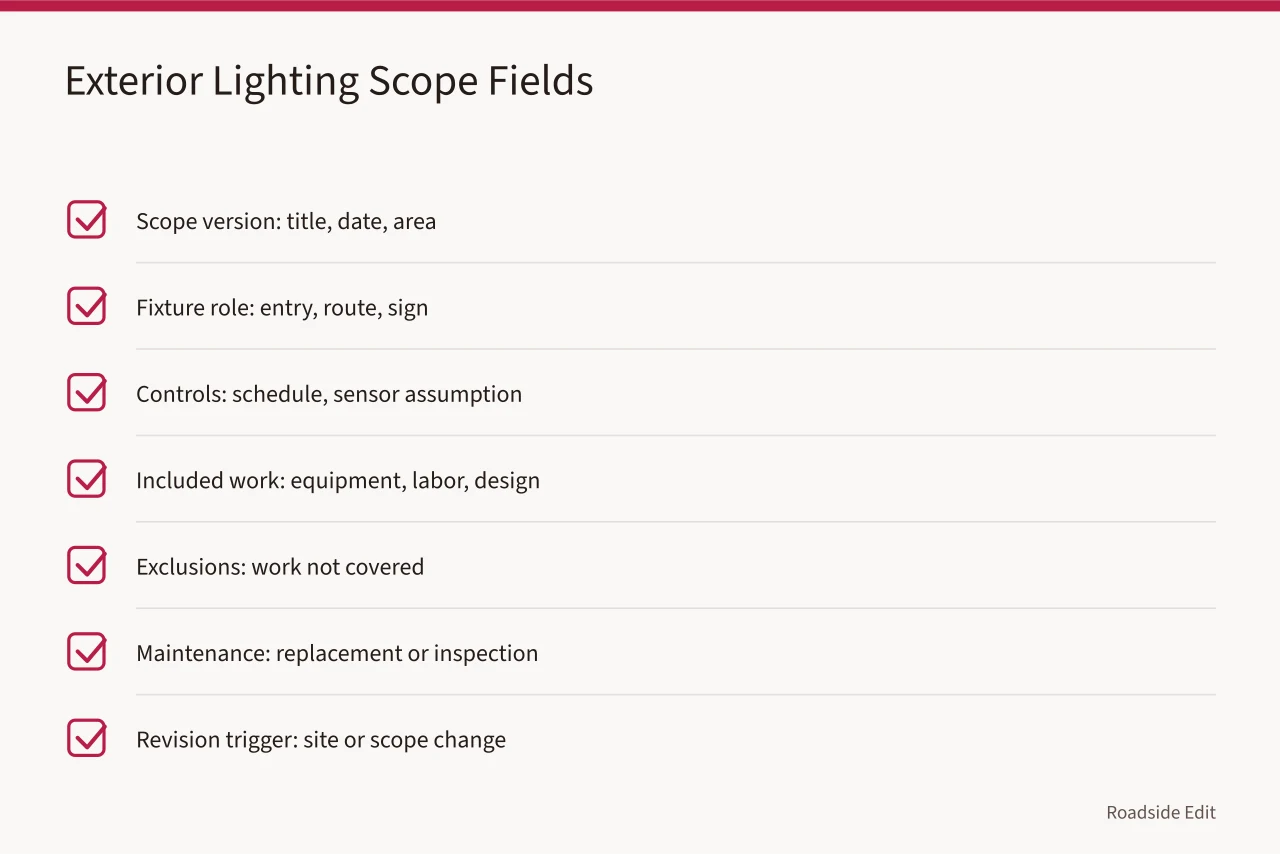
Federal acquisition guidance does not set a private project's cost and does not prove performance at your site. It is a reminder to document fixture category, control assumptions and stated scope on separate lines.
| Budget field | What to note |
|---|---|
| Scope version | Proposal title, date, and service area |
| Fixture role | Entry, route, parking, sign, or service task |
| Controls | Stated schedule, sensor, or control assumption |
| Included work | Equipment, labor, design, or other named items |
| Exclusions | Work not covered by the cited amount |
| Maintenance | Replacement, inspection, or control responsibility |
| Revision trigger | Site condition, access, approval, or scope change |
Keep an honest cost boundary
A fixture price or a funding reference is not a total project cost. A complete project may carry access, power, permits, and design. It may also carry removal, surface work, and site conditions.
If a number is unknown or private, say so. A precise gap beats a confident invented total.
Give a provisional allowance its own line. Name the condition that triggers it and the decision needed before it joins the scope. That keeps a planning placeholder from being read later as a reported expense.
On phased work, assign each line to a phase. Decision-makers get a readable first-cost view and a separate record of what the next phase could require.
Keep figures inside their stated scope
The GSA guidance on developing and managing project costs explains that cost work develops as scope becomes clearer. Keep the version date, included work, exclusions and status beside every figure.
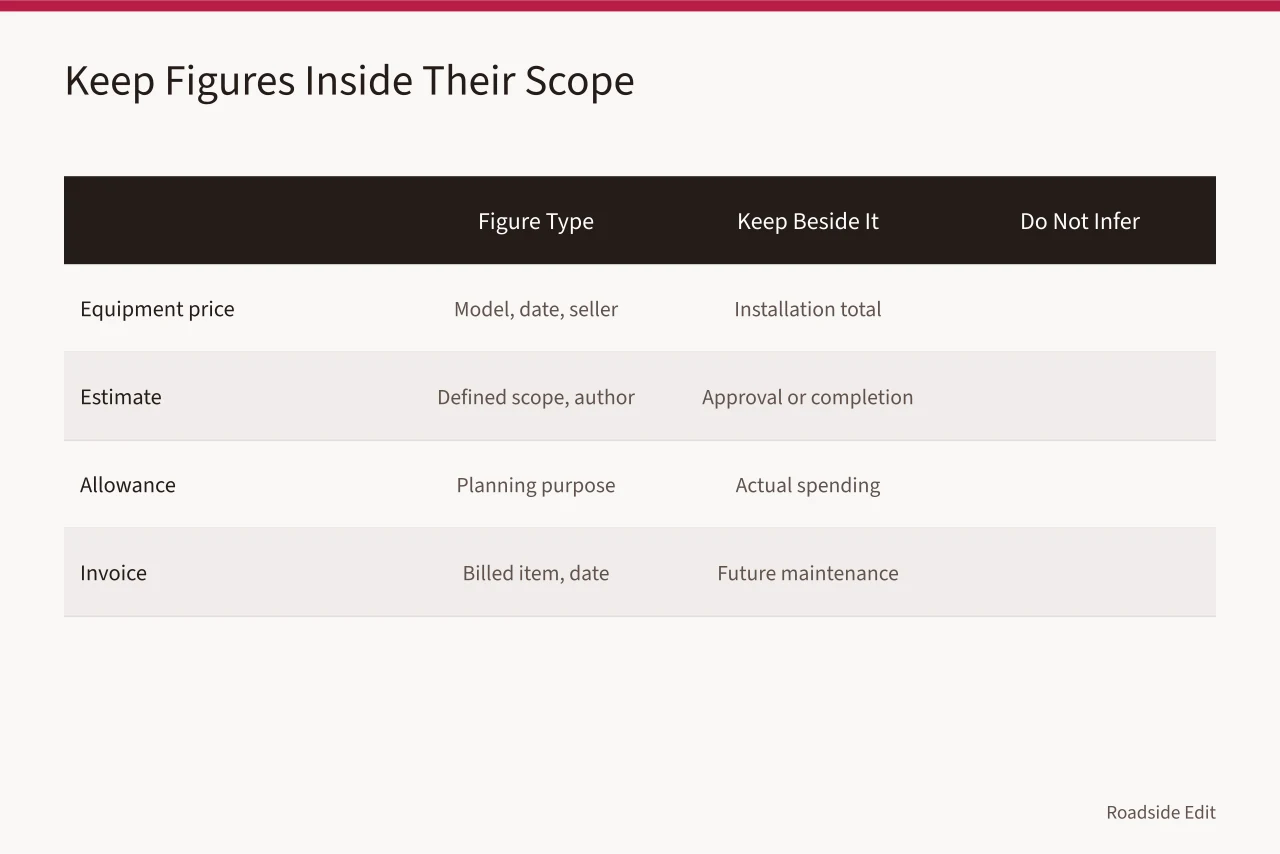
| Figure type | Keep beside it | Do not infer |
|---|---|---|
| Equipment price | Model, date, and seller context | Installation total |
| Estimate | Defined scope and author | Approval or completion |
| Allowance | Planning purpose | Actual spending |
| Invoice | Billed item and date | Future maintenance cost |
The NPS documentation standards require limits clear enough for later verification. Where the source documents no figure for a property, write the gap. Do not calculate a result from unrelated data.
The NPS project documentation overview describes documentation that informs planning and design. It treats the financial record as one input to a decision, not as the decision.
Give revisions their own entries
When a cost record changes, keep the former entry and add a row. Name the scope change, the date, the source and the status.
A fixture change can move installation work, electrical planning, control assumptions and the maintenance plan. Those belong in the record even when no public amount exists.
Do not publish a private figure to make an article look concrete. A reader gains more from knowing whether a number is an allowance, estimate, approval, invoice or reported work record. The label stops a partial figure being read as a quote.
Before comparing two figures, check they cover the same scope and date. If they do not, write that limit in the note and do not call the difference a saving or an overrun.
State each exclusion in plain words beside the figure: access, electrical work, permits, maintenance.
Common questions
Does an efficient fixture guarantee savings?
No. Energy use follows the installed system, the controls, how the site is operated and local conditions. A DLC listing shows the fixture meets a threshold, not that your bill falls.
What should happen after a scope revision?
Add a dated version naming the changed item, its financial effect and the next decision owner. Keep the superseded row so a reviewer can trace what moved.
Can a public article list a vendor's price?
Only with permission, a source, a date and a stated scope. Label it a stated price for that scope, never a market result.
Where do the 2027 numbers come from?
They are planning placeholders. Escalate public 2025 bid data with Gordian RSMeans Data and EIA electricity forecasts, then replace them with local quotes.