Guides
Part of Modern roadside design fundamentals: a 2027 guide to arrival, identity and lighting
Warning signs to check before you approve a 2027 roadside design
Before you approve a 2027 roadside design, check the pavement claim, the route, the drainage, the utility clearances and the change log against their sources.
Warning signs in a design discussion are gaps that need a better question. They are not an accusation against a contractor, designer, owner, or product. When a scope is unclear, the safest next step is to record the unknown and seek the appropriate review.
What to take away
- A pavement claim needs the site conditions it was measured under, not a temperature figure alone.
- Route access is a property-specific finding; a drawing cannot establish it.
- Drainage and forecourt grading belong in the scope before a surface is chosen.
- Every option change gets a dated line in the change log, with its source.
- A supplier or sponsor statement stays attributed and never becomes a finding.
Cool pavement is a claim about a site, not a product
EPA's cool pavements guidance describes reflective and permeable surfaces as a way to lower surface temperature, and it is explicit that costs and benefits vary by project conditions. Temperature reduction alone does not settle the choice. Read EPA guidance on cool pavements.
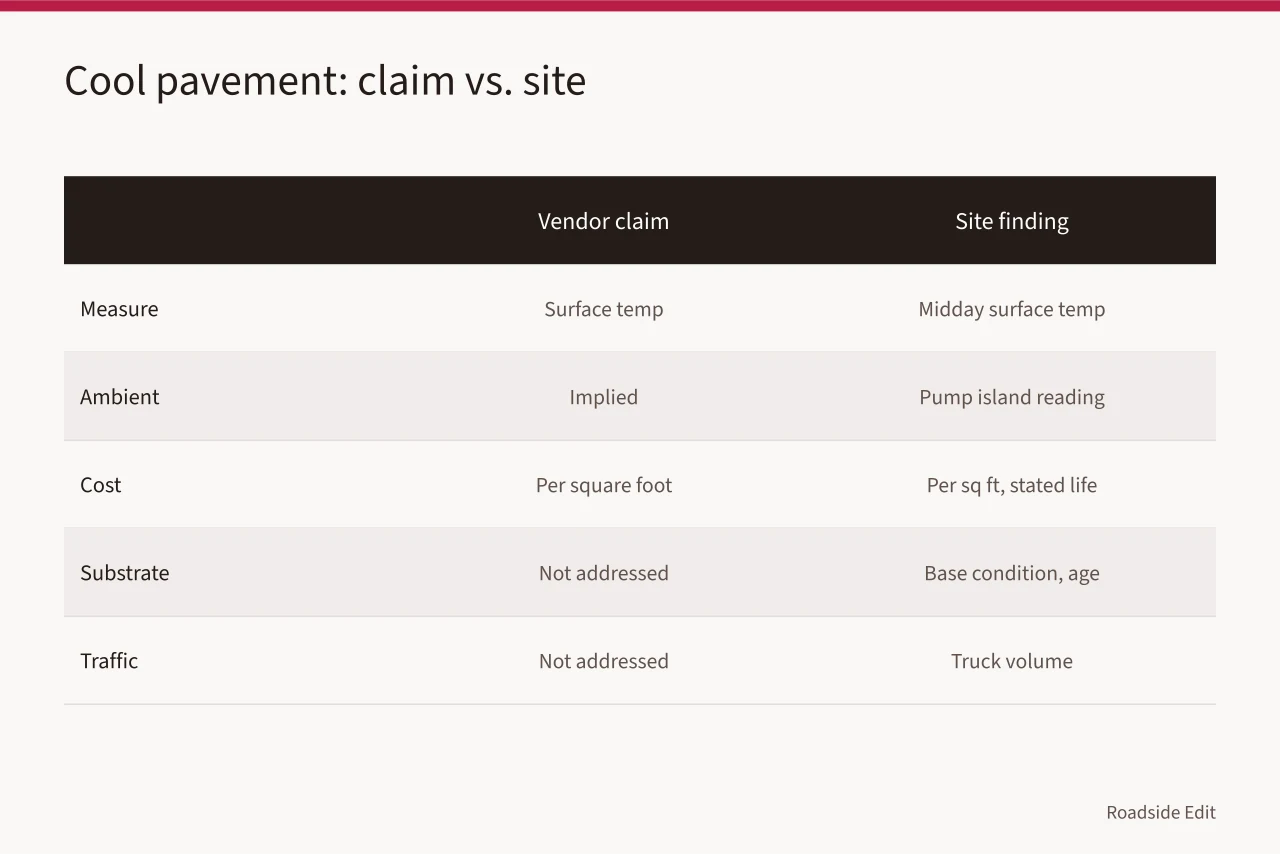
For a roadside property, the conditions that decide the answer are physical. Albedo, shade from the canopy, the age of the asphalt, and the volume of truck traffic all move the result. So does the substrate: a reflective coating over a failing base buys a season, not a decade.
Name the measure before you name the material. Surface temperature at midday, ambient temperature at the pump island, and the cost per square foot over a stated service life are three different claims. A vendor who supplies one and implies the others has not answered the question.
Accessibility and drainage are the two quiet failures
An accessible route is a finding about a specific property, made against the current edition of the applicable standard and the local amendment to it.
A rendering shows an intention. It cannot show cross-slope, surface condition, or whether the route survives a repaving.
Confirm the requirement with the local building official or the authority having jurisdiction, and record the edition they cite.
Forecourt drainage fails in a way that shows up years later. Water that leaves the pump island and the service bay has to go somewhere the site is permitted to send it. That path is a design decision, and it belongs in the scope before the surface is chosen.
The EPA Green Streets Handbook covers road, alley, and parking-lot practice, including green infrastructure. Cite it for the planning principle, then state the local question it leaves open.
| Warning sign | What to check | Safer wording |
|---|---|---|
| "This paving will solve heat" | Site conditions and the measure used | "Source discusses possible effects" |
| A fixture chosen before its task | Route, entry, sign, or service function | "Function not yet defined" |
| A price with no exclusions | Dated scope and assumptions | "Comparability not established" |
| A concept image treated as final | Decision record | "Concept status noted" |
| A path shown without existing conditions | Survey and local review | "Route requires local review" |
Keep the change log as a field list
A change log is the record that keeps a 2027 approval readable in 2032. Give it fields, not prose. Each entry carries a date, the item that moved, the source behind the move, and the reason as stated by whoever asked for it.
Two more fields close the loop. One records whether the change touches cost or scope, and how. The other names the person who owns the next decision. An entry missing either field is a note, not a record.
When a source overturns an earlier conclusion, add a dated correction. State whether the update affects the feature, its location, its date, its scope, or its status. Do not quietly delete a claim because it became hard to support.
The NPS documentation standards ask for reliable sources and stated limits. Apply that test to every promise about paving, lighting, routes, or planting. The NPS project documentation overview describes how that information feeds later planning work.
Attribution is the whole boundary
A supplier or sponsor can describe an offering. The statement stays attributed, and it never establishes the condition of a site or guarantees a result. A paid placement is not an approval, a test result, or a project outcome.
That rule holds for your own copy too. If the record describes a possibility, the article says possibility. Clear limits protect the reader who arrives after the design discussion has moved on.
Common questions
Is cool pavement always the right option?
No. EPA's guidance says costs and benefits vary by project conditions, and temperature reduction alone does not decide it. The choice turns on the site, the substrate, and the local review.
Does a concept drawing prove route access?
No. It communicates an intention. Cross-slope, surface condition, and the applicable standard are property-specific findings that need a survey and the local building official.
What belongs in a change log?
A date, the item that moved, its source, the stated reason, and the cost or scope effect. Add the owner of the next decision, and a dated correction whenever new evidence overturns an earlier conclusion.